If you have arthritis, you know the exercise paradox intimately: movement helps, but movement hurts — at least initially, and at least the wrong kinds of movement. The challenge is finding exercise that is gentle enough to be tolerable on inflamed or degraded joints, yet meaningful enough to actually make a difference. Tai chi has been studied specifically for this balance, and the results are worth understanding.
This article looks at what the clinical research shows for both osteoarthritis and rheumatoid arthritis, explains why tai chi’s movement characteristics make it particularly suitable for people with joint conditions, and gives practical guidance for getting started safely. The short version: tai chi does not treat or cure arthritis. What the evidence suggests it can do is meaningfully reduce pain and improve function in many people with the condition — as a complement to medical care, not a replacement.
Understanding Arthritis: Two Types, Two Different Situations
Before looking at tai chi specifically, it helps to be clear on what type of arthritis is being discussed, because the mechanisms and evidence differ somewhat.

Osteoarthritis (OA) is degenerative — it involves the breakdown of cartilage in joints, typically from age, mechanical wear, previous injury, or excess weight loading. The most common joints affected are knees, hips, hands, and the lumbar spine. OA is characterised by pain, stiffness (particularly in the morning or after rest), and reduced range of motion. It is the most prevalent form of arthritis.
Rheumatoid arthritis (RA) is autoimmune — the immune system attacks the synovial membranes lining the joints, causing inflammation, pain, and over time, joint damage. RA typically affects smaller joints first (hands, wrists, feet), is systemic rather than localised, and involves periods of flare and remission. Managing RA requires disease-modifying medications and close coordination with a rheumatologist.
Tai chi has been studied for both conditions, with a stronger evidence base for osteoarthritis of the knee and hip.
The Evidence for Osteoarthritis
The most cited and rigorous study on tai chi for knee osteoarthritis is a randomised controlled trial published in Annals of Internal Medicine in 2016. The trial compared tai chi directly to physical therapy — the current standard of care — in 204 participants with symptomatic knee OA. After 12 weeks, both groups showed comparable improvements in pain and function. The tai chi group also showed greater improvements in depression scores and some physical performance measures. The conclusion was not that tai chi replaced physical therapy, but that it was comparably effective — a meaningful result for what is a gentle, low-cost practice.
A systematic review and meta-analysis published in PLOS ONE in 2019 reviewed 18 randomised controlled trials on tai chi for osteoarthritis and found statistically significant improvements in pain, stiffness, and physical function compared to control conditions. The review covered 1,469 participants and concluded that tai chi is a beneficial intervention for OA, particularly for knee OA.
The Arthritis Foundation explicitly recommends tai chi as an arthritis management activity, noting its evidence base for pain reduction and improved joint function. They emphasise its accessibility — low impact, adaptable, suitable for a wide range of fitness levels.
In my experience practising tai chi alongside people who came specifically for arthritis-related reasons, what I’ve heard most consistently is that the gentle, flowing movement gets joints moving without the jarring impact that other activities produce. The slow, controlled nature of tai chi means practitioners can explore the limits of comfortable range of motion without forcing beyond them.
The Evidence for Rheumatoid Arthritis
The evidence base for RA is smaller but positive. A systematic review published in BMC Complementary Medicine and Therapies examined seven trials on tai chi for rheumatoid arthritis and found evidence for improvements in disease activity scores, pain, and physical function. Effect sizes were modest but consistent across studies.

Importantly for RA, the research suggests tai chi is safe during periods of low disease activity. During active flares, intense activity of any kind is typically not advisable — rest and medical management take priority. This is why people with RA should discuss timing and programme design with their rheumatologist before starting.
The autoimmune dimension of RA also raises a question that some practitioners ask: can tai chi influence immune function? Some research suggests that mindful movement practices may modulate inflammatory markers, but this evidence is preliminary and should not be interpreted as suggesting tai chi can treat or modify the underlying autoimmune process. RA management requires disease-modifying antirheumatic drugs (DMARDs) — that is not something a complementary practice can or should attempt to replace.
Why Tai Chi Works Well for Arthritic Joints
Several features of tai chi’s movement characteristics are particularly relevant for people with joint conditions:

Low-Impact, Low-Velocity Movement
Tai chi involves no jumping, running, or sudden impacts. All weight transfer is slow and controlled, meaning joint loading is gradual and manageable. Compare this to running — where each footstrike can exert three to five times body weight on the knees — and it becomes clear why high-impact activity is difficult for many people with OA, while tai chi is not.
Full Range of Motion Without Forced Stretch
The movements of tai chi take joints through their available range of motion gently and repeatedly. This helps maintain and gradually extend range of motion without forcing a painful stretch. Many people with arthritis experience stiffness that is relieved by movement but worsened by prolonged stillness or sudden forced motion. Tai chi provides the former without the latter.
Muscle Strengthening Around the Joint
Arthritic joint degradation is worsened when the surrounding musculature is weak — more load falls on the joint itself. Tai chi’s semi-squat stance and continuous controlled movement strengthen the quadriceps, hamstrings, and hip stabilisers without requiring equipment or high exertion. Stronger muscles mean better joint protection and support.
Proprioception and Joint Position Sense
Arthritis can impair proprioception — the joint’s ability to sense its own position and movement. Impaired proprioception contributes to instability and fall risk. Tai chi’s slow, attentive movement specifically rehabilitates proprioceptive pathways, which is one reason it appears in fall-prevention research as well as arthritis research.
Modifications for Joint-Sensitive Practice
Not all tai chi instruction is equally appropriate for people with arthritis. Here are practical modifications that matter:
Do not practise to the point of pain. Discomfort from gentle movement is acceptable; sharp or increasing pain is a signal to stop and back off. Tai chi should challenge the joint, not aggravate it.
Adjust stance depth. The semi-squat positions in tai chi can be held at different depths. Beginners with arthritic knees should start with a higher stance (less bend) and only lower progressively as strength and comfort allow. A good instructor will cue this.
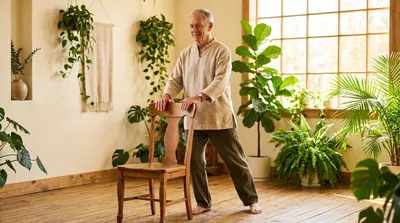
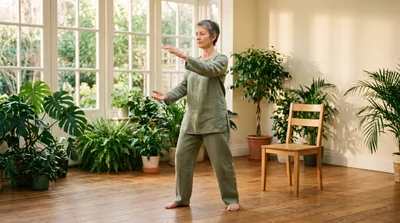
Sit down when you need to. Many tai chi movements can be adapted to a seated or partially supported position. This is not failure — it is intelligent modification. The seated qigong article covers adaptations relevant to people with significant mobility limitations.
Footwear matters. People with arthritic feet or ankles benefit from thin-soled, flexible shoes that allow natural foot movement without restricting it. Heavily cushioned running shoes can actually impair the proprioceptive feedback that tai chi is trying to develop.
Warm up first. Cold, stiff joints are more vulnerable. Ten minutes of gentle range-of-motion movements before beginning formal tai chi practice can reduce discomfort significantly.
For older practitioners approaching tai chi specifically for joint health, the tai chi for seniors article covers additional starting-point guidance relevant to this group.
Choosing the Right Style and Class
Different styles of tai chi have different characteristics that may be more or less appropriate for arthritis.

Yang style is the most common and the most studied for arthritis. Its large, slow movements are gentle on joints and allow easy modification of stance depth. This is typically the recommended starting point.
Sun style, developed in the early 20th century, incorporates “agile steps” — a way of moving that is lighter on the knees and hips than the more static stances of Yang style. Research on Sun-style tai chi for arthritis has been promising; a trial published in Arthritis Care & Research found significant improvements in pain, physical function, and quality of life for participants with OA and RA.
Chen style involves more low stances, spiralling movements, and explosive releases of energy that are generally less appropriate for people with active joint conditions, particularly at beginner level.
When selecting a class, look for instructors who explicitly address modifications for health conditions. Class descriptions that mention “therapeutic tai chi,” “tai chi for health,” or “gentle tai chi” are more likely to offer appropriate joint-sensitive instruction than classes advertising athletic or traditional training.
Tai Chi Alongside Medical Arthritis Management
This needs to be stated clearly: tai chi is a complementary practice, not an arthritis treatment.

People with RA who are on DMARDs, biologics, or corticosteroids should continue their medical management. Tai chi may reduce symptom burden, improve function, and enhance quality of life — but it does not address the underlying autoimmune process that destroys joints in RA.
People with OA who are being managed with pain relief, physiotherapy, or who are considering surgical options should discuss tai chi with their healthcare provider. In most cases, the answer will be that tai chi is a beneficial adjunct — but the timing, particularly around acute inflammation or post-surgical recovery, matters.
What tai chi can genuinely contribute to arthritis management is worth acknowledging: regular practice sustains joint mobility, builds protective musculature, provides low-level cardiovascular benefit, and improves mood and quality of life. These are not trivial contributions. For a practice that costs little and carries minimal risk when done appropriately, the risk-benefit profile for most people with arthritis is strongly positive.
The broader tai chi health benefits article covers how arthritis evidence fits within the wider research landscape — worth reading if you want context across multiple health outcomes.
Frequently Asked Questions
Is it safe to do tai chi during an arthritis flare?
For rheumatoid arthritis specifically, during an active flare — when joints are significantly inflamed, swollen, and painful — rest and medical management take priority. Gentle range-of-motion movements may be tolerated, but a structured tai chi session is not appropriate during a severe flare. Consult your rheumatologist about timing. For osteoarthritis, which does not typically involve acute inflammatory flares in the same way, practice may continue with appropriate intensity reduction if pain increases. Listen to your body; if something hurts more than usual, back off.
Does tai chi help knee arthritis specifically?
Knee OA has the strongest evidence base for tai chi. Multiple randomised controlled trials, including the well-cited Annals of Internal Medicine trial, have specifically studied knee OA and found meaningful improvements in pain and function. The Arthritis Foundation also specifically identifies knee OA as a condition where tai chi has demonstrated benefit.
How often should I practise tai chi if I have arthritis?
Research programmes that showed significant benefit typically involved two to three sessions per week of 45-60 minutes each. This appears to be sufficient to produce meaningful changes in pain and function. Daily shorter sessions (15-20 minutes) may also be beneficial as a complement to longer weekly sessions. The key is consistency over weeks and months — arthritis management is a long-term commitment, not a short-term intervention.
Will tai chi worsen my joint damage?
Appropriately performed tai chi — with correct stance depth, no forced movement, and appropriate pacing — should not worsen joint damage. The practice is specifically designed to be low-impact and non-aggressive. If practice is producing increasing or sharp pain, that is a signal that something needs to be modified — stance height, movement range, or supervision from a qualified instructor. In the research trials on arthritis, adverse events from tai chi were rare and minor.
Can I combine tai chi with physiotherapy for arthritis?
Yes — and this is often an excellent approach. Physiotherapy can address specific joint dysfunctions, post-injury or post-surgical rehabilitation, and muscle imbalances that tai chi alone would not specifically target. Tai chi then provides a sustainable, enjoyable long-term practice that maintains the gains made in physiotherapy. The two approaches address overlapping but not identical needs and complement each other well.
I have arthritis in my hands as well as my knees. Will that affect tai chi practice?
Hand and wrist arthritis does not typically prevent tai chi practice. The form involves flowing arm and hand movements but does not require gripping, load-bearing through the hands, or extreme wrist extension. If specific movements cause pain, they can be modified — the wrist rotations in some forms can be reduced in amplitude, for example. Inform your instructor of your hand arthritis; a good instructor will suggest specific accommodations.