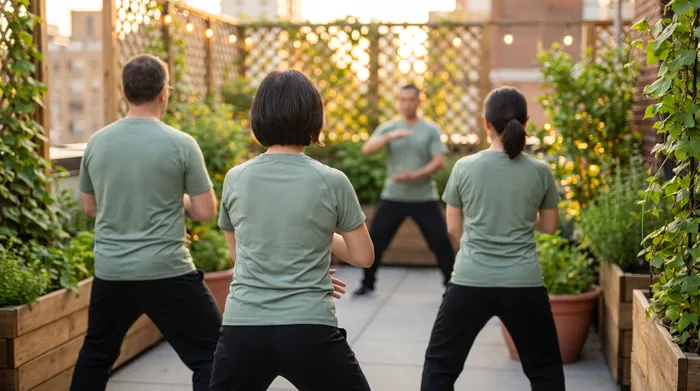
Starting tai chi is easier than most people think, and harder than most people expect. The barrier to entry is genuinely low — no equipment, no fitness prerequisite, no flexibility requirement. But the learning curve is real. Tai chi involves memorising sequences, developing body awareness, and practising slowly and deliberately in a way that runs counter to how most Western exercise works.
This guide covers everything a complete beginner needs to get started: what to expect, how to choose a style and a learning format, what to look for in a teacher, and how to build a practice that actually sticks. I’ve been practising for over 10 years, and most of what I know about starting well came from the mistakes I made at the beginning.
What to Expect When You First Start
The first thing most new tai chi students notice is that the movements look simple from the outside and feel difficult from the inside. A posture like “Ward Off” involves your arms, your weight distribution, your hip alignment, and your breath — all coordinated simultaneously. When you’re learning, it’s easy to get the arms right and forget the feet entirely.

This is normal. Don’t try to get everything perfect at once. Experienced practitioners often advise beginners to just follow the physical shape of the movements for the first month and let the finer details come with time. The body learns faster than the conscious mind does in tai chi — often you’ll find that something that felt awkward starts feeling natural before you’ve consciously worked out why.
The slowness will feel strange. Moving slowly requires more balance and body control than moving quickly. You’ll feel muscles working that you don’t normally notice. After your first session, your legs may be tired in a way that surprises you.
You’ll feel lost in class. Group classes move at a consistent pace, and if you’re new, you’ll frequently lose your place in the sequence. This is completely normal. Don’t leave. Keep watching and following. After a few classes, it starts to click.
Progress doesn’t look like progress. Tai chi improvement is incremental and internal. You won’t hit a new personal best or complete an extra rep. The improvements are in how the movement feels — more settled, more connected, more natural. Trust that this is real progress even when it’s hard to see.
Choosing a Tai Chi Style
There are five major styles of tai chi — Yang, Chen, Wu, Wu (Hao), and Sun — plus dozens of hybrid and simplified forms. For beginners, the choice usually comes down to three:
Yang style is the most widely practised in the world and the most accessible for beginners. It features large, open movements at a consistent, moderate tempo. Most group classes in Western countries teach Yang-style tai chi, and the most commonly recommended starting form — the Yang-style 24 form — was specifically designed as a beginner-accessible sequence.
Chen style is the oldest style and the origin of all the others. It includes explosive movements (called fajin) interspersed with slow sections, more jumping, and lower stances than Yang style. It’s more physically demanding and typically taught at intermediate rather than beginner level. If you encounter Chen style at a beginner class, the teacher’s approach matters a lot — some Chen teachers are very accessible; others teach a demanding version that can be discouraging for new practitioners.
Sun style was developed for health applications and features smaller, more upright movements than Yang style. It’s often recommended specifically for older adults or people with joint concerns, as it places less stress on the knees. The tai chi components of many clinical trials with elderly participants use Sun-style forms.
My recommendation for beginners: Start with Yang style unless you have a specific reason not to. The breadth of teaching resources, the community of practitioners, and the well-documented pathway from the 24 form to more advanced practice make it the most forgiving place to begin.
Finding a Teacher or Class
Learning from a live teacher — even occasionally — is significantly better than learning purely from video. A teacher can see your posture and correct things that video cannot catch. Alignment errors that go uncorrected can become habitual and are harder to fix later.

What to look for in a teacher:
- They’ve studied with a recognised lineage or senior teacher, not just self-taught from videos. Ask who they studied with.
- They can explain why a movement is done a particular way, not just demonstrate it.
- They’re patient with beginners and comfortable with questions.
- The class atmosphere is welcoming, not competitive.
- They don’t make overblown health claims or promise outcomes beyond what research supports.
What to watch out for:
- Teachers who discourage questions or enforce rigid hierarchy in a way that makes learning uncomfortable.
- Classes that jump to advanced material without establishing foundational movement principles.
- Teachers who promise specific medical outcomes (tai chi is a complementary practice, not a treatment).
Finding classes: Local community centres, parks and recreation departments, tai chi and qigong organisations (the World Tai Chi and Qigong Federation maintains instructor listings), university continuing education programmes, and martial arts schools that include internal arts. If there’s no local option, online instruction can work well for motivated self-starters.
What’s the Best Way to Learn Tai Chi as a Beginner?
The best way to learn tai chi as a beginner is a mix of in-person instruction and structured video, not one format exclusively. In my own first year, a single session where a teacher corrected a small hip-alignment issue saved me months of practising a habit I would otherwise have drilled into muscle memory from video alone. If you have access to even occasional in-person correction — a monthly workshop, a more experienced friend, a single paid lesson — pair it with whatever structured video or class schedule you’re using day to day. Neither format alone beats the two combined.
Learning from Video and Online Resources
If you can’t find a local class, or want to supplement class learning, video instruction is a legitimate path. The key is choosing good resources and approaching them with realistic expectations.

For the Yang 24 form: The most commonly recommended video series is taught by Sifu David-Dorian Ross and similar qualified instructors on platforms like YouTube and Udemy. Look for structured, progressive instruction — not just someone demonstrating the complete form at speed.
The TaiChiApp approach: At taichiapp.com, we’ve built a structured programme specifically for beginners who are learning without an in-person teacher. The video sequences are broken down movement by movement, with detailed explanations of alignment and common errors. If you’re learning at home and want a guided structure rather than piecing together YouTube videos, it’s worth a look.
What video instruction can’t do: A video cannot see you. It cannot tell you that your knee is tracking outside your foot, or that your shoulders are rising when they shouldn’t. This is why supplementing with occasional in-person instruction matters, even if it’s only quarterly.
The Equipment and Space You Need
One of tai chi’s genuine advantages as a practice is that it requires almost nothing.
Space: You need enough room to take a few steps in each direction — roughly a 6 x 6 foot area is sufficient for most forms. A backyard, a living room, a garage, a park. No special surface is required, though most practitioners prefer a solid, non-slip floor over carpet.
Footwear: Flat-soled shoes with minimal heel raise are ideal. Tai chi shoes (available cheaply from martial arts suppliers) are designed for the purpose but are not necessary. Many practitioners practise barefoot indoors. Avoid thick-soled running shoes — the heel raise interferes with the weight transfer fundamentals of tai chi.
Clothing: Anything you can move freely in. Loose trousers and a comfortable top work fine. Purpose-made tai chi uniforms are pleasant but completely optional.
Temperature: Tai chi generates less body heat than most exercise, so be aware that outdoor practice in cold weather requires warmer clothing than you might expect.
How to Structure Your First Three Months
Structure matters when you’re starting any practice. Without it, sessions become sporadic and improvement stalls. Here’s a realistic framework for the first 90 days.

Month 1: Foundation movements only
Don’t try to learn the full form immediately. Most reputable programmes front-load the fundamental movements: the basic stance, weight transfer, Ward Off, Rollback, Press, and Push. These appear throughout every Yang-style form and are worth learning well before moving forward.
Aim for 3–4 sessions per week of 20–30 minutes each. Repetition matters more than duration at this stage. A 20-minute daily practice is more valuable than a 90-minute weekly session.
Month 2: First half of the form
Once foundational movements feel reasonably stable, begin working through the first half of the Yang 24 sequence. Go slowly — learn 2–3 new movements per session maximum. Review what you know at the start of each session before adding anything new.
Month 3: Complete form + refinement
By the end of month 3, most motivated beginners can run through the Yang 24 from start to finish, albeit imperfectly. This is the goal — not perfection, but a complete first pass. Refinement happens over months and years.
For a detailed breakdown of how to structure daily sessions, the daily tai chi practice routine guide gives a practical schedule with timing recommendations.
How Do You Learn Tai Chi Step by Step as a Beginner?
You learn tai chi step by step by building from foundational stances and weight transfers in month one, into the first half of the form in month two, and a complete but imperfect run-through by month three — not by trying to absorb the whole sequence at once. When I started, I made the mistake of trying to learn six or seven movements in a single session because I was excited, and I ended up needing to re-learn half of them the following week because none of them had actually settled in. Two or three new movements per session, reviewed at the start of every practice, is a slower pace that gets you there faster.
Common Beginner Mistakes
Trying to memorise too fast. Tai chi sequences have to be embedded in muscle memory, not just declarative memory. Going slowly and repetitively works better than trying to learn the full form in a weekend.
Neglecting the lower body. Beginners naturally focus on what their hands are doing because hands are visible and interesting. The footwork and weight shifts are doing most of the structural work. Pay at least equal attention to your feet, knees, and hips.
Practising from memory too early. Until you know the sequence reliably, practise with a reference (video, notes, a teacher watching). Practising errors repeatedly encodes them. Better to stop and check than to drill a mistake.
Rushing the slow movements. The slowness is not aesthetic — it serves a function. Slow movement forces your stabilising muscles to work and gives your mind time to notice what’s actually happening in your body. Rushing defeats the purpose.
Skipping practice when you feel uncertain. Uncertainty is exactly when practice is most valuable. The feeling of “I don’t remember what comes next” is a cue to practise more frequently, not to wait until you feel ready.
What Progress Actually Looks Like
Having practised for over a decade, I can tell you that tai chi progress is less like climbing a ladder and more like widening a circle. Every time you revisit a movement you’ve done hundreds of times, there’s something new to notice about it.

In the first year, progress is mostly structural: you learn the sequence, your balance improves, the movements become less effortful. In the second and third year, the practice starts to feel more connected — your whole body begins to move as a unit rather than as separate parts. Later than that, subtle things start emerging that take real time and repetition to develop.
The standard measure in tai chi communities is often the Yang 24 form. If you’re curious about how long learning it realistically takes, the guide to how long tai chi takes to learn covers this honestly, without the vague “it depends” answer most people give.
For a broader overview of what tai chi is and its context, what is tai chi is worth reading if you haven’t already — particularly the section on how it differs from qigong and yoga.
How Long Does It Take to Learn Tai Chi?
Most motivated beginners can run through the complete Yang 24 form, imperfectly, within about three months of consistent practice — but “knowing” the form and having internalised it are very different timelines, and the second one takes years, not months. I could recite my Yang 24 sequence from memory within about ten weeks of starting, but it was well into my second year before the movements stopped feeling like a memorised routine and started feeling like something my body just did without conscious effort.
Building a Practice That Lasts
The single biggest predictor of long-term tai chi progress is consistency over intensity. People who practise 20 minutes daily make far more progress than people who do 90-minute sessions occasionally.
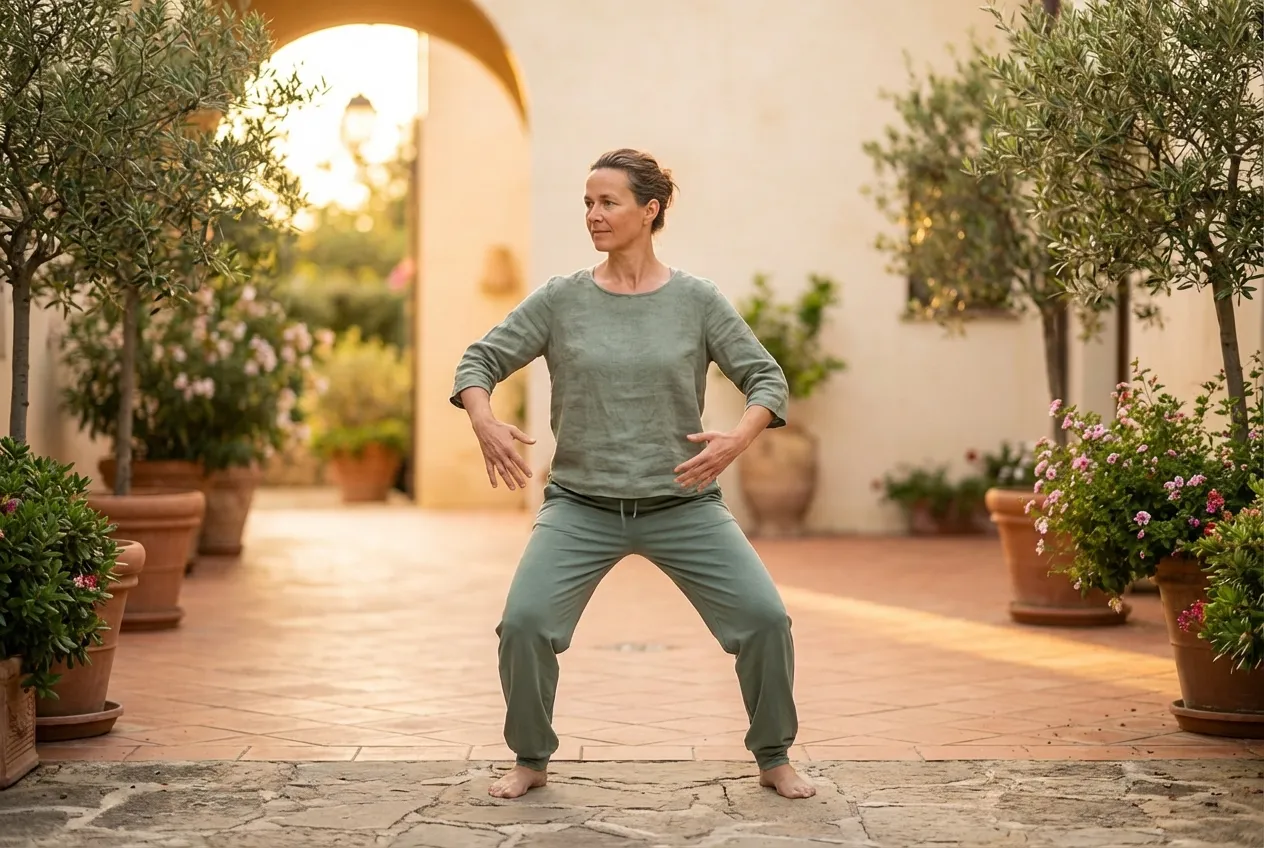
Same time, same place. Habit formation is easier when the practice is anchored to a specific time and location. Morning practice before the day’s friction builds up is the most common pattern among long-term practitioners.
Track your sessions simply. A notebook or calendar tick is enough. Watching the chain of consistent days grow is genuinely motivating.
Find community. Practising with others — even once a week — improves your practice in ways that solo practice cannot. A class, a tai chi group at a local park, or an online community all count.
Be patient with the plateau. Every practice has periods where nothing seems to be improving. These are usually followed by sudden jumps in understanding. They’re a feature, not a bug.
Browse all our tai chi for beginners guides for more resources as you deepen your practice.
Frequently Asked Questions
What is the best tai chi for absolute beginners?
Yang-style tai chi, starting with the 24 form, is the near-universal recommendation for beginners. It’s the most widely taught, has the most available learning resources, and was specifically designed as an accessible entry point. Most qualified instructors can teach it, most online programmes are built around it, and the community is the largest.
Can I learn tai chi on my own without a teacher?
Yes, though it takes longer and requires more discipline than learning with a teacher. Many people learn effectively from structured video programmes. The main limitation is that a video cannot correct your form — alignment errors can go unnoticed for months. If you’re learning solo, try to get occasional feedback from a qualified instructor, even just once every few months.
How often should I practise tai chi as a beginner?
Aim for at least 3–4 sessions per week, each 20–30 minutes. Daily practice of even 15 minutes produces faster progress than longer sessions done occasionally. Consistency is more important than duration. If you can’t manage daily, three times a week is a sustainable minimum.
Is tai chi hard to learn?
It depends on what you mean by “hard.” The movements are not physically demanding in a cardiovascular sense. But coordinating slow, precise movement across your whole body — arms, legs, weight, breath, attention — is genuinely challenging, especially at first. Most beginners feel lost in the first month. Most beginners who persist past that point find that things start clicking around weeks 4–8.
What should I wear to a tai chi class?
Comfortable, loose clothing that allows free movement. Flat-soled shoes or bare feet (if the floor is appropriate). No special clothing is required. Many students wear yoga pants or loose trousers and a t-shirt. Purpose-made tai chi uniforms are attractive but entirely optional, especially when starting out.