Building a daily tai chi practice is simpler than most people make it. You don’t need an hour. You don’t need a perfect space. You don’t need to have the form memorised perfectly before starting. What you need is a consistent structure that you can actually repeat every day — one that fits into your real life, not a theoretical ideal version of it.
This guide gives you that structure: a practical daily practice template, advice on adapting it to different time budgets, and the habit principles that actually make daily practice stick. I’ve been maintaining a daily tai chi practice for years, and the single biggest thing I’ve learned is that simplicity and consistency beat intensity every time.
Why Daily Practice Beats Weekly Sessions
Tai chi is a skill practice. Like language learning or a musical instrument, it requires regular repetition to encode in muscle memory. The neurological patterns being developed — body awareness, proprioception, coordinated slow movement — require frequent activation to consolidate.

Three weekly 45-minute sessions are not equivalent to daily 15-minute sessions, even though the total time is similar. Daily practice activates and reinforces the same neural pathways repeatedly and consistently. Weekly sessions let those pathways partially fade between sessions.
This isn’t theoretical. In my experience, the weeks when I practised daily — even briefly — produced noticeably better progress than weeks when I compressed the same time into fewer, longer sessions. The 15-minute daily practice is underrated. If that’s all you have, use it.
There’s also a mental health dimension. The daily ritual of stepping into the practice — even briefly — creates a consistent anchor in the day. A morning practice sets a particular quality of attention for the hours that follow. This effect doesn’t accumulate in the same way from twice-weekly practice.
The Basic Practice Structure
A well-structured tai chi session has three phases: preparation, form work, and closing. The proportions adjust depending on how long you have, but the three-phase structure should remain even in a 15-minute session.
Phase 1: Preparation (5–10 minutes)
Don’t skip the warm-up. Tai chi movements place specific demands on the hips, ankles, and shoulders that benefit from preparation. Cold joints and cold muscles make the early part of form practice feel mechanical and uncomfortable.
Standing warm-up: Begin with 2–3 minutes of Wu Ji standing — feet shoulder-width, knees softly bent, arms relaxed at sides, body upright and relaxed. Breathe naturally and let your attention settle. This isn’t wasted time; it transitions your nervous system from task mode to present-moment awareness.
Joint rotations: Systematically rotate wrists, elbows, shoulders, hips, knees, ankles. Small circles, unhurried. This takes 2–3 minutes and genuinely loosens the articulations that tai chi demands.
Shoulder and hip openers: A few side-to-side weight shifts with arm swings, and gentle hip circles, prepare the body for the rotational demands of tai chi movement. Nothing extreme — just activating.
Phase 2: Form Work (15–35 minutes)
The core of the session. For most practitioners, this means working through the Yang 24 form one or more times, with focused repetition on specific sections that need attention.
One complete run-through first. Start with a full pass through whatever portion of the form you know. Do this from memory, without stopping. Imperfections don’t matter — this initial run establishes where your attention is today and which sections feel unsteady.
Section repetition. After the full run, identify one or two sections that felt rough and repeat them deliberately. This is where learning happens. Run the section 3–5 times slowly, then transition it back into the surrounding sequence so you don’t practise it in isolation.
A second complete run. End form work with another full pass. You’ll often notice that the repeated section has already improved slightly.
For beginners still learning the sequence: replace the “complete run” with working through what you know. Don’t skip forward — add movements only after consolidating what’s already in memory.
Phase 3: Closing (3–5 minutes)
Don’t stop abruptly. Tai chi ending carries its own intention.
Return to Wu Ji standing. After the final form pass, return to the standing position from the beginning. Hold for 1–2 minutes. Notice what’s different in your body compared to the start of the session.
Slow breathwork. Three to five deep, slow breaths — in through the nose, out through the mouth, letting the exhale be slightly longer than the inhale. This supports the parasympathetic response that tai chi facilitates.
Gentle seated stretch (optional). If you’re working with tight hip flexors or hamstrings, a brief seated forward fold or pigeon position after practice is a good addition. Tai chi itself is not a stretching practice — the flexibility element benefits from supplementing.
Practice Schedules for Different Time Budgets
15 minutes daily: Abbreviated warm-up (2–3 min) → one complete form run (8–10 min) → Wu Ji close (2 min). This is a minimum viable practice. It’s worth doing even when life is busy.
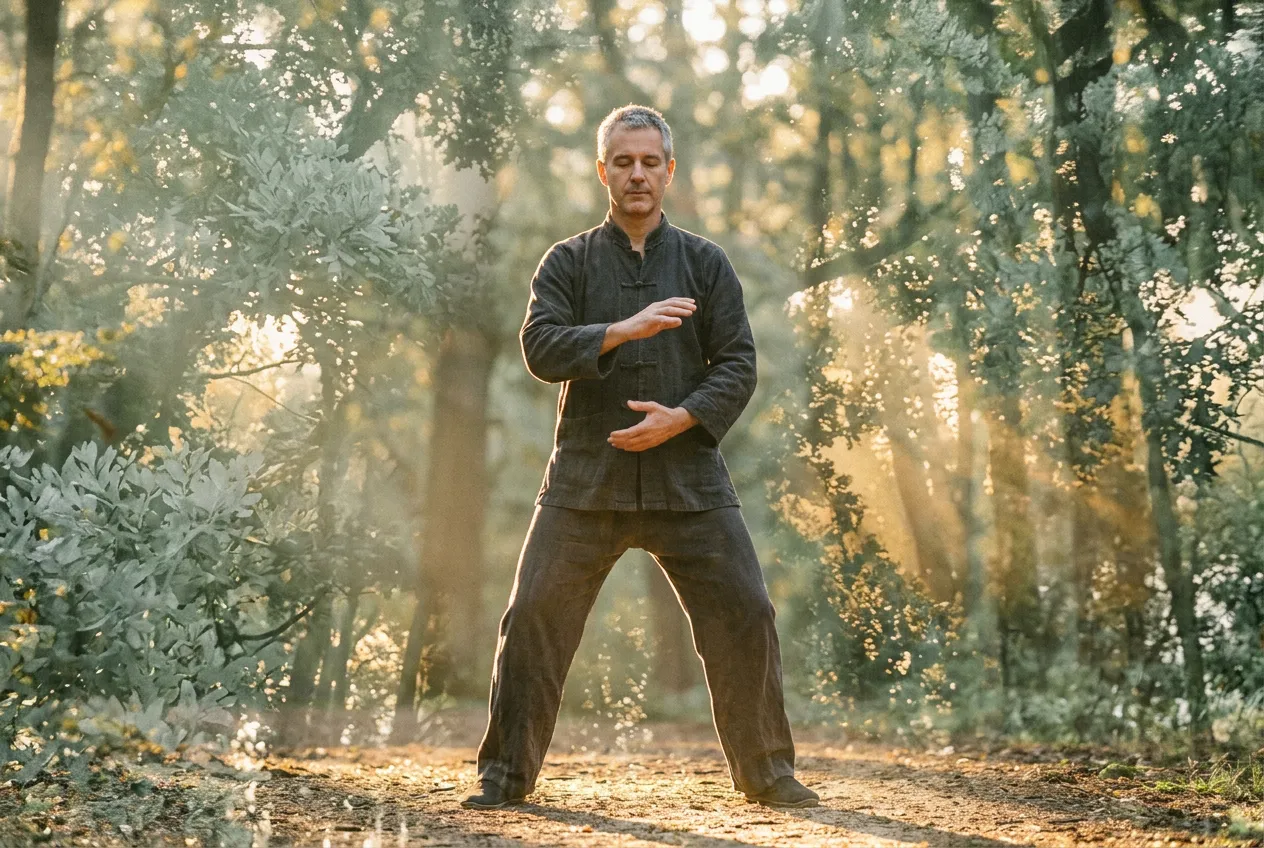
30 minutes daily: Full warm-up (8–10 min) → two complete runs with deliberate section work in between (18–20 min) → full close (5 min). This is the sweet spot for steady progress.
45–60 minutes (deeper sessions, 3–4 times weekly): Full warm-up → multiple form runs → extended section work on weak points → supplementary practice (breathing exercises, standing meditation, push hands if you have a partner) → full close.
The 45–60 minute format suits experienced practitioners or those in a phase of more intensive learning. For beginners, 30 minutes daily is more valuable than 60 minutes three times a week.
Using Guided Practice Resources
One of the most common failure modes for home practitioners is drift. Without a teacher watching, small errors accumulate. Movements gradually shift from the correct form. Sections you haven’t focused on for a while develop habitual errors that go unnoticed.
Guided video practice is the most practical solution for home practitioners. Working through sessions with a qualified instructor on screen — rather than practising from memory alone — maintains a reference point for correct form.
At taichiapp.com, we’ve structured the practice library specifically for home practitioners, with video sessions designed around the 20–40 minute time blocks that fit into daily life. If you’re practising at home and want a structured guide rather than practising from memory alone, it’s worth integrating guided sessions into your weekly rotation.
The Habit Architecture That Makes Daily Practice Work
Knowing what to do in a session matters far less than actually doing it every day. The habit design principles that make daily practice sustainable are well-documented in behavioural research and worth taking seriously.

Same time, every day. The most reliable practice is anchored to an existing routine event — immediately after waking, before breakfast, after the kids leave for school, before dinner. The key is that the trigger is automatic and consistent. Morning is the most common choice among experienced practitioners because no competing demands have accumulated yet.
Same place. A consistent practice space eliminates the small friction of deciding where to practise. Even if it’s just a cleared corner of a room, that space becomes associated with the practice state over time.
Set a minimum, not a target. Committing to “at least 10 minutes” is more sustainable than committing to “30 minutes.” On days when life is difficult, the minimum practice happens. On most days, once you’ve started, you’ll go longer.
Don’t miss twice. Missing a single day is normal. Missing two days makes it a pattern. The rule is simple: if you miss, restart immediately the next day without self-judgment.
Track completion, not quality. In the early months of habit formation, track whether you practised, not how well. A simple calendar with a mark for each day of practice is highly effective. The chain of completed days becomes motivating in itself.
Adapting Practice During Difficult Periods
Life creates periods when full daily practice isn’t possible. Injury, illness, travel, extreme stress. The habit doesn’t have to break; it needs to adapt.

For injury: Practise the non-affected movements. Arm movements can be practised seated. Leg work can be approached at a modified depth. Doing something, however modified, maintains the habit and the neural pathways.
For travel: Hotel room practice is entirely possible with a shortened warm-up and one or two form runs. The Yang 24 form fits in a 6 x 6 foot space. A 15-minute hotel room practice maintains the chain.
For illness: Rest is appropriate for genuine illness. But a brief Wu Ji standing and five minutes of slow arm movements — done gently — is better than a complete pause if you’re mildly under the weather. Know your limit.
Progressing Beyond the Basics
Once the Yang 24 form is consolidated and you’ve built a consistent daily practice, the practice can deepen in several directions.
Extended forms: The Yang 48 form and Yang 108 form offer more movement vocabulary and longer sequences to work with. These are natural progressions from the 24 form.
Push hands: Partner practice develops the sensitivity and yielding skills that solo form cannot. Even occasional push hands practice significantly enriches understanding of the form movements.
Supplementary qigong: Many practitioners add a qigong set — standing qigong, Eight Brocades, Shibashi — to their daily session. These complement the tai chi form practice and add variety.
Breathing work: Deliberate cultivation of the breath-movement coordination in tai chi is a practice area that repays significant attention. The tai chi breathing techniques guide is the starting point for developing this.
Frequency calibration: As practice matures, the question of how often to practise evolves. The how often to practise tai chi guide covers the reasoning for different practice frequencies at different stages.
For a broader context on what you’re building toward with daily practice, the complete beginner’s guide has the full framework.
Browse all our tai chi practice guides for additional resources as your daily practice develops.