Yang Style 24 Form: Complete Step-by-Step Guide
If you’ve spent any time researching tai chi, you’ve almost certainly heard of the Yang-style 24 form. It appears on every recommended beginner list, fills parks across the world every morning, and remains the most practised tai chi sequence in existence. Not bad for a form that was only codified in 1956.
The form was standardised by the Chinese National Sports Commission in 1956 as an accessible condensed introduction to tai chi for the general population. The commission worked with Yang-style masters to select 24 representative movements from the full Yang long form — which runs to 108 movements — and arrange them into a sequence that could be learned in weeks rather than years. The result became the defining tai chi form of the 20th century.
This guide covers all 24 movements, grouped by section, with a focus on how they actually feel in the body rather than how they’re typically described in textbooks.
Why the Yang 24 Is the Right Starting Point
When I first started tai chi, I spent about a month trying to learn the full Yang long form before someone with more experience pointed me toward the 24. The difference was immediately obvious. Not because the movements are simpler — many of the same core postures appear — but because the shorter form allows you to work the complete sequence many times in a single session, and repetition is how tai chi actually gets into the body.
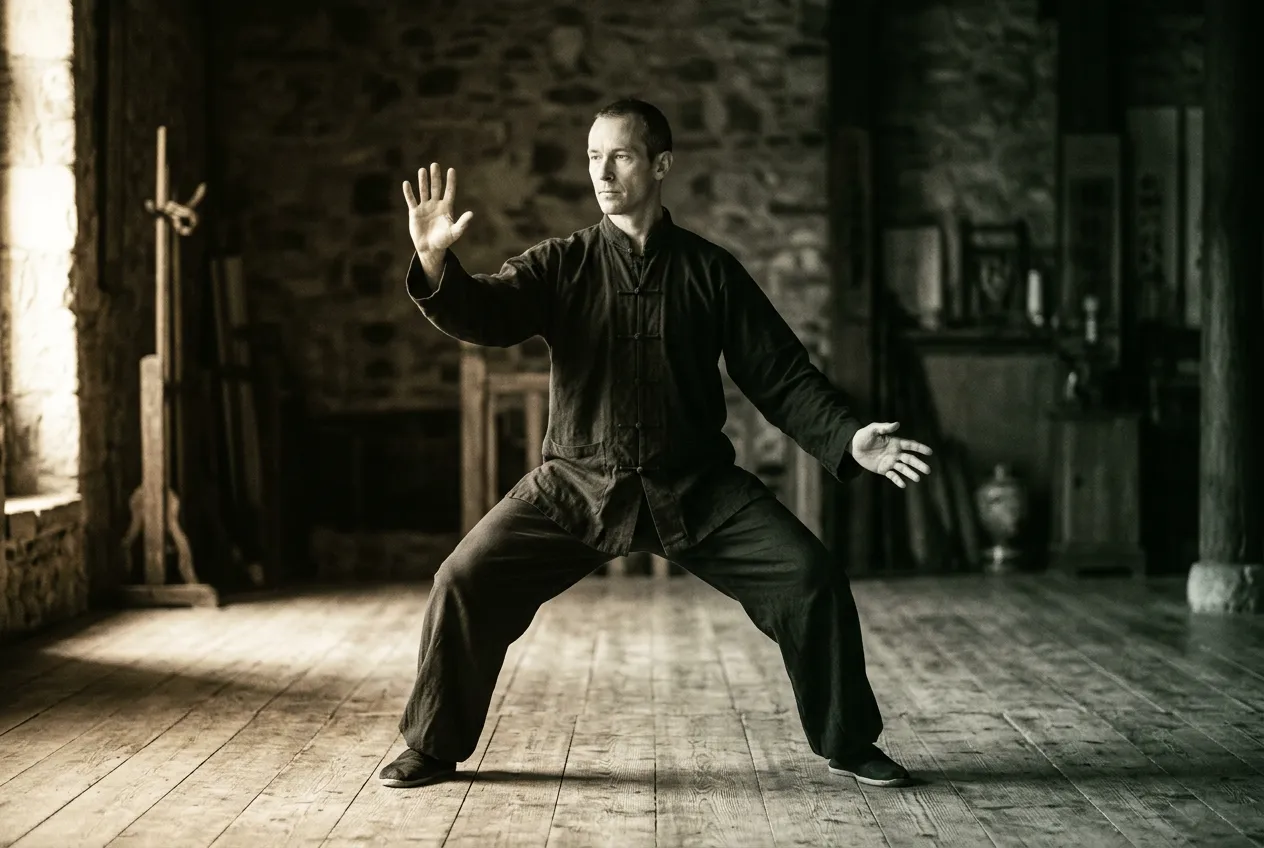
The 24 form takes most beginners eight to twelve weeks to learn the basic sequence. That means you’re doing something different from day one: actually completing something, rather than perpetually extending a sequence that feels endless. Once you can move through the whole form, each run-through deepens your understanding of the transitions rather than forcing you to focus on just remembering what comes next.
The form also introduces the key structural principles of Yang-style tai chi — rooted stances, flowing arm movements, weight shifts driven by the hips — without overwhelming new practitioners with the complexity of the longer forms. If you eventually want to learn the full Yang-style forms and their history, the 24 form gives you a genuine foundation.
Movement Groups and the Arc of the Form
The 24 form is organized into eight sections. Some teachers number them strictly, others group them by thematic similarity. What matters more than the numbering is understanding the arc: the form opens with settling, moves into more expansive bilateral movements through the middle sections, and closes with a return to stillness.
Section One: Opening and Ward Off
The form begins with two movements that set the entire tone.
1. Commencement (起势 Qǐ Shì) — This isn’t a dramatic entrance. Both feet are shoulder-width apart, arms rise slowly to shoulder height with palms facing down, then lower. The movement asks you to arrive — to settle weight into the floor and clear the mind. When I began practising seriously, my teacher suggested treating the commencement as a reset rather than a beginning. It takes longer to do well than it appears to require.
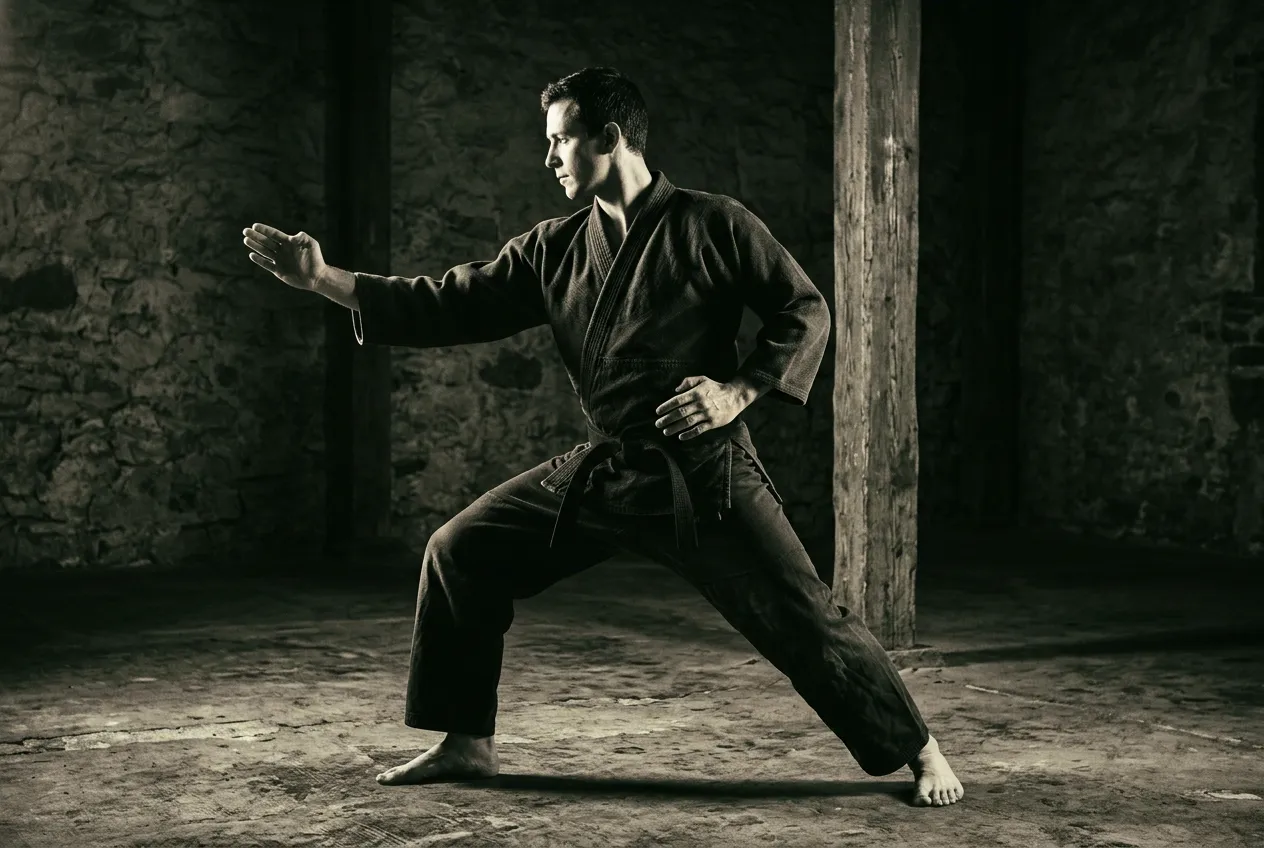
2. Ward Off Left, Then Ward Off Right (左右野马分鬃 Zuǒ Yòu Yěmǎ Fēn Zōng) — This is commonly translated as “Part the Wild Horse’s Mane,” repeated three times. The image is a practitioner parting the mane of a horse — one arm rises to shoulder height, the other sweeps low and back. The footwork introduces the basic Yang-style step-through pattern: bow stance with weight clearly committed to the front leg, back foot turned out to 45 degrees. Getting the hip rotation to drive the arm movement, rather than the shoulder, is the central challenge here.
Section Two: White Crane and Brush Knee
3. White Crane Spreads Wings (白鹤亮翅 Báihè Liàng Chì) — Weight shifts entirely onto the back leg. The high arm rises, the low arm drops. The posture requires real balance — hips centered, not tilted — and a quality of lightness that comes only after the stance feels stable enough that you stop thinking about it.
4. Brush Knee and Push (Left), Three Times (左右搂膝拗步 Zuǒ Yòu Lōu Xī Àobù) — Repeated in left and right directions across three stepping movements. One hand brushes past the knee as the other pushes forward from the shoulder. The push comes from a weight shift and hip rotation, not from the arm extending independently. Early on I had the habit of leading with my shoulder — it took weeks before the push started feeling like it originated from my centre.
Section Three: Grasp Sparrow’s Tail
5. Hand Strums the Lute (手挥琵琶 Shǒu Huī Pípá) — A brief transition posture. Weight sits on the back leg, both hands hold an imagined instrument. The posture teaches stillness within movement: arriving somewhere instead of rushing through.
6. Reverse Reeling Forearms (倒卷肱 Dào Juǎn Gōng) — Stepping backward while the forearms circle. This section reverses direction of travel, which disorients many beginners. The stepping pattern matters: step back with the toe first, then lower the heel, never slamming the foot down. Three repetitions in alternating direction.
7. Left Grasp Sparrow’s Tail (左揽雀尾 Zuǒ Lǎn Què Wěi) — Four sub-movements: Ward Off (Peng), Roll Back (Lu), Press (Ji), Push (An). This sequence, sometimes called WRRP, is considered the heart of Yang-style tai chi. The four movements explore the four cardinal directions of force — forward, yielding backward, compressing, and releasing. Getting through these four without losing your center is the most demanding thing in the first half of the form.
8. Right Grasp Sparrow’s Tail (右揽雀尾 Yòu Lǎn Què Wěi) — The same four movements on the other side, preceded by a pivot and step. The weight shift into the new bow stance needs to be genuinely complete before the Ward Off begins — half-committed stances produce half-committed movements.
Section Four: Single Whip and Wave Hands
9. Single Whip (单鞭 Dān Biān) — The form’s most iconic posture. The right arm extends fully to the right, the fingers gather into a hooked beak (crane’s beak). The left arm sweeps to the left with an open palm, and the weight settles into a wide bow stance. The challenge is keeping the hips level during the sweeping turn — beginners typically tilt one hip higher as they step through.
10. Wave Hands Like Clouds (云手 Yún Shǒu) — Three repetitions of a sideways stepping pattern with the arms moving in large horizontal circles. Of all the movements in the 24 form, this one produces the most obvious relaxation in the shoulders and chest when it’s working well. The hips lead the turn, the spine follows, and the arms move as a consequence rather than as the primary action. I remember spending an entire practice session on this movement alone — not to perfect it, but because once it started flowing it felt genuinely meditative.
11. Single Whip (repeated) — The second Single Whip closes the Cloud Hands sequence.
Section Five: High Pat and Kick
12. High Pat on Horse (高探马 Gāo Tàn Mǎ) — Weight transfers fully onto the back leg while the hands take an asymmetric position: one extends forward, one guards low. A moment of stillness in the midst of transition.
13. Right Heel Kick (右蹬脚 Yòu Dēng Jiǎo) — Weight fully on the left leg, the right leg kicks to the side at approximately knee height. The hands separate and frame the kick. Balance here is honest: if your rooted leg is not truly settled, the kick will feel precarious. When I began including this in regular practice, I was surprised how clearly it exposed whether I’d been doing the preceding movements with genuine weight transfer or just approximating them.
14. Strike Ears with Both Fists (双峰贯耳 Shuāng Fēng Guàn Ěr) — The right foot lowers, both fists arc forward in a closing movement at head height. A brief taste of martial intention within the generally soft form.
15. Turn Body and Left Heel Kick (转身左蹬脚 Zhuǎn Shēn Zuǒ Dēng Jiǎo) — A pivot on the right foot, then the left heel kick mirrors Movement 13.
Section Six: Snake and Rooster
16. Left Lower Body and Stand on One Leg (左下势独立 Zuǒ Xià Shì Dúlì) — The form drops dramatically low. The left leg extends along the ground while the right leg folds into a low crouch — a movement called Snake Creeps Down — before the practitioner rises onto the right leg, the left knee lifting to waist height, arms in a paired guard. The transition from the squat to the single-leg stand is the most physically demanding movement in the form for many practitioners.
17. Right Lower Body and Stand on One Leg (右下势独立 Yòu Xià Shì Dúlì) — The mirror image on the opposite side.
Section Seven: Jade Girl and Punch
18. Jade Girl Works the Shuttles (左右玉女穿梭 Zuǒ Yòu Yùnǚ Chuān Suō) — Four diagonal step-throughs with a Ward Off and a forward push in each. This movement covers ground — it’s one of the more spatially expansive sections. The practitioner moves to four diagonal corners, which requires spatial awareness and a good sense of direction within the form. Many beginners get temporarily confused about which diagonal they’re on.
19. Left Ward Off, Roll Back, Press, Push (Grasp Sparrow’s Tail repeated on left) — A brief revisiting of the Grasp Sparrow’s Tail pattern before the final movements.
20. Single Whip (third occurrence) — The third Single Whip signals the beginning of the form’s closing arc.
21. Wave Hands Like Clouds (second occurrence) — A shorter version of the cloud hands sequence.
22. Single Whip Low (单鞭下势 Dān Biān Xià Shì) — The Single Whip transitions into a low-body posture, the left arm extending fully while the torso sinks.
Section Eight: Needle and Closing
23. Fair Lady Works the Shuttles (Jade Girl, second side) — The diagonal stepping pattern repeats for the remaining corners.
24. Needle at Sea Bottom (海底针 Hǎidǐ Zhēn) — Weight shifts entirely onto the right foot, the left foot rests lightly forward, and the right hand points directly downward at an angle as the spine curves forward. It’s an unusual posture — a rare moment of downward extension in a form that mostly moves horizontally.
25. Fan Through Back (闪通臂 Shǎn Tōng Bèi) — The spine straightens and the arms open into a wide posture, the right arm sweeping upward and forward. This is properly the beginning of the closing sequence.
Note: Some teaching traditions count the 24 movements differently, combining or splitting certain repetitions. The standard Chinese Sports Commission count reaches 24 by grouping the repeated movements of Section 2 and counting the two Grasp Sparrow’s Tail sequences as single entries. What matters practically is that you learn the movements in order — the numbering is a teaching convention, not a sacred structure.
Closing (收势 Shōu Shì) — Both arms circle and descend, weight centralises, and the practitioner returns to the starting position. Mirror of the Commencement.
Learning the Form: Practical Guidance
The most common mistake beginners make is trying to learn the full sequence before the individual movements have settled in the body. Having worked through the form many times across different years of practice, I’ve found that learning in small groups of three or four movements — until each sub-section runs without conscious thought — produces a much more stable foundation than attempting to rush through to the end.
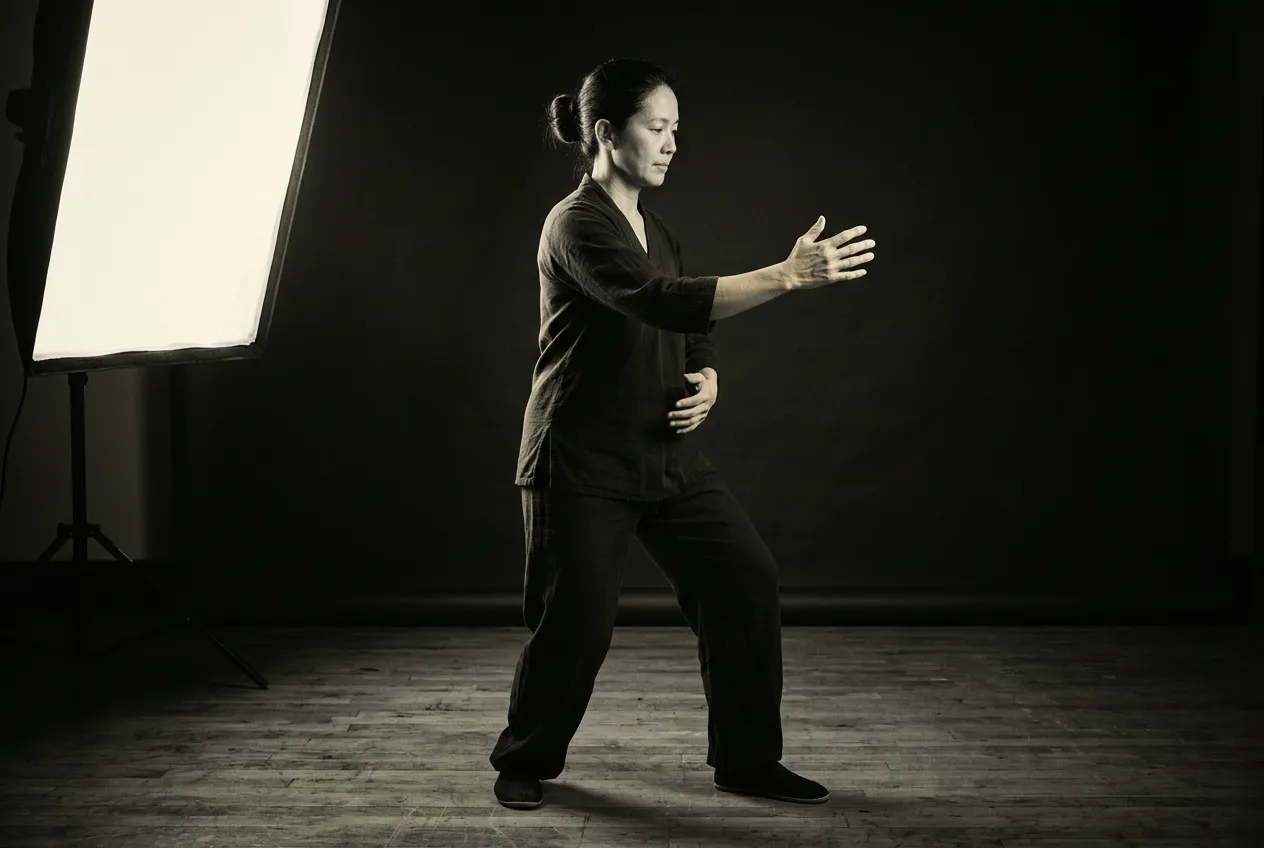
A few specific things that help:
Practise transitions, not just movements. The quality of the form lives in the moments between named postures. When a movement ends and the next begins, that transition should be as considered as the movement itself.
Slow down the weight transfers. Most beginners move the arms correctly but shift weight ambiguously. Weight should be clearly on one leg or the other for the vast majority of the form, with the transition between complete left and complete right weight being a distinct moment rather than a blur.
Record yourself. What the body feels like it’s doing and what it’s actually doing are often quite different, especially with hip positioning and back foot angles. A short video from the front and side will show you things your instructor is correcting that you’re not yet able to feel.
If you’re looking for guided video instruction to supplement your practice, TaiChiApp.com offers follow-along sequences for the Yang-24 form that show the movements from multiple angles — useful for picking up the spatial orientation that written descriptions can’t fully convey.
You can also find helpful demonstrations on YouTube channels dedicated to Yang-style tai chi, and the British Tai Chi Association maintains resources on form standards and teaching approaches.
For additional context on the movement names and what they mean, our guide to tai chi move names and posture terminology covers the naming conventions across the major forms.
Building a Practice Around the 24 Form
Once you can run through the complete sequence, the next question becomes how to make that practice progressive. The 24 form is deep enough to hold a serious practice for years — practitioners who have done it for decades still find new things in the transitions.
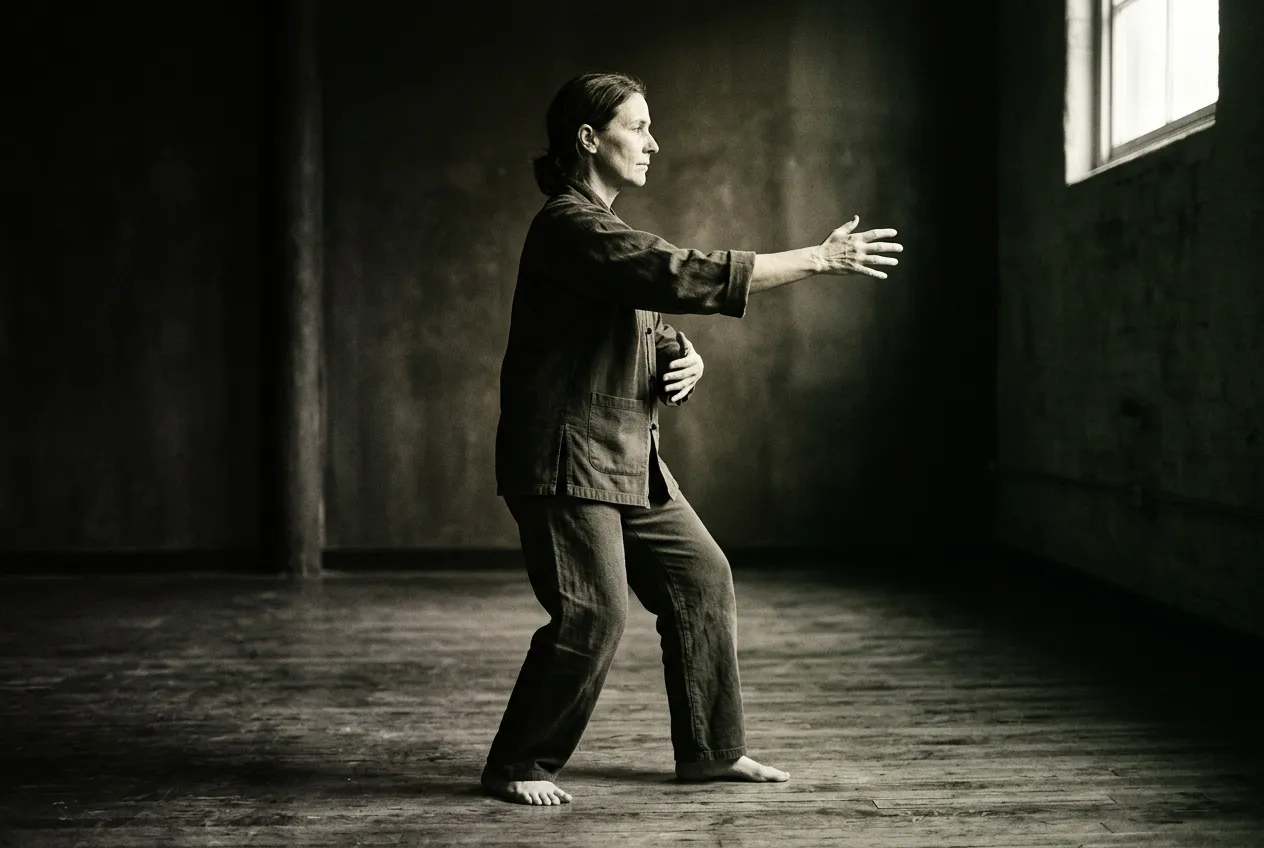
A useful structure for regular practice: two or three complete runs through the form in a session, with one run done deliberately slowly (two to three times normal speed) to focus on weight transfer, one at natural pace, and one with attention to a single principle — relaxed shoulders, for example, or continuous movement without pausing at the end of each gesture.
The daily practice routine article has more on structuring regular sessions, including how to incorporate shorter practice periods on busy days without abandoning the form entirely.
For a broader look at how the 24 form fits within the Yang-style tradition and where it sits in the history of the lineage, see our Yang-style overview.
Frequently Asked Questions
How long does it take to learn the Yang-style 24 form? Most practitioners learn the basic sequence in eight to twelve weeks with regular practice — three to five sessions per week. Being able to run through the sequence is one milestone; the deeper learning of why each movement is structured the way it is takes considerably longer. Many serious practitioners continue refining the 24 form for years.
Is the Yang 24 form suitable for complete beginners? Yes — it was specifically designed for beginners by the Chinese National Sports Commission in 1956. The movements are representative of Yang-style principles but arranged in a sequence accessible to people with no prior martial arts experience. That said, having a qualified instructor for the first several weeks significantly speeds up learning and prevents postural habits that are harder to correct later.
How many times should I practise the form in each session? Most practitioners do two to four complete runs through the form per session. Quality matters more than quantity — two attentive runs produce more benefit than five mechanical ones. As the sequence becomes familiar, the number of runs naturally increases because the form becomes shorter (faster to complete) as you stop pausing to remember what comes next.
What is the difference between the Yang 24 form and the full Yang long form? The full Yang-style long form runs to 108 movements and takes 20-40 minutes to perform, compared to five to eight minutes for the 24 form. The 24 form is a standardised subset of the long form, developed in 1956 to make Yang-style tai chi accessible to a wider audience. The 24 form contains many of the same core movements, but the long form includes more repetitions, additional variations, and a greater range of movement directions.
Can I practise the 24 form outdoors? Absolutely — the form requires approximately a 3m x 3m flat space, making it well-suited to parks, gardens, and any open outdoor area. Many practitioners specifically prefer outdoor practice for the natural environment. The main practical consideration is surface — slippery grass or uneven ground changes the physical demands of the weight transfers.
Browse our complete collection of guides on tai chi forms for more on styles, weapons forms, and practice techniques.