One of tai chi’s first confusions for new practitioners is the movement names. A teacher calls out “Single Whip” and you find yourself wondering what that could possibly mean as a movement description. Then “Golden Rooster Stands on One Leg” and suddenly it becomes both clearer and more surreal.
The names have layers. Some are purely descriptive of the movement shape. Some carry martial application in the name itself. Some are poetic images from classical Chinese that convey a quality of movement rather than a literal description. And many have multiple English translations — Cloud Hands is also called Wave Hands Like Clouds, and you’ll see both.
When I first encountered these names, I made a list and stuck it to the wall near where I practised. The Chinese names felt important to learn even imperfectly, because the Chinese terms carry a precision that English translations sometimes blur.
This guide covers the most common movement names in Yang-style tai chi, which is the most widely practised style globally. Chen and Wu styles share many of these movements under the same or similar names, though with different execution.
Foundation Movements and Opening Postures
Commencement / Preparation
- Pinyin: Qǐ Shì (起勢)
- Literal meaning: “Beginning posture” or “Rising posture”
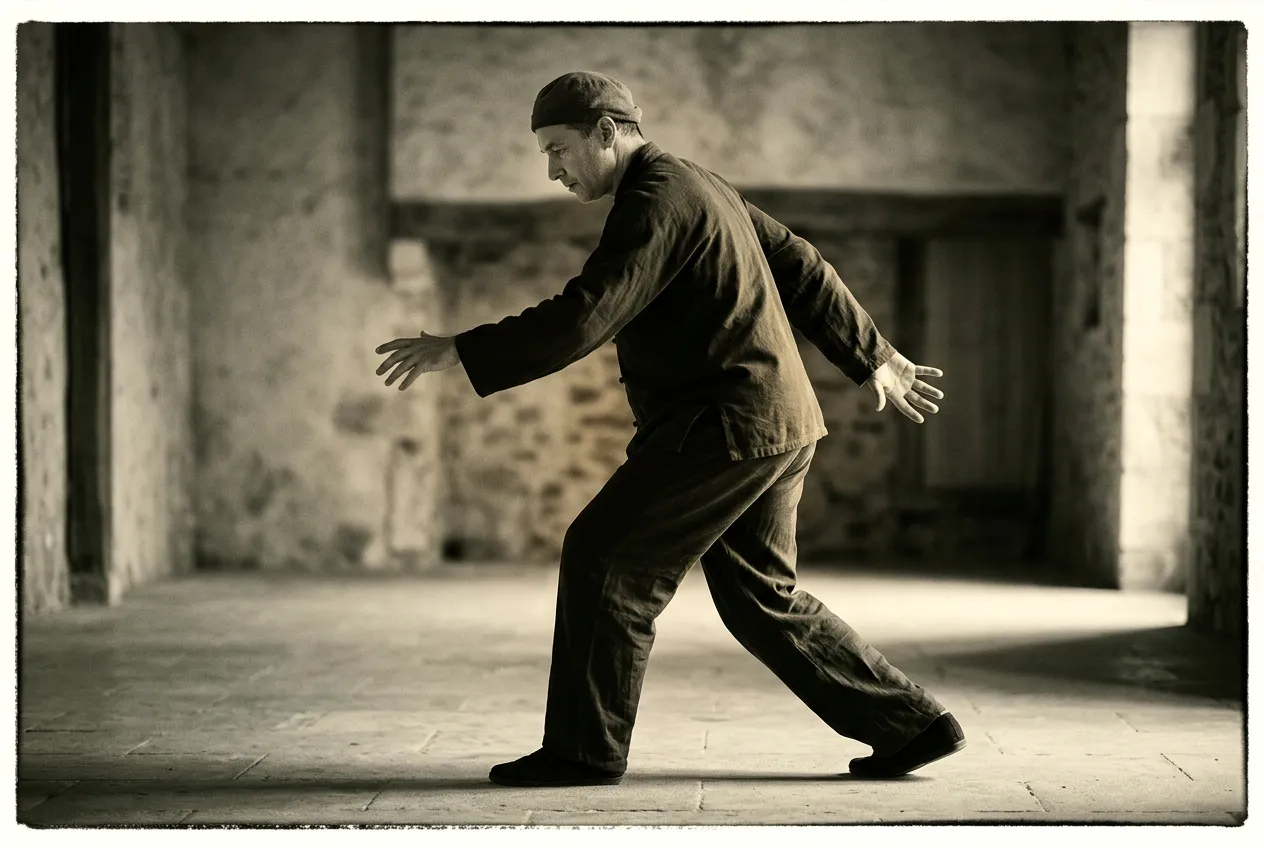
The opening movement of Yang-style tai chi. The practitioner stands with feet shoulder-width apart, weight equally distributed, arms slowly rising to shoulder height and then sinking. Qǐ Shì establishes the quality of the entire form — unhurried, rooted, with movement originating from the centre.
Martially, the rising arms can represent deflection of incoming grabs or pushes from below. Practically, it is the transition from ordinary standing into the attentive, connected quality that the rest of the form requires.
Wuji Stance / Preparation Stance
- Pinyin: Wú Jí (無極)
- Literal meaning: “Without ridgepole” — the state before yin and yang separate
Some styles and teachers include an initial standing meditation in Wuji stance before Qǐ Shì. This is simply standing in stillness before movement begins. Wuji represents the undifferentiated state — the quiet before the yin-yang alternation of the form unfolds.
The Four Primary Energies: Peng, Lu, Ji, An
These four are the foundation of Yang-style tai chi and appear throughout every form. Understanding them changes how you practise everything else.
Ward Off
- Pinyin: Péng (掤)
- Character quality: Expansive, buoyant, outward
Peng is often described as the primary energy that underlies all tai chi movement — a quality of rounded, outward-expanding energy like a ball that resists compression from any direction. In its visible form, one arm is held in a curved position at roughly chest height, as if holding a large ball. The arm does not push outward — it simply resists compression.
Martially, Peng receives an incoming strike or grab and redirects it upward and outward. The key quality is that the arm neither collapses under pressure nor meets force with equal force. It receives and deflects through its curved structure.
Roll Back
- Pinyin: Lǚ (捋)
- Character quality: Yielding, drawing back, circular
Lǚ is the yin complement to Peng — where Peng expands outward, Lǚ draws in and redirects. The movement is a circular sweeping that brings an opponent’s energy past your centre and redirects it, using their momentum rather than opposing it.
The movement looks like a smooth withdrawal and turn to the side. Martially, if someone grabs your arm and pushes, Lǚ redirects the incoming force across your body and past you, often pulling the attacker off balance.
Press
- Pinyin: Jǐ (擠)
- Character quality: Compact, forward, focused
Jǐ is a forward-moving, compact energy — pressing forward with both forearms as a single unit. Unlike a push, which uses both palms independently, Jǐ brings the back of one hand against the inside of the other wrist, forming a unified pressing surface.
Martially, Jǐ is used to press an opponent who has been destabilised by Lǚ — the Roll Back draws them off balance, and Jǐ delivers controlled forward pressure into that gap. The compact structure makes it difficult to deflect because there is no extending single point to catch and redirect.
Push
- Pinyin: Àn (按)
- Character quality: Downward-then-forward, sinking
Àn begins with a gathering (drawing the hands back toward the chest) and then releases forward and slightly downward. The palms push forward in a wave-like motion from the waist. This is the most recognisable tai chi movement to outside observers — it looks like gently pushing something away.
Martially, Àn pushes through an opponent’s centre rather than against their arms. A practitioner skilled in Àn can project significant force through what appears to be minimal contact.
Single Whip and Its Variants
Single Whip
- Pinyin: Dān Biān (單鞭)
- Literal meaning: “Single whip”
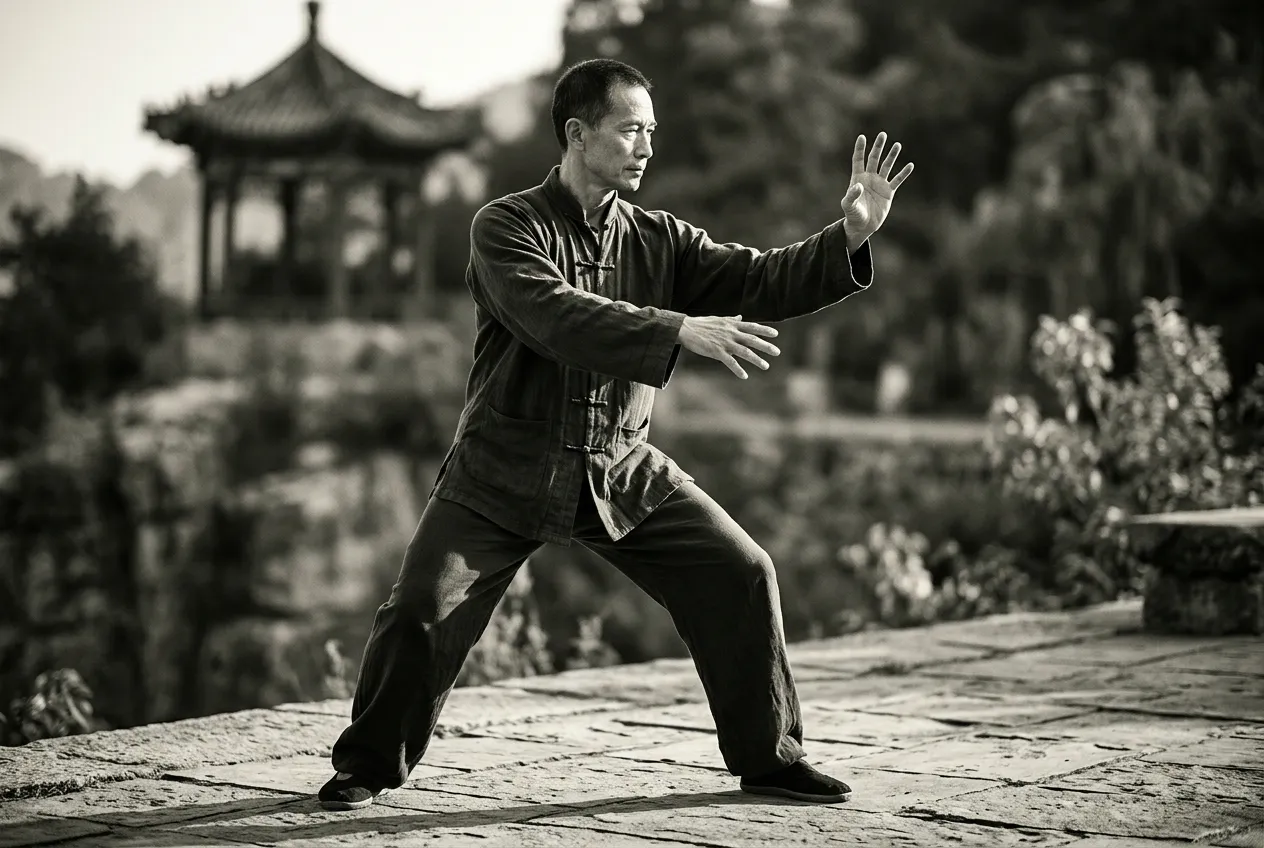
One of the most recognisable and frequently repeated movements in Yang-style forms. One arm extends far to the side with the fingers and thumb gathered into a “hook hand” (gou shou), while the other arm pushes forward with an open palm. The body turns to face one direction while the hook hand extends in the opposite direction.
The name comes from the way the hook hand snaps outward like a whip. In early Yang-style practice, the “crack” of that extension would have been a strike with the gathered fingertips. In the modern health-focused form, the movement is performed smoothly.
Single Whip appears multiple times in Yang Chengfu’s long form and in the Yang-24 sequence. Because it combines a wide turning movement with extensions in two directions, it challenges balance and hip mobility significantly — which is one reason it appears so often.
Cloud Hands
Cloud Hands / Wave Hands Like Clouds
- Pinyin: Yún Shǒu (雲手)
- Literal meaning: “Cloud hands”
Yún Shǒu is performed as a series of slow horizontal sweeping movements where the arms alternate — one arm sweeping across the front of the body as the other descends, while the feet step sideways in a continuous lateral sequence.
The name describes the quality of movement perfectly: the arms move like clouds drifting past each other, overlapping and separating in continuous, unhurried circles. The movements are not choppy or discrete — each arm’s circle flows into the next.
From a practice standpoint, Cloud Hands is one of the most effective movements for developing relaxed shoulder and wrist rotation. When I first started learning Cloud Hands, the temptation was to use arm muscles to drive the circles. When it’s working correctly, the arms rotate from the waist, and the hands follow rather than lead.
Martially, Cloud Hands represents continuous deflection of incoming attacks from both sides — each sweep redirects a strike while setting up the counter, in an alternating sequence.
Golden Rooster Stands on One Leg
Golden Rooster Stands on One Leg
- Pinyin: Jīn Jī Dú Lì (金雞獨立)
- Literal meaning: “Golden rooster stands on one leg”
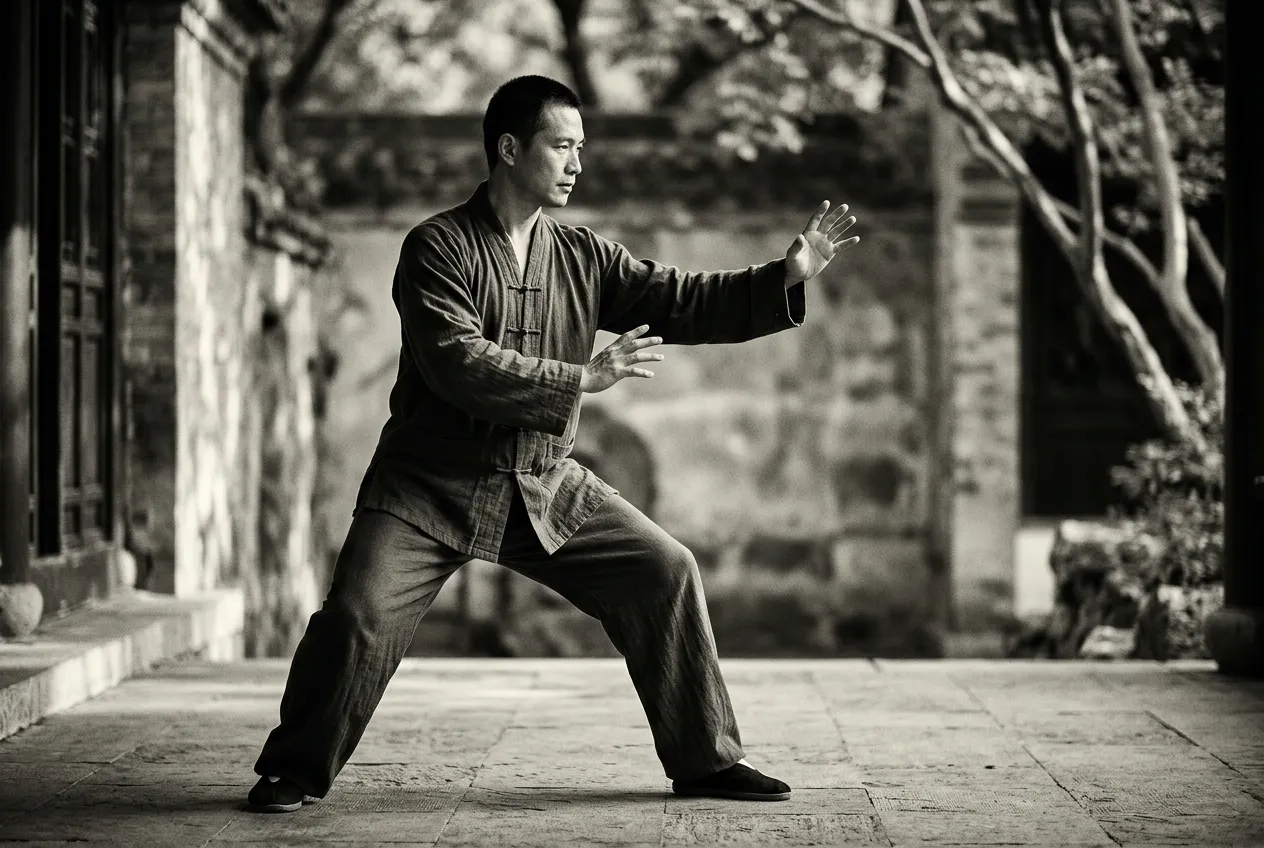
A single-leg balance posture in which one leg is lifted with the knee raised, while the same-side arm rises with the elbow slightly forward and the hand at eye level. The opposite arm drops. The posture is held briefly, then the weight shifts and the other side performs the same position.
The image is precise: a golden rooster (pheasant) balancing on one leg, as roosters famously do. The raised knee creates a natural barrier protecting the body’s centreline, while the raised hand guards against a high attack.
Martially, the lifted knee can strike or block, while the raised arm guards the high line. Practically, it is one of the most effective balance-training movements in the form — the brief single-leg hold develops proprioception and ankle stability in a way that slow continuous movement alone does not.
Repulse Monkey / Step Back to Drive Monkey Away
Repulse Monkey / Step Back to Drive Monkey Away
- Pinyin: Dào Niǎn Hóu (倒攆猴)
- Literal meaning: “Reverse coiling monkey” or “Stepping back, repulsing monkey”
One of the few retreating movements in Yang-style tai chi. While the form predominantly advances or turns, Repulse Monkey steps backward with one foot while pushing forward with the opposite arm. The movement repeats several times, each time stepping back and pushing forward.
The “monkey” in the name refers to the forward-darting nature of an attack that you are retreating from while still countering. You do not simply retreat — you back up while continuing to meet the threat.
This is a significant movement for practitioners to internalise: retreating and countering simultaneously. The weight shifts backward with each step while the forward arm extension is coordinated with (not opposed to) that retreat.
White Crane Spreads Its Wings
White Crane Spreads Its Wings
- Pinyin: Bái Hè Liàng Chì (白鶴亮翅)
- Literal meaning: “White crane spreads its wings”
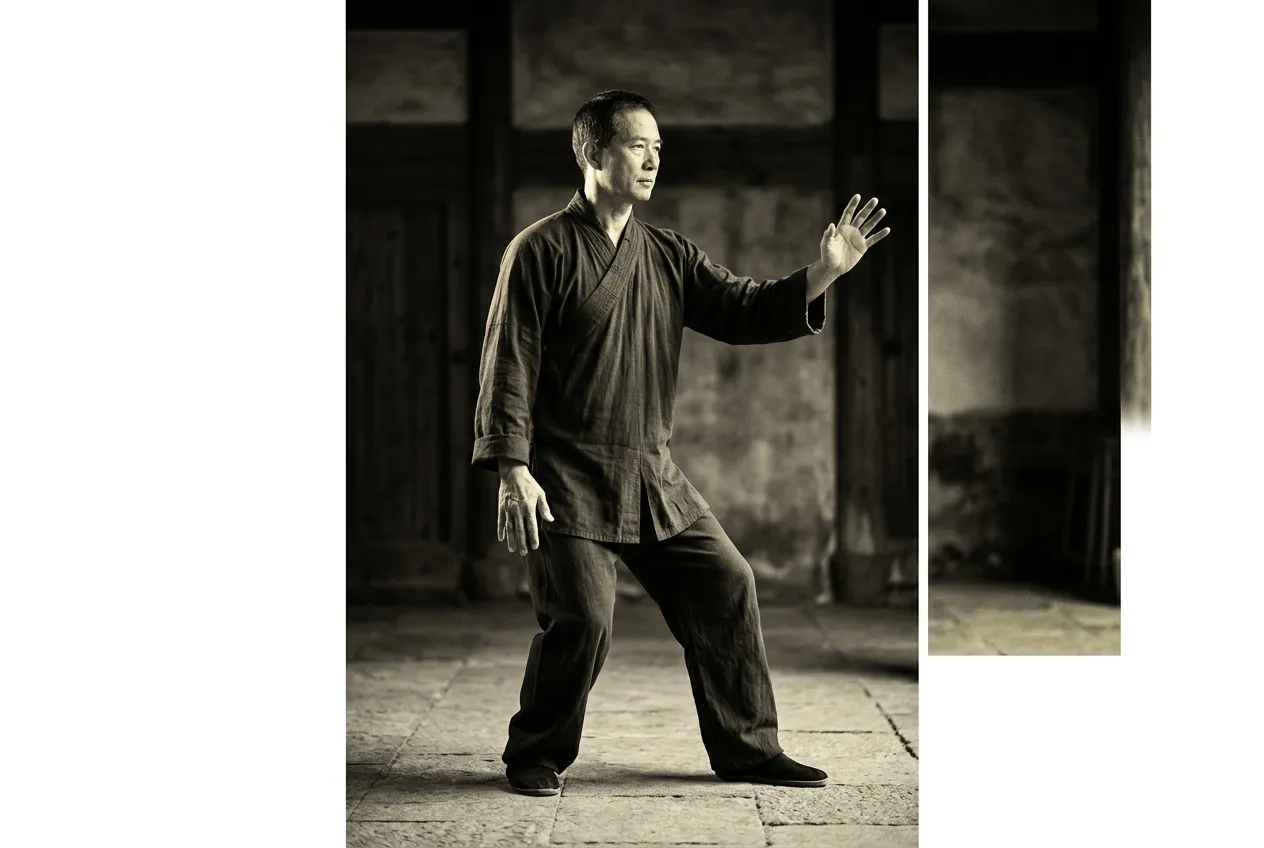
A posture in which one arm rises to guard the high line while the other descends to guard the low line, with the weight predominantly on the rear leg. The raised and lowered arms together create a shape like a crane spreading its wings — open, extended, balanced.
The movement opens after a forward-moving sequence, providing a change of direction and level. The image of the crane — elegant, still, alert — captures the quality of the posture. Not aggressive, not passive, but ready.
Brush Knee Twist Step
Brush Knee Twist Step
- Pinyin: Lǒu Xī Ào Bù (摟膝拗步)
- Literal meaning: “Sweep knee diagonal step”
A stepping movement in which one hand sweeps down past the leading knee (as if brushing away a low kick) while the other hand pushes forward. The body advances with a diagonal body alignment — the “twist step” (ào bù) referring to the crossed alignment of arms and legs.
Brush Knee Twist Step appears multiple times in the Yang forms and is one of the first movements beginners learn. The coordination required — stepping, sweeping the lower hand, and pushing with the upper hand simultaneously — makes it a useful test of the whole-body coordination that tai chi develops.
Needle at Sea Bottom and Fan Through the Back
Needle at Sea Bottom
- Pinyin: Hǎi Dǐ Zhēn (海底針)
- Literal meaning: “Needle at sea bottom”
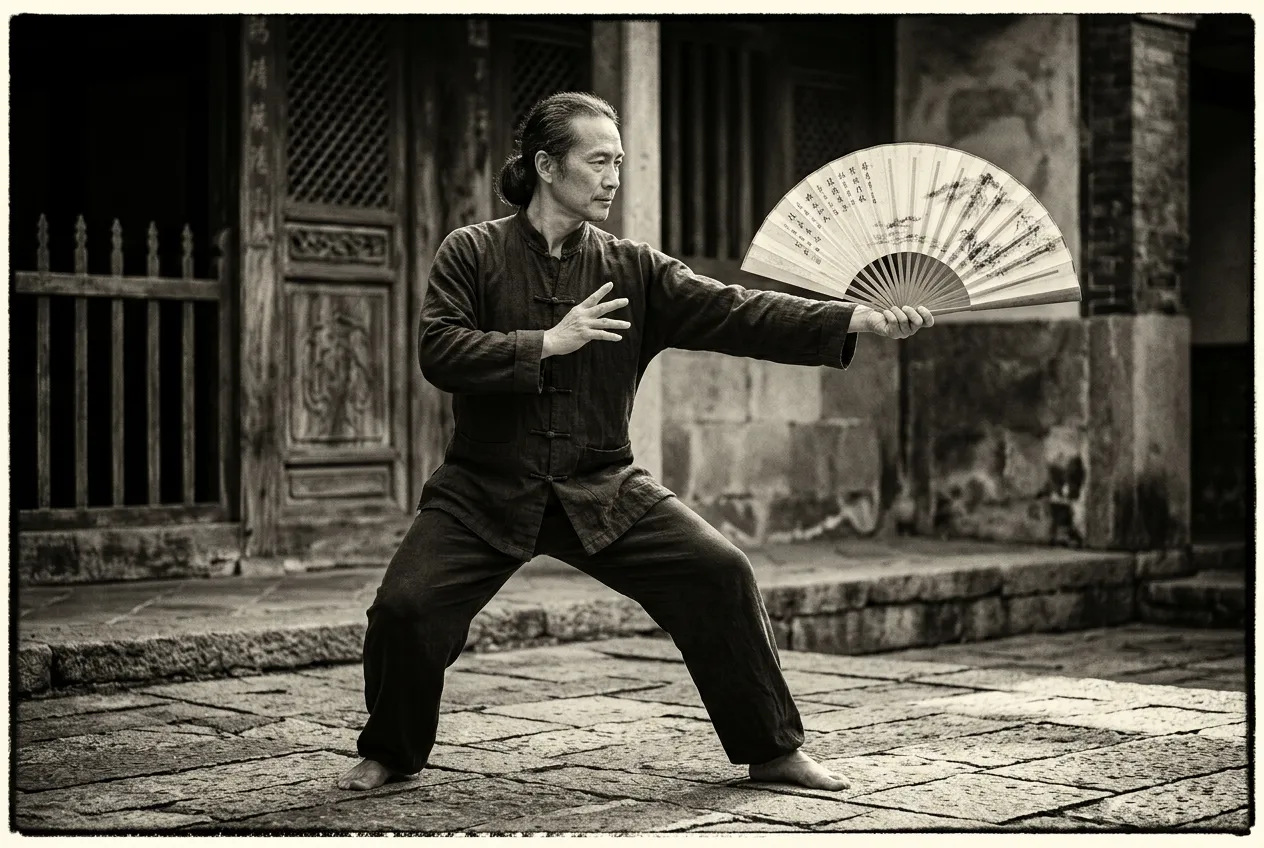
The weight sinks completely onto one leg while the body bends slightly forward and one arm reaches directly downward, fingers pointing toward the ground. The image is of reaching to the deepest point of the ocean.
This is one of the most challenging balance movements for beginners: the deep forward lean while supporting full body weight on one leg requires significant hip stability. It tests whether a practitioner has genuine root and core stability or is managing through muscular compensation.
Fan Through the Back
- Pinyin: Shǎn Tōng Bèi (閃通背)
- Literal meaning: “Flash through the back”
The movement that immediately follows Needle at Sea Bottom in most Yang-style forms. The body rises from the deep forward lean into an upright stance while one arm opens high and the other pushes forward — like a fan suddenly opening.
The transition from Needle at Sea Bottom to Fan Through the Back is one of the more testing moments in the form: rapid weight transfer from a deeply bent, low position to an upright, expanded one.
Grasp the Sparrow’s Tail
Grasp the Sparrow’s Tail
- Pinyin: Lǎn Què Wěi (攬雀尾)
- Literal meaning: “Hold/grab sparrow’s tail”
This is a sequence rather than a single movement — it encompasses Ward Off (Peng), Roll Back (Lu), Press (Ji), and Push (An) performed in continuous succession. Grasp the Sparrow’s Tail is considered the core sequence of Yang-style tai chi, encapsulating its foundational principles in a single continuous unit.
The “sparrow’s tail” refers to a light, delicate object held just firmly enough — neither gripping nor releasing. This quality of precise, calibrated contact is what the sequence is trying to develop.
For more about how these movements fit together in the Yang-24 form sequence, see our complete Yang-24 form guide. For an overview of Yang-style practice as a whole, see our Yang-style tai chi guide.
If you are just beginning and want to understand the basics before learning movement names, our complete beginner’s guide to tai chi covers what to expect in your first months of practice.
Browse all tai chi forms guides at our tai chi forms section.