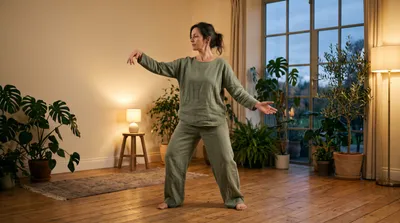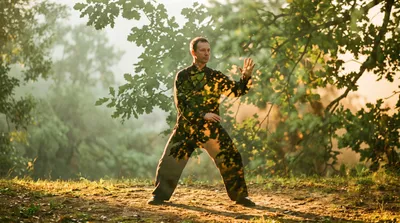
Ask a roomful of intermediate tai chi practitioners what they find hardest about the practice, and breathing comes up almost every time. Not the movement — experienced practitioners can usually replicate the shape of a posture — but the breath. How to breathe. When to inhale and when to exhale. Whether breath should lead the movement or follow it. Whether you’re breathing “correctly” at all.
I spent the first two years of my practice largely ignoring the breath question. I was focused on getting the footwork right and remembering the sequence. That was probably the right call for a beginner. But once the form became familiar, I realised I’d been breathing in a tight, shallow pattern that limited how settled and centred my practice felt. Addressing it made a more significant difference than I’d expected.
This article explains how tai chi breathing works: the underlying principles, the two main breathing patterns used in tai chi, how breath coordinates with movement, and the honest reality that most practitioners don’t need to overthink this — especially in the early stages.
The Foundation: Diaphragmatic Breathing
Before discussing tai chi-specific breathing patterns, it helps to understand what diaphragmatic breathing is and why it’s considered the starting point.
Most adults at rest breathe into their upper chest — a shallow pattern that uses the accessory muscles of the neck and shoulders more than the large, efficient diaphragm muscle at the base of the lungs. It’s functional enough for sitting at a desk, but it produces a faint low-level tension in the body that, over a full day, adds up.
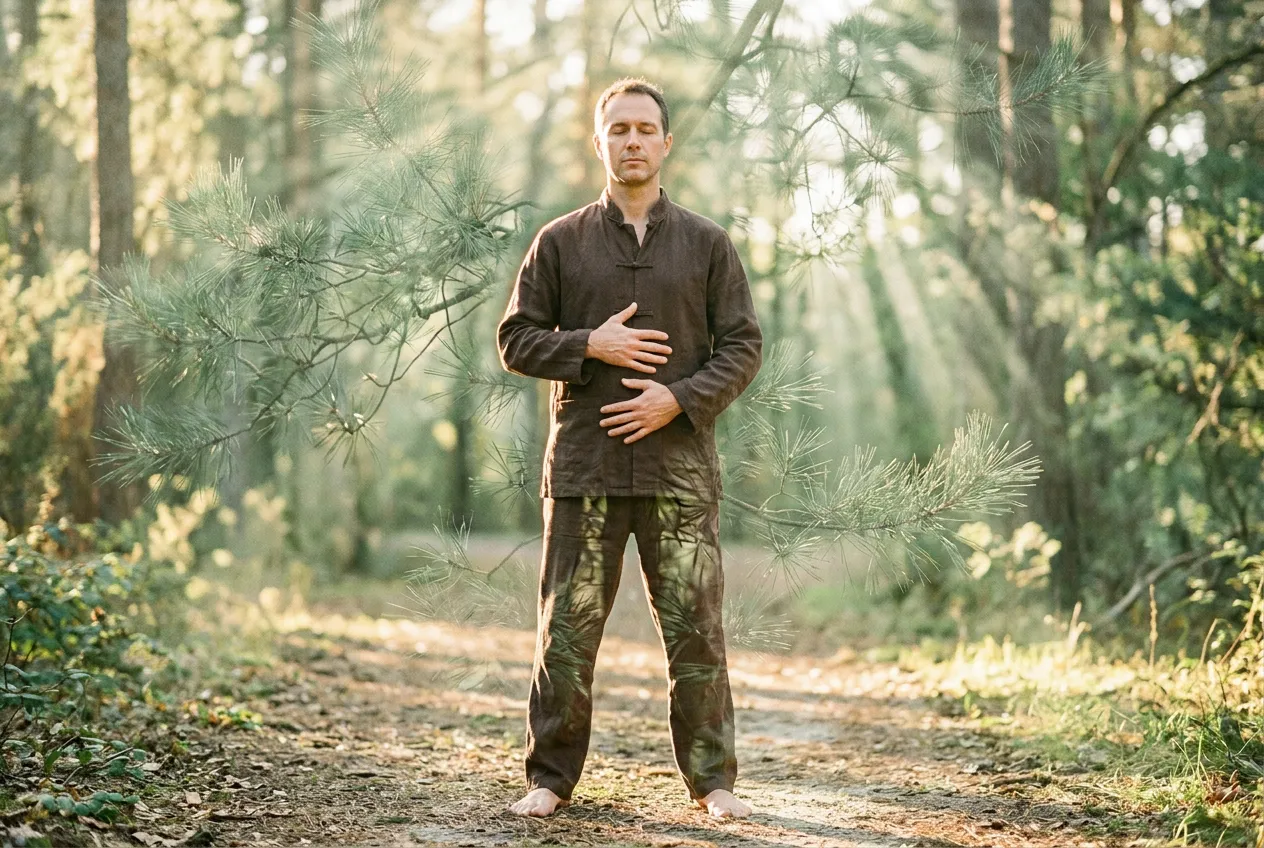
Diaphragmatic breathing — sometimes called belly breathing — uses the diaphragm as the primary breathing muscle. On the inhale, the diaphragm contracts and moves downward, creating space in the chest cavity and drawing air into the lower lungs. The belly visibly expands outward. On the exhale, the diaphragm relaxes upward and the belly draws back in. This is the breath of natural rest; watch a young child sleeping and you’ll see it.
In tai chi, diaphragmatic breathing is foundational. The lower abdomen — the dantian region, roughly three finger-widths below the navel — is considered the body’s centre of gravity and the locus of internal energy in Chinese practice traditions. Breathing into the belly activates this area and is associated with greater groundedness and stability in the posture.
When I first started paying conscious attention to my breathing in practice, I noticed I was doing the opposite: my chest would rise on the inhale while my belly stayed relatively flat. Shifting to genuine diaphragmatic breathing felt odd at first — almost counterintuitive — before it became natural.
To check your own pattern: place one hand on your chest and one on your lower belly. Breathe normally. If the chest hand moves more than the belly hand, you’re breathing high. In tai chi practice, you want the belly hand to move first and the chest hand to barely move at all.
Natural Breathing vs. Tai Chi Breathing
For most beginners, the clearest and most useful instruction is this: breathe naturally.
This isn’t a dodge. It reflects a genuine principle in traditional tai chi instruction. Forcing or controlling the breath — especially while also trying to remember the sequence, coordinate the weight transfer, and maintain posture alignment — is too many demands at once. Artificial breath control in a beginner produces tension, not ease.
Natural breathing, for the purposes of tai chi, means diaphragmatic breathing that is slightly deeper and slower than ordinary breath, coordinated loosely with movement, but never strained or held. The breath follows the movement; it doesn’t lead it.
As the form becomes more familiar and the sequence no longer requires conscious tracking, breath coordination begins to develop on its own. Practitioners often report that the breath and movement seem to “find each other” without deliberate effort — the long exhalations in a slow, flowing movement naturally tend to align with extensions; the inhales tend to settle into gather-and-sink moments.
This natural alignment is not accidental. The physical mechanics of the movements are designed around the breath cycle. Extending and opening movements tend to be exhale movements; gathering and sinking movements tend to be inhale movements. But learning these patterns intellectually is less useful than letting them emerge through relaxed practice.
Reverse Abdominal Breathing
Alongside natural diaphragmatic breathing, tai chi practice also involves a more advanced technique called reverse abdominal breathing — sometimes called Daoist breathing or Buddhist breathing in reverse.
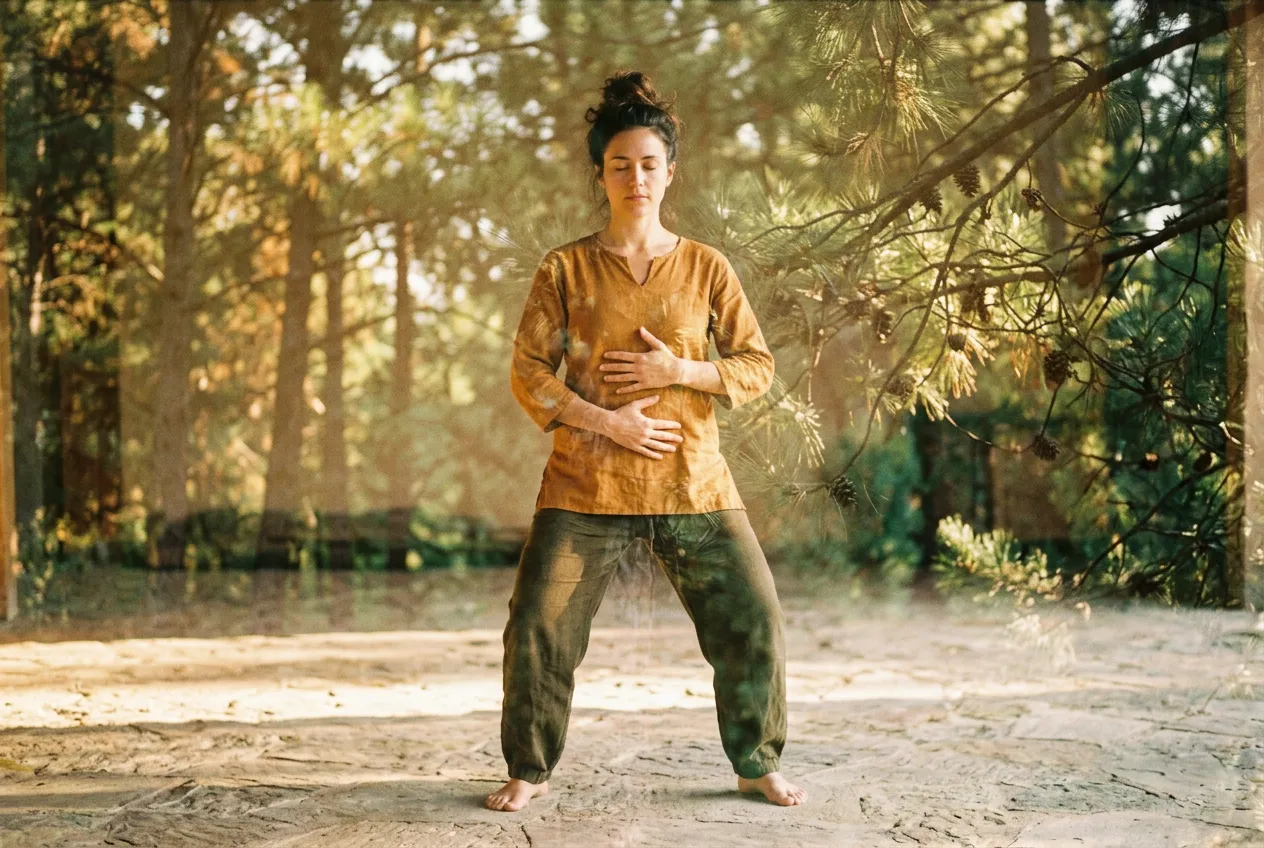
In ordinary diaphragmatic breathing, the belly expands on the inhale and contracts on the exhale. In reverse abdominal breathing, the pattern is inverted: the belly gently contracts and draws in on the inhale, while the chest and sides of the ribcage expand; on the exhale, the belly releases and expands slightly outward.
This sounds counterintuitive. It is. And it requires careful attention to learn without creating tension in the abdomen.
Reverse abdominal breathing is associated with different qualities in practice. Traditional teachings describe it as building internal pressure and developing the capacity to project force — more relevant to tai chi as a martial art than to health-focused practice. Some practitioners also report that it creates a more focused, concentrated quality in the practice, a sense of the energy drawing inward on the inhale.
As someone who came to tai chi primarily through the health and movement tradition rather than martial application, I’ve spent more time with natural diaphragmatic breathing than with reverse abdominal breathing. But I’ve experimented with both, and they do genuinely produce different qualities in the body. Whether that difference matters practically depends on what you’re doing with your practice.
For most health-focused practitioners, natural diaphragmatic breathing is entirely sufficient. Reverse abdominal breathing is worth exploring once your practice is well established — not as a requirement, but as an additional layer of depth.
Coordinating Breath With Movement
Once diaphragmatic breathing is established as a baseline habit in practice, the next step is understanding how breath coordinates with the movements of the form.
The general principle is:
- Inhale during gathering, rising, or drawing-in movements — when the arms lift, when weight shifts back, when the body contracts or gathers toward its centre.
- Exhale during releasing, extending, or expressing movements — when the arms extend or push, when weight shifts forward, when a posture opens or projects outward.
This pattern reflects the natural mechanics of breathing: the inhale draws energy in and the exhale releases it. It’s consistent with the martial tradition, where the exhale accompanies a strike or push and the inhale accompanies the retraction or preparation.
In practice, this coordination is less rigid than a rule. Tai chi movements don’t all have neat, single-breath arcs. Some transitions are longer than a single breath cycle; some require the breath to subdivide or extend through a longer movement phrase. The coordination principle provides a guide, not a constraint.
As the daily tai chi practice routine article describes, building a consistent practice is what allows breath coordination to develop naturally over time. Sessions where you’re relaxed and the form is familiar are sessions where the breath begins to integrate without effort.
The Relationship Between Breath and Mental State
Tai chi is described as a moving meditation, and the breath is a large part of why. Conscious attention to slow, deep breathing activates the parasympathetic nervous system — the branch associated with rest and digestion, as opposed to the stress-response state most people spend their working hours in.
This is why tai chi practice has measurable effects on stress and anxiety. The movements contribute; so does the social context of group practice in many cases. But the slow, regulated breathing is itself a significant mechanism. Slow diaphragmatic breathing is well documented to raise heart rate variability and shift the body toward parasympathetic dominance, which is consistently associated with lower perceived stress.
The evidence on tai chi’s mental health effects is well-established. For those interested in the broader relationship between tai chi and mental health and anxiety reduction, the picture is clear even if the specific mechanisms are still being studied.
For the practitioner in the moment, the practical experience is simpler: slow, conscious breathing during practice produces a calm, centred quality that’s hard to achieve any other way. The form slows you down; the breath slows you further. After a session, the return to ordinary activities often feels less reactive, less scattered.
The connection between breath and mindfulness in tai chi runs deep. If the meditative dimension of practice interests you, tai chi meditation explores how moving meditation works and what distinguishes it from seated mindfulness.
Practical Guidance for Developing Your Breathing
Don’t start by controlling the breath. In your first weeks or months of practice, focus on the movements. Let the breath be what it naturally is. It will settle toward diaphragmatic breathing as the body relaxes into the practice.

Check for tension. The most common breathing error in tai chi is creating tension in the abdomen, chest, or throat while trying to control the breath. If breathing feels effortful or strained, you’re working too hard. The breath should feel easy. If it doesn’t, release all conscious control and breathe normally for a few moments.
Use the warm-up to establish the breath. Before beginning the form, spend a minute or two in standing meditation, breathing slowly and fully into the belly. This establishes the diaphragmatic pattern before the movements begin. By the time the form starts, the breath is already settled.
Exhale fully. A common pattern is to take reasonably good inhales but cut the exhale short, never fully emptying the lungs. A complete exhale releases the old air and naturally draws a fuller inhale. In tai chi, the full, unhurried exhale is as important as the inhale.
Breathe through the nose. Traditional practice uses nose breathing throughout, which warms and filters the air, slightly slows the breath cycle, and maintains a quality of composure in the face that closed-mouth breathing supports. In cold outdoor practice, this can be challenging but is worth maintaining where possible.
Notice, don’t force. The most useful advice on tai chi breathing is also the simplest: notice what the breath is doing. Not to correct it immediately, but to observe. Over many sessions of this quiet observation, the breath and the movement find their natural relationship.
When Breath Coordination Becomes Natural
There’s a moment in every tai chi practitioner’s development when the breath stops being a separate thing to manage and becomes integrated with the movement. The form feels more fluid, more settled. There’s a quality that experienced practitioners sometimes call sung — a kind of relaxed, alert ease that runs through the whole body.
The breath contributes substantially to that quality. Not because you’ve achieved perfect technical coordination, but because you’ve practiced enough that the breath has found its place in the movement without being forced.
That integration takes time. And the route to it is not through more conscious control but through more relaxed, consistent practice. Show up, breathe, move. Let the relationship develop.
For further reading on building the overall practice, the tai chi practice section covers everything from physical warm-ups to meditation practice to structuring a sustainable daily routine.