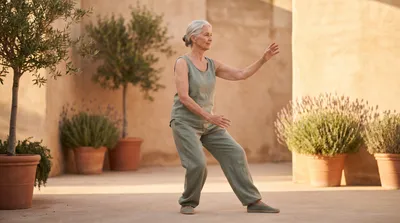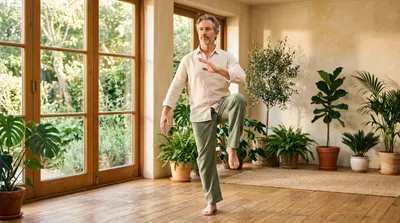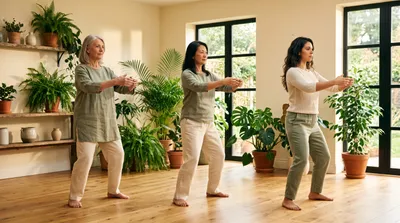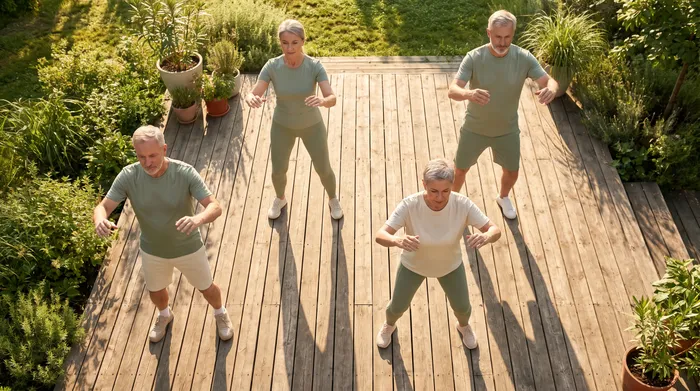
Your fifties are often the decade where the body starts sending messages. A stiff hip in the morning. A shoulder that complains after a long run. The recovery time that used to be a day stretching to three. None of this means slowing down — it means being smarter about how you move.
Tai chi fits well here. Not because it’s gentle — though it is — but because it targets the physical qualities that matter most as you age: balance, joint mobility, and the ability to move with coordination and control. It’s a practice that rewards consistency and gets more interesting the longer you do it.
This guide is for people in the 50–60 bracket who are still active, still interested in fitness, and wondering whether tai chi belongs in their routine.
What Tai Chi Offers the Active Over-50s
The 50-60 demographic is distinct from seniors in an important way: most people in this range are still working, still physically capable, and looking to maintain their fitness rather than manage decline. Tai chi meets that differently than it does for older adults.
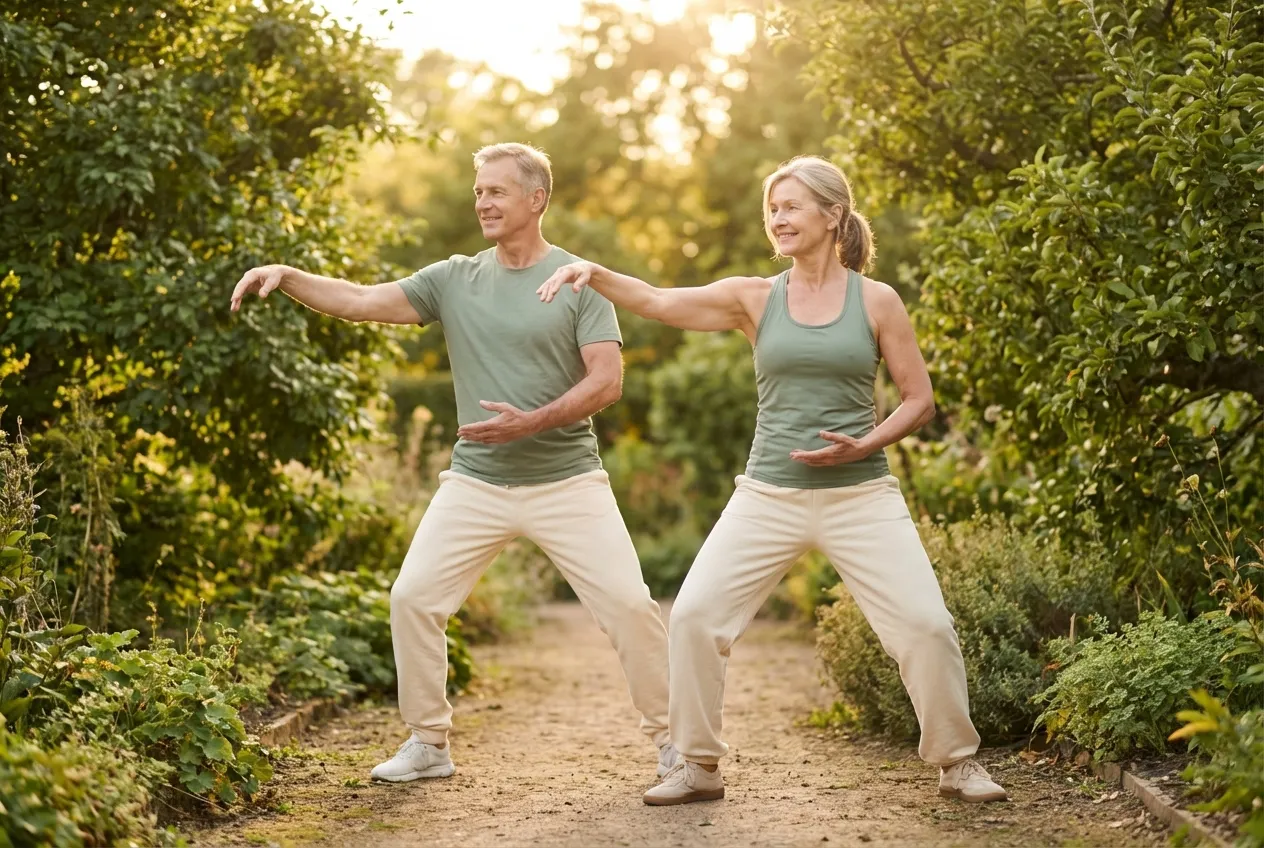
For an active person in their fifties, tai chi functions less like rehabilitation and more like cross-training. It develops qualities that are hard to build through conventional gym work: spatial awareness, hip and shoulder mobility through large ranges of motion, balance under dynamic conditions, and the kind of focused relaxation that improves recovery from higher-intensity exercise.
When I took up tai chi seriously in my forties, I was also doing other physical training. What surprised me was how much tai chi improved the other things — my body awareness, my ability to relax under physical effort, my single-leg stability. These are transferable qualities that tend to erode with age unless you specifically train them.
Mobility Without the Price Tag of Flexibility Classes
Most tai chi forms take your hips, spine, and shoulders through their full comfortable range of motion repeatedly. The turning movements challenge thoracic (mid-back) rotation. The weight-shifting challenges the hips. The arm sweeps keep the shoulders mobile.
You don’t need to be flexible to start — tai chi meets you where you are. But consistent practice does tend to improve mobility over time, and unlike aggressive stretching, it achieves this through movement rather than passive holding, which is generally better for joint health in the long term.
Stress and the Parasympathetic Switch
The over-50s are often at peak career pressure. Tai chi’s slow, rhythmic movements combined with deliberate breathing shift your nervous system toward the parasympathetic state — the rest-and-digest mode that counterbalances the chronic stress most adults accumulate.
A randomised controlled trial published in Psychoneuroendocrinology found that healthy adults who took up regular taiji (tai chi) practice showed significantly lower cortisol and heart-rate stress reactivity than a waitlist control group when exposed to a standardised psychosocial stress test, after just three months of practice. For people carrying significant work and life stress, that’s a genuine physiological benefit, not just a feeling.
The meditative quality of tai chi also provides something that high-intensity exercise doesn’t: a practice where the goal is not achievement but presence. Many practitioners find that this mental aspect becomes as valuable as the physical benefits over time.
Health Benefits That Matter Specifically in This Decade
Your fifties are when certain risk factors start accumulating — blood pressure trends upward, bone density starts declining, balance begins its slow drift. Tai chi addresses several of these proactively.
Cardiovascular health: A 2020 meta-analysis of randomised controlled trials, published in Evidence-Based Complementary and Alternative Medicine, pooled 24 trials and found that tai chi produced modest but statistically significant reductions in both systolic and diastolic blood pressure compared with inactivity. It’s not a substitute for aerobic training, but it contributes to cardiovascular health as part of a mixed routine.
Bone density: Weight-bearing movement helps maintain bone density. Tai chi qualifies, and its balance training directly reduces fracture risk — the fall prevention benefit matters from your fifties, not just in your seventies.
Balance: Tai chi for balance training is most effective when started before balance problems become apparent. Your fifties are an ideal time to build proprioceptive skills that will serve you for decades.
The research on tai chi health benefits more broadly is extensive — it’s one of the most studied exercise practices for the over-50 population.
Tai Chi at Home: The Over-50s Advantage
One of the practical advantages of being in your fifties rather than your eighties is that home practice is straightforward. You have the balance and physical capacity to practise safely without supervision, and you likely have more flexibility in your schedule than you did at 35.
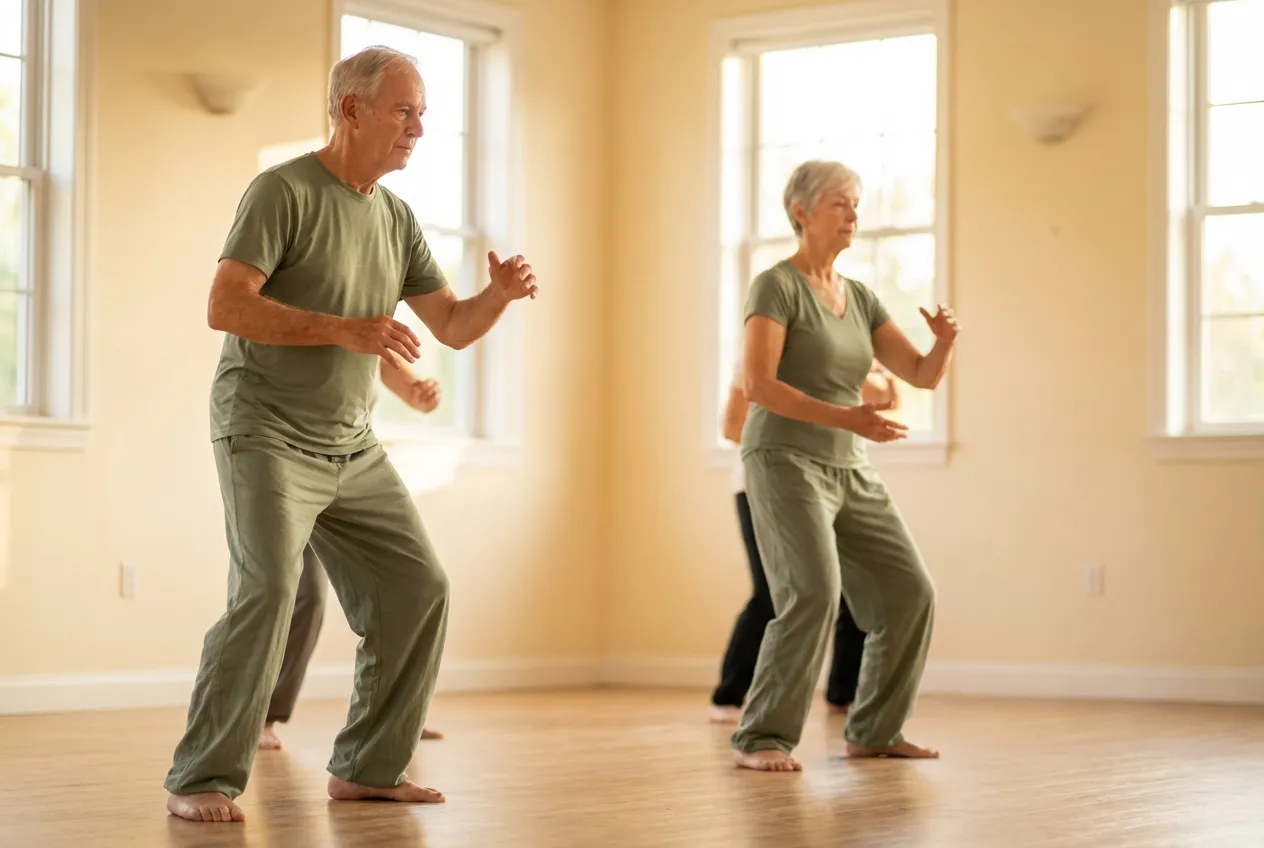
Practising tai chi at home is realistic once you’ve had some instruction — the movements are repeatable and don’t require equipment or much space. A small living room clears enough room for most beginner forms.
For building a home practice, guided video instruction is particularly useful. TaiChiApp.com offers structured video lessons that are well-suited to solo practice, with clear instruction that you can follow at your own pace. This works well as a supplement to occasional in-person classes, or as the primary learning method if you prefer to start privately.
The key to home practice is consistency over intensity — 20-30 minutes three or four times a week is more valuable than an occasional 90-minute session. Tai chi builds through accumulated repetition.
Getting Started: What You Actually Need to Do
The practical barriers to starting tai chi are low. No equipment. No particular fitness requirement. No competitive element. What you need is some instruction and a willingness to feel like a beginner for a few months.
Finding Instruction That Fits Your Life
In-person classes remain the best starting point because an instructor can see what you’re doing and correct errors that you can’t catch yourself. Many community centres, leisure centres, and martial arts schools offer beginner tai chi classes. Drop-in classes are common — you can try before committing to a term.
When looking at classes, check whether the instructor has experience with adult beginners. Yang style is the most widely taught and the best researched for health applications — a good default choice if you’re not sure which style to look for.
If your schedule doesn’t accommodate fixed class times, online learning gives you full flexibility. This is where the 50-60 active demographic has an advantage over both younger people (often distracted) and older adults (sometimes less comfortable with video instruction): you typically have the self-discipline to structure self-directed learning effectively.
What to Expect in the First Three Months
The first sessions will feel awkward. You’ll be thinking about where your hands go while forgetting where your feet are, and vice versa. This is universal.
By weeks four to eight, the basic movements start to feel familiar. The weight shift and stepping patterns become more automatic. You’ll notice the practice becoming more meditative and less purely cognitive.
By three months of regular practice, most beginners have learned enough of a beginner form to practise it end-to-end. The form itself then becomes the focus — refining it, doing it slower, noticing the breath coordination. This is where tai chi starts to reveal its depth.
For context on how the longer learning journey unfolds, the tai chi for seniors guide covers what sustained practice over years produces in terms of physical benefits.
Explore more in the full tai chi for beginners section.
Frequently Asked Questions
Is tai chi enough exercise on its own for someone in their fifties?
It depends on what you mean by “enough.” Tai chi meets physical activity guidelines if practised consistently, and it addresses balance, mobility, and stress reduction well. But it provides limited cardiovascular stimulus and relatively little resistance training. Most fitness professionals would recommend complementing tai chi with some aerobic activity and some form of strength training. As part of a mixed routine, tai chi is excellent; as the sole exercise, it leaves some gaps.
How is tai chi different for over-50s versus people in their seventies and beyond?
The physical capacity is usually higher in the 50-60 bracket, which means you can progress faster, do more demanding versions of postures, and practise standing forms without the fall-risk caution that shapes instruction for very elderly beginners. The over-50 approach is more fitness-oriented; the over-70 approach is often more medically oriented, with more emphasis on fall prevention and modified postures.
Will tai chi help with the stiffness and joint aches common in your fifties?
Many practitioners report that regular tai chi reduces the morning stiffness and joint discomfort that accumulates in middle age. The continuous, low-impact movement lubricates joints, and the relaxed posture avoids the tension-building that exacerbates stiffness. This isn’t guaranteed — it’s a common reported benefit rather than a consistently measured clinical outcome — but it’s plausible given the mechanics.
Can I do tai chi if I already run or cycle?
Yes, and many endurance athletes find tai chi a useful complement. It develops body awareness, hip and shoulder mobility, and the parasympathetic recovery capacity that high-intensity training tends to deplete. Most runners who take up tai chi find it doesn’t interfere with training and often improves their movement efficiency and recovery.
How long does it take to feel reasonably competent at tai chi?
Most people who practise consistently (three or more times per week) feel reasonably competent with a basic Yang-style short form within four to six months. “Competent” means you can do the form end-to-end with reasonable accuracy, not that you’ve mastered it — that takes much longer and is part of tai chi’s appeal.