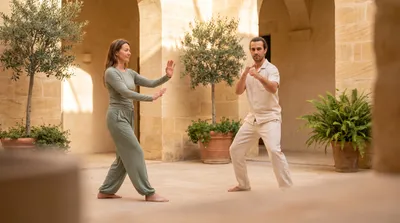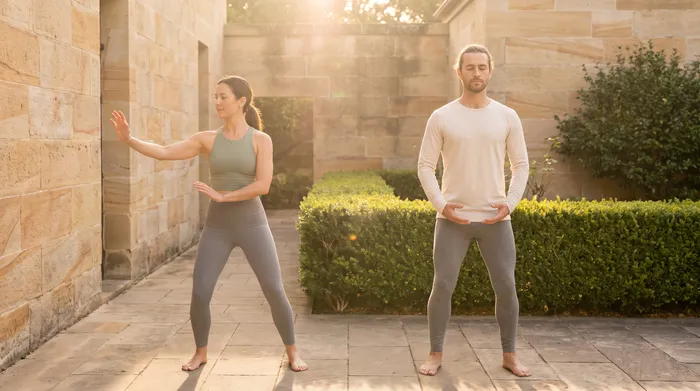
The question “what is the difference between tai chi and qigong?” comes up constantly — and it gets confusing quickly, because the honest answer is that tai chi IS a form of qigong, while also being something distinct from qigong in important ways.
Let me explain that apparent contradiction, because once it’s clear, both practices make a lot more sense.
The Relationship: Tai Chi Is a Form of Qigong
Qigong (氣功) means, roughly, “working with qi (vital energy)” — a broad category that encompasses hundreds of practices from simple standing exercises to complex movement sets. The key defining feature of qigong is deliberate cultivation of qi through controlled movement, breath, and mental attention.
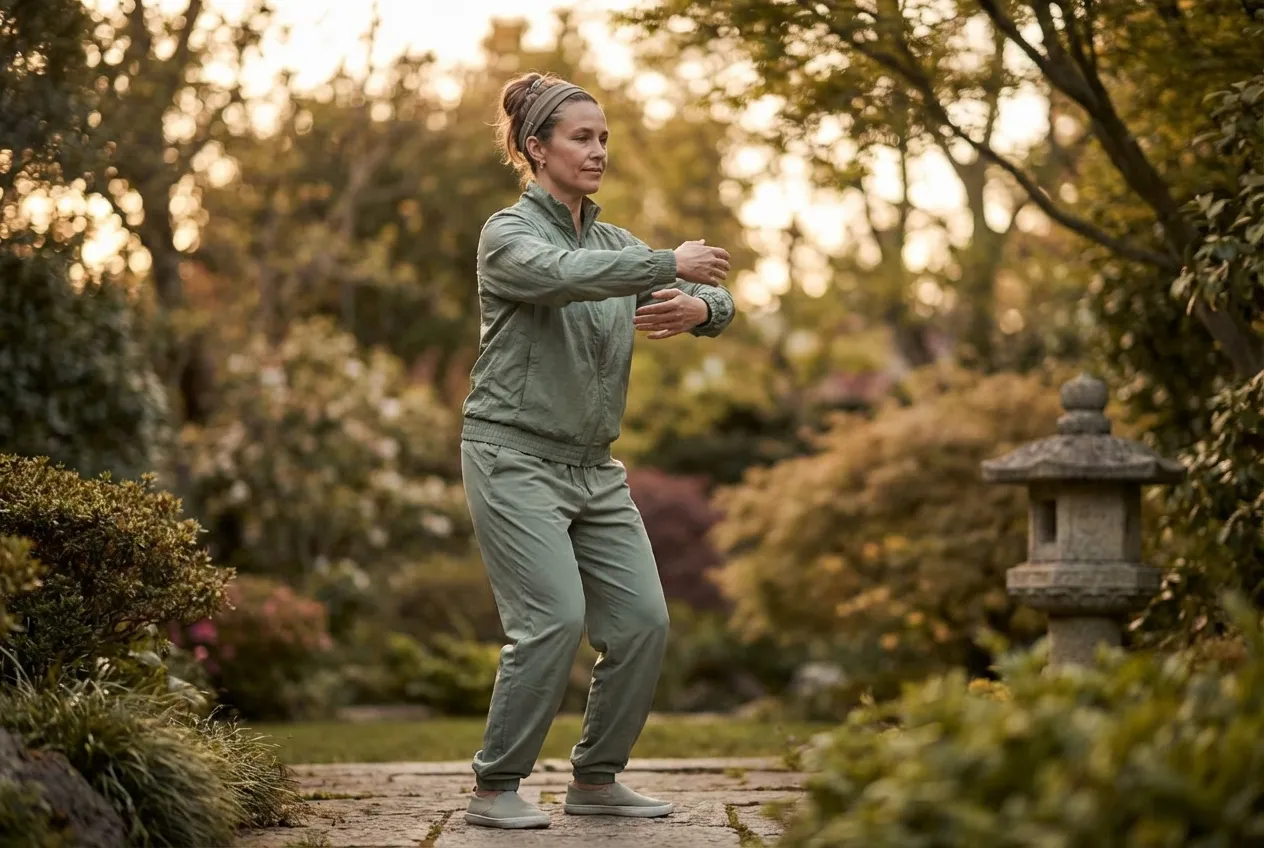
By that definition, tai chi qualifies as qigong. It involves deliberate movement, coordinated breathing, and mental attention directed at the internal experience. Tai chi practitioners do develop qi cultivation skills. The Chinese Health Qigong Association includes tai chi in its broader framework of health qigong practices, and many tai chi teachers describe their practice explicitly as qigong.
So why does the question “tai chi vs qigong” get asked at all? Because in practice — in how classes are taught, what the exercises look like, and what tradition they come from — tai chi and qigong are distinct in meaningful ways.
When I first started practising, I actually spent a period doing qigong exercises alongside tai chi forms, and the difference in character was immediately apparent. Both felt like valuable practice. They felt like the same kind of practice only in the broadest sense.
What Makes Tai Chi Distinct
Tai chi has specific historical origins as a martial art. The system developed in Chen Village (see our history of tai chi for context) was explicitly a fighting system — the movements have martial applications, the training methodology was developed with combat in mind, and the classical texts discuss martial strategy extensively.
Three features distinguish tai chi from most qigong practices:
Fixed sequential forms. Tai chi is practised as forms — sequences of movements with defined order and structure. Yang-style, Chen-style, Wu-style — each has its own forms, and learning tai chi means learning these sequences. The sequence is not arbitrary; each movement connects to the next in ways that develop specific qualities and provide specific training.
Martial application. Every tai chi movement has a martial interpretation, even in the health-focused Yang-24 form. The slow, flowing appearance is a training method for developing relaxed power and sensitivity — the same skills that make the movements effective for self-defence. This martial foundation shapes the structure and quality of movement in ways that pure health qigong practices do not share.
Partner practice (push hands). Tai chi’s core practice includes tui shou (push hands) — a partner exercise that develops sensitivity to another person’s structure and intent. Push hands is central to tai chi training in a way that has no direct equivalent in most qigong practices.
What Makes Qigong Distinct
Qigong covers a wide territory. A beginner might encounter any of these:
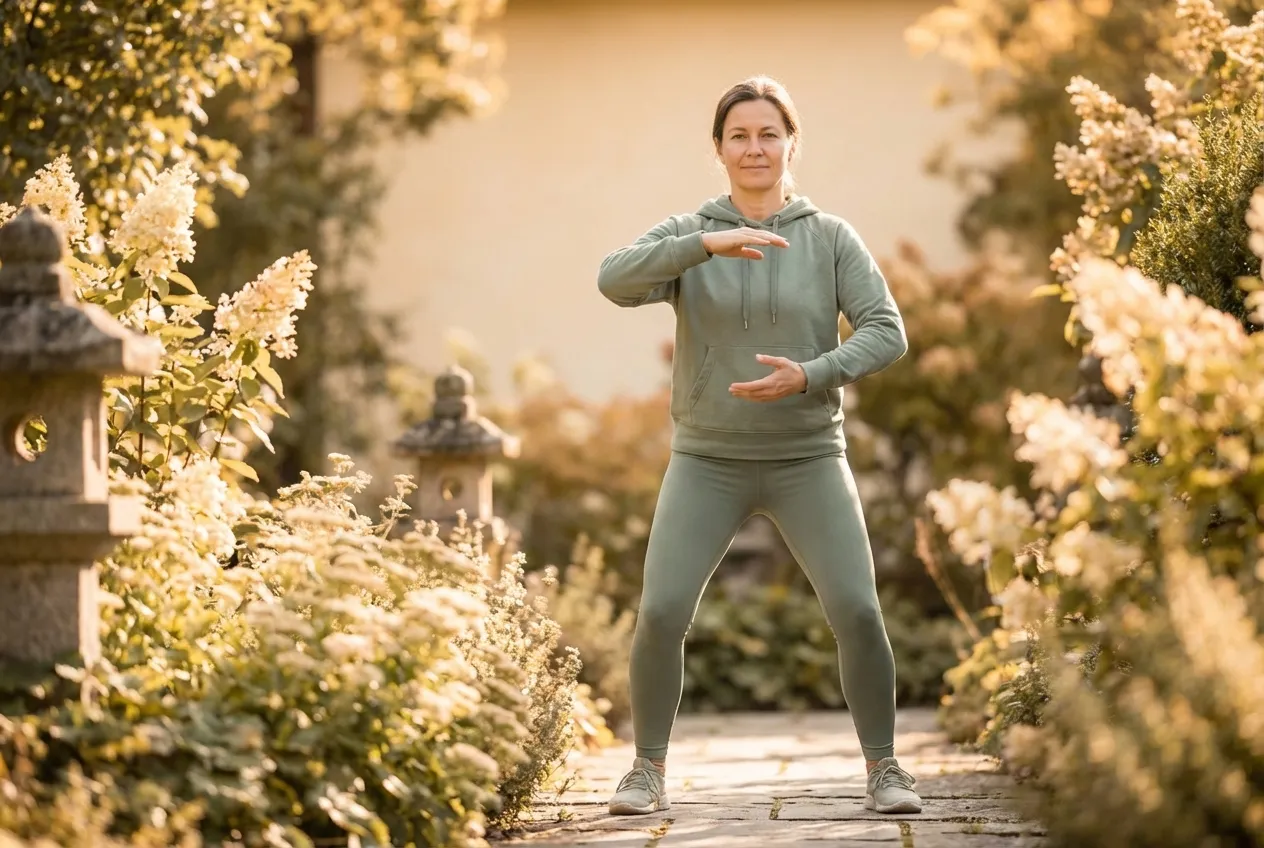
- Standing exercises (zhan zhuang) where you hold postures for extended periods to develop internal awareness
- Simple repetitive exercises like the Eight Brocades (Ba Duan Jin), each of which can be practised individually without the others
- Flowing movement sets like Shibashi (18 Movements)
- Breathing exercises with no movement
- Guided visualisation practices
What these share is intentional qi cultivation without the structured sequential forms of tai chi, without martial application, and without partner training. Qigong practices tend to be simpler in individual exercise structure — a single Ba Duan Jin exercise might take a few minutes to learn, while a tai chi form takes months or years.
This simplicity is a genuine advantage. Qigong is accessible to people who cannot learn a long sequence, people with limited mobility, and people who want specific targeted practices without committing to a comprehensive form.
Health Benefits: Where They Overlap
For health purposes, the evidence base for tai chi and for qigong overlaps considerably, because the mechanisms are similar: slow, controlled movement with attention to breath and body awareness, practised regularly.
Both are broadly linked to the same category of wellbeing effects: steadier balance, a calmer stress response, better sleep, and gentle cardiovascular conditioning. The specific trial evidence differs claim by claim rather than applying evenly across both practices — the National Qigong Association maintains a research library on qigong specifically, and the qigong and tai chi health benefits guides linked below cover the individual studies behind each claim.
Neither practice should be presented as “better” than the other for health. The honest answer is: the best practice for health is whichever one you will actually do consistently. A qigong routine you do every morning for five minutes is more valuable than a complete tai chi form you practise only occasionally.
For a deeper look at qigong’s health evidence, see our qigong health benefits guide.
Choosing Between Them
If you are trying to decide which to explore, some honest guidance:
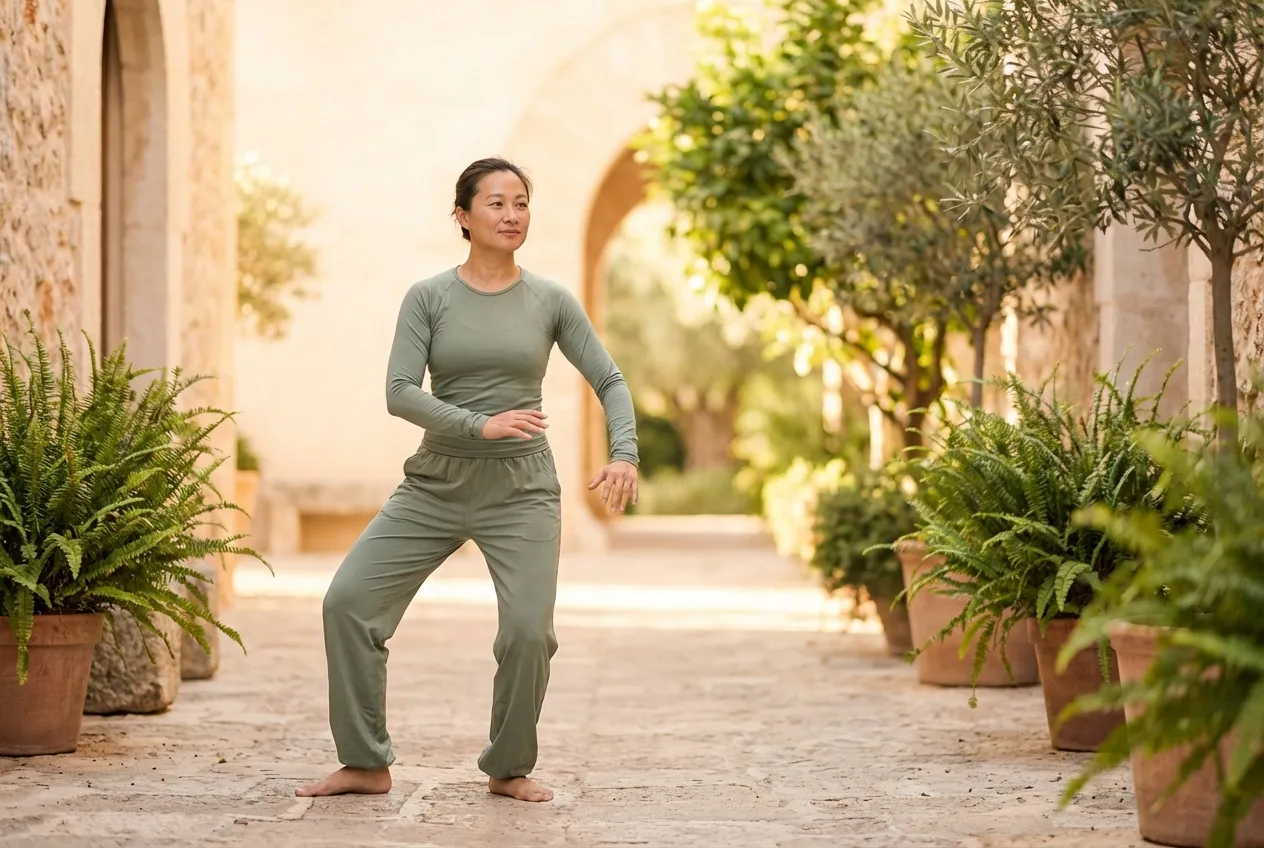
Choose tai chi if you are interested in a practice with a deep martial history and structural complexity, you enjoy the challenge of learning a long sequential form, you find the progression from beginner to intermediate to advanced motivating, or you are drawn to push hands and partner training.
Choose qigong if you want simpler individual exercises you can learn quickly, you have mobility limitations that make a flowing form challenging, you prefer targeted practices (specific exercises for specific benefits), or you want something you can begin with minimal instruction.
Consider doing both. This is not a cop-out. Many tai chi practitioners include qigong warm-up exercises or standing practice (zhan zhuang) alongside their form work. Many qigong practitioners add tai chi forms as their practice deepens. The two complement each other well — qigong’s simplicity and targeted nature works alongside tai chi’s comprehensive complexity.
For a broader look at how tai chi compares with another popular practice, our tai chi vs yoga comparison covers the key differences in approach and outcome.
If you are new to tai chi and want to understand what to expect when starting, our complete beginner’s guide to tai chi is a good foundation.
Browse all beginner-focused articles at our tai chi for beginners section.
Frequently Asked Questions
Is tai chi a type of qigong?
Yes, in the broad sense. Tai chi involves deliberate movement, coordinated breathing, and qi cultivation — the defining features of qigong. But tai chi is also more specific: it has a martial history, uses fixed sequential forms, and includes partner training (push hands). In practice, when people say “qigong,” they typically mean simpler, non-martial practices distinct from tai chi forms.
Which is better for beginners, tai chi or qigong?
Qigong is often easier for complete beginners because individual exercises are simpler and can be learned in a single session. Tai chi’s forms take longer to learn but offer a more comprehensive practice in the long run. If you are unsure, starting with basic qigong exercises (the Eight Brocades is a common recommendation) and adding a tai chi form later is a practical approach many practitioners take.
Can I practise tai chi and qigong together?
Yes, and many practitioners do. Qigong warm-up exercises before a tai chi form, or standing practice (zhan zhuang) alongside form practice, are common combinations. The two practices develop complementary qualities: qigong’s focused simplicity and tai chi’s sequential complexity work well together.
Do tai chi and qigong use the same breathing?
Both coordinate movement with breath and emphasise abdominal (diaphragmatic) breathing. The specifics vary by style and teacher. Generally, both practices develop awareness of breath as part of movement rather than imposing a rigid breathing pattern onto every moment. Some qigong practices have more explicit breath coordination instructions (breathe in on expansion, breathe out on contraction); tai chi typically develops natural, coordinated breathing as a byproduct of relaxed practice.
Is qigong easier than tai chi?
Individual qigong exercises are typically simpler to learn than a complete tai chi form, yes. But advanced qigong — particularly standing practices like zhan zhuang — develops its own depth and difficulty that is different from but comparable to advanced tai chi. Neither is “easy” when practised seriously. The comparison of difficulty is more useful when choosing a starting point than when comparing full practice depth.