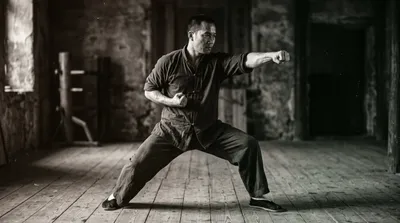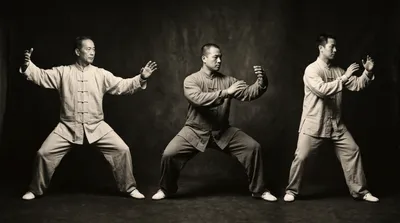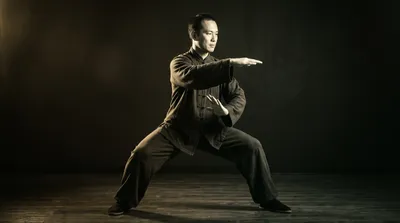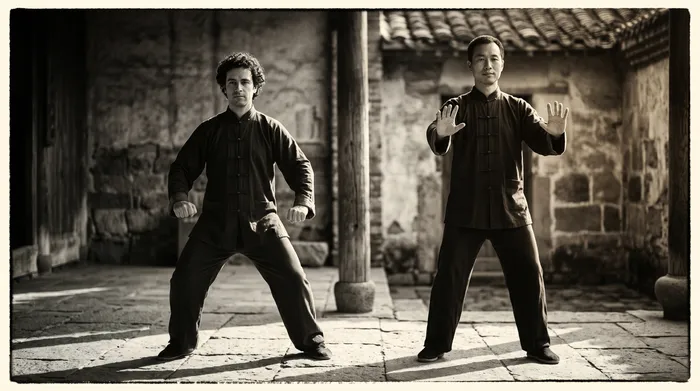
If you have watched a few tai chi videos you have probably noticed that some of them do not look like tai chi at all. Slow, flowing arm movements interrupted by a sudden stamp and a whip-crack of the arms — that is Chen style, and it surprises people who arrived expecting the serene park-practice version. The serene version is usually Yang.
Both are genuine tai chi. Yang descends directly from Chen, and the family resemblance is obvious once you know what to look for. But as practices to take up, they ask quite different things of you. This comparison works through the differences that actually affect your decision.
The Relationship Between Them
Chen is the older lineage, developed in Chenjiagou in Henan Province and attributed to Chen Wangting in the seventeenth century. Yang style begins with Yang Luchan (1799-1872), who learned at Chen Village under Chen Changxing and then took the art to Beijing, where he taught it — in modified form — to a very different audience.
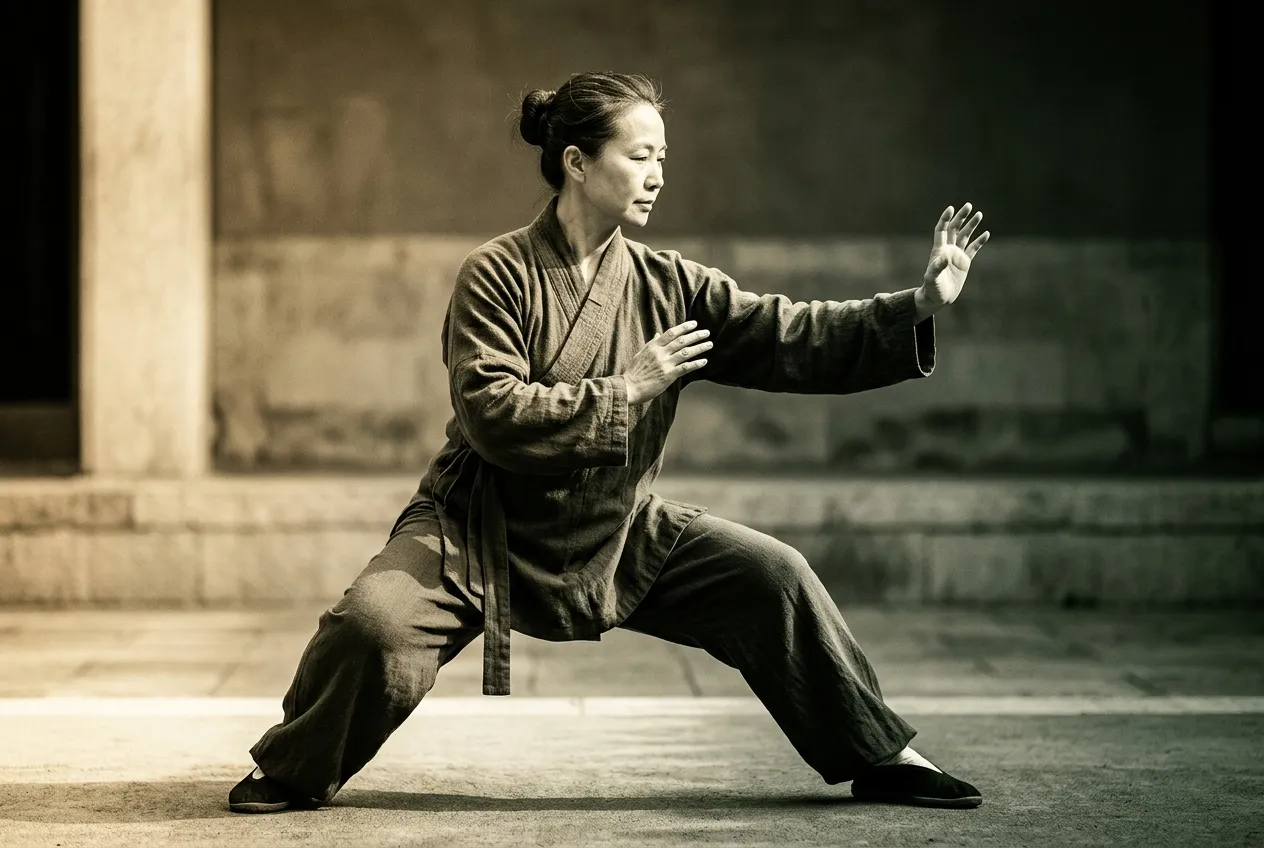
That modification is the whole story. Yang Luchan and his descendants, particularly his grandson Yang Chengfu (1883-1936), progressively smoothed the explosive elements, raised the stances, evened out the tempo, and produced something teachable to court officials and civilians rather than to village martial artists. What resulted became the most widely practised martial art tradition in the world.
So the differences between the styles are not arbitrary variations. They are the deliberate result of adapting a demanding martial system for a broader population — which is exactly why the choice between them still matters today.
Tempo and Rhythm
This is the difference you notice first.
Yang maintains an even tempo throughout. A movement takes as long as the movement before it, the pace does not change, and the whole form has a continuous, unbroken quality. Practitioners describe it as moving through water. The evenness is a training device: it removes the possibility of hurrying through the difficult transitions.
Chen alternates. Long slow passages are punctuated by sudden accelerations — a stamp, a fast strike, a sharp release known as fajin. The rhythm is deliberately uneven, and the contrast between the slow and fast sections is part of the training.
The practical consequence: Yang is easier to practise badly-but-safely, because the even tempo forgives a lot. Chen’s fast releases demand structure you may not yet have, and executing fajin with poor alignment is how people hurt their backs and knees.
Stance Height and Physical Demand
Chen uses lower stances, held longer, with more single-leg loading. A Chen form is physically hard work in a way that is obvious within five minutes. The low postures develop considerable leg strength, and they also load knees and hips substantially.
Yang uses higher stances that can be raised further without violating the style’s principles. A Yang form can be practised by someone in their eighties with a walking aid nearby, and it can also be practised in a demanding low frame by someone who wants that. The range of viable intensity is much wider.
For anyone weighing this up: Chen is comparable to a moderately demanding strength session for the legs. Yang can be that, or can be a gentle mobility practice, depending on how you set it up.
Silk-Reeling and Spiralling
Chen style is built around chan si jin — silk-reeling energy — a continuous spiralling of the limbs and torso that runs through every movement. The arms rotate as they extend, the waist coils and uncoils, and the whole body moves in connected spirals.
Yang retains this quality but expresses it far more subtly. The spiralling is present in the internal organisation of the movement rather than in visible rotation. Yang practitioners talk about it; Chen practitioners train it explicitly and visibly.
This has a real teaching consequence. Chen’s spiralling is easier to see and therefore easier to learn as a physical skill, but harder to perform well. Yang’s is more forgiving in the short term and takes longer to understand.
Difficulty and Learning Curve
Yang is the easier entry point by a considerable margin. The 24-form — twenty-four movements, five to eight minutes — can be learned to independent practice in three to six months. The movements are large, distinct, and repeated in ways that aid memory.
Chen typically starts with Laojia Yilu (Old Frame First Routine), a form of roughly seventy-five movements taking fifteen to twenty minutes. There are shorter Chen introductory forms — 18 and 19 movement sets are common — but the traditional entry is substantial. Expect a year or more to learn Yilu adequately, and considerably longer to perform it well.
My own route in was through Yang, and when I later watched Chen practitioners closely I found I could see what they were doing but had no realistic chance of reproducing it. The physical vocabulary is different enough that it is more like learning a related art than a variation.
Martial Content
Both are martial arts. Chen simply looks like one.
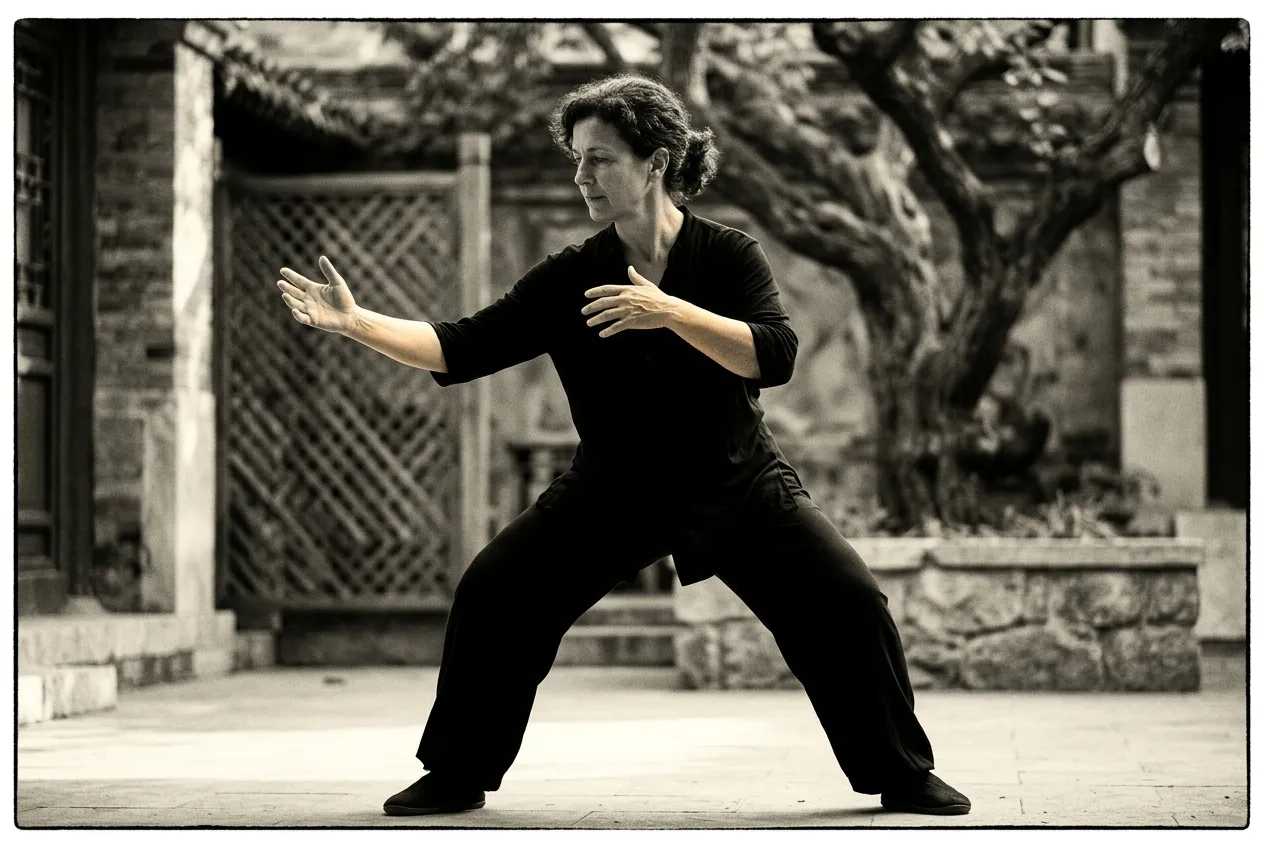
Chen retains visible strikes, stamps, elbow and shoulder strikes, low sweeps, and the explosive power releases that make its combat lineage obvious. Training routinely includes push hands, and often weapons and partner drills.
Yang contains the same applications, but expressed so smoothly that they are invisible to the untrained eye. Every Yang movement has a martial meaning — ward off, roll back, press, push are all techniques — but most modern Yang classes never mention it. This is a genuine difference in what is transmitted, not just in appearance: many Yang practitioners have never been shown the applications of movements they have performed thousands of times.
If martial content matters to you, Chen classes are more likely to deliver it. Yang classes vary enormously, from serious martial schools to health-only community groups.
Health Suitability
For most health purposes, Yang has the stronger case, and this is not close.
Almost all the clinical research on tai chi has used Yang-derived forms, usually the 24-form or a simplified variant. That is not because Yang is inherently more therapeutic — it is because Yang is standardised, teachable in twelve weeks, and safe across a wide range of physical capacity, which makes it usable in a trial. But it does mean the evidence for balance, falls, blood pressure, and arthritis is Yang evidence.
Chen’s low stances and explosive movements make it a poor fit for anyone with knee problems, arthritis, balance impairment, cardiovascular limitations, or general frailty. That is most of the population the health research targets.
For a healthy adult under sixty with no joint problems, Chen is perfectly appropriate and arguably a better workout. The styles comparison guide covers where Wu and Sun styles sit relative to both, and Sun in particular is worth knowing about for anyone with arthritis.
Which to Choose
A reasonably direct answer, since that is what most people want:
Choose Yang if you are over about fifty-five, have any joint or balance concerns, want the health benefits the research supports, prefer a gentler practice, want the widest choice of classes and teachers, or simply want to be practising rather than still learning in six months.
Choose Chen if you are physically fit, have a martial arts background or interest, want a practice that is visibly demanding, are drawn to the explosive quality, and have access to a competent teacher — which matters more for Chen than for Yang, because doing it wrong carries a higher cost.
Choose whichever is taught well near you if you are undecided. This is the underrated answer. A good Chen teacher beats a poor Yang teacher and vice versa, and the availability of quality instruction should probably outweigh the style comparison for most beginners.
One further consideration: starting with Yang and moving to Chen later is a well-trodden path, and the Yang foundation transfers reasonably well. Going the other way is less common. If you genuinely cannot decide, Yang first is the lower-risk order.
Points of Confusion Worth Clearing Up
“Chen is the real tai chi and Yang is watered down.” This is a common claim and it is unfair. Yang is a deliberate adaptation by highly skilled martial artists, not a dilution by people who could not manage the original. Yang Luchan’s reputation was built on fighting, not on gentleness.
“Yang is for old people.” Yang can be practised gently, which is different from being only for gentle practice. A traditional Yang long form performed in a low frame is demanding work.
“They are basically the same underneath.” They share principles — rooting, relaxation, waist-led movement, continuity — but the physical training is different enough that competence in one does not transfer straightforwardly to the other.
For deeper treatment of each style on its own terms, the Chen style overview covers Laojia, Xinjia, silk-reeling, and fajin in detail, and the Yang style overview covers the family lineage, the major forms, and what to look for in instruction. Both sit within the wider set of tai chi forms guides.