Sun style is the youngest of the five major tai chi styles and the one most people have never seen. It is also the style you are most likely to encounter without knowing it, because the Tai Chi for Arthritis programme taught in health services and community centres around the world is built on Sun-style principles.
If you have knees that object to deep stances, or you are looking for a style designed from the outset to be light on the joints, Sun is worth understanding. This guide covers where it came from, what makes it distinctive, and who it suits.
Sun Lutang and the Synthesis
Sun style is named for Sun Lutang (1860-1933), who occupies an unusual position in Chinese martial arts history: he was a genuine master of three separate internal arts and one of the first to write about them systematically for a public readership.
His training order matters for understanding the style. He learned xingyiquan first, from Li Kuiyuan and then from the renowned Guo Yunshen. He took up baguazhang under Cheng Tinghua in the 1890s. And he came to tai chi last, studying Wu (Hao) style with Hao Weizhen from around 1911 — reportedly after Sun took the ailing Hao into his home and cared for him, with the teaching offered in return.
By then Sun was already in his fifties and a recognised master of two other internal systems. What he produced was not a modification of the tai chi he had learned but a synthesis: tai chi’s structure and principles, xingyi’s stepping and body method, and bagua’s turning and circular footwork, integrated into a single practice.
That origin explains most of what is distinctive about the style. Sun style feels different from other tai chi because roughly two-thirds of its influences are not tai chi.
What Makes Sun Style Distinctive
Three features define it.
The Agile Step
In Yang, Chen, Wu, and Wu (Hao) styles, the feet are largely planted — weight transfers between them but the stance itself changes relatively rarely, and stepping is deliberate and infrequent.
Sun style uses what is variously translated as “agile step”, “lively step”, or “following step”: when one foot advances, the other follows immediately, so the stance stays compact and the practitioner is almost continuously moving. This comes directly from xingyi.
The practical effect is significant. Because the feet keep adjusting, the stance never gets long or wide, weight is never held in a deep single-leg load for extended periods, and the knees are subjected to far less torsion than in styles that pivot on a planted foot.
Open-Close Hands
The movement most immediately identifiable as Sun style is kai he shou — opening and closing hands. The palms face each other in front of the chest and draw apart, then come together, repeatedly, appearing throughout the form as a kind of punctuation between other movements.
It functions as a breathing and gathering movement, and as a transition that resets the posture. Newcomers often find it the oddest-looking part of the form; practitioners tend to describe it as the part that makes the rest cohere.
High Stances and No Vigorous Elements
Sun style omits the crouching, leaping and explosive fa jin found in Chen style, and uses stances noticeably higher than Yang’s. The circles described by the hands are smaller and more contained.
This was not a health-driven concession. Sun Lutang was a formidable martial artist, and the compact, mobile frame is a fighting choice rooted in xingyi’s preference for direct, efficient movement over large postures. That it also happens to suit older and less robust practitioners is a fortunate coincidence that the twentieth century made a great deal of.
The Forms
The traditional Sun tai chi form is usually counted at around ninety-seven movements, though counts vary between lineages and teachers depending on how repetitions are enumerated. It takes fifteen to twenty minutes to perform.
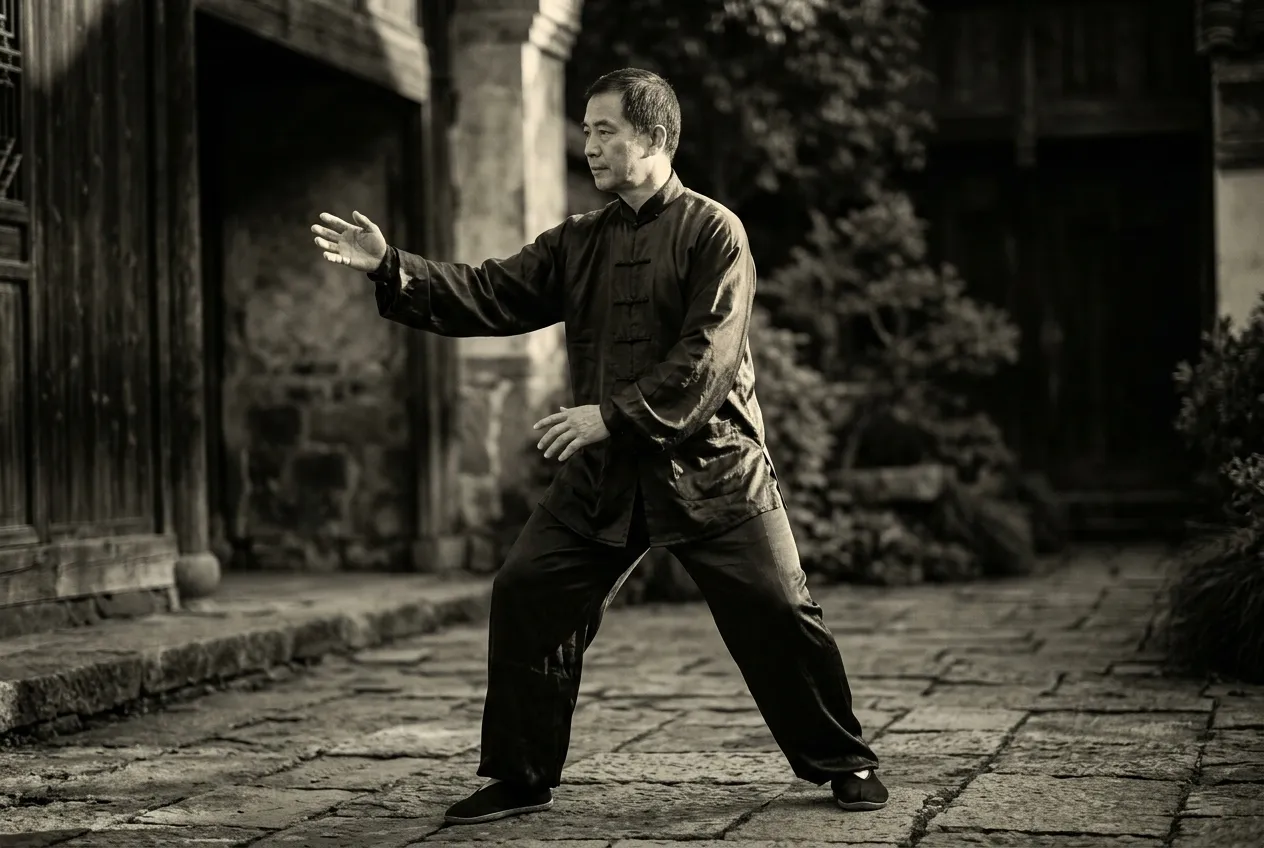
A standardised Sun 73-form was developed for competition purposes as part of China’s modern wushu framework, and is what most formal Sun-style competition uses.
Shorter health-oriented sets are far more common in practice. The best known is Tai Chi for Arthritis, developed by Dr Paul Lam and taught widely through health services and arthritis organisations. It uses a small number of Sun-style movements, is designed to be taught in a twelve-week course, and has been used in clinical research. Anyone who has attended a health-service tai chi class in Britain, Australia, or the United States has a reasonable chance of having learned Sun-derived movement without the style ever being named.
Sun style also has weapons forms, including sword and sabre, though these are much less commonly taught outside dedicated Sun-style schools.
Why It Suits Arthritis and Older Practitioners
The features that make Sun style distinctive line up unusually well with joint protection.
Less knee torsion. The following step means fewer pivots on a weighted foot, which is the movement pattern most likely to aggravate a knee.
Shorter single-leg loading. Weight moves between the feet more frequently and rests less time in deep single-leg support.
Higher stances by design. No need to modify the style to raise it — it is already high.
Continuous stepping trains balance dynamically. Dynamic balance while stepping is closer to the demands of everyday walking than static balance in a held stance, and it is the capacity most relevant to falls.
Smaller circles are easier on shoulders. The contained hand movements suit anyone with shoulder restriction.
Clinical research supports the practical instinct. A randomised clinical trial published in the Journal of Rheumatology had older women with osteoarthritis practise 12 forms of Sun-style tai chi for 12 weeks and found significant improvements in pain, stiffness, balance, and physical functioning compared with a control group. The tai chi for arthritis guide covers that evidence alongside the wider arthritis research.
I have practised Yang for most of my time in tai chi, and the first time I worked through Sun-style movements the thing that stood out was how much less my legs complained. The trade-off is that it never produces the deep, grounded stability that a low Yang stance builds — which is exactly the trade Sun Lutang’s structure makes.
Finding Sun Style Instruction
Sun is the least commonly taught of the major styles, and dedicated Sun schools are thin on the ground outside China. Two practical routes:
Tai Chi for Arthritis and similar health programmes. Widely available through community health services, arthritis charities, and leisure centres. These teach Sun-derived movement in an accessible format, which is the right entry point for most people considering the style for health reasons.
Dedicated Sun-style schools. Rarer, and worth travelling for if you want the full traditional form and its weapons. Instructors trained through Sun Jianyun (1914-2003), Sun Lutang’s daughter, who taught into her later years, form one of the main transmission lines.
If you cannot find either, a good Yang class practised with high stances gives you most of the practical joint-protection benefit. Style purity matters far less than instruction quality for anyone practising primarily for health.
Learning Sun Style: What to Expect
A few practical observations for anyone starting.
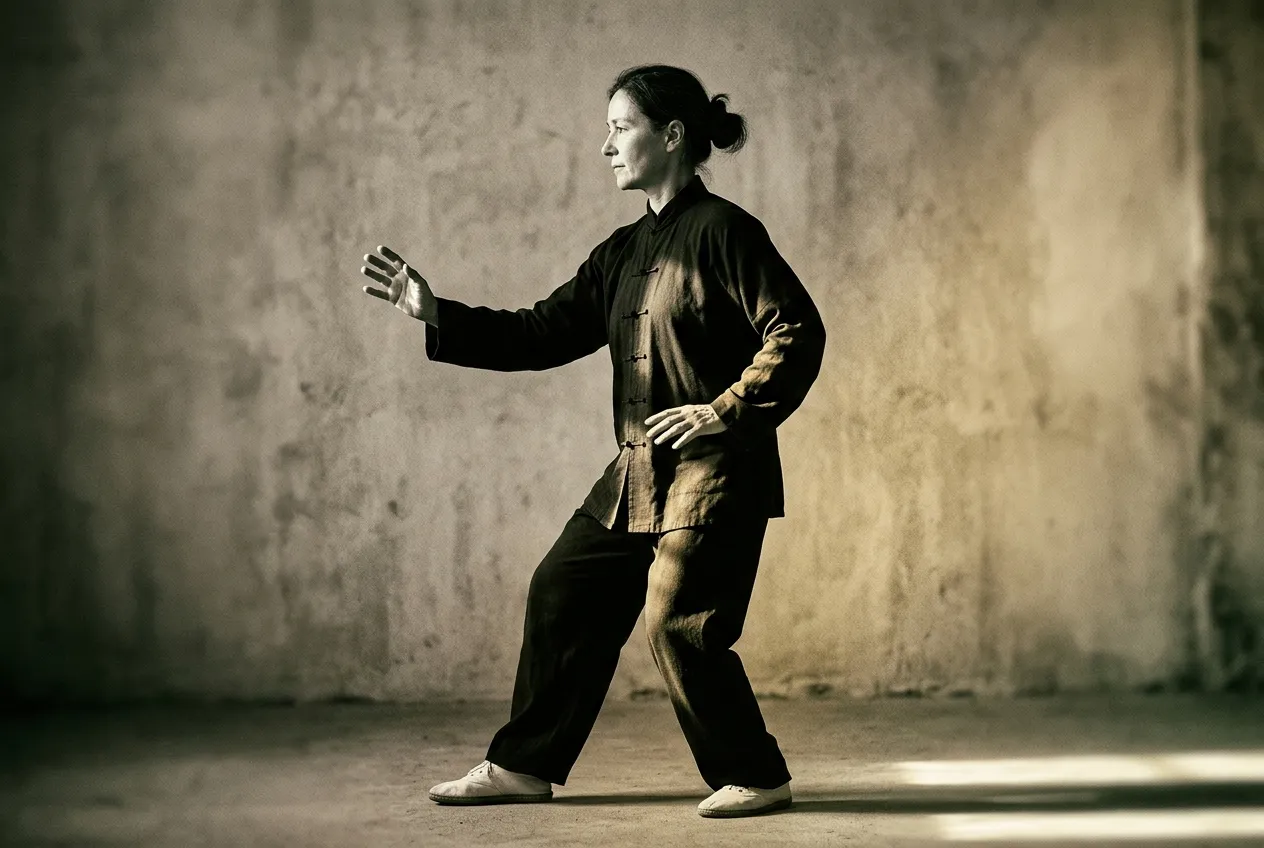
The stepping takes adjustment if you come from Yang. In Yang style you learn to settle into a stance and move from a stable base. Sun asks you to keep moving, and the instinct to plant and settle has to be unlearned. It took me several sessions before the following step stopped feeling like an interruption to the movement rather than part of it.
Open-close hands is a placeholder for something. Beginners tend to perform it as an arm movement. It is meant to coordinate with the breath and with a subtle opening and closing through the whole body — chest, back, hips. Treating it as decoration means missing most of what the style transmits.
The form is longer than it looks. Ninety-seven movements sounds daunting, but Sun forms contain a great deal of repetition and the open-close transitions break the sequence into digestible sections. It is not harder to memorise than a Yang long form.
Progress feels slower. Because the stances are high and the movements small, the sense of physical achievement that comes from holding a deep Yang posture is absent. Some people find the style unsatisfying for exactly this reason, and that is a legitimate preference rather than a misunderstanding.
Health-programme versions are genuinely abbreviated. A twelve-week arthritis course teaches a handful of movements. That is appropriate and effective for its purpose, but nobody should finish one believing they have learned Sun-style tai chi. It is a doorway, and a good one.
Where Sun Sits Among the Styles
Positioned against the others: Chen is the oldest and most physically demanding, Yang the most widely practised and most researched, Wu the most compact and known for push hands sensitivity, Wu (Hao) the smallest-framed and most theoretically oriented, and Sun the most mobile and the gentlest on the joints.
For a healthy beginner with no particular constraints, Yang remains the sensible default simply because instruction is easier to find. For someone with arthritis, knee problems, or balance concerns, Sun is arguably the better-matched style — and the practical route to it usually runs through a health-service class rather than a traditional school.
The full styles comparison sets all five side by side, the Yang style overview covers the style Sun is most often compared against, and the rest of the style guides are collected in the tai chi forms section.