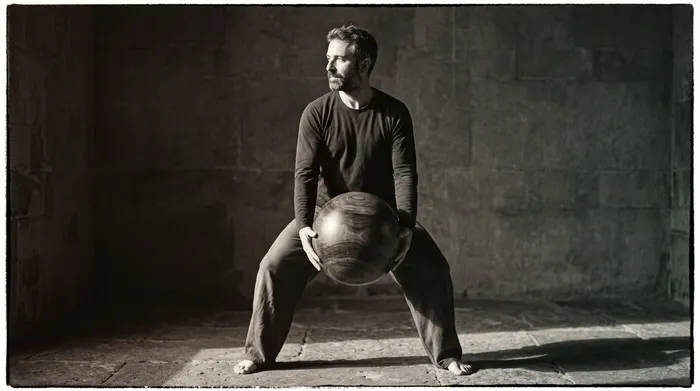
Of all the traditional tai chi training implements, the ball is the one that most reliably makes newcomers ask what on earth it is for. A wooden or stone sphere, somewhere between a football and a medicine ball in size, held in both hands and slowly rotated, circled, and wrapped around the body — it looks like tai chi performed while carrying the world’s least convenient object.
That, roughly, is the point. The taiji ball (taiji qiu) is a resistance and coordination tool: it takes the circular, whole-body movement the empty-hand form tries to teach and makes it impossible to fake, because a weight held in both hands broadcasts every disconnection instantly. This guide covers what the practice is, what it trains, and how to start without buying anything exotic.
First, the Necessary Disambiguation
Three different things get called “tai chi balls”, and search results mix them freely.
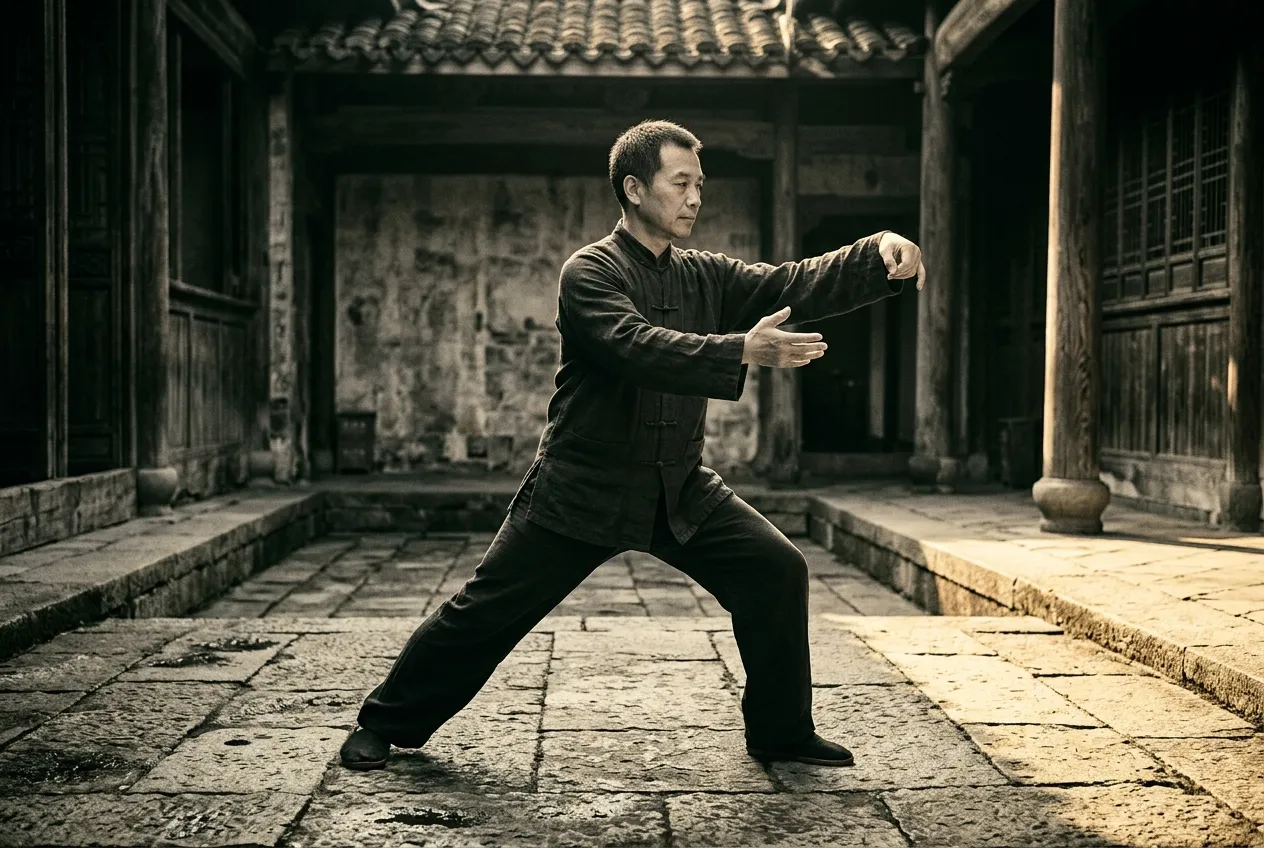
The taiji ball — this article’s subject — is a single, two-handed training sphere, traditionally wood or stone, in modern practice often a weighted or even inflatable ball. Sizes vary from grapefruit to beach-ball; weights from a kilogram or two to genuinely heavy stone spheres in old-school Chen training.
Baoding balls are the small paired metal spheres, often chiming, rotated in one hand — a dexterity and mobility practice for the fingers and forearm with its own long history. Pleasant, useful for hand mobility, and unrelated to the training below.
“Tai chi ball” gym classes — some modern fitness programmes use a soft weighted ball with tai chi-flavoured choreography. Closer to the real thing than baoding balls, but usually stripped of the structural detail that makes the traditional work valuable.
What Ball Training Actually Does
The ball earns its place by enforcing four things the empty-hand form merely requests.
Connection. With a weight held in both hands, moving the arms without the waist is immediately, visibly laborious. The only comfortable way to carry the ball through circles is to drive the movement from the legs and waist and let the arms transmit — which is precisely the whole-body connection tai chi spends years teaching. The ball is a lie detector for it. This is the same logic by which weapons training magnifies faults along a blade; the ball does it symmetrically, in both hands at once.
Continuous spiral movement. Ball exercises are built from circles — horizontal, vertical, figure-eight — that keep the wrists, forearms and shoulders rotating through ranges ordinary training barely visits. Chen practitioners will recognise the silk-reeling content immediately, and it is no accident that the ball survives most prominently in Chen-influenced schools; the Chen style overview covers the spiral principle the ball exists to train.
Structural endurance. Holding even a modest weight away from the body for minutes at a time builds exactly the shoulder, back and grip endurance that long forms and standing practice demand — as anyone who has held a posture with tiring arms knows. It is conditioning, but conditioning shaped like the art rather than borrowed from the gym.
Dantian awareness. The traditional instruction is that the ball is moved by the dantian — the lower abdomen — with everything else following. Held in front of the body, rising and falling and circling with the breath, the ball gives that abstraction something to be true about. It is the most concrete lesson in waist-led movement I have encountered, and I say that as someone who spent years nodding along to “move from the dantian” while quietly moving from the shoulders.
Starting Without Special Equipment
You do not need a hand-carved rosewood sphere. A basketball works. A slightly heavier medicine ball of two to four kilograms works better once the patterns are familiar. Choose a size you can hold with both palms comfortably facing each other, and a weight you could carry in front of you for two minutes without strain — lighter than intuition suggests, because the exercises hold the weight away from the body and time multiplies everything.
1. Holding. Stand in the basic posture — feet shoulder-width, knees soft — and hold the ball at the lower abdomen as though it rested on a shelf of air. Two minutes, breathing slowly, shoulders down. This is standing practice with a teaching aid, and it is harder than it reads.
2. Rising and falling. Let the ball rise to chest height on the inhale and sink on the exhale, driven by the legs slightly straightening and bending rather than by lifting with the arms. Ten slow repetitions. If the shoulders burn quickly, the arms are doing the legs’ job.
3. Horizontal circles. Carry the ball in a flat circle in front of the body — out to the left, forward, right, and back — letting the waist turn to carry it, weight shifting between the feet with the circle. Eight one way, eight the other. Keep the circle small before making it large.
4. Vertical circles. The ball traces a wheel in front of the torso, rolling up one side and down the other, the whole body lengthening and settling with it. Eight each direction.
5. Figure-eights. Once circles are smooth, join them into a horizontal figure-eight, the ball sweeping from hip to hip. This is where the practice starts producing the continuous spiralling quality it exists for, and where the wrists begin rotating the ball itself as it travels.
Ten to fifteen minutes covers the set. The universal fault list is short: shrugged shoulders, locked knees, arms working alone, and breath held during the transitions — the same four faults as everywhere else in tai chi, which is rather the point of the tool.
Traditional and Modern Variations
For anyone who takes to the basic set, the practice has depth beyond it.
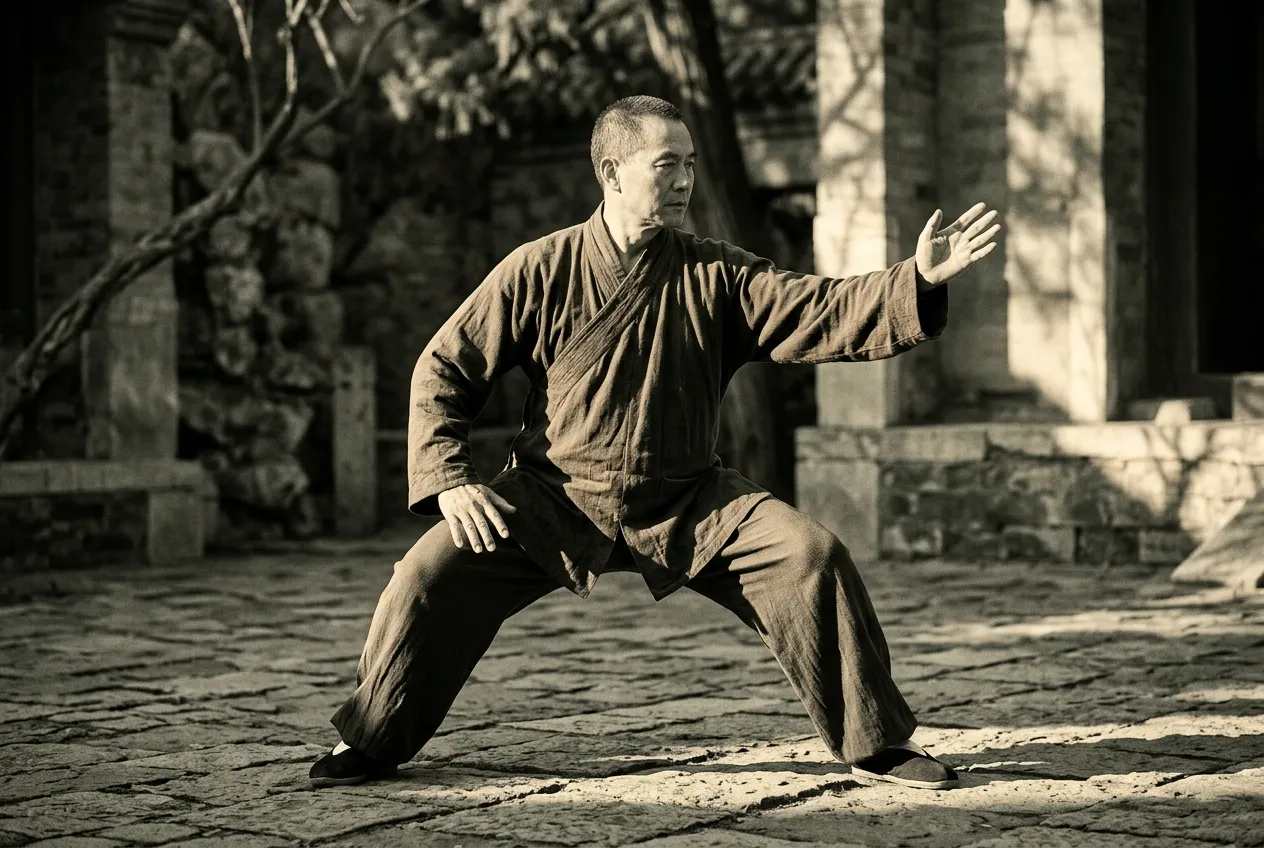
Progressive weight is the traditional axis. Old Chen and Shaolin-adjacent accounts describe stone balls of genuinely punishing weight, trained in low stances as strength work. The modern equivalent — moving from two kilograms toward eight or ten over a year or two — builds remarkable trunk and shoulder capacity, with the standing caveat that weight added faster than structure develops just teaches muscling.
Wall and table rolling appears in several lineages: the ball rolled continuously against a wall with one or both hands, or circled on a tabletop, adding friction and an external contact point to sense through. It is quietly excellent preparation for push hands, training the same listening-through-contact skill against an object that never gets impatient.
Partner ball work — the ball passed, rolled, or maintained between two people’s hands through circling patterns — exists in some schools as a bridge between solo work and push hands proper.
The Yang Jwing-Ming curriculum deserves a mention as the most systematised modern presentation: his published taiji ball qigong material organises the patterns into a full progression, and is the most accessible route for anyone wanting structure beyond what an article can carry.
None of this is required. The five basic exercises, done slowly with attention, contain the core of what the tool teaches.
Where It Fits
Ball training is a supplement, not a system. Traditionally it slots in the same place as pole shaking and other conditioning work: alongside the form, feeding qualities back into it. Two or three short sessions a week is plenty, and the sensible sequencing for a newer practitioner is form first, fundamentals established, ball added once there is a structure for it to strengthen — roughly the same readiness point as weapons.
It also makes an unusually good travel practice. A hotel room, a basketball from any shop, and fifteen minutes reproduce most of the training effect of far more elaborate setups, which is more than can be said for sword work.
The ball will never be the famous part of tai chi. But of all the supplementary practices, it delivers the most correction per minute for the least learning overhead — a piece of equipment whose entire function is to make the art’s central principle impossible to avoid. More on the forms and their supporting practices is collected in the tai chi forms section.