Most people meet tai chi as an empty-hand practice and are surprised to learn that every traditional style has weapons forms — and that in a traditional curriculum, weapons are not an optional extra but the stage the empty-hand form prepares you for.
The reason is straightforward once stated. Tai chi is a martial art, and martial arts in China developed in a context where weapons decided outcomes. The empty-hand form teaches structure, rooting, and coordination; the weapon extends that structure beyond the body and exposes every fault in it.
This guide covers the main tai chi weapons, what each one trains, and how to approach starting.
The Straight Sword (Jian)
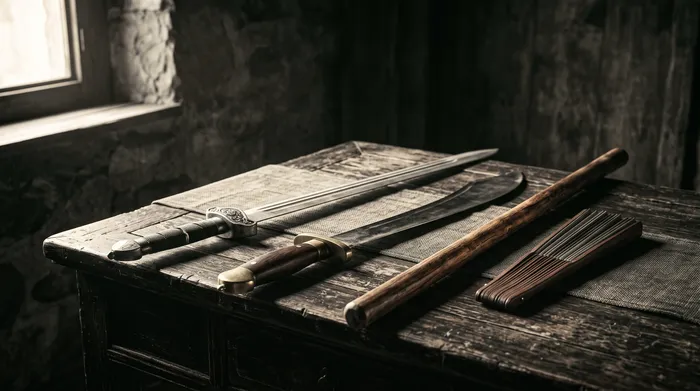
The jian is the weapon most associated with tai chi and the one most commonly taught. It is a double-edged straight sword, light, flexible, and historically the weapon of scholars and officers rather than of infantry — sometimes described as the gentleman of weapons.
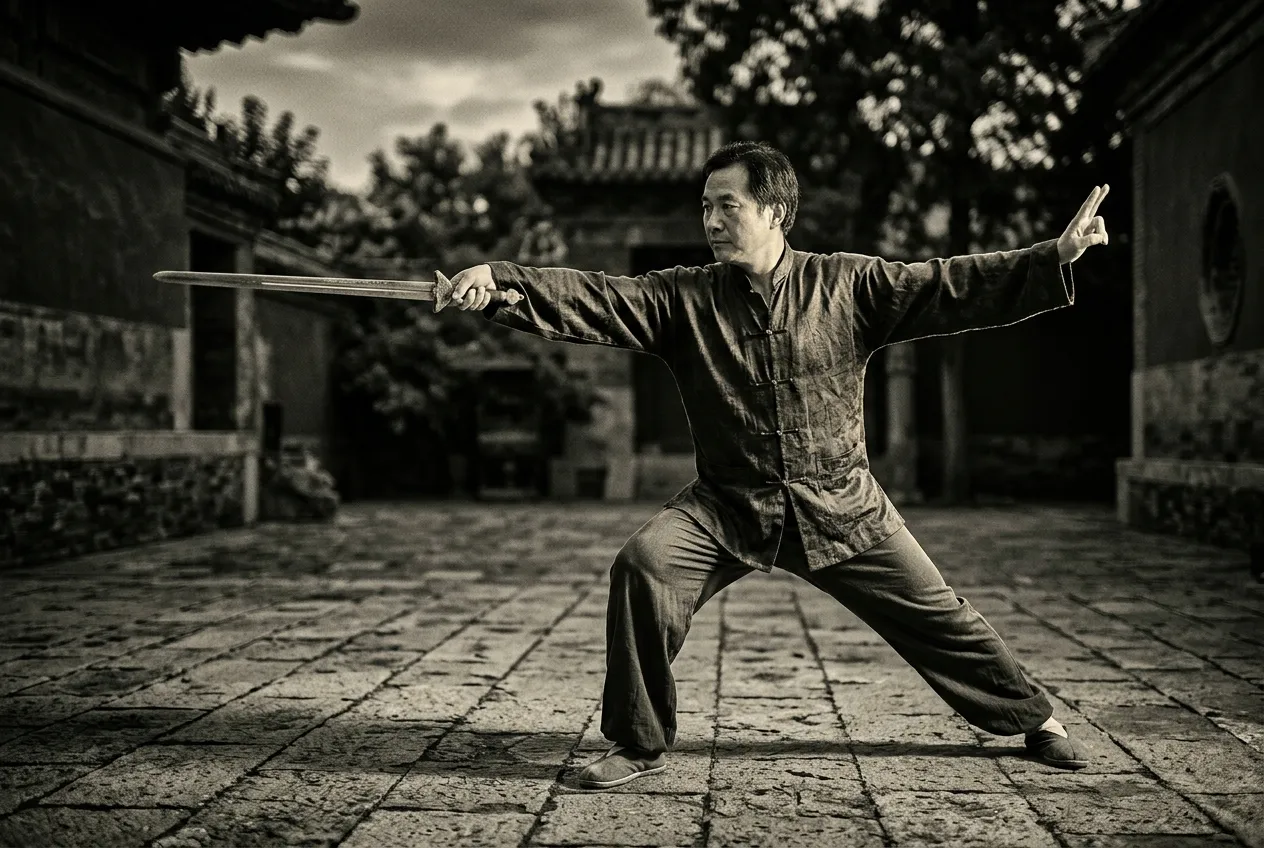
Its defining quality is precision. Jian technique uses the point far more than the edge, and the movements are small, exact, and directed. Because the blade is light, there is no momentum to hide behind: everything the sword does must come from correctly organised body movement, and any disconnection between hand and waist shows immediately.
Most tai chi sword forms run to thirty-two, forty-two, or fifty-four movements depending on style and standardisation, and take five to ten minutes. The tai chi sword form guide covers the sequences, the grip, and the sword-finger hand position in detail.
If you learn one weapon, this is usually the one.
The Sabre or Broadsword (Dao)
The dao is single-edged, curved, and heavier than the jian — a battlefield weapon rather than a duelling one, and historically far more common in Chinese armies.
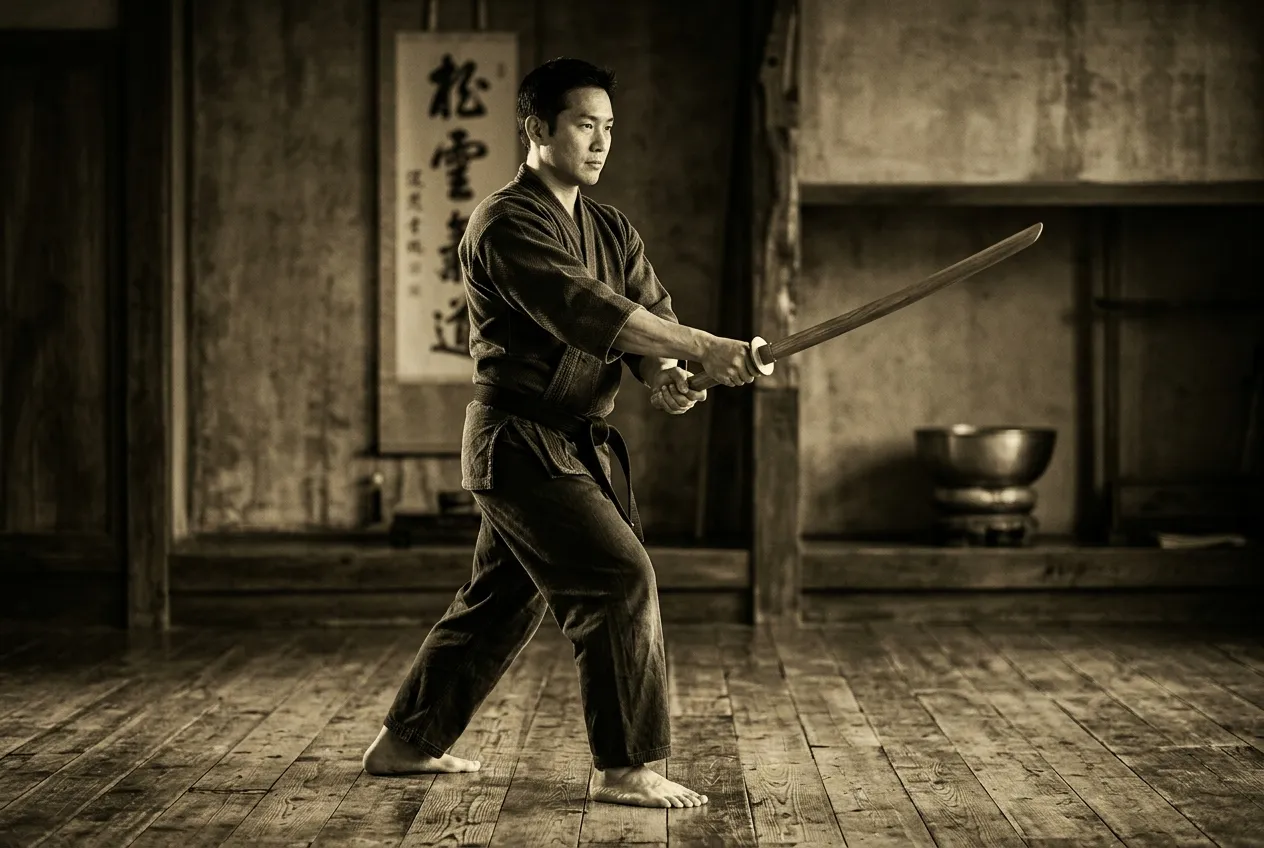
Tai chi sabre forms have a noticeably different character from sword forms. Where the jian is precise, the dao is powerful. Techniques involve chopping, sweeping, and wrapping the blade around the body, and the weapon’s weight means momentum genuinely matters. Sabre forms are typically shorter and more vigorous than sword forms, and they build considerably more forearm and grip strength.
The wrapping movements — passing the blade around the head and body — are the distinctive element, and they demand a spatial awareness that empty-hand practice does not develop.
Many practitioners find the dao easier to learn than the jian and harder to perform elegantly. The weight gives useful feedback about whether your body is actually connected, which is helpful, but it also lets you muscle through movements that the jian would have exposed.
The Staff and Spear (Gun and Qiang)
Long weapons occupy a different place in the curriculum, and are more prominent in Chen style than in Yang.
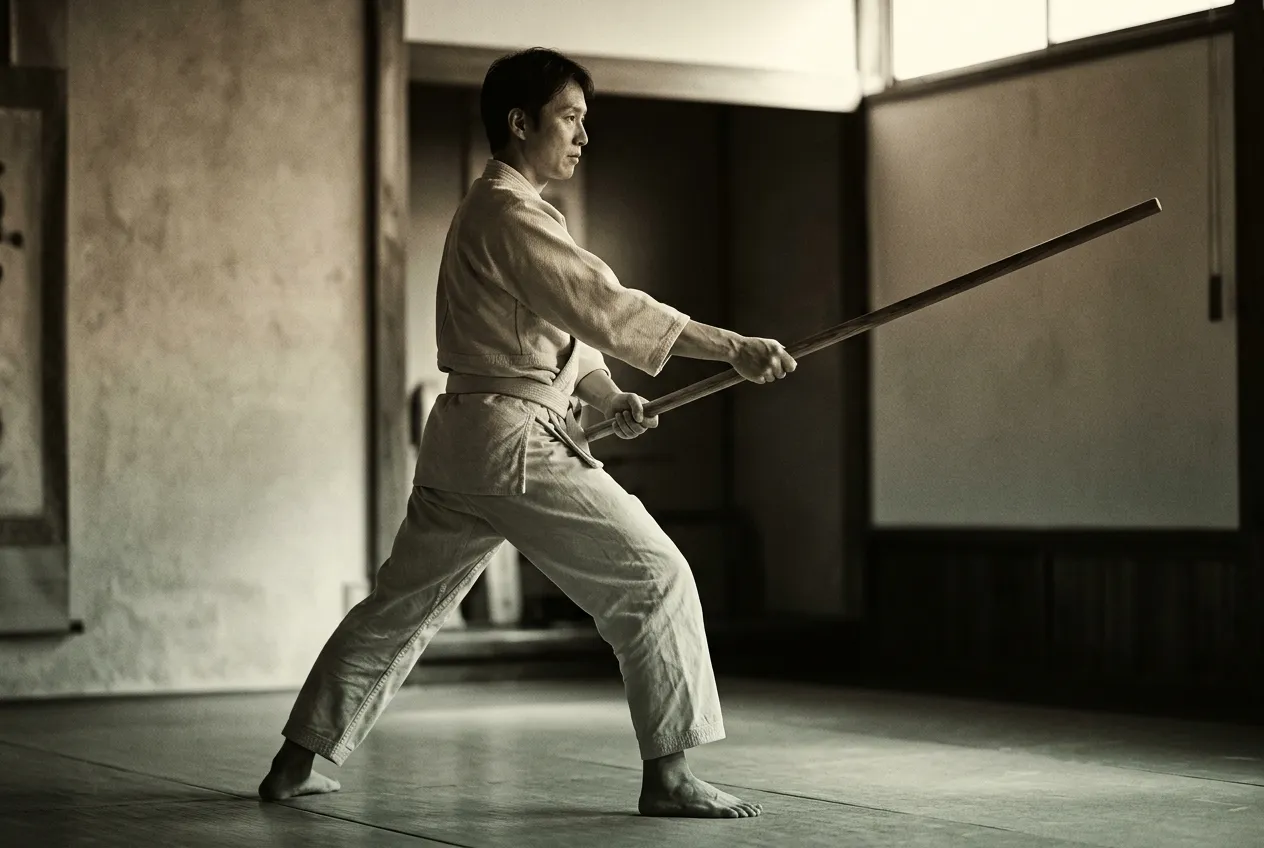
The staff (gun) is a plain wooden pole, usually shoulder to head height. Staff work develops whole-body power transmission — you cannot move a long staff well using the arms alone, so the practice enforces the connection from feet through waist to hands that tai chi is always trying to teach.
The spear (qiang) adds a point and a more complex set of techniques, including the coiling and shaking movements that are among the hardest skills in Chinese martial arts.
Chen style also trains with the dagan — a long pole, often three metres or more, used for a small number of movements repeated for conditioning. It is closer to strength training than to form practice, and it is brutally effective at revealing whether your structure is real.
Long weapons are less commonly taught outside traditional schools, largely because they need space and because their appeal is more obviously martial than health-oriented.
The Fan (Shan)
The tai chi fan is the newest of the common weapons and the one most likely to draw a raised eyebrow — until you have seen one used well.
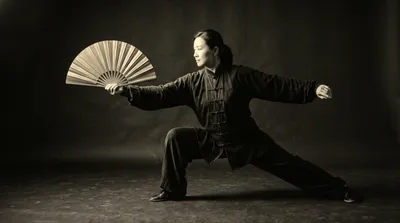
Fan forms are typically shorter, more visually dramatic, and more rhythmically varied than sword forms, with the snap of the fan opening providing punctuation. They are popular in group performance and in demonstrations, and they are widely taught in China as a health practice, particularly among older women.
The martial pedigree is genuine — a folding fan with a reinforced frame is a concealed weapon with a long history — but modern fan practice is mostly about coordination, wrist mobility, and enjoyment. The tai chi fan form guide covers the sequences and technique.
For anyone who finds the sword intimidating or the sabre too heavy, the fan is an accessible entry into weapons practice.
Double Weapons and Others
Beyond the main four, traditional curricula include a range of less common implements.
Double weapons — paired swords, paired sabres, paired fans — add the coordination challenge of two independent implements. They are advanced practice and are usually learned after competence in the single-weapon version.
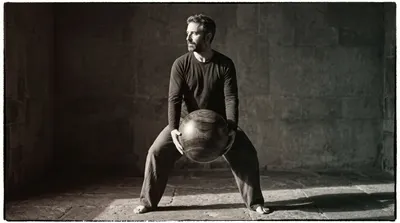
The tai chi ruler and tai chi ball are training implements rather than weapons. The ruler is a short wooden dowel held between the palms; the ball is a weighted sphere rolled and circled around the body. Both are used to train specific qualities — connection, spiralling, whole-body coordination — rather than to be performed as forms.
Halberds, hooks, and whips appear in some traditional lineages and are rare enough that most practitioners will never encounter them.
What Weapons Practice Actually Trains
The common assumption is that weapons forms are decorative, learned for performance or novelty. In a traditional curriculum they serve specific purposes.
They extend the body’s structure. A weapon acts as a lever. Whatever misalignment exists in your shoulder or waist gets magnified along its length, which makes weapons practice a diagnostic tool as much as a skill.
They demand precise spatial awareness. Empty-hand forms are forgiving about exactly where your hand ends up. A three-foot blade passing near your own head is not.
They build specific physical capacities. Grip and forearm strength from the sabre, whole-body power transmission from the staff, wrist mobility from the fan, fine control from the sword.
They reveal disconnection. This is the point most often made by teachers. If your movement is driven by your arms rather than your waist, a weapon makes it obvious in a way that empty-hand practice can conceal for years.
The first time I handled a sword after several years of empty-hand practice, my immediate impression was that all the smoothness I thought I had developed disappeared the moment there was something in my hand. That experience is apparently near-universal, and it is the reason weapons are taught after the empty-hand form rather than alongside it.
Weapons Across the Styles
Which weapons you encounter depends heavily on which style you practise.
Chen style has the most extensive weapons curriculum of the major styles — straight sword, sabre, spear, staff, halberd, and the long-pole conditioning work. Weapons are treated as a core part of the system rather than as an addition, and Chen schools generally expect students to take them up.
Yang style centres on the straight sword, with the sabre next most common and the spear taught in some lineages. The Yang sword form is one of the best-known weapons sequences in tai chi and is what most Yang practitioners eventually learn.
Wu style teaches sword and sabre, with a particular reputation for its sabre work, and the compact frame of the style carries over into how the weapons are handled.
Sun style includes sword and sabre forms, though they are much less commonly taught outside dedicated Sun schools, which are themselves uncommon.
Modern standardised wushu has its own competition weapons routines — the 32-form and 42-form sword sets in particular — which are widely taught and are what many people learn regardless of the family style their empty-hand practice comes from.
The practical implication is that your access to weapons practice depends more on your teacher than on your style. Plenty of Yang classes never touch a weapon; some community classes teach fan forms and nothing else. If weapons interest you, it is worth asking about them before committing to a school rather than assuming they will appear in due course.
When to Start Weapons
The traditional sequencing is empty-hand form first, to a reasonable standard, then weapons. There is good reason for it: weapons magnify whatever is already there, and magnifying poor structure produces bad habits that are harder to correct later.
A practical benchmark: you should be able to perform your main empty-hand form from memory, at a consistent tempo, without thinking about the sequence. If you are still recalling what comes next, adding a weapon divides attention that is already fully committed.
In time terms, that usually means one to two years of regular practice for someone learning a short form, longer for a traditional long form. Some schools start weapons earlier, particularly with the fan, and that is a reasonable choice for practitioners whose interest is more recreational.
Choosing a First Weapon
Choose the jian if you want the classical tai chi weapon, you value precision over power, and you have decent shoulder mobility. It is the standard first weapon and the most widely taught.
Choose the dao if you prefer something with more physical substance, you want the grip and forearm conditioning, or the sword’s fine control frustrates you.
Choose the fan if you want something accessible and enjoyable, you have limited space, or shoulder problems make a sword uncomfortable.
Choose the staff if you have space, an interest in power transmission, and access to a teacher who trains it properly — which is the limiting factor for most people.
Practical considerations that matter more than they sound: space is the main constraint, since almost all weapons forms need more room than empty-hand practice and a sword in a domestic living room is a genuine hazard. Practise weapons outdoors or in a hall.
Equipment Notes
Practice weapons are not sharp. Tai chi swords and sabres for form practice are blunt, and many are made from flexible spring steel or aluminium alloy. Sharpened blades exist for demonstration but have no place in ordinary practice.
Weight and length should suit you. The traditional guide for a sword is that with the blade held vertically against the forearm, the tip should reach roughly to the ear. Too long and the point wanders; too short and the movements cramp.
Start cheap. An inexpensive aluminium practice sword is entirely adequate for learning. Spending significantly on a weapon before knowing whether you will continue with it is a common and avoidable mistake.
Wooden versions exist for early learning and are safer for practising in confined spaces or with others nearby.
Check local law. Rules on carrying and owning bladed items vary considerably by country and region, and transporting a practice sword to class is worth understanding before you do it.
Where Weapons Fit in a Practice
For most people practising tai chi for health, weapons are optional and add little that empty-hand practice does not already provide. Nothing in the clinical research involves weapons forms.
For anyone interested in tai chi as a martial tradition, or simply wanting a longer horizon than a single form provides, weapons open up decades of material. They also, in my experience, restore a sense of beginning again — which after several years of the same form is more valuable than it sounds.
The sword form guide and fan form guide go deeper on the two most commonly taught weapons, the Chen style overview covers the style with the most extensive weapons curriculum, and the rest of the sequences are collected in the tai chi forms section.