Tai Chi Fan Form: Techniques, Styles, and How to Begin
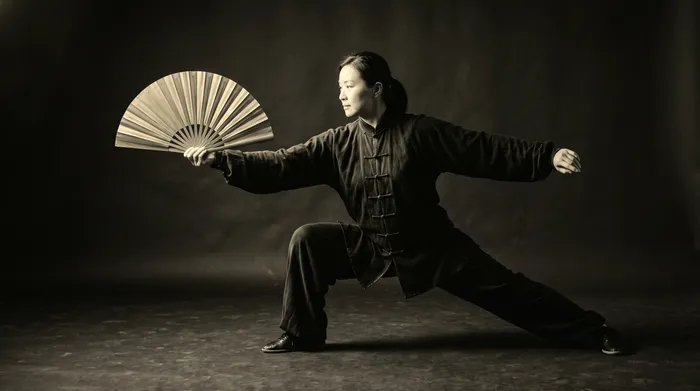
The tai chi fan form is one of the more visually striking practices in the tai chi tradition. The fan — opened and closed in fluid coordination with the hand forms — produces an effect that is simultaneously martial, aesthetic, and meditative. If you’ve watched tai chi demonstrations at festivals or cultural events, you’ve likely seen fan practitioners: the opening snap of the fan punctuating a movement, the sweeping arc of fabric against the sky.
Fan forms have existed in Chinese martial arts for centuries, but their place within contemporary tai chi practice is relatively recent. While traditional weapons like the sword (jian) and broadsword (dao) have deep roots within the major tai chi lineages, modern tai chi fan forms — the kind most widely taught today — were developed primarily in the late 20th century as expressive, accessible additions to the practice. This doesn’t make them less valuable, but it does mean their relationship to historical tai chi is different from the relationship of the jian forms.
Understanding what the fan form actually is — and isn’t — is the right starting point.
The Fan as a Weapon and as an Instrument of Practice
In Chinese martial arts history, folding fans were genuinely used as concealed weapons. A closed fan can strike, block, and control in ways similar to a short stick or short baton. An open fan can deflect and create visual confusion. Fan fighting techniques appear in several traditional Chinese martial arts systems.
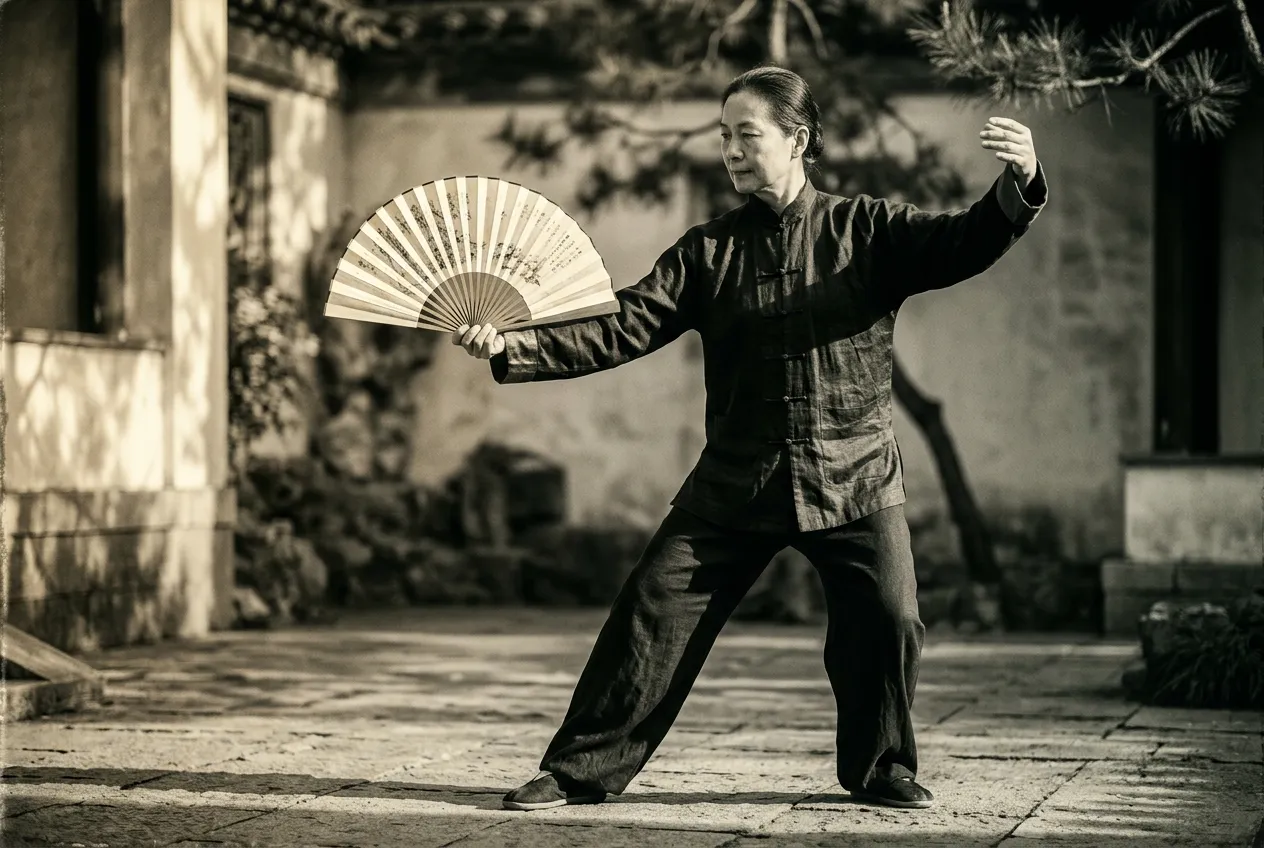
Within tai chi specifically, the fan’s martial history is less directly documented than the sword’s. The major classical tai chi texts and the traditional Chen, Yang, Wu, Sun, and Wu Hao lineages don’t describe fan forms in the same way they describe jian or dao practice. What we see in contemporary tai chi fan forms is more accurately understood as a creative synthesis: traditional tai chi movement principles applied to fan techniques, often with an aesthetic and performance dimension that the classical weapons forms don’t have.
This distinction matters for how you approach the practice. If your interest is in the historical martial tradition of tai chi, the sword form is the more direct path. If your interest is in the expressive, flowing possibilities of tai chi practice — and in a form that is genuinely enjoyable to perform and watch — the fan form has real value.
Coming to fan practice as someone who’d spent years with bare-hand forms and the sword form, I was struck by how the fan’s visual character changes the quality of attention you bring to the movements. The visual feedback of the open fan — its position in space, the plane it occupies — makes certain aspects of arm extension and rotation more immediately perceptible.
Fan Technique Fundamentals
Before learning any fan form sequence, it’s useful to understand the basic vocabulary of fan technique. The movements of the fan fall into a few categories:
Opening (開扇 kāi shàn): Opening the fan is either a single smooth motion — the wrist rotates as the hand propels the leading stick — or a snapping motion that produces the characteristic crisp sound. In tai chi fan forms, the opening is typically controlled and deliberate rather than snapping; the snap version is more associated with performance styles. The timing of the opening relative to the body movement is one of the key coordination challenges.
Closing (合扇 hé shàn): The fan closes by reversing the opening motion. The practitioner typically holds the frame (the outer stick) with one hand while the wrist of the other hand rotates to bring the fan closed. In sequences, the fan often closes during transitions and opens at specific movement peaks.
Sweeping (掃扇 sǎo shàn): The open fan sweeps horizontally, vertically, or diagonally. In martial terms, a horizontal sweep at the opponent’s eyes creates distraction; in tai chi form terms, the sweep creates a flowing visual arc that expresses the movement’s energy.
Stabbing and thrusting with the closed fan: The closed fan, held with its leading edge forward, can thrust in a motion similar to a short spear thrust. This movement appears in forms that emphasise the martial dimension of fan practice.
Fan circles: Circular movements with the open fan, similar to the circular sword movements (yun) in jian practice. These require smooth wrist rotation while maintaining the fan’s orientation in space.
A good-quality tai chi fan for practice opens and closes smoothly, has a sufficient number of spokes to maintain the fan’s shape under movement stress, and is sized appropriately to the practitioner’s arm length. Practice fans typically run 33-36cm when closed. Avoid lightweight decorative fans — they don’t hold up under regular use and don’t have the weight and structure necessary for correct technique.
Common Fan Forms
Several fan forms are widely taught, and they differ in character, length, and stylistic orientation.
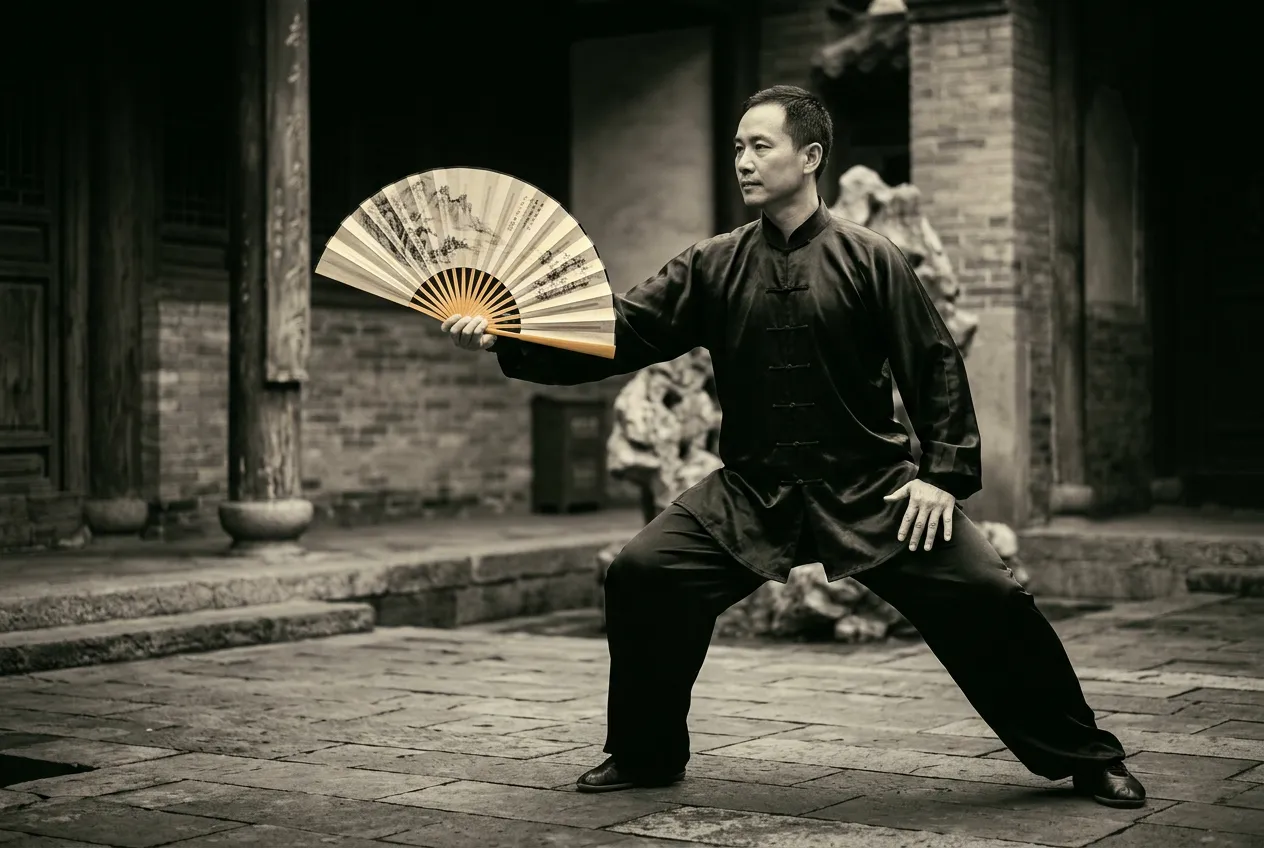
Yang 52 Fan Form: One of the most widely taught fan forms, this sequence was developed in the late 20th century drawing on Yang-style tai chi principles. At 52 movements, it’s substantial in length but follows the Yang-style movement vocabulary that many practitioners already know from the bare-hand forms. The form includes the characteristic Yang-style qualities of flowing, even movement, slow weight shifts, and open, expansive postures. The fan opening and closing are integrated into these Yang-style movements.
Chen Style Fan Forms: Several Chen-style fan forms exist that incorporate Chen’s characteristic alternation of soft and explosive movements. The fan opening in Chen fan forms sometimes coincides with a fajin release — the snap of the fan and the explosive discharge of power combined into a single moment. These forms are more physically demanding and less common in general tai chi classes.
42 Competition Fan Form: Developed for international competition, this form incorporates elements from multiple tai chi styles into a competition-oriented sequence. It’s technically precise and designed to showcase a range of movements within a fixed time frame. Some practitioners learn it as an introduction to fan work; others find the competition orientation less aligned with their practice goals.
Regional and teacher-specific forms: Many tai chi teachers have developed their own fan forms, drawing on the principles of their primary style. These aren’t internationally standardised but can be excellent introductions to fan practice within a particular lineage.
Performance Fan vs. Martial Fan
The difference between performance-oriented and martial-oriented fan work is significant enough to address directly.
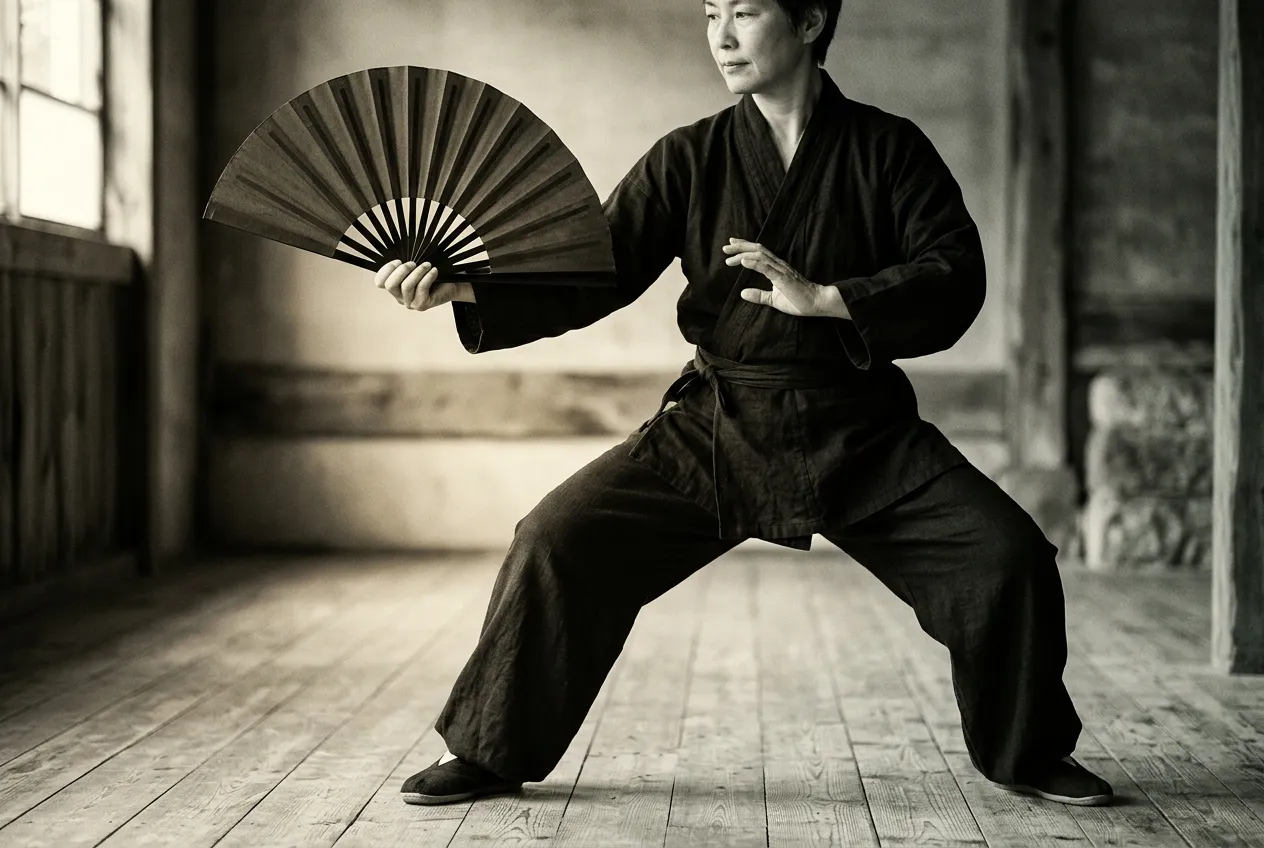
Performance fan work emphasises aesthetic qualities: the visual arc of the fan in space, the synchronisation of fan movement with music, the crisp sound of the fan opening, the visual impact of the form as a whole. Many tai chi fan demonstrations are explicitly performance-oriented — the practitioner is creating something beautiful to watch. Competition fan practice falls here. The movements are technically rigorous but evaluated for visual quality rather than functional martial application.
Martial fan work — found more in traditional Chinese martial arts systems that include fan practice — focuses on the practical applications of the fan’s techniques: how the closed fan strikes, how the open fan deflects and obscures, how the fan’s edge or spike can be used in close quarters. In contemporary tai chi, truly martial-focused fan work is rare; most tai chi fan practice sits closer to the performance end of the spectrum.
Neither orientation is wrong. The distinction matters when you’re choosing what to pursue and how to evaluate the quality of what you’re learning. A teacher emphasising performance qualities will give you different feedback from a teacher emphasising martial logic. Knowing which context you’re working in helps you interpret that feedback correctly.
Most practitioners beginning tai chi fan practice will find themselves in performance-oriented classes. This is appropriate for most goals: fan practice as an extension of flowing, expressive tai chi movement is a legitimate and rewarding practice, regardless of its martial authenticity.
Getting Started with Fan Practice
Fan practice is generally introduced after some bare-hand form foundation. The reasons are practical: the fan adds coordination demands, and attempting to learn tai chi movement basics while simultaneously managing a fan object in the hand is harder than it needs to be. Having the Yang-24 or equivalent established first means you can focus on the fan technique itself rather than on basic weight-transfer and posture.
That said, some teachers introduce simple fan opening and closing exercises very early — as supplementary work alongside bare-hand form learning. This is fine. The problem is attempting to learn a full fan form from scratch without any tai chi background.
For learning fan forms via video, the fan’s position in space — particularly its edge orientation during sweeping movements — is the hardest quality to assess from a single camera angle. Slow-motion demonstrations and close-up wrist footage make a significant difference. TaiChiApp.com offers fan form video guidance with detailed technique demonstrations, which is useful for understanding the opening and closing timing that’s so central to fan form quality.
For broader practice resources, YouTube searches for Yang 52 fan form will surface a range of demonstrations from qualified practitioners. Watching multiple practitioners perform the same form is useful for understanding which elements are standardised and which are stylistic.
Fan forms are also well-suited to group practice — the visual character of the fan makes synchronised group fan work particularly striking. Many tai chi schools include fan practice in their regular class schedule.
For context on where fan practice fits within the broader tai chi weapons tradition, our guide to tai chi weapons covers the full range. Our guide to the tai chi sword form covers the most widely practised tai chi weapon for practitioners considering where to start with weapons work.
For a broader picture of Yang-style tai chi and how weapons practice fits within it, see our Yang-style overview.
Browse all our tai chi forms guides for more on forms, weapons, and styles.
What to Expect from Fan Practice
Fan practice rewards attentiveness. The coordination demands — matching fan opening and closing to specific moments in the body’s movement — require the kind of present-moment focus that is, itself, one of the central benefits of tai chi practice.
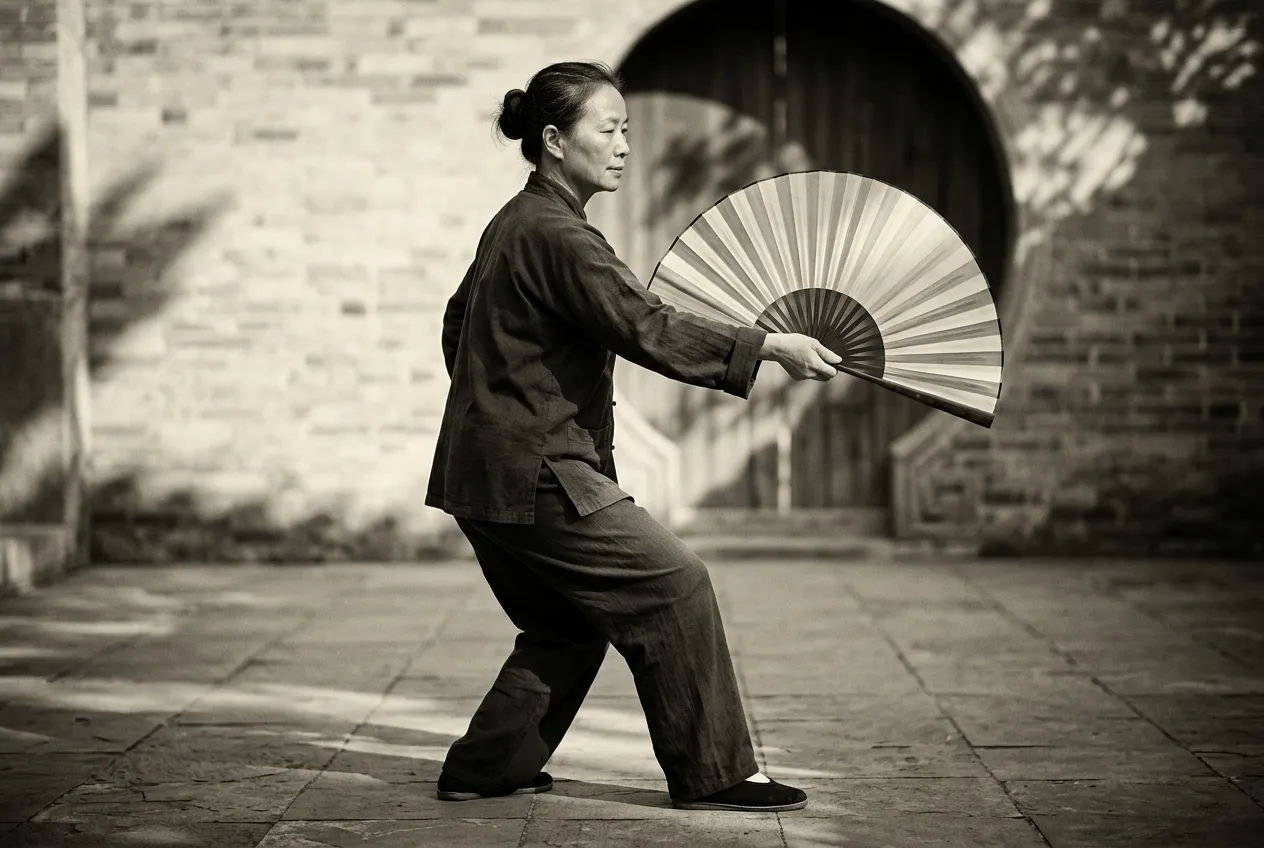
Practitioners who come to the fan form after years of bare-hand work often report that the form clarifies aspects of arm extension and wrist position that had been unclear in empty-hand practice — the fan’s visual feedback makes those qualities more perceptible. Practitioners newer to tai chi find the fan form an accessible and visually rewarding way into weapons practice.
The form is also genuinely enjoyable. The opening of the fan at the right moment in a movement, when the timing is correct, produces a satisfaction that’s hard to describe and easy to understand the first time it happens.