Tai Chi Sword Form: Learning the Jian in Yang Style
The jian — the straight, double-edged sword of Chinese martial arts — is considered one of the four classical Chinese weapons and holds a particular status in tai chi practice. It’s called the “gentleman’s weapon” in many traditions, a description that points to both its refinement and its technical demands. Of all the weapons in tai chi’s extensive arsenal, the jian is the one most widely taught, and the Yang-style 32-movement sword form is the most commonly practised tai chi sword sequence in the world.
Learning the tai chi sword form adds a dimension to practice that the bare-hand forms can’t provide. The sword acts as an extension of the arm, making certain qualities of movement — particularly the precise transmission of energy through the wrist and into the blade — visible in a way that’s harder to see in empty-hand work. When the sword wobbles during a thrust, you know immediately that something in the wrist, elbow, or shoulder is tense. The sword is an honest teacher.
The Jian: What It Is and How It Differs from Other Weapons
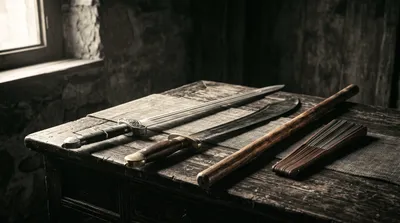
The jian (剑) is a straight, double-edged sword, as distinct from the dao (刀) — the curved, single-edged broadsword, sometimes called a sabre. Both appear in tai chi, but the jian is generally introduced first in Yang style, and it carries a different technical character.
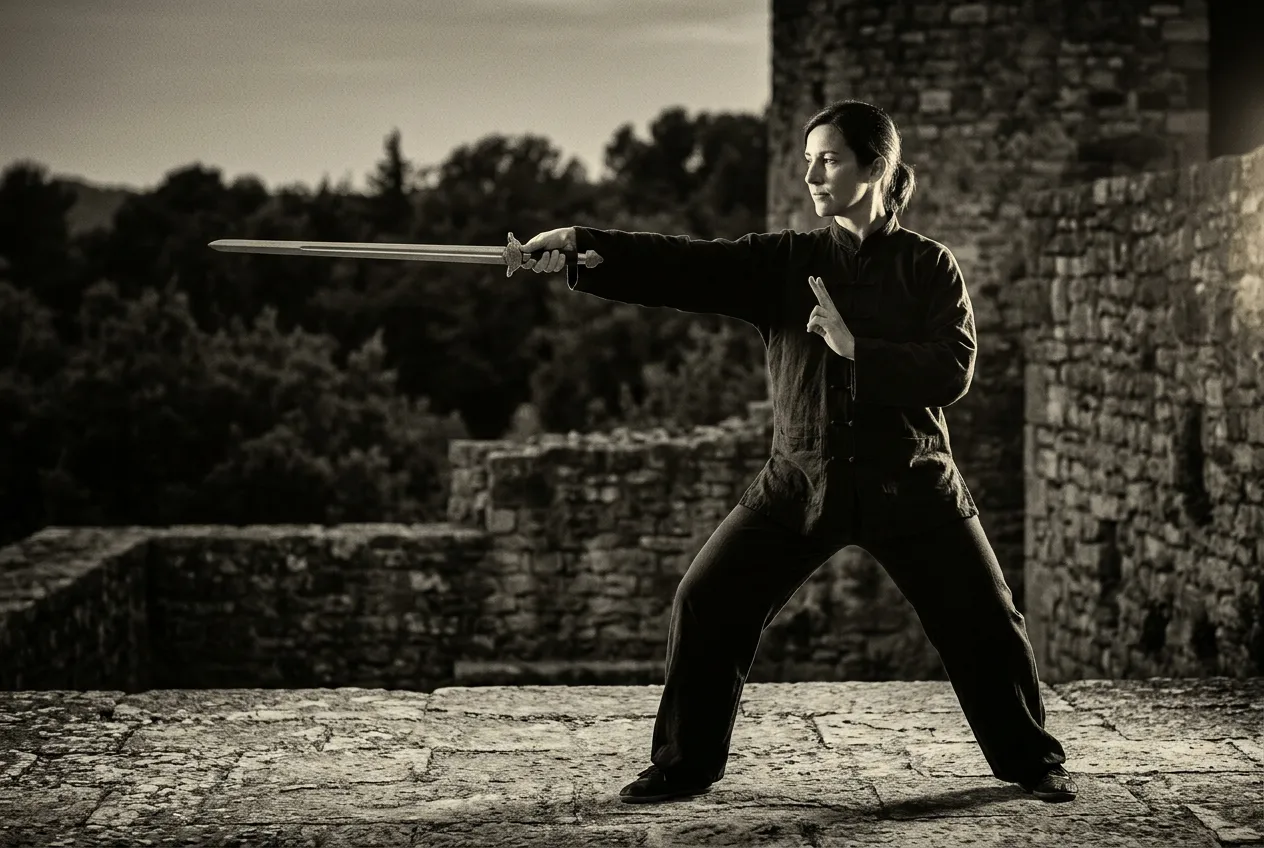
The dao is typically described as more forceful — the cuts are larger, the power more obviously physical. The jian is faster and more refined, emphasising point work, controlled thrusts, and precise arc-cuts rather than sweeping power strikes. In practice, working with the jian tends to emphasise sensitivity in the wrist and the quality of the connection through the arm — qualities that directly complement bare-hand tai chi training.
A tai chi practice sword is typically made from flexible stainless steel or aluminium, with a blade length matched to the practitioner’s arm — the standard sizing check places the pommel in the armpit with the blade pointing forward along the extended arm; the tip should reach approximately to the wrist of that arm. Practice swords are intentionally flexible and not sharp; sharpened jian are used in advanced cutting practice by experienced practitioners, but beginners begin with practice swords.
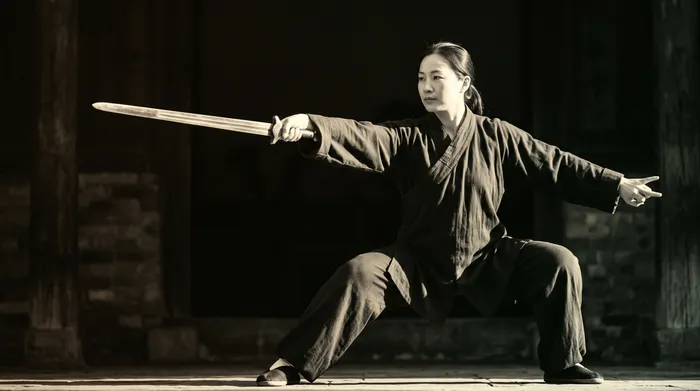
The sword is generally held in the right hand throughout the forms. The left hand forms the sword fingers (jian zhi 剑指): the index and middle finger extended together, the other fingers folded, the thumb resting on the ring finger. The sword fingers are not decorative — they’re understood to direct energy and balance the extension of the sword hand.
Having worked with a jian for several years, I’ll say that the sword-fingers concept took me a long time to take seriously. They felt like an affectation until a more experienced practitioner pointed out that the positioning of the non-sword hand genuinely affects the quality of extension and rotation in the sword arm, and then I started to understand the concept from the inside.
Basic Techniques: Cuts, Thrusts, and Parries
The jian’s vocabulary of techniques is more extensive than beginners usually expect. The 32-movement sword form contains most of the fundamental sword techniques, so learning the form is also learning the technical vocabulary. Some key techniques:
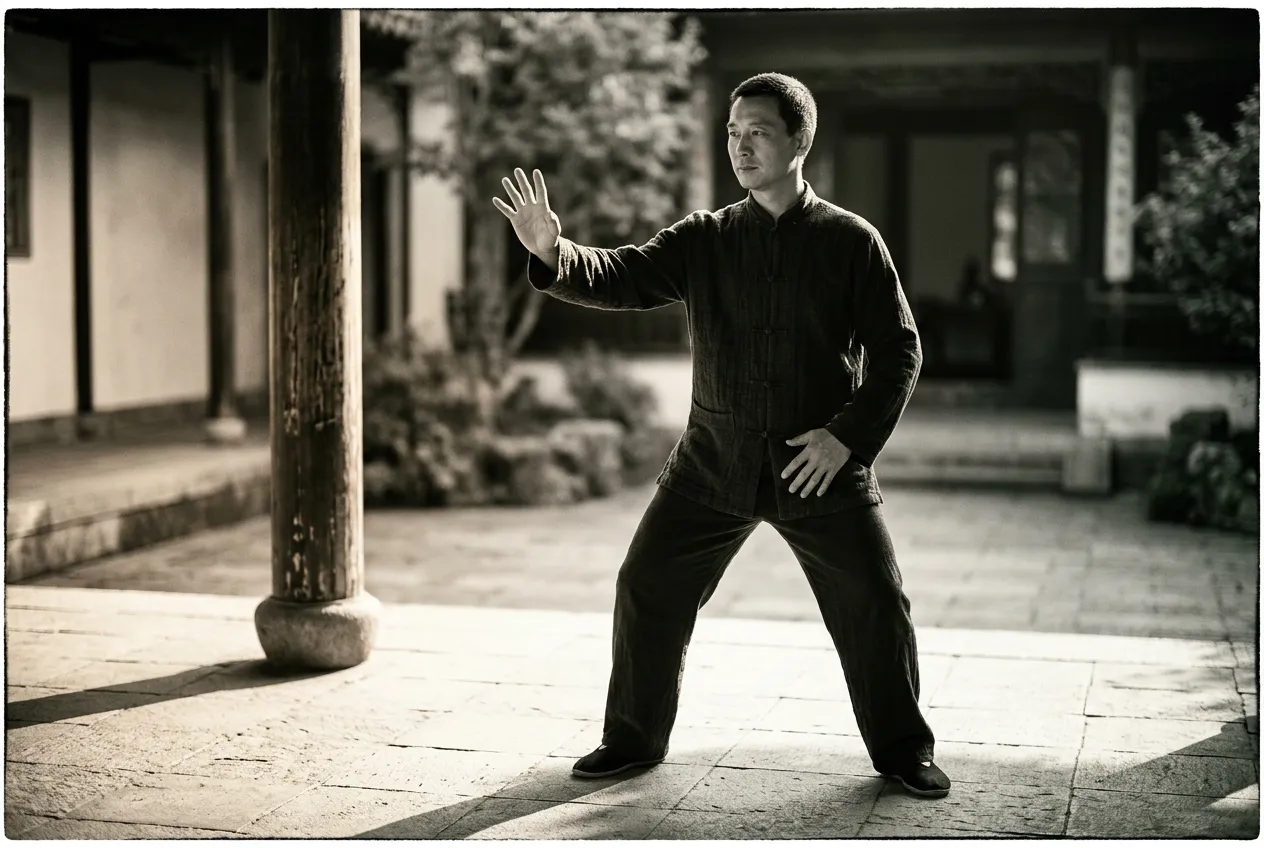
Point work (ci 刺 and jian 劍): Direct thrusts with the sword point. The power comes from whole-body coordination — a weight shift and hip rotation transmit through the arm into the sword, not from extending the arm in isolation. The wrist remains relaxed but precise.
Arc-cuts and slicing: The jian cuts using both edges, with horizontal and diagonal slicing movements. Unlike a cleaving cut with a heavier weapon, jian cuts rely on the edge traveling along the target rather than striking through it — a quality of movement that requires both precision and relaxation to produce correctly.
Upward parry (liao 撩): A sweeping upward movement with the blade. Used to deflect incoming strikes and simultaneously position for a counterattack.
Downward cut (pi 劈): A downward cut using the upper edge of the sword, often combined with a weight shift.
Circular cuts (yun 云): The sword draws a horizontal circle, typically at head height. One of the more visually distinctive movements in the sword form.
Withdrawing (dian 點 and beng 繃): Short, precise movements of the sword point — flicking downward or upward — that are characteristic of jian work and require precise wrist control.
The Yang-Style 32-Movement Sword Form
The Yang-style 32-movement sword form (三十二式太极剑) was standardised in 1957 by the Chinese National Sports Commission, the same body that produced the Yang-24 bare-hand form a year earlier. The standardisation brought a consistent reference sequence to Yang-style sword practice across the country.
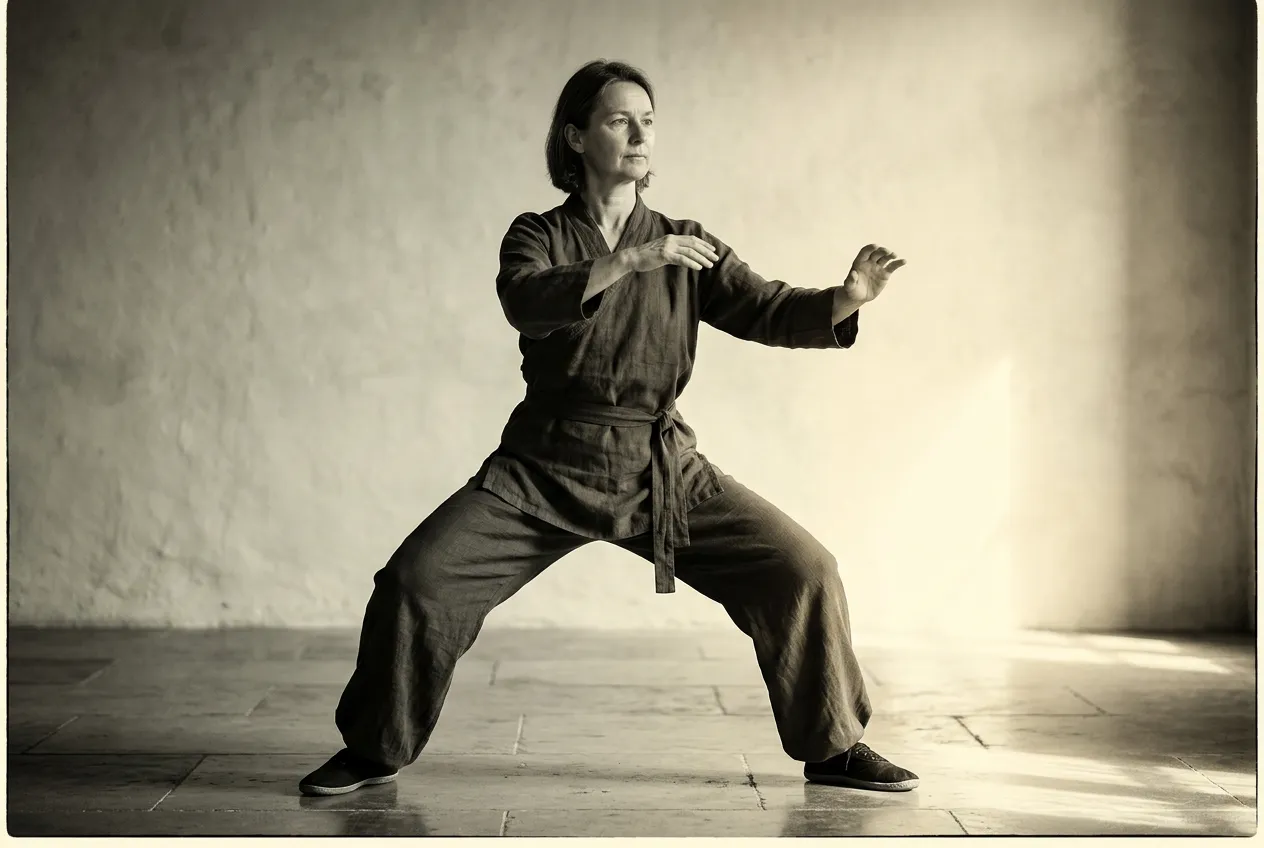
The form runs approximately six to eight minutes at normal practice speed. Like the Yang-24, it condenses the essential movements of the full Yang sword form into an accessible and well-structured sequence. The 32 movements are grouped into eight sections of four movements each.
The character of the form: Unlike the bare-hand forms, the sword form has more varied rhythm. Some movements are slow and flowing, others use a sudden directional change that approaches fajin in character. The sword requires the practitioner to be aware of the blade at all times — its position, its edge orientation, its path through space. This spatial awareness develops gradually and is part of what makes sword practice mentally engaging.
Spatial demands: The sword form covers more ground than the Yang-24 and moves in more directions, including behind the practitioner. You’ll need a practice space of approximately 4m x 4m minimum, more if you want room to move freely.
Learning sequence: Most teachers recommend having the Yang-24 or equivalent bare-hand form established before beginning sword practice. The reason is practical: bare-hand practice develops the postural and weight-transfer foundations that the sword form requires, and attempting to build those foundations while simultaneously managing a sword in hand is more cognitively demanding than necessary.
For those learning the sword form via video, positioning and blade angle are the most difficult aspects to assess from a single camera angle. Multiple camera angles and close-up demonstrations of the wrist and sword orientation make a significant difference. TaiChiApp.com offers detailed sword form video instruction with multi-angle demonstrations, which is particularly helpful for the thrusting and arc-cutting movements where wrist position is critical but hard to see in full-body views.
You can also find comprehensive sword form demonstrations on YouTube — searching for “Yang 32 sword form” will surface multiple senior practitioners’ demonstrations, which is useful for seeing the form’s overall shape and rhythm. The United States Tai Chi Association and similar national organisations maintain lists of qualified sword form teachers.
Developing Sword Form Quality
The sword form’s specific technical demands mean that typical beginner mistakes in bare-hand tai chi — shoulder tension, incomplete weight transfers, broken movement continuity — show up immediately and clearly in sword practice.
Wrist tension is the most universal beginner issue. The instinct to grip the sword tightly produces rigidity that travels up the arm and into the shoulder. The jian should be held firmly enough not to drop it, but lightly enough that the wrist can rotate and flex freely. A useful test: if you can’t rotate the sword through 180 degrees in a single smooth movement without breaking the wrist’s alignment, the grip is too tight.
Sword tracking: Each cut and thrust should follow a clear, intentional path through space. Beginners often allow the sword to take imprecise paths — particularly during the transition movements between named techniques. Working through the form slowly and tracing the exact path the sword tip takes is a useful diagnostic exercise.
Coordination of sword fingers: The left hand’s position is often ignored by beginners focusing on the sword hand. But the sword fingers have defined positions throughout the form, and maintaining their coordination with the sword hand is part of the form’s structure.
Continuity: Like the bare-hand forms, the sword form should flow without pause. The named movements are waypoints, not stops. The transitions between them are as important as the movements themselves — perhaps more so, because transitions are where sword positioning is most easily lost.
Working slowly through just the first section — movements 1-4 — until the transitions are as comfortable as the named movements themselves is more productive than racing to complete the whole form sequence.
For practitioners who want to place sword practice within the broader context of bare-hand training, our guide to the Yang-24 form covers the bare-hand foundation, and our Yang-style overview discusses how weapons training fits within the Yang-style system.
The Sword in Context: Martial Meaning and Contemporary Practice
The jian’s historical function was combat — cutting, thrusting, parrying, controlling distance. Understanding the martial meaning of the movements isn’t strictly necessary for health-focused practitioners, but it provides context that makes the form’s structure logical rather than arbitrary.
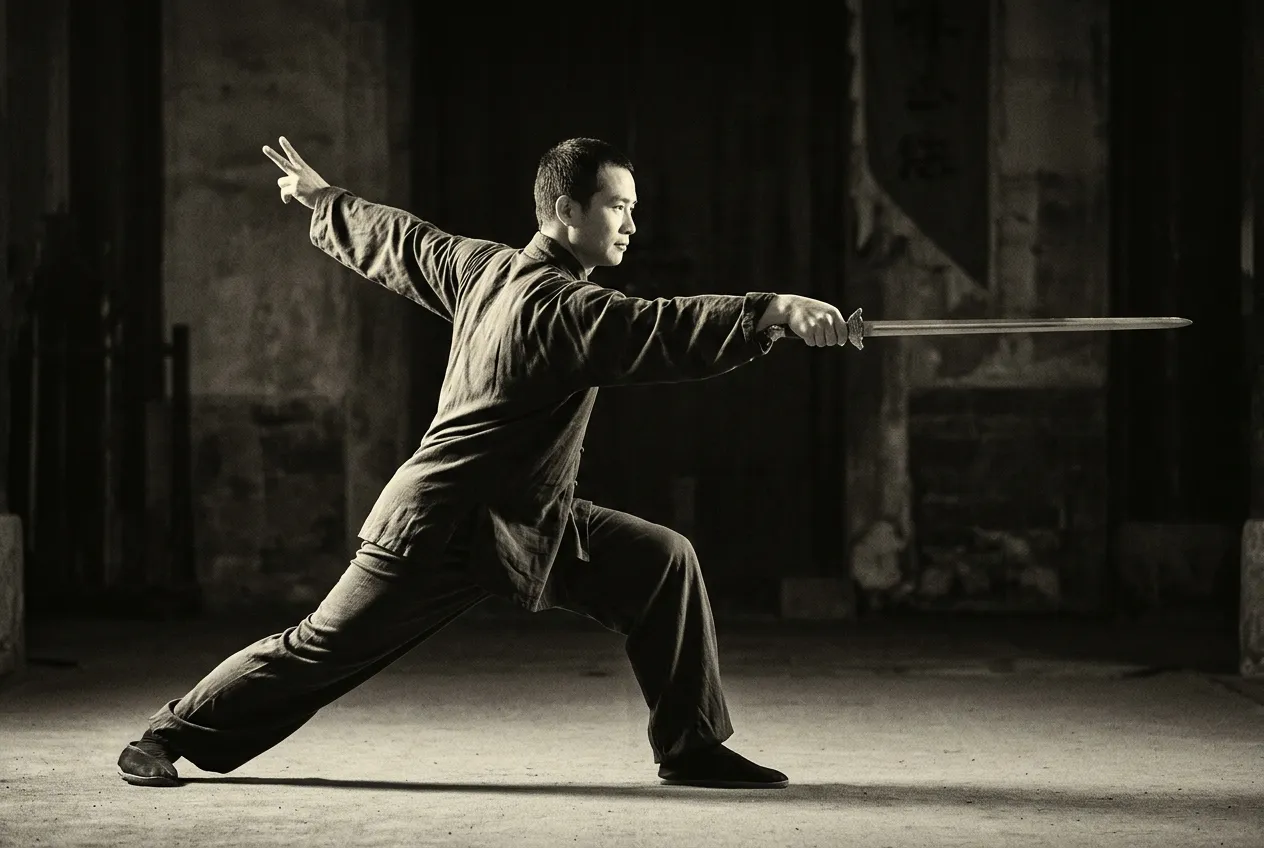
A thrust has a specific target and a specific defensive relationship with the practitioner’s body — understanding this gives the posture precision it can’t have if it’s just a movement learned by rote. A circular cut at head height makes spatial sense when you understand what it deflects and what it creates. This functional context is one reason experienced practitioners often describe weapons training as having accelerated their understanding of the bare-hand forms.
Contemporary tai chi sword practice has two broad expressions: the form-focused practice of learning and refining the 32-movement sequence, and the partner-practice context of sword matching — two practitioners working together with practice swords to develop responsive, yielding sword-to-sword contact, analogous to push-hands in bare-hand practice. Most beginners begin with form practice; sword matching is typically introduced after several years of form work.
For a broader overview of tai chi weapons practice beyond the sword, our guide to tai chi weapons covers the full range of weapons in the tradition.
Browse all our tai chi forms guides for more on forms, styles, and practice approaches.
Frequently Asked Questions
Do I need my own sword to learn the tai chi sword form? Most teachers will lend practice swords initially, but having your own sword becomes important once you begin practising regularly at home. A good practice tai chi jian costs between $40–$100 for a stainless steel practice sword. Avoid buying sharpened or very lightweight decorative swords — a proper practice jian has weight and flexibility. Your teacher can advise on appropriate options for your size and level.
How long does it take to learn the 32-movement sword form? With regular practice, most students can learn the basic sequence of the 32-sword form in three to six months. This assumes an established bare-hand foundation. As with all tai chi learning, knowing the sequence and practising the form well are different milestones — the latter is a much longer journey.
Is tai chi sword practice safe for older practitioners? Yes. The movements of the 32-sword form are no more physically demanding than the bare-hand forms — the sword’s weight (typically 400-600g for a practice sword) adds minimal load. The balance demands of single-leg postures that appear in the sword form are the same as in the bare-hand forms. Many senior practitioners specifically enjoy sword practice for the proprioceptive feedback the sword provides.
Can I start with sword practice without learning a bare-hand form first? Technically yes, but most teachers advise against it. The bare-hand forms develop the postural foundation, weight-transfer patterns, and movement coordination that make sword practice productive. Learning both simultaneously as a complete beginner is considerably harder than it needs to be. Establishing the Yang-24 form first — even to a basic level — makes the sword form significantly easier to learn.
What is the difference between the tai chi jian and other Chinese swords? The jian (straight, double-edged) is distinguished from the dao (curved, single-edged broadsword/sabre) primarily by its cutting geometry and weight distribution. The jian is point-oriented and lighter; the dao is edge-oriented and typically heavier. Both appear in tai chi practice. The jian is introduced first in most Yang-style schools; the dao is often the second weapon studied.