Search for “white crane tai chi” and you will find two quite different things tangled together: a posture that appears in almost every tai chi form, and a family of southern Chinese martial arts that are not tai chi at all.
The confusion is understandable — both use the crane as their organising image, both trace to Chinese martial tradition, and the names look similar in English. But they are separate arts with separate histories, and knowing which one you are looking at saves a good deal of wasted searching.
This article covers both: the tai chi posture in detail, and the White Crane martial arts that share its name.
White Crane Spreads Its Wings: The Tai Chi Posture
In tai chi, White Crane Spreads Its Wings — bai he liang chi (白鶴亮翅) — is a posture, not a style. It appears early in the Yang form, usually within the first handful of movements, and versions of it exist in Chen, Wu, and Sun styles as well as in the standardised 24-form.
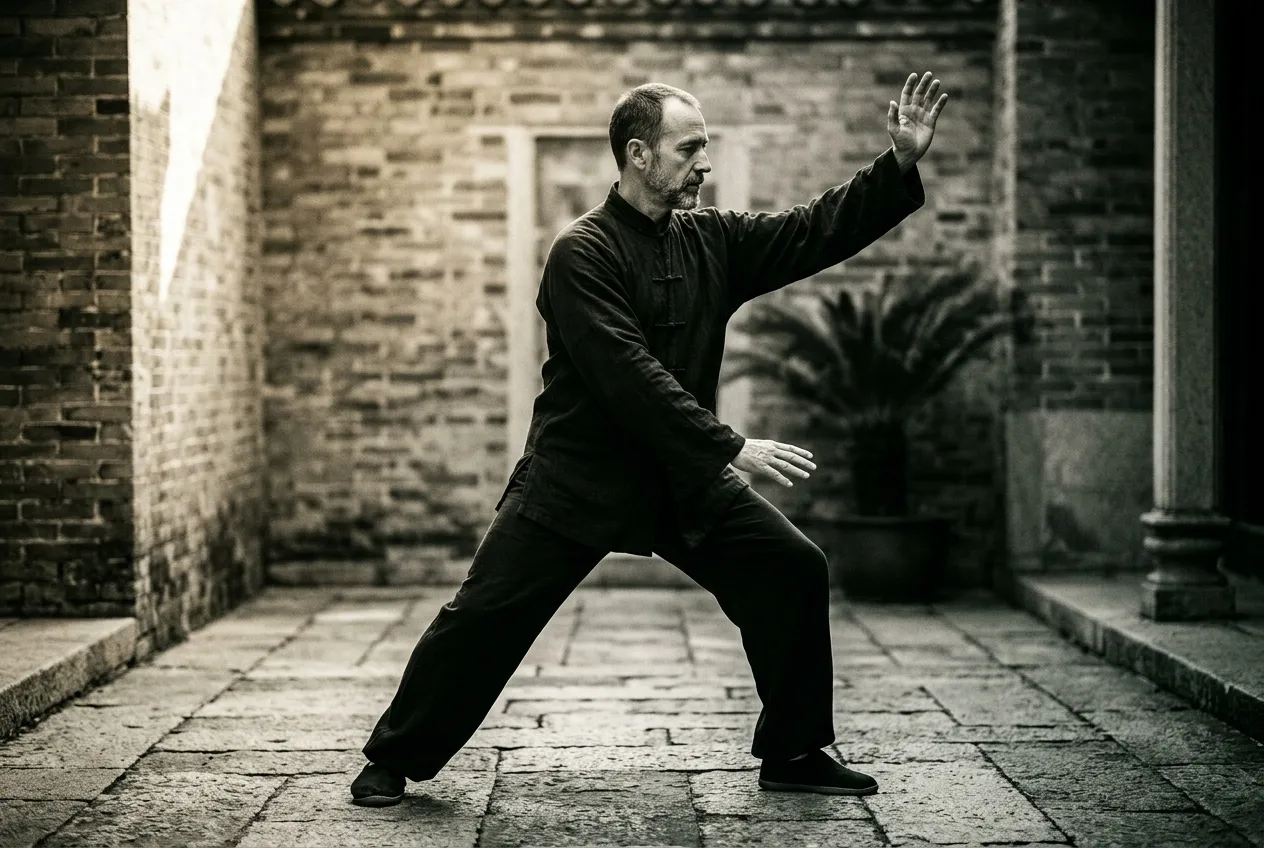
The image is a crane settling: one wing lifted and one lowered, the body poised on a single supporting leg with the other foot resting lightly. It is one of the more visually distinctive postures in the form and one of the first that beginners recognise in others.
The Shape
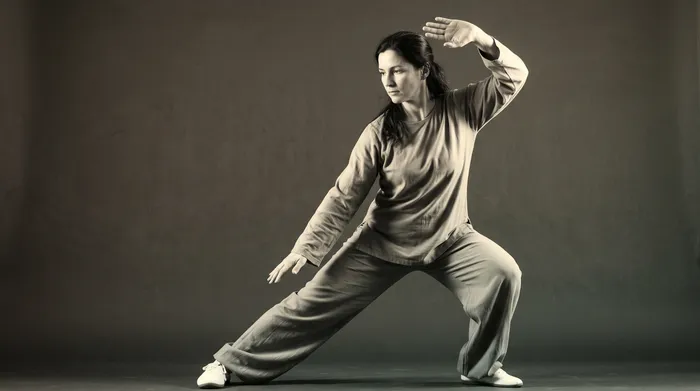
The posture is typically performed from an empty stance (xu bu) — most of the weight on the rear leg, the front foot touching the ground lightly with the toe or ball, carrying little or no weight.
The arms separate vertically. The upper hand rises to around forehead height, palm generally facing outward or angled, positioned above and slightly to the side of the head. The lower hand settles beside the hip or thigh, palm facing down.
The torso stays upright and lengthened. The chest is neither puffed nor collapsed. There is a sense of expansion between the two hands — the posture should feel open across the front of the body rather than merely having the arms in two different places.
How It Is Usually Performed Badly
Four faults account for most of what goes wrong:
Weight on the front foot. The empty stance means empty. If the front foot is carrying weight, the posture loses its defining quality and the balance training it provides.
Leaning back. Raising one arm high tempts the torso backwards. The spine should stay vertical, with the arm rising independently of the trunk.
The shoulder rising with the arm. The upper arm should lift while the shoulder stays down — one of the harder coordinations in tai chi and one that takes a long time to establish.
Arms arriving before the body. The separation of the hands should be driven by the turn and settling of the body, not performed as an arm movement while the trunk stands still.
That last one took me an embarrassingly long time to notice in my own practice. The posture looked correct in a mirror and was completely disconnected — my hands got where they were meant to be entirely under their own power.
What It Trains
The posture is doing more work than its appearance suggests.
It is a single-leg balance position held in the middle of a flowing sequence, which trains the transition into and out of one-legged support rather than static balance alone. It requires vertical separation of the arms while maintaining an unrotated, upright spine, which is a genuine coordination challenge. And it trains the empty stance, a position that recurs throughout tai chi and that many practitioners never perform with a truly unweighted front foot.
Martially, the interpretation usually given is a simultaneous upward deflection with one arm and downward deflection or strike with the other, splitting an opponent’s attacking limbs. Whether or not you are interested in application, that reading explains the shape — the two hands are doing different things in different directions, which is why the posture feels awkward if performed symmetrically.
Practising the Posture on Its Own
Because it appears so early in the Yang form, White Crane Spreads Its Wings is worth isolating and drilling rather than only meeting it in sequence. A short drill:
Stand with feet shoulder-width. Shift the weight fully onto the right foot until the left could lift freely. Turn the waist slightly right and let the arms cross in front of the body, right hand below, left hand above.
Now turn back to the front as the arms separate — the right hand rising to forehead height, the left settling beside the left thigh — while the left foot slides forward to touch the ground with the ball of the foot, carrying no weight. Hold for two or three breaths.
Reverse the movement to return, and repeat ten times. Then practise it on the other side, which the form itself does not do, to avoid building an asymmetry.
Two things to check while holding. Can you lift the front foot off the ground entirely without any shift of the torso? If not, the weight distribution is wrong. And is your raised shoulder level with the other one? Almost certainly not, at first.
Holding the posture for longer — thirty seconds or a minute — turns it into a standing practice that builds single-leg strength and exposes exactly where your balance strategy relies on gripping the floor with the toes.
Fujian White Crane: A Different Art
Now the other thing the search term finds.
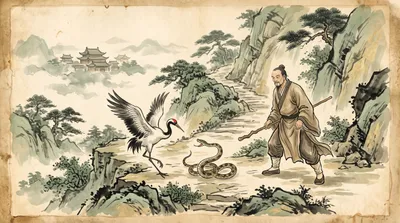
Fujian White Crane — bai he quan — is a southern Chinese martial art from Fujian province, and it is not tai chi. Traditionally, its creation is attributed to Fang Qiniang, a woman said to have developed the style after observing a crane defending itself against her attempts to drive it away with a staff, and finding that its evasion and precise counters defeated her existing training.
The style is a southern external art characterised by close-range fighting, sharp short-range power, and hand techniques that imitate a bird’s pecking and wing movements. It is historically important well beyond its own lineage: Fujian White Crane influenced a large family of southern Chinese styles, and its transmission to Okinawa is part of the ancestry of modern karate.
The differences from tai chi are fundamental rather than stylistic. White Crane is trained at speed with visible tension and release, uses short, sharp power generation rather than the continuous rounded quality of tai chi, has no equivalent of the slow solo form as a primary training method, and comes from an entirely separate lineage with no historical connection to the internal arts of Henan and Hebei.
Two further arts share the name and add to the confusion. Tibetan White Crane (bak hok pai) is a distinct southern style with its own long-range character, and various Shaolin crane forms exist within northern and southern Shaolin curricula. None of them is tai chi.
Is There a White Crane Style of Tai Chi?
Not in the sense that Chen, Yang, Wu, Wu (Hao), and Sun are styles of tai chi. Those five are the recognised major family lineages, and White Crane is not among them.
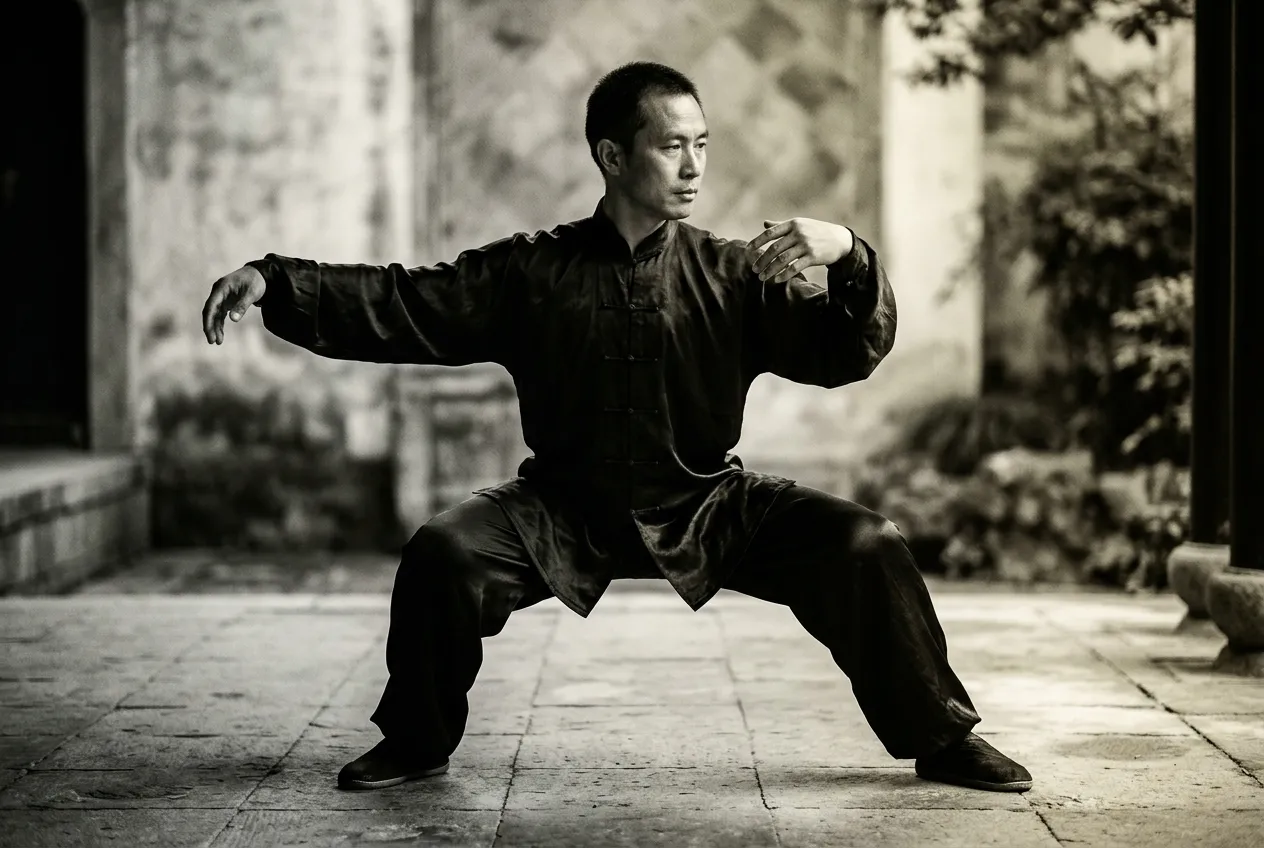
What does exist:
Individual schools that blend crane-derived material with tai chi, usually reflecting a particular teacher’s background in more than one art. These are legitimate practices but they are that teacher’s synthesis rather than an established lineage.
Qigong sets using crane imagery, which are common. The crane is one of the animals in the Five Animal Frolics, and crane-themed qigong sequences exist independently of any martial style.
Postures and forms named for the crane across many Chinese arts, since the crane is among the most widely used animal images in Chinese martial culture — associated with longevity, poise, and balance on one leg.
If you have been told you are learning “White Crane tai chi”, it is worth asking the teacher what they mean by it. The answer may be a crane-influenced tai chi practice, a southern crane style being described loosely, or simply the posture. All three are reasonable things to be doing; they are just different things.
Which One Are You Looking For?
A short decision guide.
If you want the slow, health-oriented practice with the crane posture in it, you want ordinary tai chi — most likely Yang style, where White Crane Spreads Its Wings appears within the first few movements of both the traditional form and the 24-form. The Yang style overview covers where to start.
If you want a faster, harder southern martial art with crane techniques, you want Fujian White Crane or one of its relatives, and you should look for southern kung fu schools rather than tai chi classes.
If you are simply trying to work out where crane imagery sits in Chinese martial arts generally, the answer is that it is everywhere, in many unrelated systems, because it is a good image for what these arts are trying to teach.
The tai chi styles comparison sets out the five recognised tai chi lineages, the history of tai chi covers where they came from and how they relate to the wider martial tradition, and the rest of the technical guides are in the tai chi forms section.