The question “where did tai chi come from?” sounds simple. The answer is anything but. Tai chi’s history runs through verified historical records, oral traditions, disputed lineages, and — most famously — a legend involving a Taoist immortal watching a snake and a crane fight. Separating what we know from what we believe is part of what makes this history genuinely interesting.
Having practised tai chi for over a decade and read a fair amount on its origins, I find the contrast between legend and documented history striking. The legendary account is more poetic. The documented account is more remarkable.
The Legend of Zhang Sanfeng
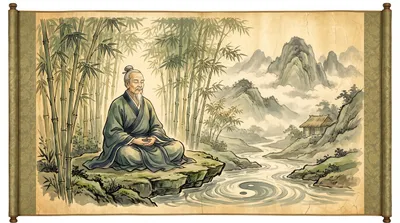
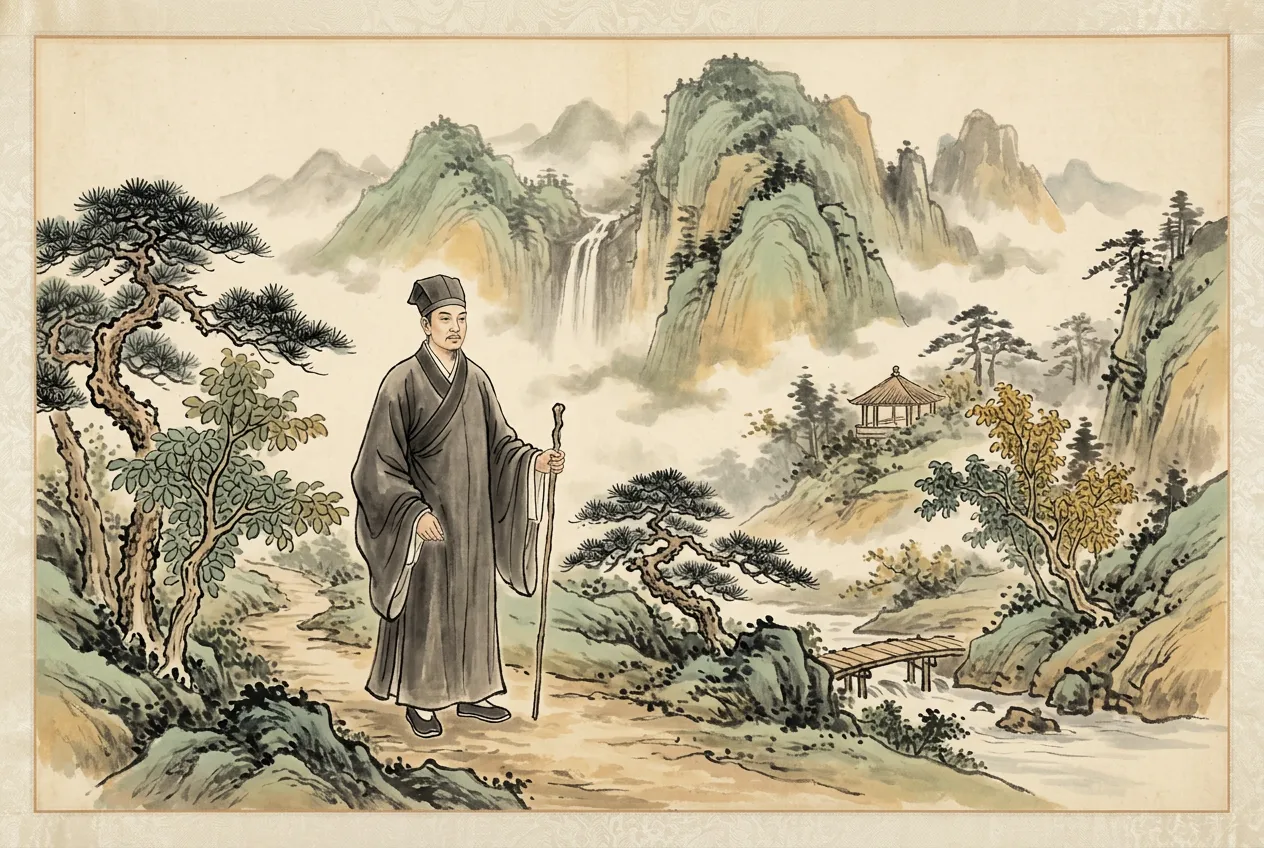
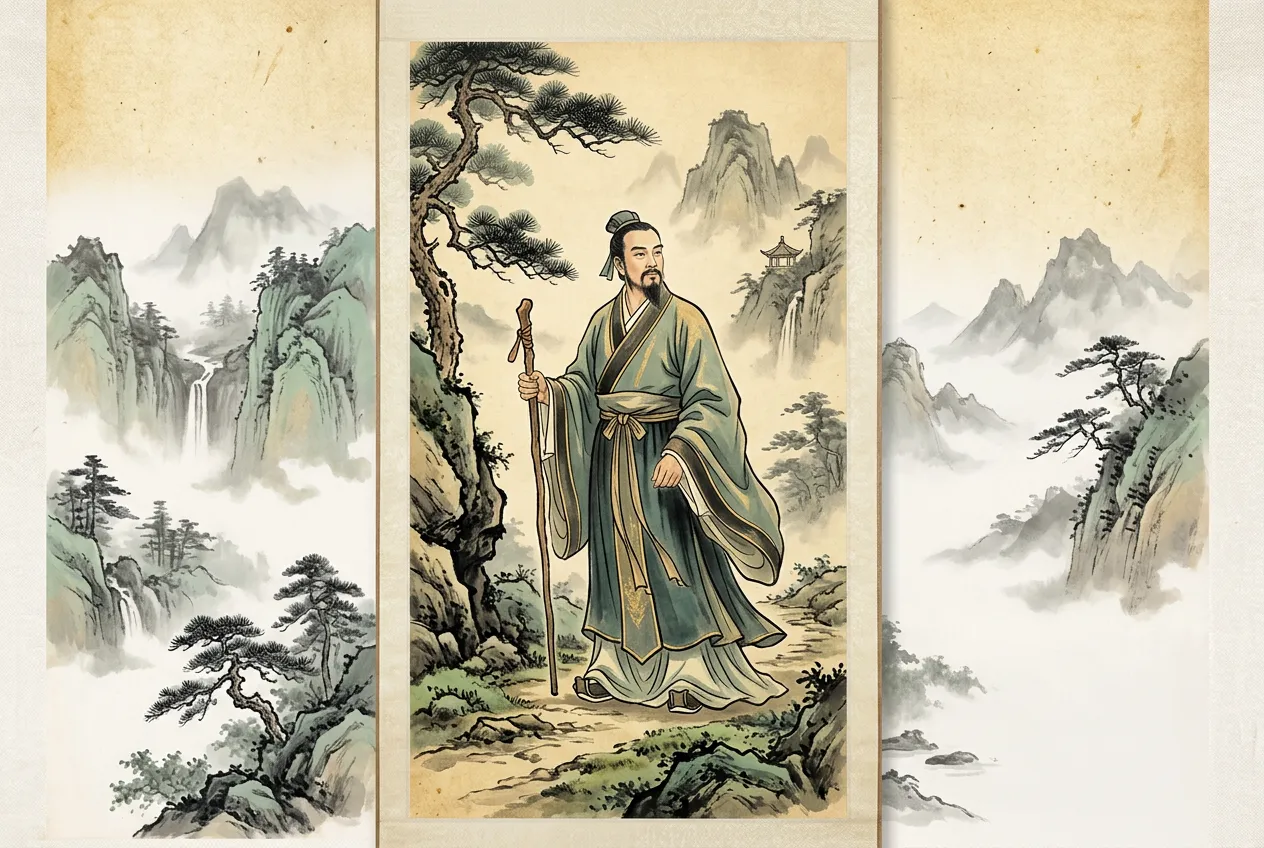
The most widely repeated origin story credits a semi-mythical Taoist priest named Zhang Sanfeng (張三丰) with inventing tai chi some time during the Song Dynasty (960–1279 CE) or, depending on the version, the Ming Dynasty (1368–1644 CE). The inconsistency in dates is itself a clue about the legend’s historical reliability.
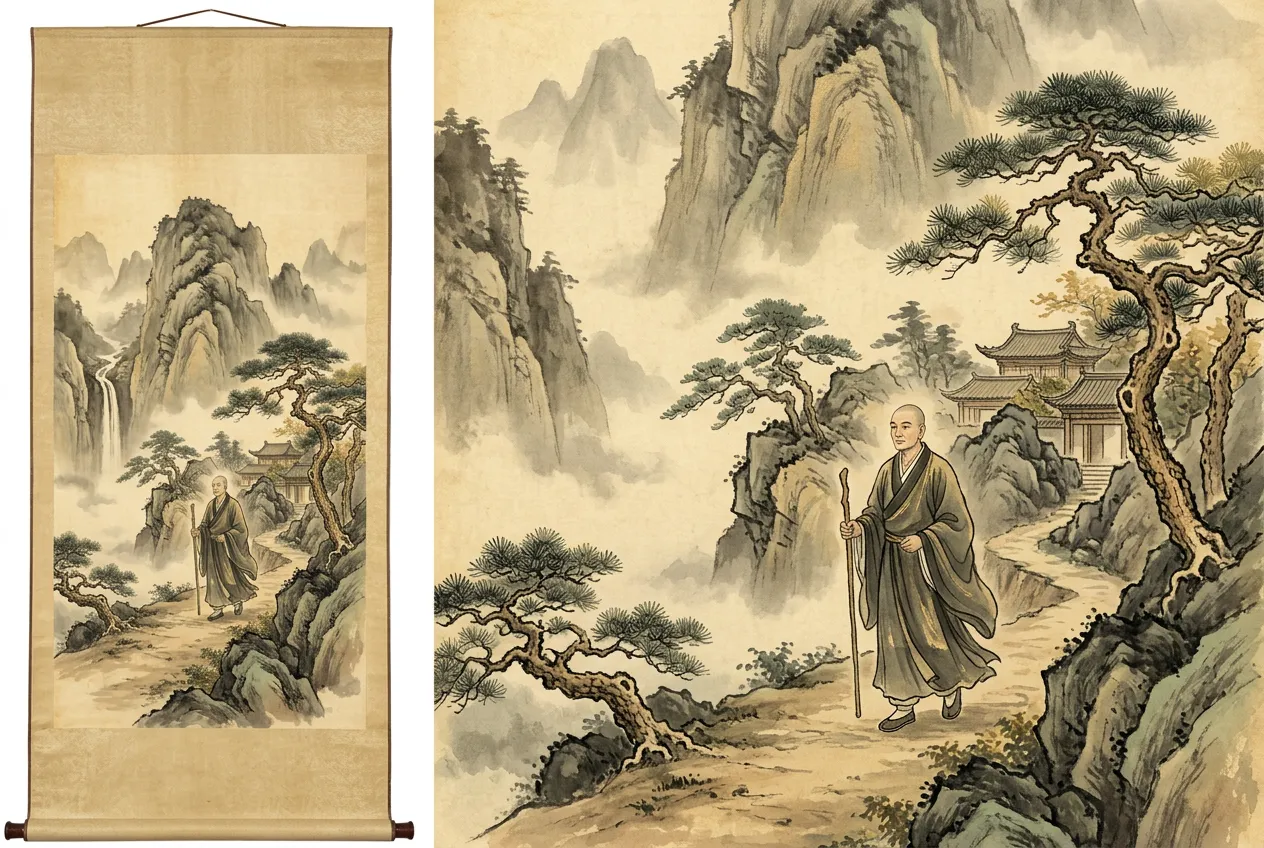
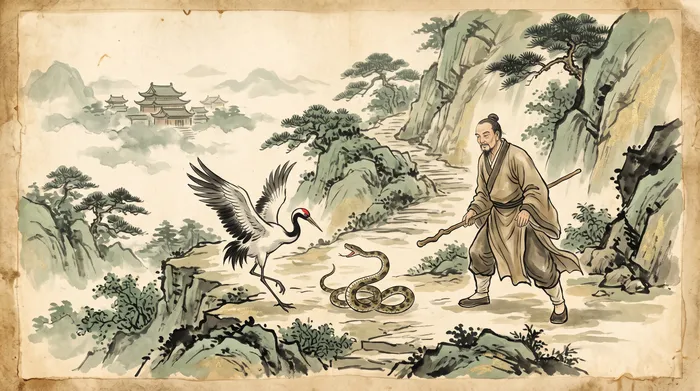
The most common version goes like this: Zhang Sanfeng, observing a fight between a snake and a crane, was struck by how the snake’s yielding, spiralling evasions overcame the crane’s sharp, powerful strikes. He used this insight to develop a martial art based on yielding rather than meeting force with force — the philosophical and physical foundation of what we now call tai chi.
It is a compelling story. It encapsulates the core principle of tai chi — softness overcoming hardness — in a single vivid image.
But there is no contemporary historical evidence that Zhang Sanfeng created tai chi. Wikipedia’s article on Zhang Sanfeng notes that while he is mentioned in Ming Dynasty court records as a Taoist figure the Yongle Emperor sent envoys to find, there is no verifiable connection to the creation of tai chi in any contemporaneous source. The attribution appears in Chinese martial arts lore from the 17th century onward, but credible tai chi historians regard it as tradition rather than documented fact.
This matters because the legend serves a purpose beyond simple origin story. Attributing tai chi to a Taoist immortal elevated the art’s spiritual status, connected it to classical Chinese philosophy, and positioned it within Taoist cosmological frameworks. Understanding the legend as tradition — rather than dismissing it as false — gives us insight into how Chinese martial arts culture transmitted and elevated its own knowledge.
The actual documented history of tai chi begins elsewhere: in a village in Henan Province.
Chen Village: The Documented Origin
The earliest verifiable history of tai chi traces to Chen Wangting (陳王廷, c. 1600–1680), a Ming Dynasty general and martial artist from Chenjiagou (陳家溝) — Chen Village — in Wenxian County, Henan Province.
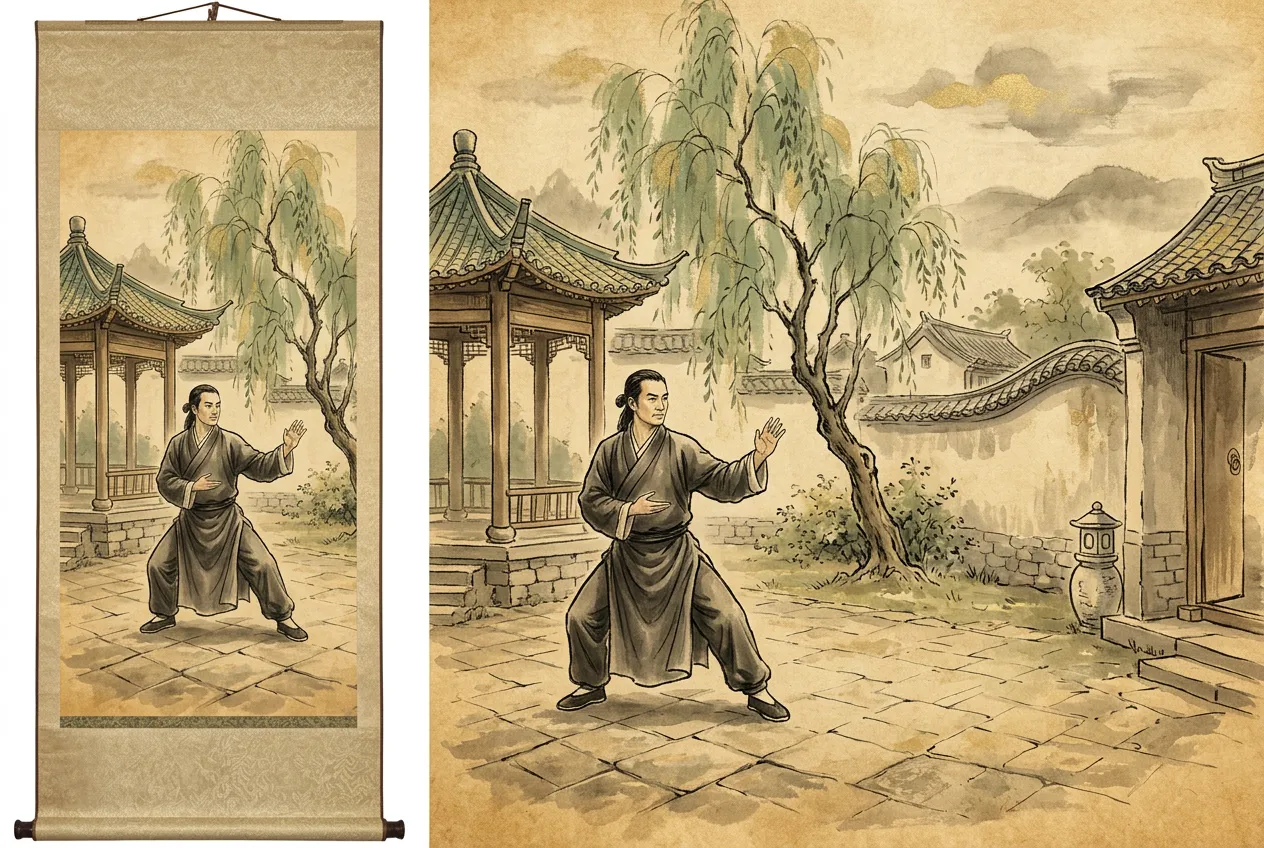
Chen Wangting is credited with synthesising the martial arts knowledge of his time into a coherent system that became Chen-style tai chi. He drew on classical Chinese martial arts texts, including the 32-posture sword manual by General Qi Jiguang (a major 16th-century military manual), and integrated Taoist breathing and meditative practices into the framework.
What makes Chen Wangting’s system distinctive is its combination of explosive power (fa jin), spiral force (chan si jin — silk-reeling energy), and the alternation between fast, dynamic movements and slow, deliberate ones. Early Chen forms are characterised by this contrast — powerful leaps and stomps alongside flowing, continuous sequences. If you have ever seen Chen-style tai chi practised at full intensity, you understand why its martial origins are not in doubt.
The Chen family kept this system largely within the village for several generations. It was transmitted as a family art, not publicly taught. This exclusivity is significant: it explains both the art’s preservation and the reason the wider world didn’t know it existed for well over a century after Chen Wangting’s death.
In my practice, I have found Chen-style’s explosive quality striking the first time you encounter it. There is nothing slow or meditative about a Chen practitioner releasing fa jin — it is genuinely surprising how much power that system generates.
The Five Major Family Styles
Tai chi today encompasses five major family styles, each with a distinct lineage and character. Understanding how they branched from the Chen trunk gives the history its coherent shape.
Chen Style (陳式)
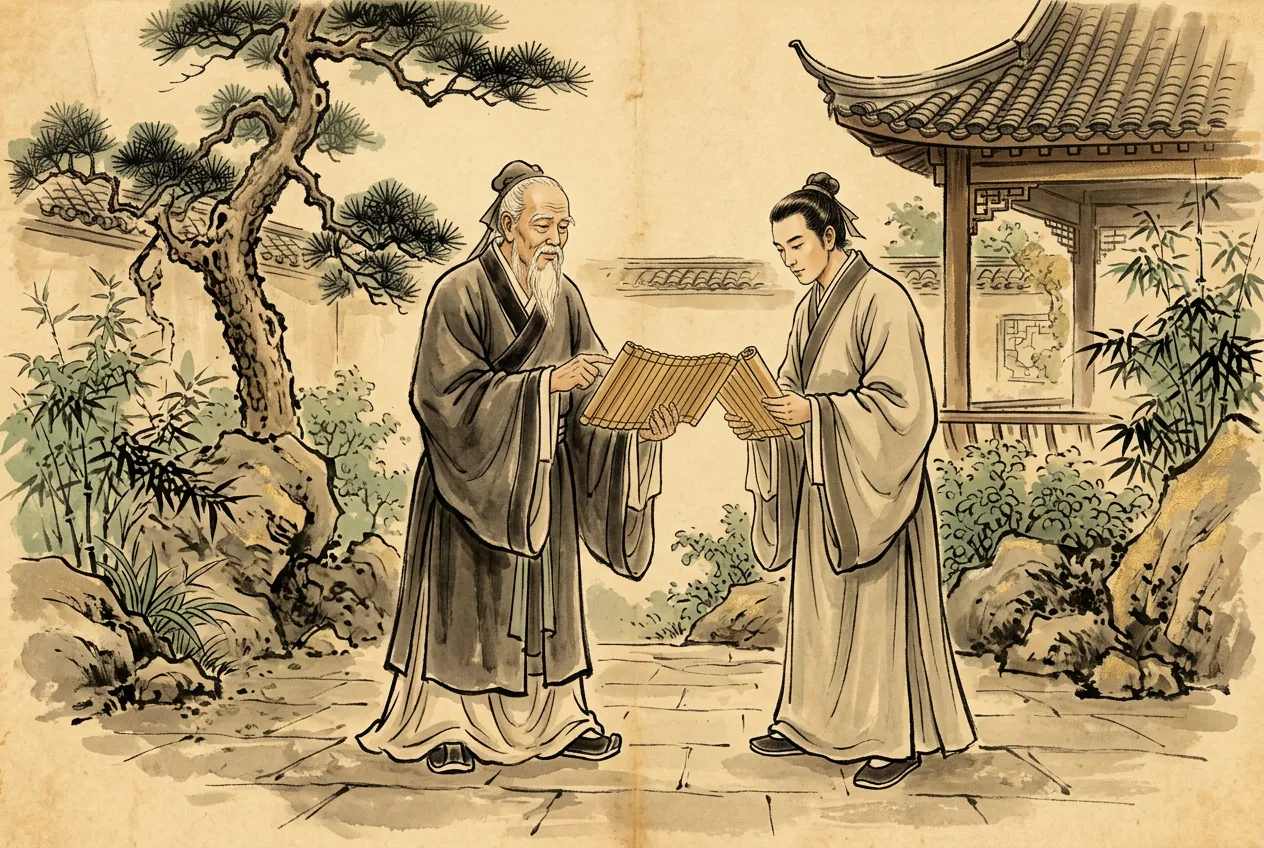
The original. Chen Village style retained the explosive power, low stances, and alternating tempos of Chen Wangting’s system. It is characterised by silk-reeling energy, visible coiling movements, and the contrast between slow, meditative sections and sudden fast strikes.
Chen style remained a closely held family art until the 19th century, when it was taught to an outsider for the first time — an event that would change the entire history of the art.
Yang Style (楊式)
Yang Luchan (楊露禪, 1799–1872) is one of the most important figures in tai chi history. Born in Yongnian County, Hebei Province, he is credited as the first non-Chen-family member to learn Chen-style tai chi, reportedly studying under Chen Changxing (陳長興) in Chen Village.
Yang Luchan subsequently moved to Beijing, where he taught tai chi — reportedly including to imperial household guards — and his skill earned him the nickname “Yang the Invincible” (楊無敵). In Beijing, he modified the Chen system into what became Yang-style: a more flowing, rounded form with higher stances that made it accessible to a wider population.
His grandson Yang Chengfu (楊澄甫, 1883–1936) standardised what we recognise as Yang-style tai chi today. Yang Chengfu’s form — characterised by large, flowing, even movements — became the most widely practised tai chi form in the world. The Yang-24 form created by the Chinese Sports Commission in 1956 is a simplified version of Yang Chengfu’s standardised sequence.
For a detailed account of the Yang family’s role, see our article on the Yang family lineage.
Wu/Hao Style (武/郝式)
Wu Yuxiang (武禹襄, 1812–1880) learned from Yang Luchan and also briefly studied with Chen Qingping, a Chen-family practitioner of a different Chen form (Xin Jia, the small frame). From this synthesis he developed Wu/Hao style — a compact, internal system focused on fine sensitivity and sophisticated internal energy work rather than large external movements.
Wu/Hao style is the least widely practised of the five major styles, but it had a significant theoretical influence: Wu Yuxiang wrote extensively on tai chi principles, and his theoretical writings form part of the classical tai chi canon.
Wu Style (吳式)
Wu Quanyou (吳全佑, 1834–1902) was a Manchu military officer who studied with Yang Luchan’s son, Yang Banhou. His son Wu Jianquan (吳鑑泉, 1870–1942) refined and popularised the style that bears the family name — Wu style.
Wu style is characterised by a slight forward lean of the torso, softer and more compact movements than Yang style, and a reputation for exceptional sensitivity in push hands practice. It is particularly popular in Hong Kong and the broader Chinese diaspora.
Sun Style (孫式)
Sun Lutang (孫祿堂, 1861–1932) was already a master of both Xing Yi Quan and Bagua Zhang when he studied with Hao Weizhen, a successor to Wu Yuxiang’s Wu/Hao lineage. Sun Lutang synthesised elements of all three internal martial arts into Sun style.
Sun style is distinctive for its “follow step” footwork (in which the rear foot follows the front foot with each step), the lively and compact nature of its movements, and an open-and-close breathing coordination pattern. It is widely regarded as particularly suitable for older practitioners and those with joint issues, partly because of its agile footwork and high stances.
How Tai Chi Spread Globally
For most of its documented history, tai chi was a regional Chinese practice. The transformation into a global phenomenon happened in stages.
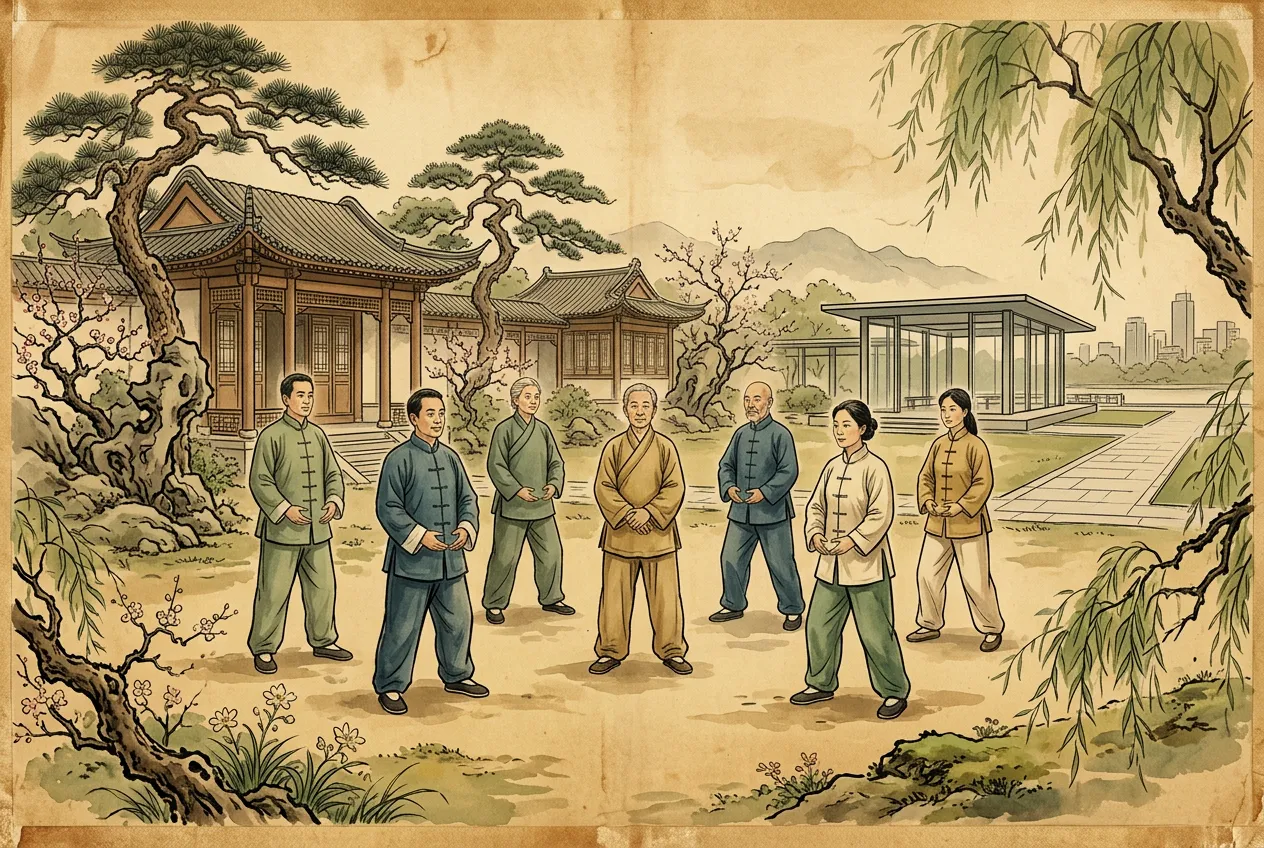
Yang Luchan’s teaching in Beijing in the mid-19th century was the first major dissemination beyond Chen Village. Yang Chengfu’s teaching in Shanghai and across China in the 1920s and 1930s was the second wave. When Yang Chengfu published his 1934 book The Complete Principles and Practice of Tai Chi Chuan, it gave the art a documented, teachable form for the first time.
The founding of the People’s Republic of China in 1949 had a profound effect on tai chi’s trajectory. The Chinese government identified tai chi as a cultural and health asset and commissioned the standardisation of practice — the most visible result being the Yang-24 form (1956), developed by a committee that simplified Yang Chengfu’s long form into a sequence accessible to the general public without any martial arts background.
This standardised form was then taught through Chinese schools, parks, and physical education programmes — reaching literally millions of people within years. When Chinese communities emigrated to the United States, Europe, and Southeast Asia during the mid-20th century, they brought tai chi with them. By the 1970s and 1980s, tai chi classes were appearing in community centres across the Western world.
Today the World Tai Chi and Qigong Day organisation reports tai chi is practised in over 80 countries. The World Taijiquan Federation promotes competitive tai chi internationally. The explosion of research into tai chi’s health benefits — particularly for balance, fall prevention, and stress — from the 1990s onward gave the art a credibility in Western medical culture that accelerated its adoption further.
For a deeper exploration of how philosophical principles from Taoism shaped the practice, see our article on tai chi philosophy and Taoism.
What This History Means for Practice
Understanding tai chi’s origins changes how you approach practice. Knowing that the smooth, flowing Yang-24 form you might learn in a local class is a 1956 simplification of a form that traces back through Yang Chengfu to Yang Luchan to Chen Village is humbling. Every movement carries that lineage.
Understanding that the art was originally a martial system — and that its distinctive principles of yielding, adhering, and following came from combat analysis — gives the slow movements their proper weight. Cloud Hands is not just a relaxing meditation movement. It is a sophisticated evasion and counter-attack refined over generations of martial practice.
None of this requires you to study tai chi as a fighting art. But holding the lineage lightly in mind — knowing what the movements were and why they evolved the way they did — deepens practice in a way that purely physical instruction cannot.
For context on how tai chi fits within Chinese philosophy’s broader framework, see our guide to what tai chi is.
To explore the specific styles in detail and understand their differences, see our tai chi styles comparison.
Browse the full collection of history and philosophy articles at our tai chi history section.
Frequently Asked Questions
Who really invented tai chi?
The honest answer is we don’t know for certain. The legend attributes tai chi to Zhang Sanfeng, a Taoist figure. The documented history traces the art to Chen Wangting (c. 1600–1680) of Chen Village, Henan Province. Most tai chi historians accept Chen Wangting as the earliest verifiable source, while acknowledging that his own synthesis drew on earlier Chinese martial arts traditions.
How old is tai chi?
If we accept the Chen Wangting origin, tai chi as a coherent art is approximately 350–400 years old. The Zhang Sanfeng legend would place it earlier (Song or early Ming Dynasty), but this attribution lacks historical documentation. The movement practices that influenced Chen Wangting are older still.
Is Yang style or Chen style the original tai chi?
Chen style is the older documented style. Yang style developed from Chen style — Yang Luchan learned from Chen Changxing in the 19th century. However, the Yang-style form that most people practise today is an evolution and simplification that occurred over several generations; it is not simply “Chen style made slow.”
Are all five styles authentic tai chi?
Yes. All five major styles — Chen, Yang, Wu/Hao, Wu, and Sun — trace documented lineages to verifiable historical figures and share the core principles of tai chi (rooting, silk-reeling or continuous connection, yin-yang alternation, yielding). They are all legitimate transmissions of the art.
Why did China standardise tai chi in 1956?
The Chinese government standardised the Yang-24 form to make tai chi accessible to the general population as a health practice. The original family styles required years of study to learn and had no standardised curriculum. The 24-form reduced the barrier to entry enormously, which is why it became — and remains — the most widely practised tai chi form in the world.