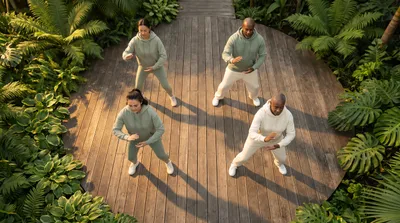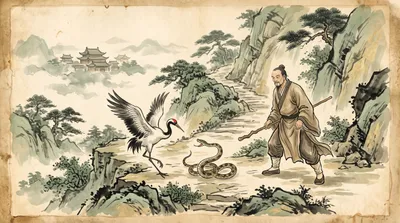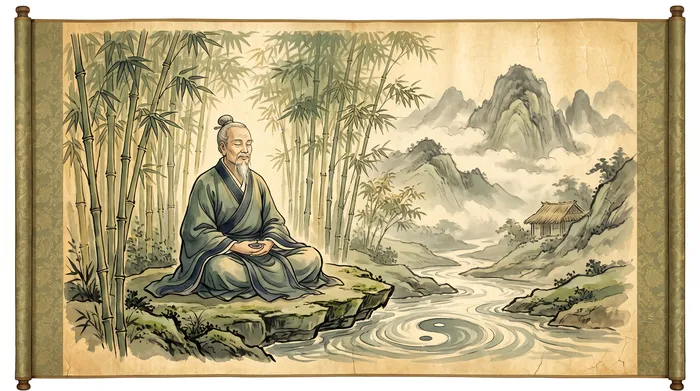
Tai chi is not a philosophy course that happens to involve movement. It is a physical practice that embodies philosophical ideas — so thoroughly that the movement and the philosophy cannot be separated without losing something essential from both.
I have found that understanding even a little Taoist philosophy changes how tai chi feels from the inside. The concepts stop being abstract labels and start describing what you are actually trying to do with your body. The yin-yang symbol stops being a decorative image and starts describing the weight shift in every step.
This article does not require any background in philosophy. It requires only a willingness to take Taoist ideas seriously — as a coherent and sophisticated way of understanding the world, not as an exotic Eastern curiosity.
The Tao: What Tai Chi Is Trying to Align With
The word “Tao” (道) is typically translated as “the Way” — though every translator who has worked with it notes that translation immediately falls short. Lao Tzu’s Tao Te Ching, the foundational Taoist text (traditionally dated to the 6th century BCE, though modern scholarship places it later), opens with a paradox: “The Tao that can be named is not the eternal Tao.”
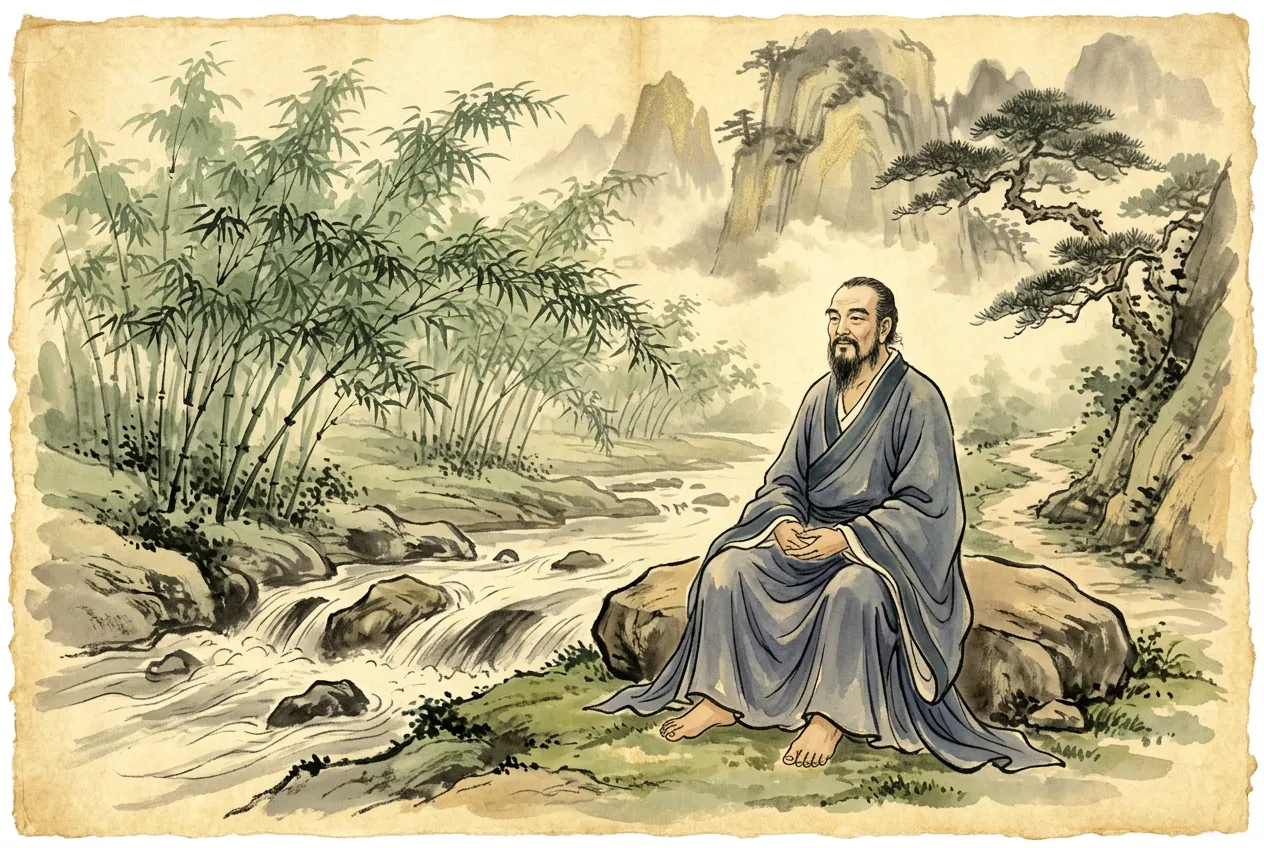
What Taoism describes as the Tao is the underlying principle of existence — the process by which things arise, change, and return. It is not a deity. It is not a moral code. It is closer to what physicists might call the fundamental laws of nature, except that Taoism arrives at this through observation of natural patterns rather than mathematical abstraction.
The relevant point for tai chi practitioners is this: Taoist philosophy holds that human beings can either move with the Tao (achieving harmony, efficiency, and a kind of effortless power) or against it (achieving friction, exhaustion, and eventual failure). Tai chi is, among other things, a physical method for practising alignment with the Tao.
In my practice, the clearest way I have felt this is in moments when a movement suddenly stops feeling effortful. When the weight shift in Wave Hands Like Clouds settles into the right tempo and the arms move in response rather than leading — there is a quality of ease in that moment that stands in contrast to when I am pushing the movement rather than following it. Whether you want to call that “aligning with the Tao” or simply “moving efficiently,” the phenomenological experience is the same.
Yin and Yang: The Engine of Movement
The yin-yang symbol (taijitu — literally “diagram of the supreme ultimate”) is so ubiquitous that it has become almost meaningless as a symbol. In the context of tai chi, it is not a decoration. It is a description of how the practice works.
Yin and yang are complementary, mutually dependent opposites: dark and light, heavy and light, yielding and firm, full and empty, slow and fast. The crucial point is that they are not static opposites — they are dynamic processes. The seed of yin is within yang; the seed of yang is within yin. Each contains and generates the other.
In tai chi movement, this shows up constantly:
- Every weight shift moves from yin (empty/light) to yang (full/weighted) in one leg as the opposite leg simultaneously shifts from yang to yin.
- Every extension of a push contains the preparation for the pull back.
- Every moment of firmness (peng — ward off energy) has a yielding quality within it; every moment of yielding has a firm rooting beneath it.
The technical vocabulary of tai chi’s eight gates (ba men) is structured around yin-yang pairs: Ward Off (Peng) and Roll Back (Lu), Press (Ji) and Push (An), Pull Down (Cai) and Split (Lie), Elbow Strike (Zhou) and Shoulder Strike (Kao). These are not eight separate techniques — they are four complementary pairs, each pair itself a yin-yang relationship.
Learning to feel rather than think yin and yang is, in my experience, one of tai chi’s core developmental challenges. The conceptual understanding comes quickly. The embodied understanding — actually sensing when your weight is fully committed versus when you are balancing between two legs, neither full nor empty — takes considerably longer.
Wu Wei: Effortless Action
Wu wei (無為) is often translated as “non-action,” but this translation misleads as often as it helps. A better translation might be “effortless action” or “action that does not force.”
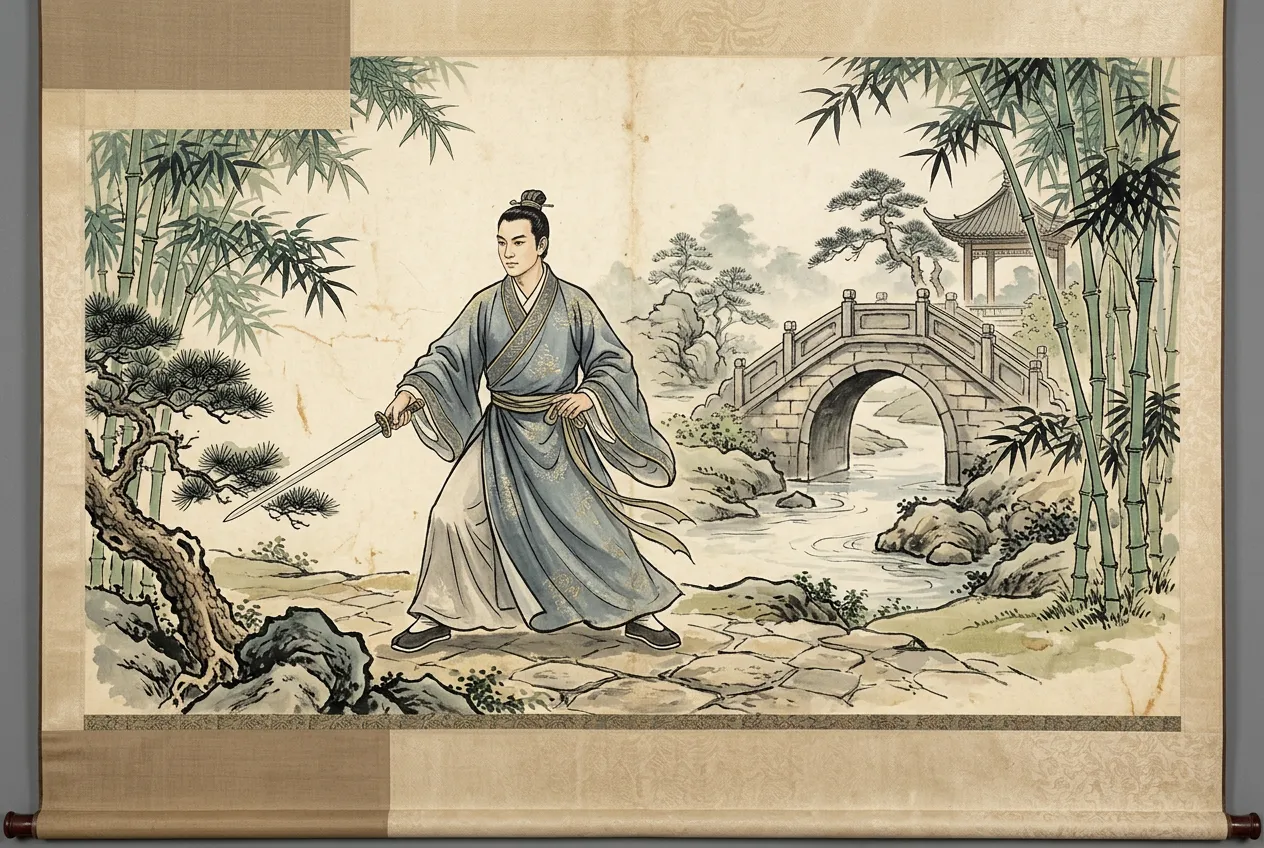
Wu wei does not mean passivity. It means acting in accord with the natural situation rather than imposing force onto it. Water provides the classic Taoist illustration: water does not fight the rocks in its path. It finds the way around, over, or through — and in time, it carves new channels without ever resisting directly. The Tao Te Ching describes this as the most powerful force in existence.
In tai chi’s martial context, wu wei means not meeting force with force. When a push comes toward you, the wu wei response is to yield, redirect, and return the force — not to brace against it or push harder. In push hands (tui shou) practice, the clearest sign of wu wei is when a practitioner’s response to incoming force appears to require no effort: the force simply goes somewhere other than where it was aimed.
In health and movement practice, wu wei shows up as the quality of not muscling through movements. Tai chi done with wu wei has a different quality from tai chi done with effort — lighter, more continuous, more responsive. This is also why tai chi practice develops sensitivity rather than just strength.
The I Ching and Tai Chi’s Theoretical Structure
The I Ching (易經, “Book of Changes”) predates Taoism as a formal philosophy, but Taoist thought incorporated it deeply. The I Ching is built on the observation that all phenomena arise from the interaction of yin and yang through eight trigrams (ba gua) and their 64 combinations (hexagrams).
The connection to tai chi is direct: tai chi’s eight fundamental energies (the ba men gates mentioned above) map onto the eight trigrams of the I Ching. The five footwork directions (wu bu) map onto the five phases or elements (wu xing). Together, the eight energies and five directions give 13 postures — a term used in some classical tai chi texts to describe the entire art’s foundation.
This is not numerological mysticism. It is a mapping of practical martial principles onto an existing philosophical framework that helped Chinese practitioners understand and transmit the art’s underlying logic. The I Ching’s framework provided a vocabulary for describing energy relationships that didn’t have obvious parallels in ordinary descriptive language.
The Tao Te Ching’s Influence on Tai Chi Principles
Several passages from the Tao Te Ching read, in retrospect, like direct descriptions of tai chi principles.
Chapter 78 states: “Nothing in the world is as soft and yielding as water. Yet for dissolving the hard and inflexible, nothing can surpass it.” This is the philosophical basis for tai chi’s central martial principle: yielding overcomes force.
Chapter 22 states: “Yield and overcome. Bend and be straight.” This describes what happens in push hands when a practitioner yields to incoming force and returns it.
Chapter 16 describes the movement of return, of things returning to their root — which maps onto tai chi’s emphasis on maintaining root (connection with the ground) and always returning to the centre.
Whether the Tao Te Ching directly influenced Chen Wangting’s development of tai chi, or whether tai chi practitioners in later centuries found these parallels and used them to articulate what the practice was doing, is debated. Both are probably true to some extent. What is clear is that the Taoist philosophical framework provides tai chi with its most coherent theoretical foundation.
How Philosophy Manifests in Practice
Understanding the philosophy is useful. But tai chi is ultimately a physical practice, and the philosophical ideas only become real when they show up in the body.
A few concrete examples:
Yin-yang in the stance: When you stand in a basic tai chi stance, one leg should be full (yang — bearing the majority of the weight) and the other empty (yin — light, ready to move). Practitioners who stand with weight equally distributed between both legs are “double-weighting” — a common error that the classical texts criticise specifically. The yin-yang principle makes the correction obvious: pick a leg and commit to it.
Wu wei in the arms: In many tai chi movements, the arms are led by the torso and waist rotation rather than driven independently by shoulder muscles. When this works, the arms feel light and follow the body’s rotation. When it doesn’t, you can feel the shoulder muscles working unnecessarily. The wu wei principle names what you are aiming for: arms that move in response to the body’s natural rotation, not arms that impose their own force.
The Tao in continuous movement: Classical tai chi texts describe the ideal practice as “one movement from beginning to end” — a continuous thread of motion without sharp stops. This is the Taoist principle of flow made physical. The pauses that beginners often insert between movements are not just technical mistakes; they interrupt the very quality the practice is trying to develop.
For a deeper exploration of the wuji concept — the undifferentiated state before yin and yang — that forms the foundational position in tai chi, see our article on the wuji concept. For the documented history of how tai chi developed, see our history of tai chi origins.
To understand how tai chi is practised as moving meditation today, visit our tai chi meditation guide. For a grounding in what tai chi actually is, see our what is tai chi guide.
Browse all philosophy and history articles at our tai chi history section.
Frequently Asked Questions
Do I need to be Taoist to practise tai chi?
No. Tai chi’s philosophical background enriches practice, but it does not require religious belief or commitment to Taoism. Many people practise tai chi purely for health, movement quality, or stress relief with no particular interest in Taoist philosophy. The principles work regardless of whether you engage with their philosophical origins.
What is the connection between tai chi and Taoism?
Tai chi was developed within a cultural context shaped by Taoist philosophy, and its theoretical frameworks — yin-yang, wu wei, the Tao — are central to how practitioners understand and describe what the practice is doing. The martial and health principles of tai chi are articulated through Taoist philosophical vocabulary. They are inseparable in theory, though practitioners can engage with the physical practice without the philosophical framework.
What is yin-yang in the context of tai chi practice?
In tai chi, yin and yang describe the quality of movement and weight distribution at any moment: a full weighted leg is yang, an empty unweighted leg is yin. A firm outward energy (peng) is yang; a yielding, absorbing energy (lu) is yin. Every movement involves continuous transitions between these qualities. The skill of tai chi lies partly in developing sensitivity to these transitions — knowing when you are full and when you are empty.
Is the Tao Te Ching a tai chi text?
Not in the strict sense — the Tao Te Ching predates tai chi as a martial art by centuries. But Taoist philosophical frameworks, including ideas from the Tao Te Ching, are deeply embedded in classical tai chi theory. The connections are genuine and were consciously drawn by tai chi theorists. Reading the Tao Te Ching with tai chi in mind is often illuminating.
What is wu wei in practical terms for tai chi?
In tai chi practice, wu wei refers to the quality of moving without forcing — letting movements arise from structural alignment and the body’s natural momentum rather than muscular effort. In push hands, wu wei describes yielding to incoming force rather than resisting it. The practical result is movement that looks effortless because it largely is: the practitioner is working with the body’s natural mechanics rather than against them.