Before movement, there is stillness. Before form, there is formlessness. Before yin and yang, there is wuji.
The concept of wuji (無極, pronounced “woo-jee”) sits at the philosophical foundation of tai chi, and understanding it transforms the practice from a sequence of movements into something with genuine depth. Wuji is not an abstract concept to be filed away in a philosophy appendix. It is a principle that tai chi practitioners embody at the start of every session, in the wuji stance — standing still, formless, before the form begins.
This article traces wuji from its Taoist cosmological origins through to its practical application in tai chi. We’ll look at the classical texts, the historical transmission of the concept, and what it means when a teacher tells you to “stand in wuji” before beginning the form.
Wuji in Taoist Philosophy: Before Yin and Yang
The character 極 (jí) refers to a ridgepole — the central beam of a traditional Chinese roof, around which everything is organised. Wu (無) means “without” or “non-.” So wuji literally means “without ridgepole” — a state without the central axis around which things are structured. In Taoist cosmological terms: the state before distinction, before organisation, before duality.
The concept appears in classical Chinese thought as the precondition for the emergence of taiji (太極) — the Supreme Ultimate, the dynamic interplay of yin and yang that generates all phenomena. The Tao Te Ching, the foundational Taoist text attributed to Laozi, opens with a description of the formless source: “The Tao that can be named is not the eternal Tao.” Wuji is that unnamed, unformed source — the void from which taiji emerges.
The cosmological sequence, as described in the I Ching (Book of Changes) and elaborated in Neo-Confucian thought, runs: wuji → taiji → yin and yang → the ten thousand things. Each step is a differentiation — an introduction of distinction into formlessness. Wuji is the starting point of all existence.
The Song dynasty philosopher Zhou Dunyi (1017–1073) wrote the “Taijitu shuo” (Explanation of the Diagram of the Supreme Ultimate), which became a key text in Neo-Confucian and later Taoist metaphysics. His opening line — “Wuji er taiji” (Wuji and yet Taiji) — has been interpreted and debated for centuries. The paradox at its heart: how can the limitless give rise to the limited? How can formlessness produce form? This tension is not resolved in the philosophy; it is held, explored, and practised. It is precisely the kind of tension that tai chi embodies.
I came to these philosophical layers through practice rather than through study. I remember reading about wuji early in my tai chi journey and finding it abstract to the point of frustration. It was only years later, after many hours of standing practice, that the concept stopped feeling like words and started feeling like something I’d actually touched. That’s how tai chi philosophy tends to work — it becomes experiential before it becomes intellectual.
The Wuji Stance: Stillness as Practice
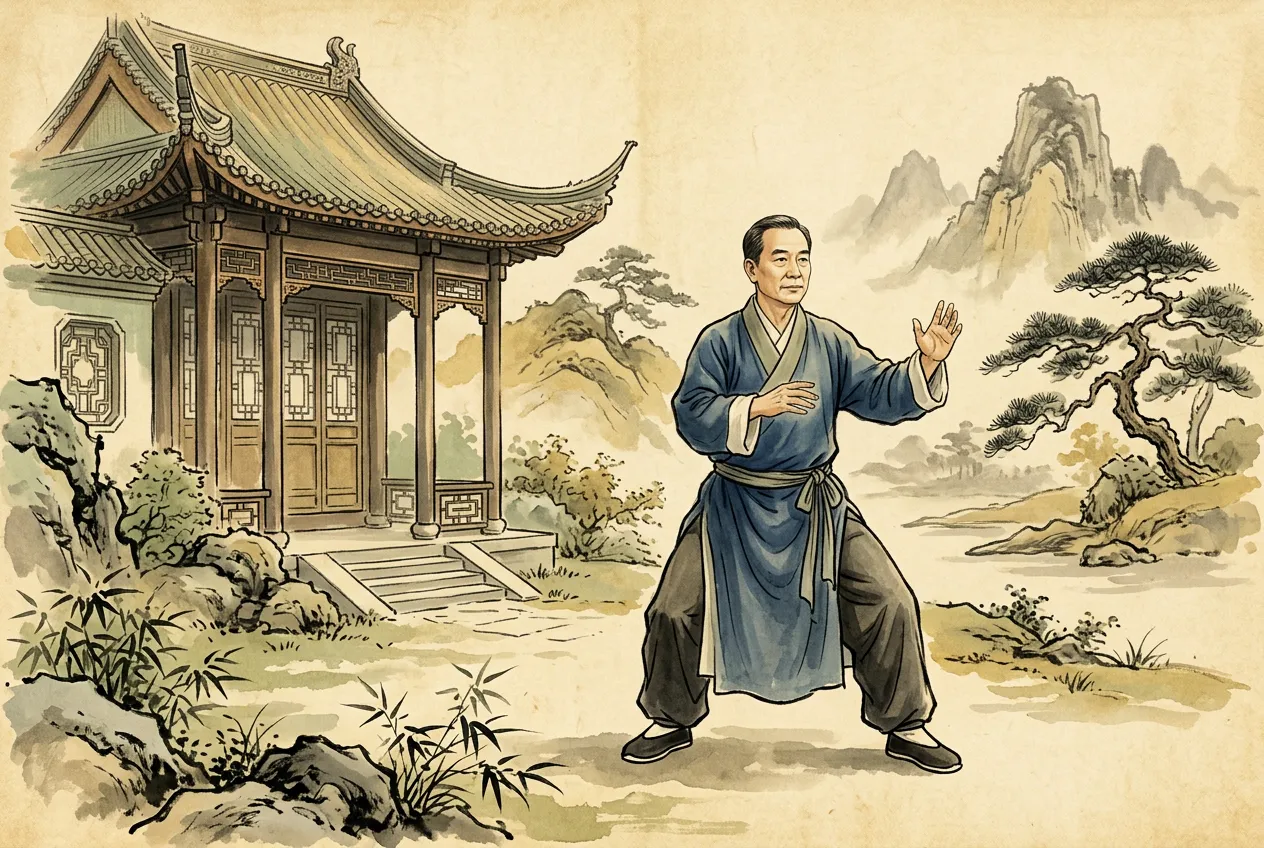
In tai chi, wuji is not just a concept — it is a posture. The wuji stance is the standing position from which the form begins and to which it returns at the end. In Yang style, it is the starting position of the 24-form commencement — feet together or shoulder-width apart, arms hanging naturally, eyes forward, mind still.
But calling it simply a “standing position” undersells what it is.
The wuji stance is a form of standing meditation — what Chinese practice calls zhan zhuang (站樁), meaning “standing like a post.” In this position, the practitioner is neither active nor passive. They are present, gathered, grounded. The body is alive with subtle micro-adjustments — maintaining upright alignment, distributing weight evenly, keeping joints neither locked nor collapsed. The mind is neither projected outward nor withdrawn inward. It is alert and still simultaneously.
This is the embodiment of wuji: a dynamic stillness before differentiation into movement.
The wuji stance in tai chi serves several practical functions alongside its philosophical significance:
Centering and settling: Standing in wuji before practice allows the practitioner to leave behind the fragmented attention of daily life. It is a transition into a different quality of presence.
Postural alignment: The wuji stance requires — and teaches — proper skeletal alignment. Head floats at the top of the spine, shoulders release, knees are soft, weight distributes evenly through both feet. This is the alignment from which all tai chi movement originates.
Cultivating yi (intent): In classical tai chi theory, yi (intention or mental focus) precedes qi (vital energy) and qi precedes movement. Standing in wuji before the form is the cultivation of yi before action — an internal preparation that is as important as the physical one.
For a more detailed exploration of the practice side of this, the tai chi standing meditation article covers zhan zhuang as a standalone practice with its own benefits.
Wuji and Taiji: The Relationship Between the Two
Understanding wuji requires understanding its relationship to taiji (太極), because the two concepts define each other.

Taiji — often translated as the “Supreme Ultimate” — is the primordial unity that contains both yin and yang in dynamic tension. The familiar yin-yang symbol is the visual representation of taiji: two opposites, each containing a seed of the other, continuously rotating into each other. This is the principle of tai chi (taijiquan) as a martial art and health practice — the cultivation and expression of dynamic balance between opposing forces.
Wuji is prior to taiji. If taiji is the dynamic interplay of yin and yang, wuji is the state before that interplay begins — the undifferentiated potential from which yin and yang arise. In cosmological terms, wuji is the source; taiji is the first principle that emerges from the source.
In tai chi practice, this relationship is experienced directly in the transition from the wuji stance to the beginning of the form. The practitioner stands in wuji — still, undifferentiated, neither yin nor yang, neither full nor empty. Then the form begins: weight shifts, one leg becomes substantial while the other becomes insubstantial, yin and yang emerge. Taiji has arisen from wuji. The cosmological principle is enacted in the body.
The tai chi philosophy and Taoism article explores the broader philosophical context — including how yin and yang principles operate throughout the form — if you want to continue following this thread.
Historical Transmission into Tai Chi
How did wuji, a Taoist cosmological concept, enter the technical vocabulary of a martial art?
The transmission runs through classical tai chi texts. The “Taijiquan Classics” — a collection of foundational texts attributed to various masters in the tai chi tradition — repeatedly invoke cosmological principles, including wuji and taiji, as the theoretical basis for the practice. While the precise authorship and dating of these texts is historically contested, they represent a coherent integration of Taoist philosophy with martial and health practice.
The Wikipedia article on the Tai Chi Classics provides a useful overview of these texts and their transmission. The integration was not incidental — it was foundational to how tai chi was taught and understood.
This philosophical grounding is part of what distinguishes tai chi from other martial arts and from general exercise. The cosmological framework is not decoration. It is a theoretical system that shapes how practitioners understand their own movement, their relationship to gravity, force, and intention, and the purpose of the practice as a whole.
Wuji in Contemporary Tai Chi Practice
For most contemporary tai chi practitioners, wuji is encountered first as a posture, then gradually — if the practice goes deep enough — as an experiential understanding.

The wuji stance is present in virtually every tai chi class, even when it is not named or explained. Teachers who say “stand quietly before we begin” are invoking the principle even without the philosophical framework. The act of gathering attention, settling the body, and pausing before movement is a practice of wuji.
Some teachers emphasise wuji explicitly as a practice in itself — standing for extended periods (five to thirty minutes) before the form begins. This is closer to the zhan zhuang tradition and can be a profound practice in its own right: the mind settling, the breath deepening, the body finding its natural plumb line. The effort is effortless; the activity is stillness.
In my years of practice, I have come to think of the wuji principle not just as the opening of the form but as the quality of presence that the whole practice is trying to develop. The form is not about producing movements; it is about moving from a state of wuji — still, centred, present — through differentiation and back to stillness. Every form ends where it begins: standing quietly, the movement returned to formlessness.
That is the practice. Wuji is not just where you start. It is what you are practising.
What Is Wuji?
Wuji is the Taoist concept of the undifferentiated, formless state that exists before yin and yang separate — in tai chi, it names both this cosmological idea and the physical standing posture practitioners take at the very start and end of the form. The two senses are not separate meanings that happen to share a word; the posture is meant to be a direct physical embodiment of the philosophical state, not a stance that merely borrows its name. I find that distinction is the one most explanations skip, and it’s the one that actually changes how the opening stillness feels once you understand it.
Why Do Tai Chi Forms Begin in Wuji?
Tai chi forms begin in the wuji stance because the practice is designed to enact, in the body, the same movement from stillness into differentiation that Taoist cosmology describes — standing still before the first posture is not a formality or a countdown, it is the philosophical starting point made physical. When the form’s first weight shift occurs and one leg becomes substantial while the other becomes insubstantial, that is taiji arising out of wuji, played out in real time rather than described in a text. In my own practice, that opening stillness stopped feeling like “waiting to start” once I understood it as the actual beginning of the practice, not a pause before it.
Frequently Asked Questions
What does “wuji” literally mean?
Wuji (無極) is composed of two characters: wu (無), meaning “without” or “non-,” and ji (極), meaning “ridgepole” or “ultimate.” The literal translation is “without ridgepole” — a state without the central axis that organises structure. In philosophical usage, it is typically translated as “limitless,” “boundless,” or “the infinite void” — the state before any form or distinction arises.
What is the difference between wuji and taiji?
In Taoist cosmology, wuji is the undifferentiated state before form — pure potentiality without distinction. Taiji (the Supreme Ultimate) is the first principle that arises from wuji: the dynamic interplay of yin and yang, the polarised duality from which all phenomena emerge. Wuji is prior to and contains taiji. In tai chi practice, the wuji stance embodies undifferentiated stillness; the form embodies the taiji principle of continuous yin-yang balance.
Is the wuji stance the same as zhan zhuang (standing meditation)?
They overlap significantly. The wuji stance as practised in tai chi — standing still before the form begins — is a brief form of zhan zhuang. Dedicated zhan zhuang practice extends this standing into a substantial meditation practice in its own right, sometimes held for twenty to thirty minutes or more. Both share the principle of cultivating presence, alignment, and internal awareness through stillness.
Where does the concept of wuji appear in classical texts?
The concept has roots in the Tao Te Ching attributed to Laozi, appears in the I Ching (Book of Changes), and was elaborated in the “Taijitu shuo” by Song dynasty philosopher Zhou Dunyi. Within tai chi specifically, wuji is referenced in the Taijiquan Classics — the foundational texts of the tai chi tradition — as the source state from which the form’s dynamic movement arises.
Do all tai chi styles incorporate the wuji concept?
The wuji stance is present in most major styles, though it is given different emphasis. Yang style is probably the most explicit in naming and teaching the wuji principle as part of form instruction. Chen style tends to integrate the principle differently, with less separation between the wuji starting position and the beginning of movement. Sun and Wu styles also incorporate the concept. Regardless of style, standing quietly and centred before the form begins reflects the wuji principle, whether named or not.