Standing still is the hardest thing in tai chi, and almost nobody does enough of it.
Zhan zhuang — usually translated as “standing like a post” or “pole standing” — is the practice of holding a static posture for an extended period. It looks like nothing at all from the outside. Internally it is demanding enough that five minutes is a genuine achievement for a beginner, and the practitioners who take it seriously tend to be the ones whose form looks most convincing.
This guide covers the main postures, what standing actually trains, and how to build a practice that you will keep doing.
What Standing Practice Is
The practice is simple to describe. You adopt a posture, you hold it, and you stay relaxed while doing so. There is no movement, no counting of repetitions, and no obvious progression except duration.
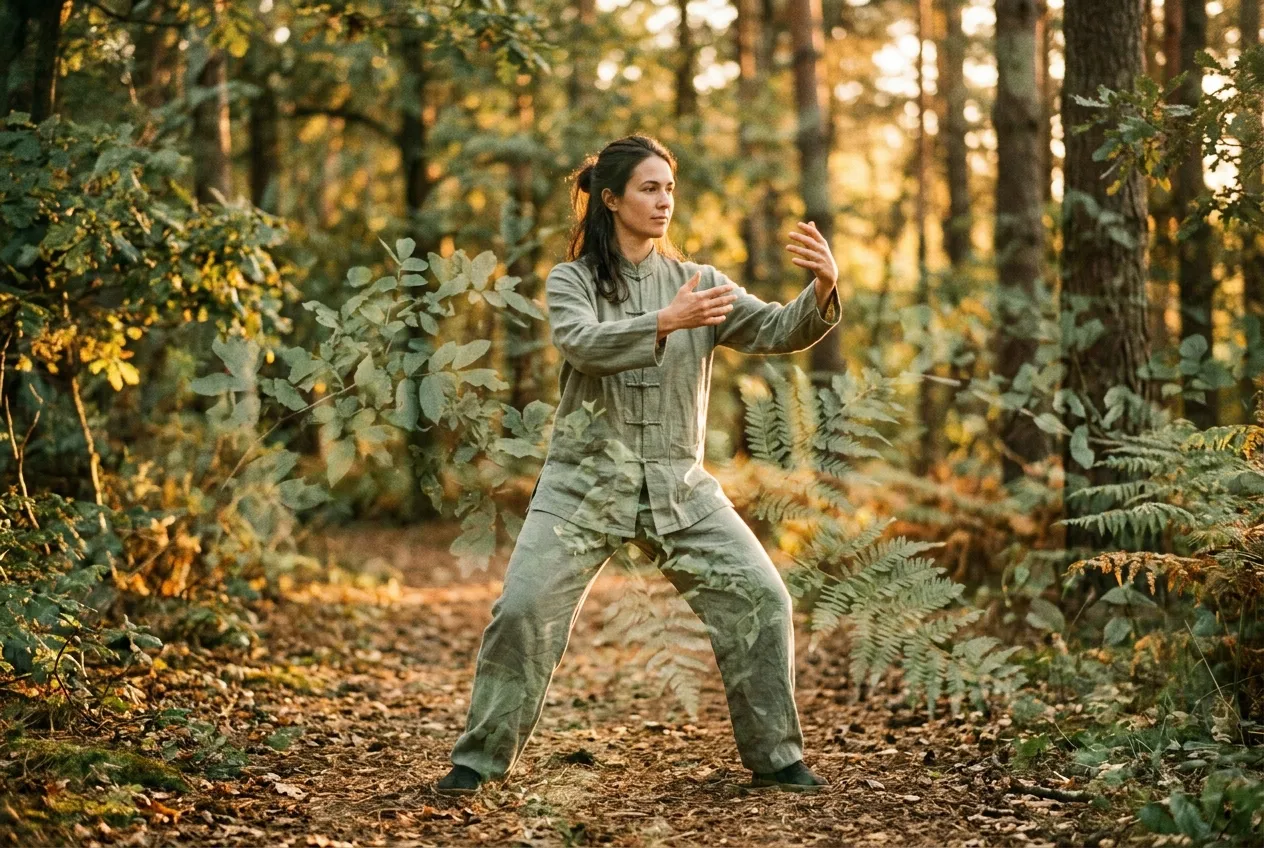
It comes from the wider Chinese internal arts rather than from tai chi specifically. Yiquan, an art derived from xingyiquan in the twentieth century, made standing its central method and did more than anything to popularise it. Chen village training includes extensive standing work, and most serious tai chi schools include some, though many health-oriented classes skip it entirely.
The relationship to the form is direct. Every posture in a tai chi form is a moment of the standing practice, passed through rather than held. Standing isolates the structural requirements — alignment, relaxation, weight distribution — from the additional demands of moving and remembering, and trains them on their own.
The Main Postures
Wuji Standing
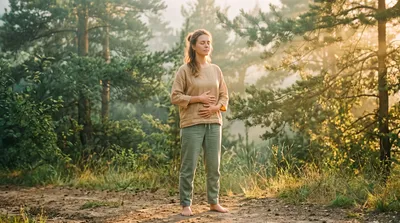
The simplest and the place to start. Feet parallel and shoulder-width apart, knees soft and unlocked, arms hanging at the sides, spine long, head balanced as if suspended from above, eyes soft or closed.
This is the posture the form begins and ends in, and its name points to the wuji concept — the undifferentiated state before movement and division. Nothing about it looks like exercise. Holding it attentively for ten minutes is nonetheless demanding.
Holding the Ball
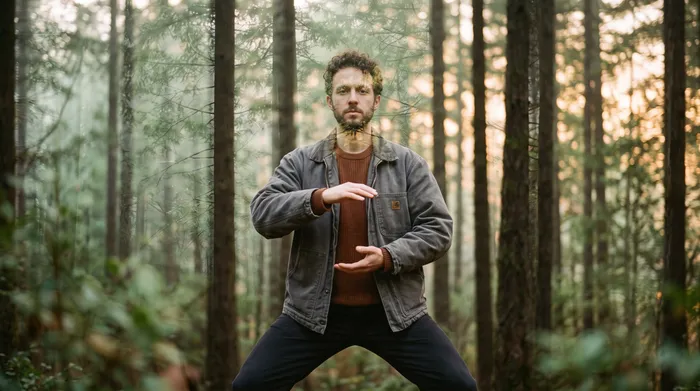
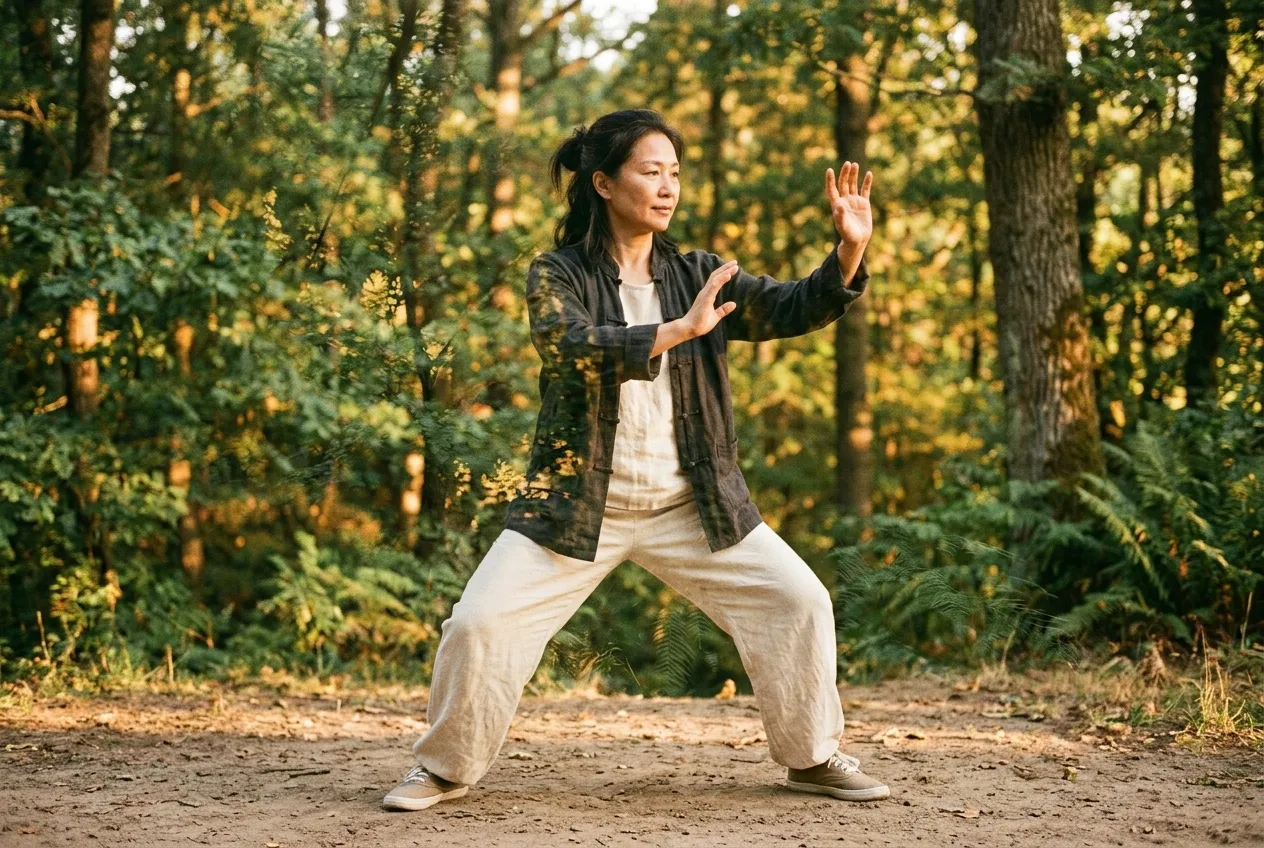
The classic standing posture, and the one usually meant when people say zhan zhuang. From the wuji position, raise the arms in front of the chest as though holding a large, light ball — elbows slightly lower than the wrists, shoulders down, fingers gently spread, a space under each armpit as though holding an egg.
Arm position varies by school: lower at abdomen height, at chest height, or higher. Chest height is the standard version and is quite hard enough.
Holding the Ball, Lower
The same arm position with a deeper knee bend. This substantially increases the leg loading and is used for building strength. It should be added only once the higher version is comfortable for ten minutes or more.
Single-Weighted Standing
Weight almost entirely on one leg, the other foot resting lightly, arms in one of the form’s positions. This is closer to what the form actually demands, and it exposes the balance strategies you rely on without noticing.
Getting the Posture Right
More detail on the holding-the-ball position, since almost all the common faults live here.
Feet. Parallel, shoulder-width, weight spread evenly across the whole foot rather than concentrated on the heels or the balls. A useful check: you should be able to lift and wiggle your toes without your balance changing. If you cannot, you are gripping the floor.
Knees. Unlocked and slightly bent, tracking over the direction of the feet. Not pushed forward past the toes. The bend can be very slight — the depth is not the point at this stage.
Pelvis. Neutral, with the tailbone dropped slightly rather than tucked hard or allowed to tip back into an arched lower back. This is the adjustment most people get wrong, usually by over-tucking after being told to.
Spine and head. Long, with the sense of the crown of the head being gently suspended from above. The chin comes back very slightly as a result rather than being pulled in deliberately.
Shoulders. Down. Then, five minutes later, down again — they will have crept up without your noticing.
Arms. Rounded, elbows slightly below wrist height, hands roughly opposite the chest, fingers gently spread and slightly curved. Space under the armpits.
Breathing. Through the nose, into the abdomen, unforced. Do not count or control it beyond letting it settle.
A mirror helps initially, and a photograph or a short video from the side helps more — the sensation of being upright and the fact of being upright diverge more than anyone expects.
What Standing Trains
The value is not obvious from the outside, which is why the practice gets skipped.
Structural alignment. Held for long enough, a posture reveals every place where you are supporting yourself with muscular effort instead of with skeletal alignment. Those places start to ache, which is uncomfortable and also exactly the information you need.
Relaxation under load. The instruction to relax while holding a demanding position is a genuine paradox, and resolving it is most of the work. Standing teaches the difference between the tension that is holding you up and the tension that is merely habit.
Leg strength and endurance. Isometric loading of the quadriceps, glutes, and calves. Ten minutes in a moderate stance is real training, and the strength transfers directly to form practice.
Attention. Without movement to occupy the mind, standing becomes an attention practice by default. This is the element it shares with seated meditation, and the tai chi meditation article covers that overlap.
Breathing. Stillness makes the breath easy to observe and easy to slow. The breathing techniques guide covers the abdominal pattern that standing practice naturally settles into.
Sensitivity to your own body. Small internal shifts become perceptible when nothing external is happening. Practitioners describe noticing weight micro-adjusting between the feet, tension releasing in layers, and the sense of the body’s structure clarifying.
How Long to Hold
The honest progression is slower than most people expect.
Weeks 1-2. Two to three minutes, once a day. This will feel easy for the first minute and long by the third.
Weeks 3-6. Five minutes. Around here most people meet the first real barrier — shoulder burning in the holding-the-ball posture, and the strong urge to stop.
Months 2-3. Ten minutes. This is a reasonable long-term target and a genuinely productive daily practice.
Beyond. Twenty to thirty minutes is the range serious practitioners work in. Some traditions go considerably further, and there is no need to.
Two rules that matter. Build duration gradually — jumping from three minutes to fifteen produces sore shoulders and a practice you abandon. And hold the posture, not the tension: if the shoulders have crept up, lower them; if that means shortening the session, shorten it.
Standing is the part of my own practice I have most often let lapse, and reintroducing it is always instructive. The form quality improves within a fortnight, noticeably, which is a better argument for it than anything I could write here.
Working With Discomfort
Standing produces sensations that need interpreting, because some should be worked with and some should not.
Muscular burning, usually in the shoulders and thighs, is normal and is the training effect. Work with it — soften around it, breathe, and stop when it becomes the only thing you can attend to.
Trembling in the legs is common and normal, particularly in lower postures. It generally settles as the pattern establishes.
Heat, tingling, or heaviness in the hands and arms is very commonly reported. Traditional explanations attribute it to qi; the more prosaic reading is circulatory and neurological adaptation to a sustained unusual position. Either way it is benign.
Emotional restlessness — boredom, irritation, the urge to check the time — is the most common experience and the least discussed. It is the same phenomenon that arises in seated meditation.
Sharp or joint pain is not normal and means the posture is wrong. Knee pain usually means the knee is travelling past the toes or the stance is too low. Lower back pain usually means the pelvis is tilted and the lumbar spine is arched. Adjust rather than endure.
Building It Into Your Practice
Three approaches, all workable.
Before the form. Five to ten minutes of standing, then the form. The standing establishes the alignment and the settled attention that the form then carries. This is the most common arrangement and the one I would suggest.
As a separate session. Ten to twenty minutes on its own, at a different time of day. Suits people who want more standing than fits comfortably alongside form practice.
As the whole practice on some days. On days with little time, or when energy is low, standing alone is a complete practice and is arguably more valuable than a hurried form.
What matters more than the arrangement is that it happens at all. Standing is easy to postpone indefinitely because it produces no visible progress and no immediate satisfaction. The practitioners who do it consistently are recognisable in how they move, which is the only real advertisement it has.
The tai chi meditation article covers the attentional side in more depth, the wuji concept covers the philosophical background to the standing posture, and more practice guidance is collected in the tai chi practice section.