
The microcosmic orbit is the most famous meditation practice in the Daoist tradition, and one of the easiest to describe badly. Depending on the source, it is either the key to health and longevity, an advanced energetic technology requiring initiated instruction, or mystical nonsense. None of those descriptions helps someone who simply wants to know what the practice is and whether it is worth their time.
This is a grounded introduction: what the practice consists of, where it comes from, how to actually do a basic version, and an honest account of what can and cannot be claimed for it.
What It Is
The microcosmic orbit — xiao zhou tian, “small heavenly circuit” — is a breathing and attention practice in which awareness is circulated around a loop through the torso and head: up the spine from the base of the torso to the crown, and down the front midline back to the lower abdomen.
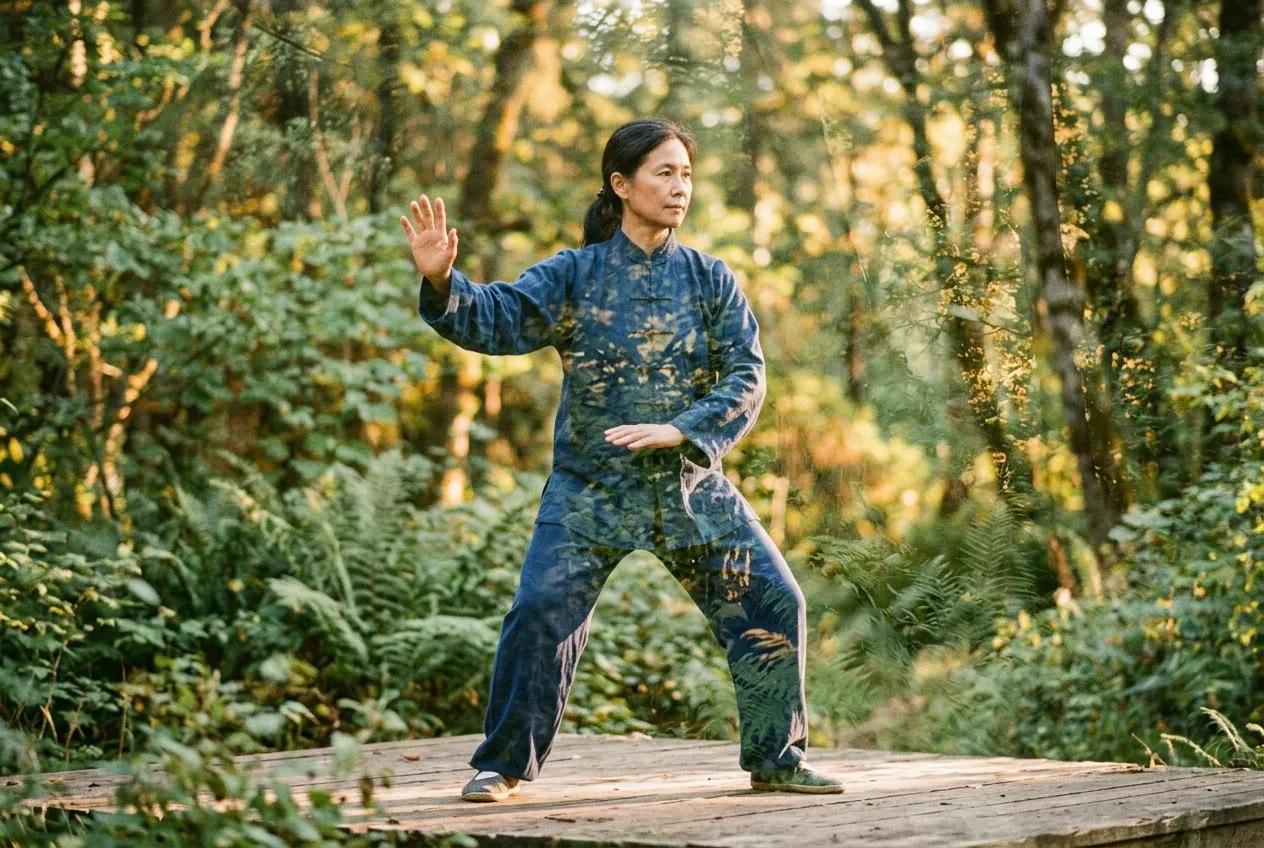
The loop follows two channels from traditional Chinese medicine’s meridian map: the du mai (governing vessel) up the back, and the ren mai (conception vessel) down the front. In the traditional account, the practice circulates qi around this circuit, clearing obstructions and building the foundation for deeper internal work. It sits at the centre of Daoist internal alchemy (neidan), and versions of it appear across qigong systems, in some tai chi lineages as an adjunct practice, and in the modern Western teaching descended from writers such as Mantak Chia, who did more than anyone to popularise it outside China.
Stripped of framework, what a practitioner actually does is: sit or stand still, breathe slowly, and move attention in a slow loop around the body’s midline, coordinated with the breath. Whether you take the traditional description literally, treat it as a map of subjective experience, or regard it purely as a structured attention exercise, the practice itself is identical.
Where It Sits Relative to Tai Chi
The orbit is not part of tai chi, and most tai chi practitioners never learn it. It belongs to the neighbouring tradition of seated and standing Daoist meditation, and it travels alongside tai chi the way the standing practice does — same family, different member.
Where the two connect is the lower abdomen. Tai chi instruction constantly directs attention to the dantian, the point a few finger-widths below the navel where the orbit begins and ends, and trains the slow abdominal breathing the orbit assumes. A practitioner with an established tai chi or breathing practice arrives at the orbit with most of its prerequisites already in place — which is the sensible order, and the reason this article sits in the practice section rather than being pitched at complete beginners.
A Basic Practice, Step by Step
This is the simple, safe, widely taught version: attention and breath only, nothing forced.
1. Sit or stand comfortably. Seated on the front edge of a chair, spine self-supporting, or in wuji standing. Hands rest on the lower abdomen or thighs. Eyes closed or lowered.
2. Settle the breath into the abdomen. Several minutes of slow nose breathing, belly swelling on the inhale. Do not begin the circuit until this feels established rather than performed.
3. Rest attention at the lower dantian. The point below the navel, inside the body rather than on the skin. Stay there for a dozen breaths. Warmth or heaviness may appear; nothing needs to.
4. On the inhale, trace attention up the back. From the base of the spine, up through the mid-back, the neck, to the crown of the head — a slow sweep of attention timed to the length of the breath. Not visualising light or force: just attending to each region in sequence, the way you might slowly scan sensation up your back.
5. On the exhale, trace down the front. From the crown, down through the face, the throat, the chest, the solar plexus, returning to the lower abdomen. The traditional instruction to rest the tongue lightly against the palate, which tai chi practitioners will already know, is said to bridge the front and back channels; practically, it is simply part of the standard relaxed mouth position.
6. Continue for five to fifteen minutes. One full circuit per breath cycle is the common beginner timing; some traditions run slower, taking several breaths per circuit. When attention wanders — it will — return to the dantian and resume.
7. Close at the dantian. Always end with attention resting in the lower abdomen for a minute or two. Every tradition that teaches the orbit insists on this, and as a matter of practical experience, sessions closed properly leave you settled and sessions abandoned mid-loop leave you scattered.
That is the entire basic practice. The elaborate versions — specific gates along the circuit, timed holds, reversed directions — belong to particular systems and genuinely do warrant a teacher, not because the basic version is dangerous but because the elaborations are easy to practise wrongly and pointlessly without feedback.
A pacing note from experience: the loop feels awkward for roughly the first ten sessions — attention jumps rather than glides, and the front-of-body descent is vaguer than the spine ascent for almost everyone. That asymmetry is normal and resolves on its own. Nothing about early clumsiness means the practice is not working.
A Short History, Lightly Held
The circuit the practice traces appears in Daoist texts across many centuries, embedded in the tradition of internal alchemy — neidan — which framed meditation as a literal refinement process: essence transformed to energy, energy to spirit, through staged practices of which the small circuit was an early foundation. Classical manuals such as the Ming-era texts on the “small heavenly circuit” describe gates along the spine where attention tends to stall, timings keyed to breath counts, and elaborate cosmological correspondences — the same broader current of Daoist philosophy that shapes tai chi’s own vocabulary of yin, yang, and effortless action.
How literally practitioners took all this varied then as now. The tradition contained its own sceptics and its own reformers, and the same circuit was taught with more or less metaphysical freight depending on lineage and era.
The modern Western history is shorter and mostly runs through a handful of twentieth-century teachers and their books — Mantak Chia’s presentations from the 1980s onward being the most influential — which repackaged the practice for readers with no Daoist background. That transmission simplified some things usefully and added some flourishes of its own; anyone reading around the topic will meet wildly different versions and should know that none of them is the single authentic original. A practice this old, transmitted this widely, exists in variants all the way down.
For a practitioner today, the history earns its place for one reason: it explains why instructions differ between sources, and licenses you to take the simple, breath-led version above as complete in itself rather than as a diluted fragment of something secret.
What to Expect, Honestly
Commonly reported and unremarkable: warmth in the palms and abdomen, tingling along the spine or scalp, a sense of the breath deepening on its own, and marked mental settling. These are the ordinary physiology of slow breathing and sustained interoceptive attention, and they arrive within weeks of regular practice.
The traditional claims — circulation of qi, clearing of energetic blockages, the alchemical transformations of neidan — are framework, not measurable fact. I practise a version of this and find the traditional map genuinely useful as a structure for attention; I would not defend it as physiology, and this site’s treatment of tai chi philosophy takes the same line. You can hold the map lightly and lose nothing of the practice.
What the practice defensibly offers is what any well-structured meditation offers: trained attention, parasympathetic downshift, better body awareness, and a calm that outlasts the session. The orbit’s particular virtue is that its moving focus suits people who find single-point meditation — breath at the nostrils, say — grindingly difficult. Giving the attention a path to travel keeps it occupied.
What to avoid is effortful forcing: straining to feel something, pushing the breath, or chasing dramatic sensations. The traditional literature itself warns against exactly this, and the warnings map onto ordinary sense — forced breathing produces dizziness, and hunting for sensations produces tension. If practice ever generates persistent discomfort, agitation, or anything that concerns you, ease off and, if it continues, take it to an experienced teacher.
Building It Into a Routine
The natural slot is at the end of existing practice: after a tai chi form or a standing session, already settled, sit for ten minutes of the orbit and close at the dantian. As a standalone, morning or evening both work; consistency matters more than clock time, as with everything else in this tradition.
A reasonable progression: two weeks of abdominal breathing and dantian-resting only (steps 1-3), then add the circuit. Rushing to the loop before the foundation settles is the standard beginner error, and it converts a calming practice into a mildly frustrating one.
For the wider context this practice sits in — moving meditation, standing work, and how the attention training relates to the form — the tai chi meditation article and the rest of the practice section carry on from here.