Of all the health conditions tai chi has been studied for, Parkinson’s disease produced the result that got the most attention from mainstream medicine — a randomised controlled trial in the New England Journal of Medicine, one of the few tai chi studies ever to appear in a journal of that standing.
Parkinson’s is a progressive neurodegenerative condition. Nothing in this article suggests tai chi slows that progression, and no evidence supports such a claim. What the research does support is that tai chi improves postural stability, reduces falls, and improves functional capacity in people with mild to moderate disease — which addresses one of the most disabling and dangerous aspects of living with the condition.
The NEJM Trial
In 2012, researchers led by Fuzhong Li published a randomised controlled trial of 195 patients with stage 1 to 4 Parkinson’s disease on the Hoehn and Yahr scale. Participants were assigned to one of three groups — tai chi, resistance training, or stretching — with 60-minute sessions twice weekly for 24 weeks.
The tai chi group outperformed both comparison groups on postural stability measures, including maximum excursion and directional control in limits-of-stability testing. Tai chi also outperformed stretching on all secondary outcomes and outperformed resistance training on stride length and functional reach. Crucially, the tai chi group had significantly fewer falls than the stretching group, and the benefits were still present three months after the intervention ended.
The design deserves note. The comparison groups were not sham treatments or waiting lists — resistance training is an active, credible intervention for Parkinson’s, and tai chi still came out ahead on the balance outcomes. That is a considerably stronger result than beating no treatment.
Subsequent trials and meta-analyses have generally supported the finding, particularly for balance and functional mobility outcomes. Effects on core motor symptoms as measured by the UPDRS motor scale have been less consistent across studies.
Why Tai Chi Suits Parkinson’s Specifically
Parkinson’s produces a characteristic constellation of motor problems: bradykinesia, rigidity, postural instability, reduced stride length, freezing of gait, and a tendency toward a stooped, forward-shifted posture with a narrowed base of support. Falls are common and consequential.
Several features of tai chi map onto those problems directly:
Continuous weight shifting. The form is essentially an extended sequence of controlled transfers from one leg to the other. That is precisely the skill that postural instability erodes, and it is trained continuously rather than in isolated repetitions.
Deliberate, large-amplitude movement. Bradykinesia and hypokinesia mean movements become smaller and slower without the person noticing. Tai chi demands consciously large, extended movements — the same principle that underlies amplitude-based Parkinson’s therapies such as LSVT BIG.
Trunk rotation. Rigidity tends to lock the trunk into moving as a block. Tai chi requires the waist to turn independently of the hips and shoulders, working directly against that pattern.
External attentional focus. People with Parkinson’s often move better when attending to an external cue than when attending to the movement itself. Following a form provides continuous external structure.
Postural extension. The upright, lengthened spine that tai chi requires opposes the stooped posture that develops with disease progression.
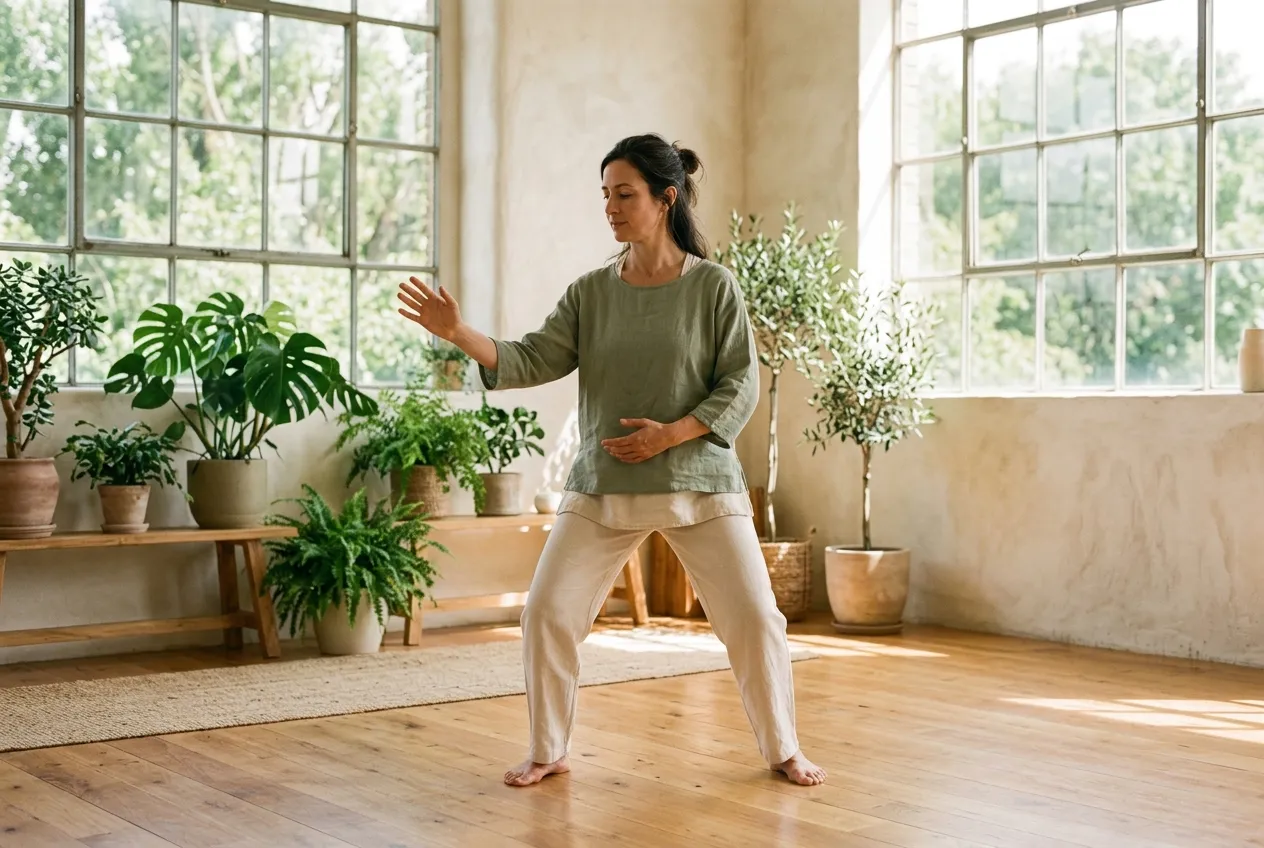
Base of support. Stances are wider than normal standing, which trains stability at the edges of the base rather than only in the middle.
That combination is unusually well matched to the deficits, which is probably why the effect showed up so clearly in a properly controlled trial.
What Improves, and What Does Not
The realistic picture from the evidence:
Improves with reasonable consistency: postural stability, balance confidence, stride length, functional reach, gait measures, falls frequency, and quality-of-life scores.
Sometimes improves: overall motor scores on standard rating scales, freezing of gait, and depression scores. The evidence is mixed and effects are smaller.
Does not change: the underlying neurodegeneration, medication requirements, or disease progression. Tai chi is a symptomatic and functional intervention.
The falls outcome is the one that matters most in practical terms. Falls in Parkinson’s frequently cause fractures, and hip fracture in an older adult with a neurological condition can be the beginning of a rapid decline. An intervention that reduces falls is doing something meaningful even if it changes nothing else. The fall prevention article covers the broader falls evidence, most of which comes from general older-adult populations rather than Parkinson’s specifically.
Adapting Practice for Parkinson’s
Standard tai chi classes are not always well suited to people with Parkinson’s, and some adaptations make a substantial difference.
Use Support Early
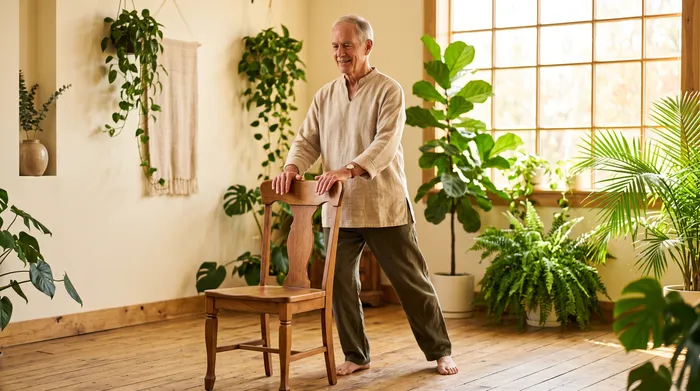
Practising near a wall, a sturdy chair back, or a counter is not a failure of technique. It allows the practice of weight transfers that would otherwise be too risky, and support can be reduced as stability improves. The trial participants were supervised throughout; practising alone without support at home is a different risk profile entirely.
Widen the Stance
The conventional shoulder-width stance can be widened for a larger base of support. Stability first, orthodoxy second.
Keep Amplitude Large
Given the tendency toward shrinking movement, err on the side of movements that feel exaggerated. What feels large to someone with Parkinson’s often looks normal to an observer. A mirror or a training partner giving feedback helps calibrate this.
Time Practice With Medication
Practise during an “on” period, when levodopa or other dopaminergic medication is working. Practising during an “off” period is harder, less productive, and carries more falls risk. For most people this means starting a session 45 to 90 minutes after a dose, though individual timing varies considerably.
Watch for Turning and Freezing
Turns are a common freezing trigger. Break turns into smaller steps, keep them wide rather than pivoting on the spot, and use a counting or visual cue if freezing occurs. Some forms contain more turning than others — Yang-style simplified forms are relatively turn-light compared with longer traditional sequences.
Prefer Simplified Forms
Learning demands are real. A shorter form learned well and practised often is better than a long form half-remembered. Many Parkinson’s programmes use six to eight movements repeated rather than a full sequence.
Practise Often, Briefly
Two 20-minute sessions daily is generally better tolerated and more effective than one 40-minute session, both for fatigue management and for medication timing.
A Starting Sequence
The NEJM protocol used a small set of movements rather than a full form, which is a useful model for anyone starting. A workable beginning sequence, practised with a chair or wall within reach:
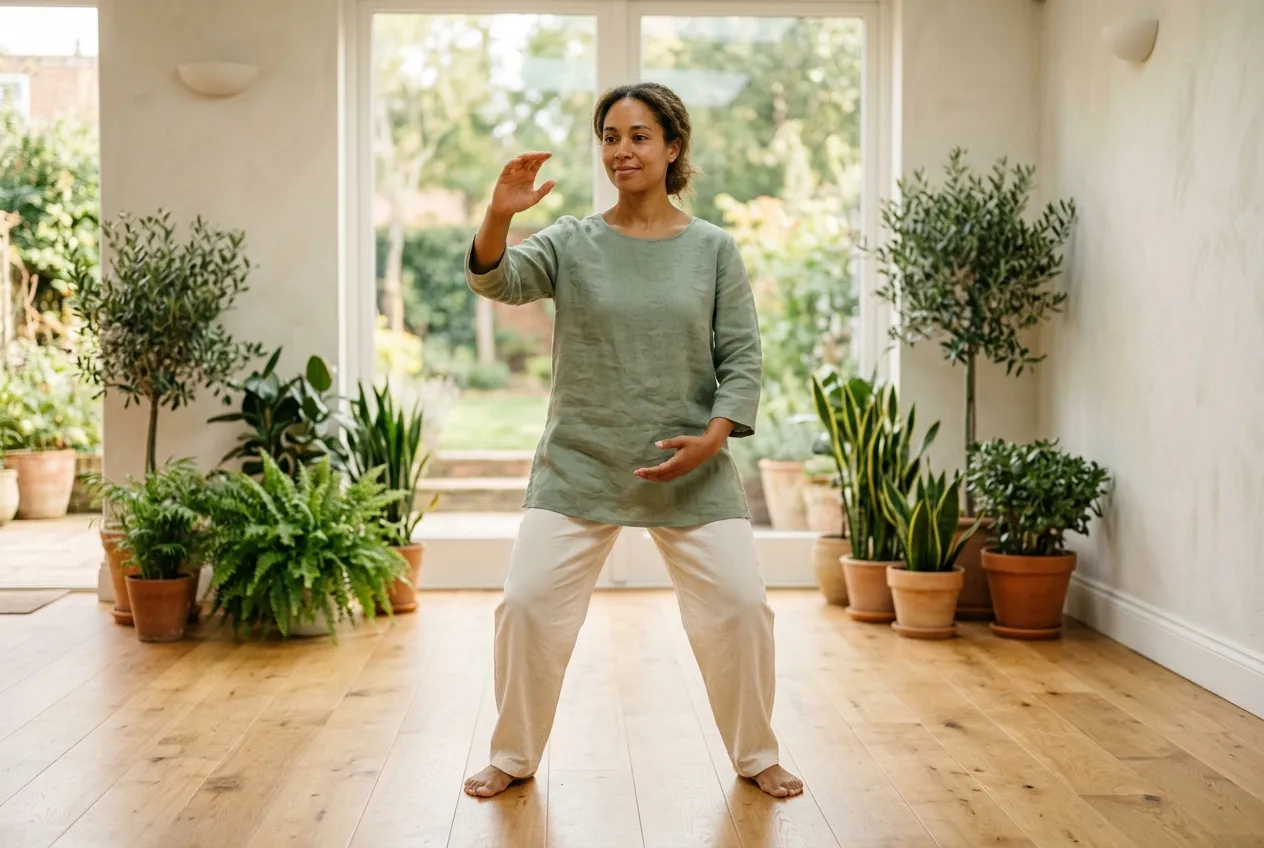
Weight shifts, side to side. Feet slightly wider than shoulder-width, hands resting on the chair back. Transfer weight fully onto the right foot until the left could lift, hold for two breaths, then transfer back. Ten repetitions. This is the single most important element and it is worth practising on its own for a fortnight before adding anything else.
Weight shifts, forward and back. One foot ahead of the other, hands supported. Shift weight forward onto the front foot, then back onto the rear foot, keeping the trunk upright rather than leaning. Ten repetitions each side.
Waist turns. Feet parallel, arms hanging loose. Turn the waist left and right, letting the arms swing and tap the body naturally. Ten each way. This works directly against trunk rigidity.
Cloud hands, supported. Sideways stepping with the hands passing across the body. Start facing a counter with fingertips resting on it, and progress to unsupported only when the stepping is reliable.
Standing and breathing. Two or three minutes at the end, feet parallel, weight even, breathing slowly into the abdomen. Do not skip it — the settling matters as much as the movement.
Twenty minutes covers all five with rests. Build the reliability of each element before adding a longer form, and treat the sequence as something to be repeated rather than progressed through quickly.
The instinct with a progressive condition is to feel that time is short and progress should be fast. The evidence points the other way: the trial that produced the best results ran for six months on two sessions a week, with a handful of movements.
Finding the Right Class
The ideal is a class run specifically for people with Parkinson’s, often through a neurological rehabilitation service, a Parkinson’s charity, or a physiotherapist with neurological training. These exist in more places than people expect — the Parkinson’s Foundation maintains exercise guidance and can point toward local options, as can national Parkinson’s organisations elsewhere.
Failing that, a general “tai chi for health” class with a small group size and an instructor willing to adapt is a reasonable alternative. Speak to the instructor in advance, explain the condition, and ask specifically about support options and whether they are comfortable with you practising near a wall or chair.
What to avoid: large classes with no individual attention, traditional martial-oriented classes with deep stances and fast transitions, and any setting where you would be practising unsupervised on an unfamiliar floor surface.
Involving Physiotherapy and the Care Team
Tai chi complements rather than replaces specialist Parkinson’s physiotherapy. A neurological physiotherapist can assess specific deficits — freezing triggers, particular directions of instability, gait asymmetries — and prescribe targeted work that a group class cannot.
The most effective arrangement I have seen described is physiotherapy providing the assessment and the specific corrective work, with tai chi providing the sustainable ongoing practice that maintains those gains. Physiotherapy episodes end; a tai chi habit does not have to.
Anyone with Parkinson’s considering starting should mention it to their neurologist or Parkinson’s nurse specialist. Approval is near-universal — exercise is now firmly established as part of Parkinson’s management — but the conversation is worth having, particularly around falls history and medication timing.
The balance article covers the mechanisms behind the stability improvements in more depth, and the health benefits overview places the Parkinson’s evidence alongside the other clinical research. More condition-specific guides are collected in the tai chi health section.
Frequently Asked Questions
Does tai chi slow Parkinson’s progression?
No evidence supports that claim. The trials show improvements in balance, gait, and falls — symptomatic and functional benefits — not disease modification. Exercise generally is being actively researched for potential neuroprotective effects, but nothing established justifies telling someone tai chi will slow their disease.
How much practice is needed to see a benefit?
The New England Journal of Medicine trial used two 60-minute sessions per week for 24 weeks, with benefits persisting three months after the programme ended. Two to three sessions a week is a reasonable target, and daily shorter practice appears to work well as an alternative. Benefits took months rather than weeks to develop in the trial.
Is tai chi safe if I already fall frequently?
It can be, with appropriate support and supervision — but it should not be started alone at home. Someone with a history of frequent falls should begin in a supervised setting, practising near a wall or chair, ideally after an assessment by a physiotherapist. The whole point is to reduce falls, and the practice should not create them in the process.
Which style of tai chi is best for Parkinson’s?
Yang-style simplified forms dominate the research, and the NEJM trial used a tailored six-movement protocol rather than a full traditional form. Simplified, health-oriented programmes are the sensible choice. Chen style, with its low stances, rapid direction changes, and explosive movements, is not appropriate.
Can tai chi help with freezing of gait?
The evidence is mixed and weaker than for postural stability. Some people find that the rhythmic, externally cued nature of practice helps, and the improvements in stride length seen in the trials are relevant to gait quality generally. Freezing specifically is often better addressed with targeted cueing strategies taught by a neurological physiotherapist.
Should I practise during an “off” period to build tolerance?
No. Practise when your medication is working. Off-period practice is more dangerous, less productive, and more discouraging. Building tolerance to being off medication is not a therapeutic goal.
Can I practise seated if standing is unsafe?
Yes. Seated tai chi and qigong preserve the upper-body movement, trunk rotation, and breathing elements, and are used routinely in later-stage disease. The balance training component is necessarily lost, but the practice remains worthwhile — and seated work can be combined with supported standing practice to keep some weight-transfer training in the routine.