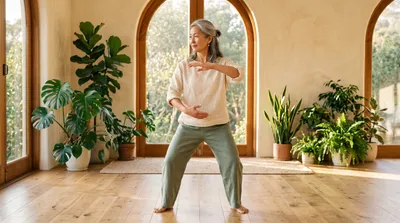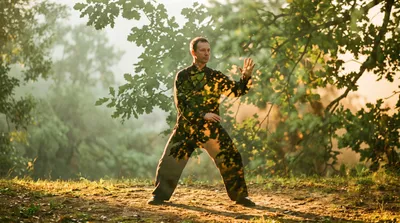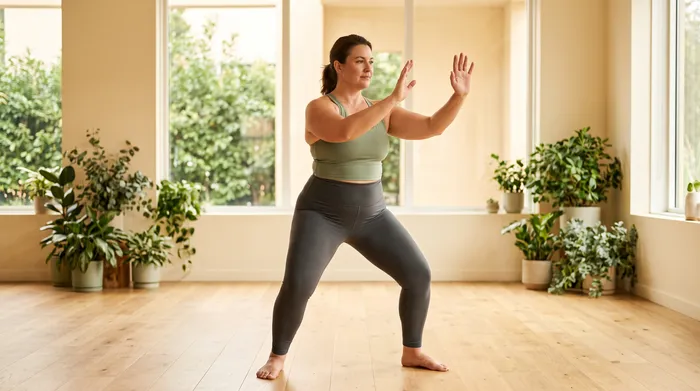
Tai chi burns roughly as many calories as a slow walk. If you are looking for an efficient way to create an energy deficit, there are far better options, and anyone selling tai chi as a fat-burning workout is not being straight with you.
That should be the end of the article — except that a large randomised trial published in Annals of Internal Medicine found tai chi reduced waist circumference about as effectively as conventional exercise in adults over 50 with central obesity. The relationship between tai chi and body composition turns out to be more interesting than the calorie arithmetic suggests, and this article works through why.
What the Calorie Numbers Actually Are
Tai chi is generally rated at around 3 METs — three times resting metabolic rate — putting it at the lower end of moderate-intensity activity, comparable to a leisurely walk or light housework. Some styles and faster forms rate higher, up to around 4 METs; slow, high-stance practice sits closer to 2.5.
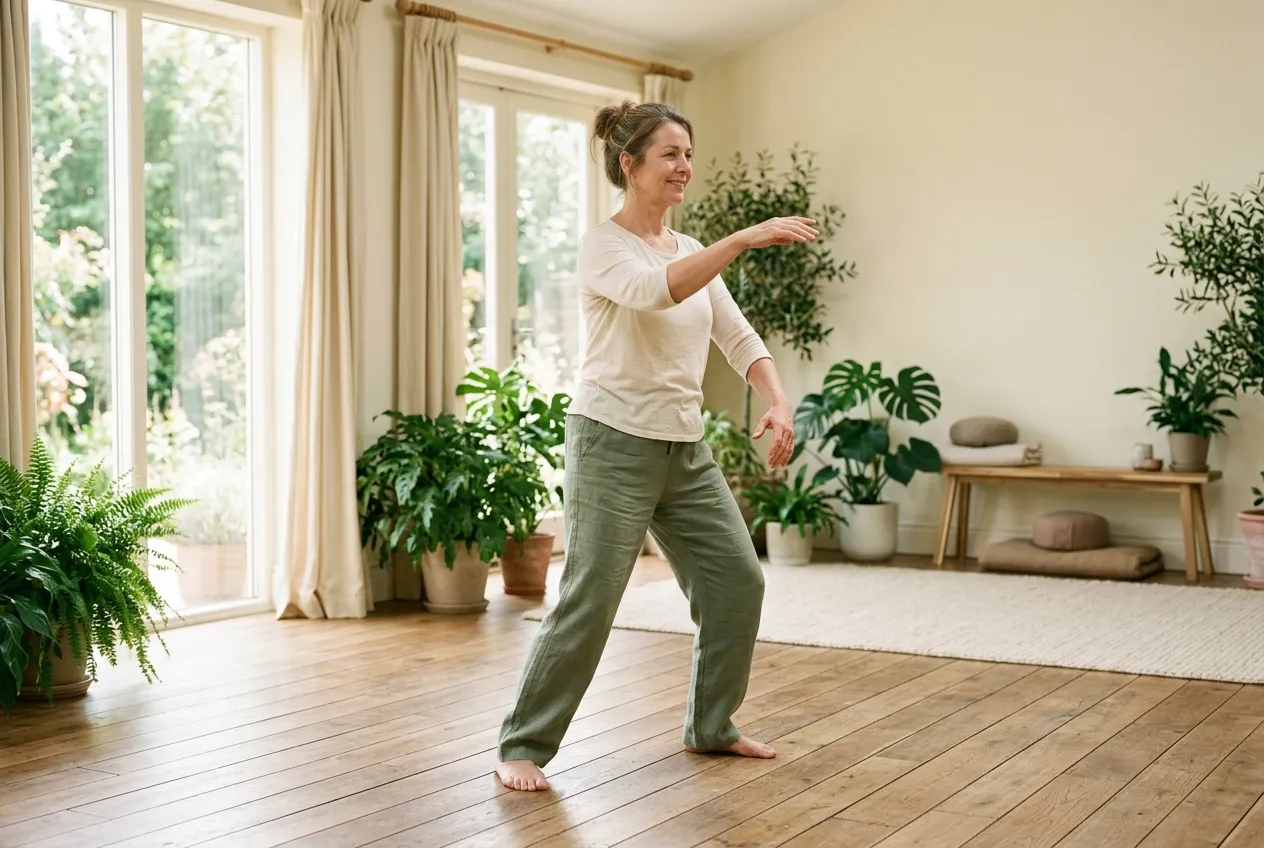
In practical terms, an hour of tai chi burns somewhere in the region of 150 to 250 calories for a typical adult, varying with body weight, stance depth, and how continuously you practise. Compare that with roughly 400 to 600 calories for an hour of running, or 300 to 400 for brisk cycling.
The arithmetic follows from there. A pound of body fat represents roughly 3,500 calories. Practising tai chi for an hour four times a week, with no change in diet, produces an energy deficit that would take somewhere between three and five weeks to account for a single pound — assuming, unrealistically, that appetite and non-exercise activity do not compensate at all.
I say this to practitioners fairly often and it lands badly, because nobody wants to hear that their practice is not doing the thing they hoped. But being wrong about the mechanism leads people to abandon a practice that is helping them in ways they have not measured.
The Central Obesity Trial
Here is where it gets more interesting. A three-group randomised controlled trial published in Annals of Internal Medicine in 2021 recruited 543 adults aged 50 or over with central obesity in Hong Kong, assigning them to tai chi, conventional exercise (brisk walking plus strength training), or a no-intervention control. Both exercise groups trained three times a week for twelve weeks.
The result: tai chi produced reductions in waist circumference comparable to conventional exercise, with both intervention groups outperforming the control. Reductions in body weight and in HDL cholesterol measures also favoured the intervention groups.
That finding sits awkwardly against the calorie arithmetic, and the honest answer is that the mechanism is not fully established. Several explanations are plausible and probably all contribute:
Waist circumference is not weight. Central adiposity responds to factors beyond energy balance, including cortisol and insulin sensitivity. Reducing chronic stress plausibly reduces visceral fat storage independent of calories burned.
Displacement of sedentary time. Three sessions a week of anything replaces sitting. Total daily energy expenditure includes far more than the formal exercise session.
Behavioural spillover. People who take up a regular practice often change other habits — eating more attentively, drinking less, sleeping better. Trials measure the intervention, not the whole cascade it triggers.
Sleep and appetite regulation. Poor sleep disrupts leptin and ghrelin signalling and increases appetite. Improving sleep quality has downstream effects on intake that no calorimeter captures.
The upshot is that tai chi appears to affect body composition through routes other than burning calories during practice. That is a genuinely useful thing to know, but it does not turn it into a weight loss programme.
Where Tai Chi Genuinely Helps With Weight
Setting aside the direct fat-burning question, several contributions are real:
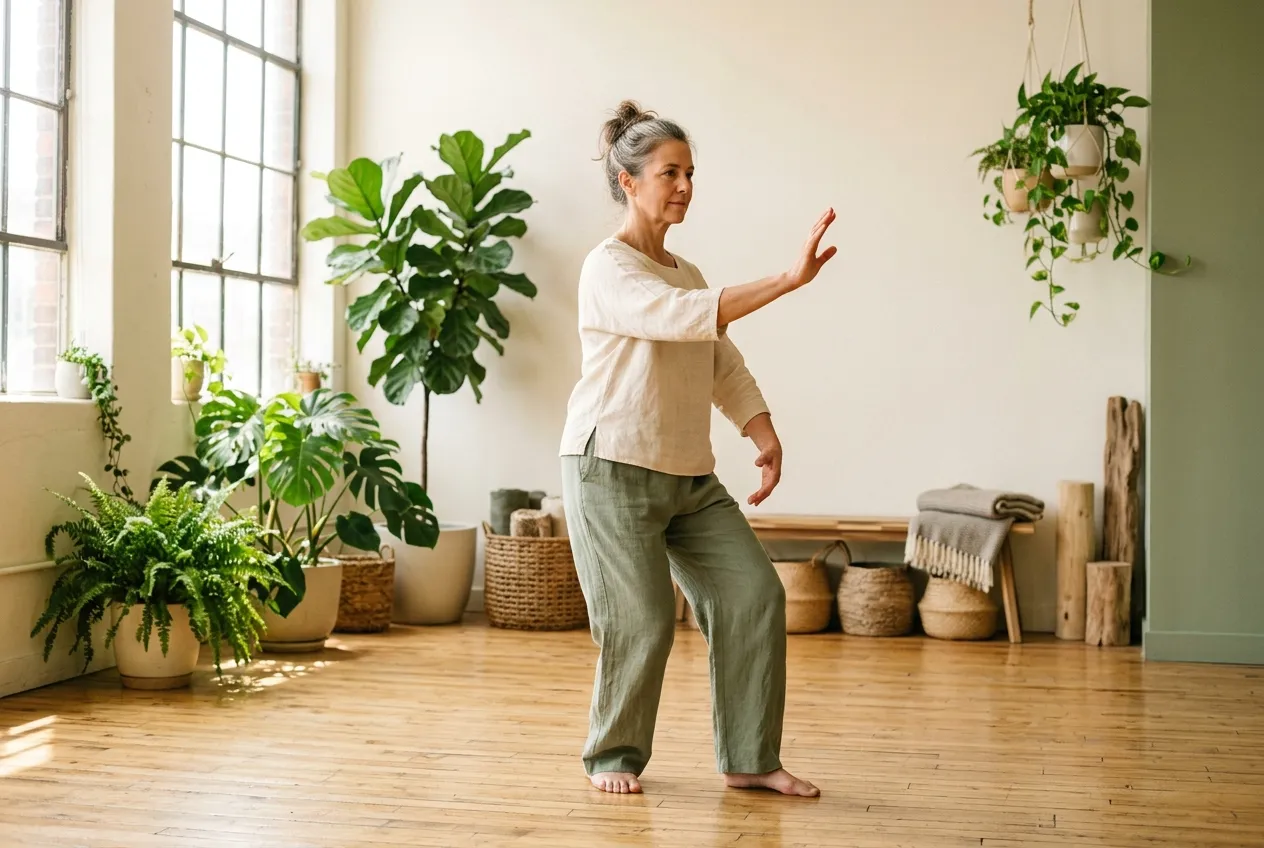
It is sustainable. The single largest predictor of long-term weight outcomes is whether someone keeps doing the thing. Tai chi has low drop-out rates because it does not hurt, does not exhaust, does not require equipment, and does not become impossible at seventy.
It suits people who cannot do conventional exercise. For someone with significant obesity, knee osteoarthritis, or low fitness, brisk walking may be genuinely painful and running out of the question. Tai chi provides movement at an intensity that is achievable, which is the necessary first rung.
It preserves muscle in a deficit. The sustained partial-squat postures load the legs continuously. This is not resistance training and will not build much muscle, but during weight loss, some lower-limb loading helps limit lean mass loss.
It reduces stress eating. For people whose eating is stress-driven — a very large group — an activity that reliably reduces stress load addresses the actual mechanism rather than the symptom.
It builds body awareness. This one is soft but I think real. Regular attention to how the body feels tends to spill into noticing hunger, fullness, and the difference between the two. Nothing in the literature establishes this; I mention it as an observation from my own practice rather than a finding.
Building a Weight-Management Routine That Includes Tai Chi
If weight is the goal, tai chi should be one component of a plan whose main lever is elsewhere.
Diet does the heavy lifting. Energy intake is where meaningful deficits are created. No exercise programme outruns a diet that is not working, and this is more true for low-intensity activity than for anything else.
Add walking volume. Steps accumulate. A daily walk on top of tai chi practice adds more energy expenditure than making the tai chi sessions longer would.
Add resistance work if you can. Preserving muscle mass during weight loss protects resting metabolic rate and function. Two short sessions a week with bands or bodyweight is enough to matter.
Use tai chi for consistency, stress, and sleep. Four or five sessions of 30 minutes weekly, treated as the sustainable base of the routine rather than the fat-burning component.
Measure waist, not just weight. Given that the trial evidence is about central adiposity, waist circumference is the more sensitive measure for this kind of intervention, and it tracks health risk better than weight does anyway.
That structure is honest about where each element contributes. The daily practice routine guide covers how to build the tai chi component into a week, and if you are new to the practice entirely, the introduction to what tai chi is covers the fundamentals before you worry about outcomes. The broader health benefits article sets the body composition findings alongside the other research, and more condition-specific summaries are in the tai chi health section.
Making Practice More Physically Demanding
If you want tai chi itself to contribute more, there are legitimate ways to raise the load without turning it into something it is not.
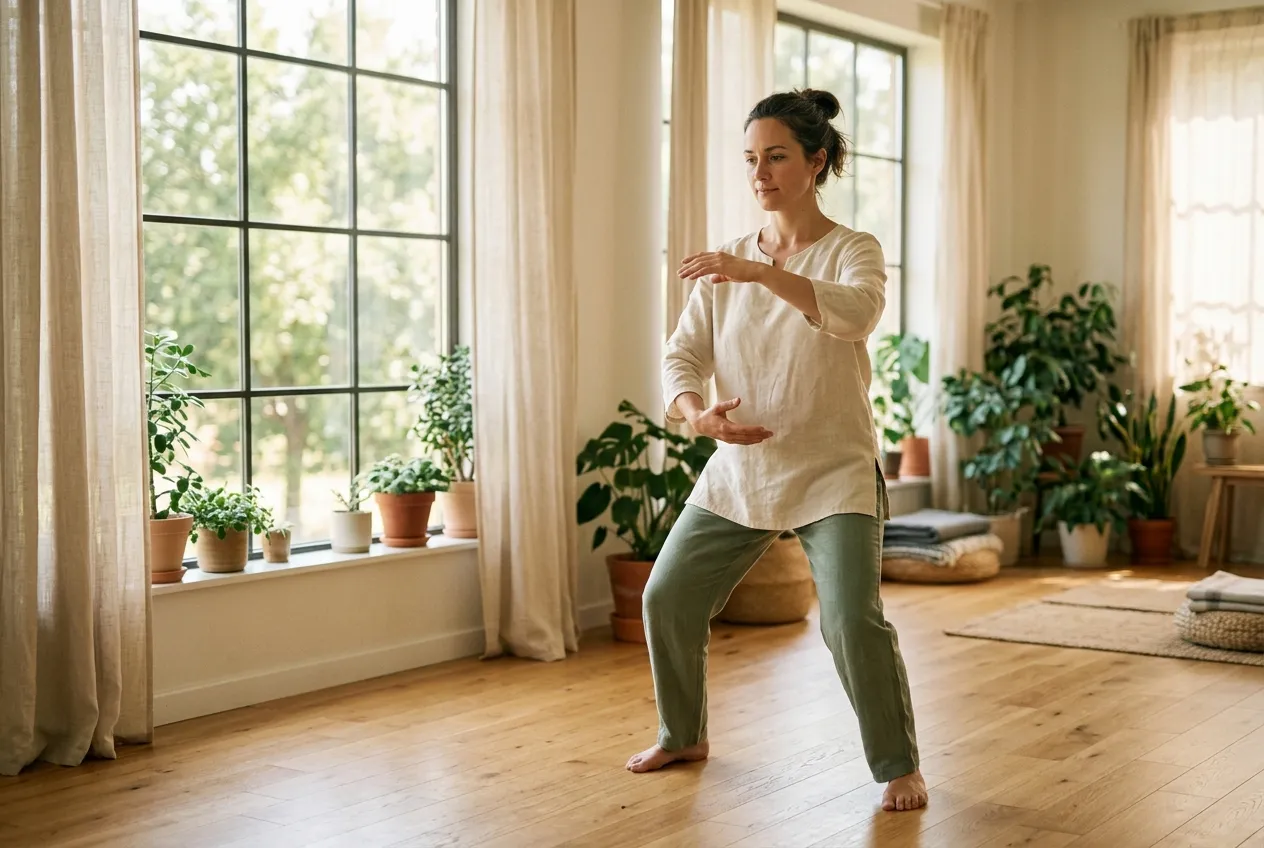
Lower the stance. This is the largest single variable. A form performed with the thighs closer to parallel is dramatically more demanding than the same form performed nearly upright — the quadriceps are working isometrically throughout. Only do this if your knees tolerate it, and build gradually.
Slow down rather than speed up. Counter-intuitive, but true. Moving slowly through a weight transfer means spending longer in the single-leg loaded position, which increases time under tension. Fast forms are often easier than slow ones.
Repeat rather than extend. Running a short form through five times is more demanding than working through a long form once, because you spend less time thinking and more time moving.
Add standing practice. Holding a static posture for two or three minutes at a time is genuinely hard work and builds the leg strength that makes lower stances possible.
Practise longer, not harder. Two 45-minute sessions do more than three 20-minute ones, and duration is the variable that scales without compromising quality of movement.
Even applied together, these will not turn tai chi into a high-calorie activity. What they will do is make it a better strength and endurance stimulus for the lower body, which matters for maintaining function and lean mass over the years — arguably a more valuable outcome than a marginally larger energy deficit.
I went through a period of deliberately practising in a much lower stance to build leg strength, and the honest result was that my legs got noticeably stronger and my weight did not change at all. That is a fair summary of what to expect.
Frequently Asked Questions
How many calories does tai chi burn?
Roughly 150 to 250 calories per hour for a typical adult, depending on body weight, form speed, and stance depth. That places it at about 3 METs, similar to a leisurely walk. Deeper stances and faster forms such as Chen style push the figure higher; slow practice with high stances puts it lower.
Can you lose weight doing only tai chi?
Without a dietary change, weight loss from tai chi alone will be slow and small. The Annals of Internal Medicine trial did find reductions in waist circumference and modest weight reductions from tai chi alone over twelve weeks, so the answer is not strictly no — but anyone expecting substantial weight loss from practice alone will be disappointed.
Does tai chi reduce belly fat specifically?
The trial evidence points that way, with tai chi reducing waist circumference comparably to conventional exercise in adults over 50 with central obesity. Spot reduction of fat from a specific area is not a thing, so the likely explanation is a general reduction in visceral fat driven partly by stress and sleep pathways rather than by targeting the abdomen.
Is tai chi or yoga better for weight loss?
Neither is a strong weight-loss intervention. Vigorous styles of yoga — power or hot yoga — reach higher intensities than tai chi and would produce a larger energy deficit; gentle or restorative yoga is comparable to tai chi. Both practices contribute more through stress, sleep, and adherence than through calories burned.
How long until I see changes?
The trial measured outcomes at twelve weeks and found significant changes at that point. Expect to see nothing meaningful before six to eight weeks, and measure waist circumference alongside weight, since that is where the evidence sits.
Should I practise faster to burn more calories?
You can, and forms performed at a brisker tempo do raise energy expenditure — but speeding up degrades the qualities that produce the other benefits, and the additional calories are marginal. If you want a higher energy expenditure, add a walk rather than rushing the form.