If you practise tai chi in the United States, there is a fair chance your teacher’s teacher’s teacher was a small, goateed Chinese scholar who taught in a New York loft in the late 1960s and told his students to invest in loss. Cheng Man-ch’ing — “the Professor” — did more than any single person to establish tai chi in the West, and the short form he created remains one of the most practised sequences in the world.
He is also a genuinely interesting figure independent of the tai chi: painter, poet, calligrapher, and doctor of Chinese medicine, in a tradition that regarded such breadth as a single cultivated life rather than a list of hobbies. His story is worth knowing even for practitioners outside his lineage, because the questions his career raises — what may be simplified, what must be transmitted whole, how an art crosses cultures without dissolving — are the questions every modern tai chi practitioner is living inside, whether they notice or not.
The Five Excellences
Cheng was born in Yongjia (modern Wenzhou), Zhejiang Province, at the turn of the twentieth century. His path was scholarly and artistic before it was martial: trained in painting and poetry, he was teaching at art colleges in Shanghai as a young man, and made his early reputation as a painter.
The traditional account, repeated by his students, is that he came to tai chi through illness — tuberculosis in his twenties — and took up the art as therapy under Yang Chengfu, the man who standardised the modern Yang style and the pivotal figure of the Yang family lineage. Cheng is said to have studied with him from the early 1930s, within the circle that produced several of the twentieth century’s most consequential Yang teachers.
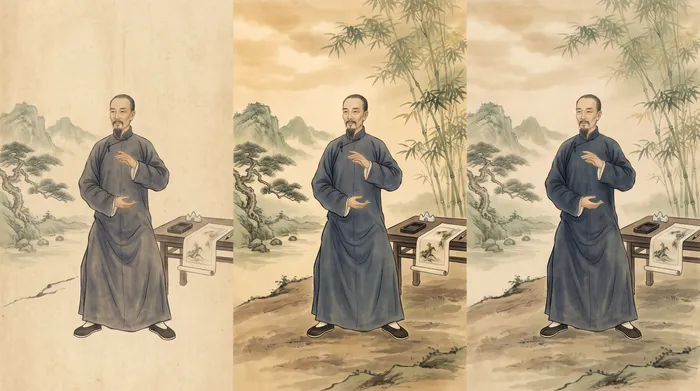
Alongside the martial art, he practised Chinese medicine and continued as a working artist and poet — hence the label that followed him: master of the five excellences, painting, poetry, calligraphy, medicine, and tai chi. The title was partly marketing, as such titles always are, but the accomplishments behind it were real, and the breadth shaped his teaching. His explanations of tai chi reach constantly for the brush, the Classics, and the pharmacy rather than the fist.
The 37-Posture Short Form
Cheng’s most consequential act was editorial. In the late 1930s, while involved in martial arts instruction in wartime China, he condensed Yang Chengfu’s long form — over a hundred movements, twenty-plus minutes — into a sequence of thirty-seven postures taking around eight to ten minutes.
His stated reasoning was practical: the long form’s length was an obstacle to the people who most needed the practice. Cut the repetitions, keep the essentials, and more people would actually practise. Traditionalists regarded the abridgement with suspicion then and some still do; the argument is a familiar one, and it recurs with the state-sponsored 24-form that followed a similar logic two decades later.
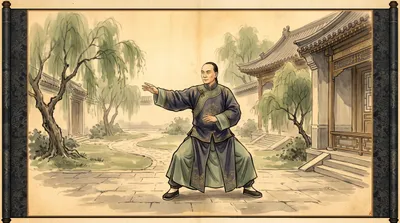
The Cheng form has recognisable characteristics beyond its length. The postures are performed with notably relaxed, “beautiful lady’s hands” — wrists unbent, fingers soft. The stances are more compact than large-frame Yang. And the whole is saturated with Cheng’s central teaching obsession: song, the release of all unnecessary tension, pursued to a degree that even other Yang stylists found extreme. His famous image was of swimming in air — the body moving as though the air itself offered the resistance of water.
Taiwan, and Then New York
Cheng moved to Taiwan with the Nationalist government as it retreated at the end of the Chinese Civil War, where he taught for nearly two decades and where his school, and students such as Benjamin Lo, established the form’s Asian base.
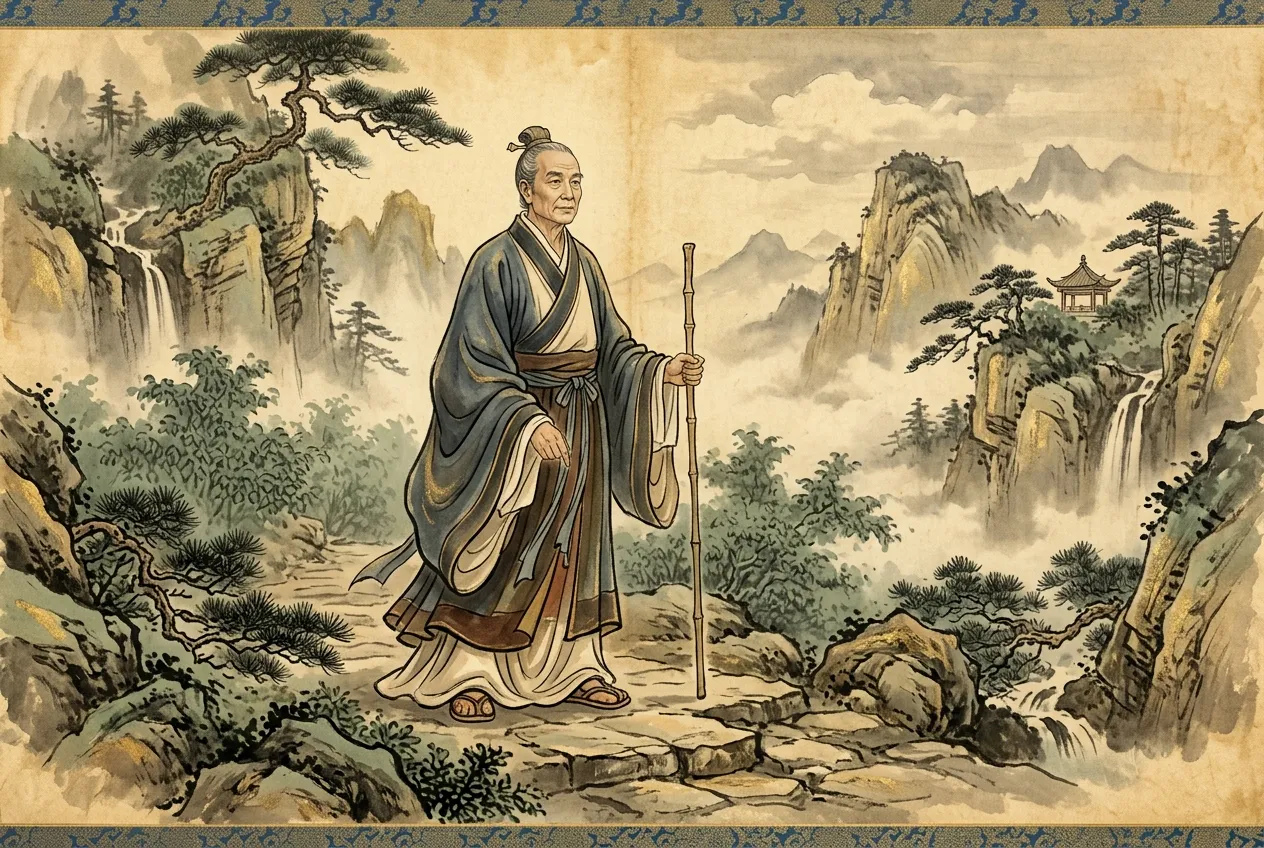
In the mid-1960s he moved to New York — initially in connection with cultural work — and began teaching in Manhattan, eventually at the Shr Jung school on the Bowery run with his senior students. The timing was historically perfect. America in the late 1960s was newly and hungrily curious about Asian practices, and here was a classically trained Chinese scholar-artist-doctor teaching an internal art in downtown New York, in person, to anyone who committed.
The students who came through that room — Benjamin Lo, William C. C. Chen, Maggie Newman, Ed Young, Tam Gibbs, and the writer Robert W. Smith in nearby orbit — became the teachers and authors through whom a large share of American tai chi descends. Smith’s books, and later Wolfe Lowenthal’s affectionate memoir There Are No Secrets, fixed the Professor’s image for readers who never met him.
Accounts of the Shr Jung years describe a teaching style that puzzled students schooled on Asian martial formality: Cheng corrected little, demonstrated much, answered questions with paintings or quotations as often as with mechanics, and left students to discover through push hands what explanation could not transmit. Some found this profound; some found it maddening; most reported both reactions in sequence. The pattern — minimal correction, maximal demonstration, discovery through partner work — became a recognisable house style that his students carried into their own schools, and it still distinguishes Cheng-lineage classes from the more drill-oriented mainstream.
Cheng returned to Taiwan in his final years and died there in the mid-1970s.
What He Taught
Three ideas recur through everything transmitted from Cheng, and they explain his continuing influence better than the biography does.
Song — relax, then relax further. Cheng treated deep release of tension not as a beginner’s instruction but as the art’s actual content, the thing decades of practice progressively uncover. Where other teachers balanced softness against structure, Cheng pushed softness to the foreground and trusted structure to emerge from alignment rather than effort.
Invest in loss. His most quoted instruction, aimed at push hands: accept being pushed over rather than stiffening to win, because the stiffening is the defeat. The phrase has escaped tai chi entirely and shows up in business books and sports psychology, usually unattributed. Within the practice it remains the hardest advice to follow, which is presumably why it needed saying.
The Classics as working documents. Cheng wrote commentaries — his Thirteen Treatises is the best known — treating the classical tai chi texts as practical manuals to be tested in the body rather than venerated. For English-speaking students, his books (with Smith’s T’ai Chi the widely read collaboration) were among the first serious attempts to explain the internal content of the art rather than just its choreography.
Practising the Cheng Form Today
For anyone who encounters the 37-form and wonders how it relates to what they already practise, some practical orientation.
If you know the 24-form, the Cheng form will feel like a cousin: similar length, overlapping vocabulary, different flavour. The 24 is larger-framed and more standardised; the 37 is softer, more compact, and varies noticeably between lineages, since Cheng’s students each carried their own emphasis away from the room. Neither is a stepping stone to the other — they are parallel short forms descended from the same Yang material.
Finding instruction is easiest in the northeastern United States, where the New York lineages remain dense, and in Taiwan and the communities its teachers reached. Elsewhere, Cheng-lineage teachers exist but are patchier; asking a prospective teacher who their teacher was, and following the chain, usually settles within two steps whether you are in this family.
The signature checkpoints if you want to recognise the style: unbent wrists with soft open fingers, weight fully committed to one leg at a time with the empty foot genuinely empty, a torso that stays vertical without visible effort, and an overall impression less of performing movements than of being moved by something unhurried. Watching old film of Cheng himself — much of it survives and circulates freely online — remains the best single corrective for anyone whose short form has drifted toward stiffness.
The reading order for the books: Lowenthal’s There Are No Secrets first for the person and the teaching atmosphere, then the Thirteen Treatises once you have enough practice for it to land. Reversing the order makes the second book harder and the first less meaningful.
The Books Themselves
Since Cheng’s writing is a large part of his transmission, a reader’s map helps.
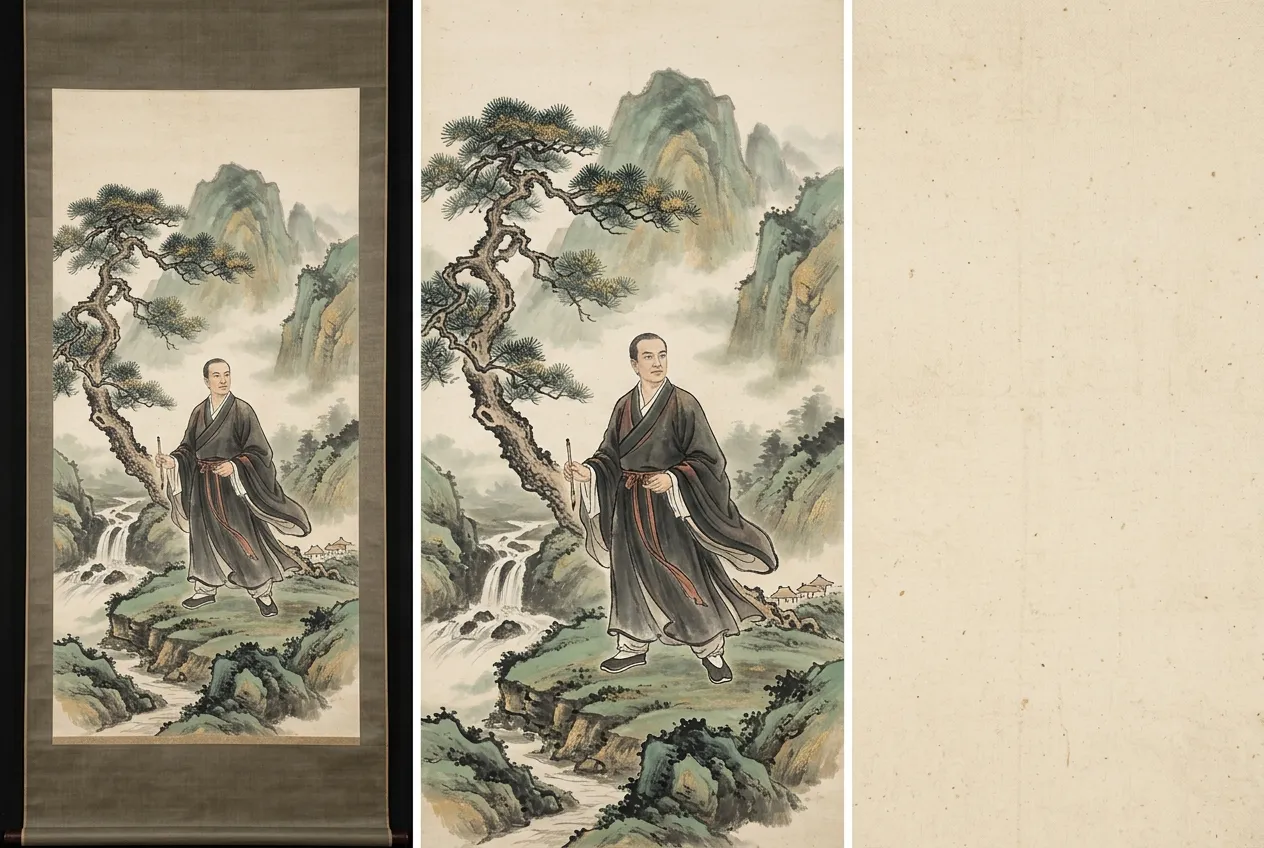
The Thirteen Treatises (Cheng Tzu’s Thirteen Treatises on T’ai Chi Ch’uan) is the core text: short essays on principle — song, sinking, the substantial and insubstantial, breath, the relation of the art to health and to the Classics — dense enough that practitioners reread it for decades. T’ai Chi, the compact collaboration with Robert W. Smith, is the accessible entry, combining introduction, photographs of Cheng’s form, and translated principles. His commentaries on the Tao Te Ching and the classical canon show the scholar at work and reward readers who want the intellectual hinterland; the painting and poetry survive in collections and in Taiwanese museum holdings, a reminder that tai chi was one wing of a larger cultivated life.
The recommended order, argued more fully in the books guide: Lowenthal’s memoir for the person, Smith’s collaboration for the outline, the Treatises for the long haul.
Legacy, With the Arguments Included
An honest account includes the disputes, most of which continue.
Lineage purists note that Cheng’s standing among Yang Chengfu’s students was contested by some contemporaries, and that his form departs from family orthodoxy — the standing of any abridgement always is contested. Martial critics questioned the fighting depth behind the softness, a question sharpened by the general reckoning covered in the tai chi as martial art article. Admirers reply that Cheng’s push hands was, by consistent first-hand account, extraordinary, and that no one did more to make the art’s internal content articulate.
What is not disputed is the demographic fact. The Cheng short form became the vehicle through which enormous numbers of Westerners — and, through the parallel Taiwan lineage, practitioners across Asia — actually learned tai chi. His students’ students run schools on every continent. The relaxed, health-forward, meditation-adjacent flavour of much Western tai chi is, for better and worse, substantially his flavour.
He belongs on any short list of the masters who shaped the art, and arguably on a shorter list still: the handful without whom the art’s global spread — traced in the history of tai chi — would look entirely different. More figures and background are collected in the tai chi history section.
Reading Cheng is still worth any practitioner’s time, and I say that as someone who came to him late and sceptical of the hagiography. The Thirteen Treatises contains sentences that mean nothing for years and then, after enough practice, abruptly describe something you have just felt. That delayed detonation is the mark of writing from inside the skill — and it is the best argument that whatever else the Professor was, he was describing something real.