
The chest is one of the most habitually closed areas of the modern body. Hours at a desk, driving, or looking at a phone pull the shoulders forward and compress the front of the torso. Tai chi chest openers counter this directly — they work against the grain of that habitual closure and restore the open, expansive posture that tai chi demands.
These five movements can be used as a warm-up before form practice, as a standalone qigong set in their own right, or as a midday reset if you spend long hours at a desk. They require no equipment and take about ten minutes if performed thoughtfully.
Video instruction helps with subtleties of body mechanics that are difficult to convey in text alone — see the tai chi shoulder exercises guide and tai chi warm-up exercises guide for related movement guidance.
Before You Begin
Start in a basic standing posture: feet shoulder-width apart, knees soft (never locked), spine gently lengthened, arms relaxed at your sides. Take three slow nasal breaths. The exhalation should be longer than the inhalation — this activates the parasympathetic nervous system and prepares the body to release held tension.
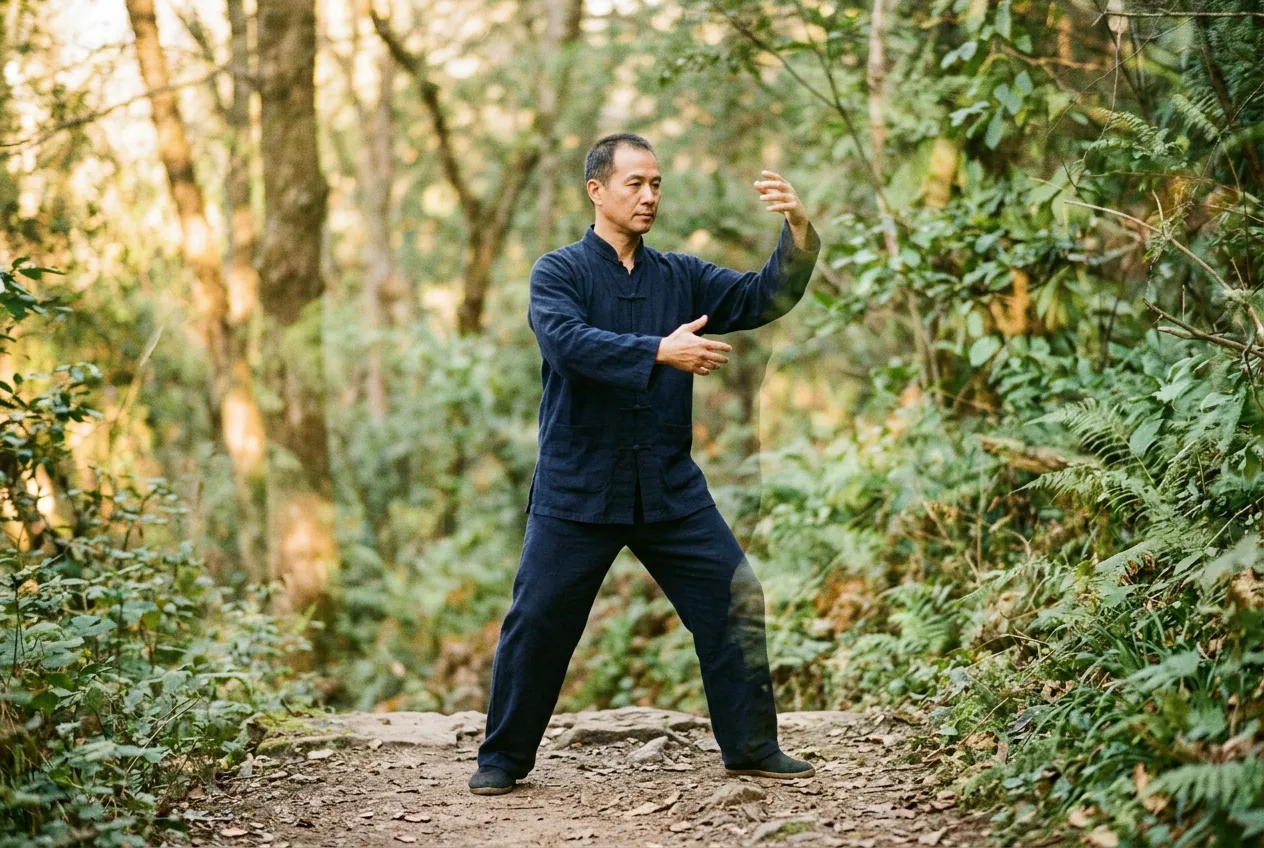
A note on correct form: descriptions in text are necessarily imprecise. Video guidance or in-person instruction makes the subtleties — particularly the timing of breath with movement, and the degree of rotation in the shoulders — much clearer. Use these descriptions as a starting point, not as a complete substitute for visual demonstration.
The Five Chest Opening Movements
1. Opening and Closing the Chest
Starting position: Feet shoulder-width apart, arms hanging naturally, palms facing inward.
The movement: On an inhalation, slowly raise both arms in front of you to about chest height, with the palms facing each other as if holding a large ball. Continue inhaling as you open the arms wide to the sides, expanding the chest and drawing the shoulder blades toward each other. Hold briefly at full opening — this is where you feel the stretch across the front of the chest.
On the exhalation, reverse: arms sweep back to the front, palms facing each other, and the chest gently closes. Allow the upper back to round slightly as you close, releasing the back muscles.
Repetitions: 6–8 slow cycles. Keep the movement continuous and breath-led — do not pause at the open position long enough to hold your breath.
What to notice: The stretch across the pectoral muscles as the arms open. If you feel pinching in the front of the shoulder joint, reduce the range of motion slightly.
In my practice I have found this the most immediately satisfying of the chest openers — after a long day, the opening phase creates a relief that is almost audible.
2. Arm Swings with Trunk Rotation
Starting position: Feet slightly wider than shoulder-width, arms hanging relaxed.
The movement: Allow the arms to swing freely to the right as the torso rotates right, letting the left arm cross the front of the body and the right arm sweep back. The arms are completely passive — they follow the torso rotation rather than leading it. Then swing back through centre and continue to the left side.
This is not a rigid twist. The hips and spine rotate together. Let the momentum of the arms at the end of each swing help initiate the return swing — find the natural rhythm rather than muscling through.
Repetitions: 10–12 per side in a continuous swinging rhythm. Let the speed of the swing settle naturally.
What to notice: The back of the shoulder and across the chest as each arm reaches the end of its range. Avoid locking the knees — they should stay soft and responsive throughout.
3. Raising the Sky (Modified Single-Arm Stretch)
Starting position: Feet shoulder-width apart, arms at sides.
The movement: On an inhalation, slowly raise the right arm up over your head, palm facing upward as if pressing against the ceiling. At the same time, press the left hand gently downward, palm facing the floor. Feel the gentle side stretch along the left side of the torso and through the left shoulder.
Hold for one breath, then slowly reverse on the exhalation. Repeat on the other side.
This is a chest opener in a less obvious way than the arm swing — it works by lengthening the lateral lines of the body and creating space between the ribs, which allows the chest to expand more fully on subsequent movements.
Repetitions: 5–6 per side.
What to notice: The lengthening sensation along the side of the body. If you feel your rib cage crunching on the raised-arm side, you have leaned too far — come back toward vertical.
4. Bear Embracing Tree (Continuous Round-Back)
Starting position: Feet shoulder-width apart, arms extended in front at chest height as if hugging a large tree, elbows soft and rounded.
The movement: On the inhalation, gradually open the arms outward, drawing the elbows back and expanding across the chest. The head stays level, the chin neither tucking nor lifting.
On the exhalation, slowly close the arms back to the hugging position, rounding the upper back and allowing the shoulder blades to spread apart. Feel the stretch across the upper back at the closing point.
The key distinction from Movement 1 is the sustained rounded posture of the closing phase — this targets the rhomboids and mid-trapezius, which hold the shoulder blades together when tight.
Repetitions: 8–10 cycles. Move slowly — this movement benefits from deliberate pace.
5. Silk Reeling Shoulder Circles
Starting position: Feet shoulder-width apart, arms relaxed at sides.
The movement: Beginning from the shoulder joint, slowly circle one arm in a large forward rotation — forward, up, back, and down. This is not an arm swing from the elbow; the movement originates from deep in the shoulder socket. After 4–5 rotations, reverse direction. Then repeat with the other arm.
Between the two arms, you can try both arms together in opposite directions — one circling forward while the other circles backward. This creates a gentle opening twist across the chest with each pass.
Repetitions: 5–6 circles each direction, each arm.
What to notice: Any clicking or catching in the shoulder joint. Some clicking is benign joint noise; persistent clicking with pain should be evaluated. If this movement is uncomfortable at any point, reduce the range of motion or stop.
Combining the Set
If you practise these five movements as a complete set, move through them in the order given — beginning with the broadest, most bilateral movements and ending with the more rotational and isolated work. Allow 2–3 minutes for each movement, so the complete set takes approximately 12–15 minutes.
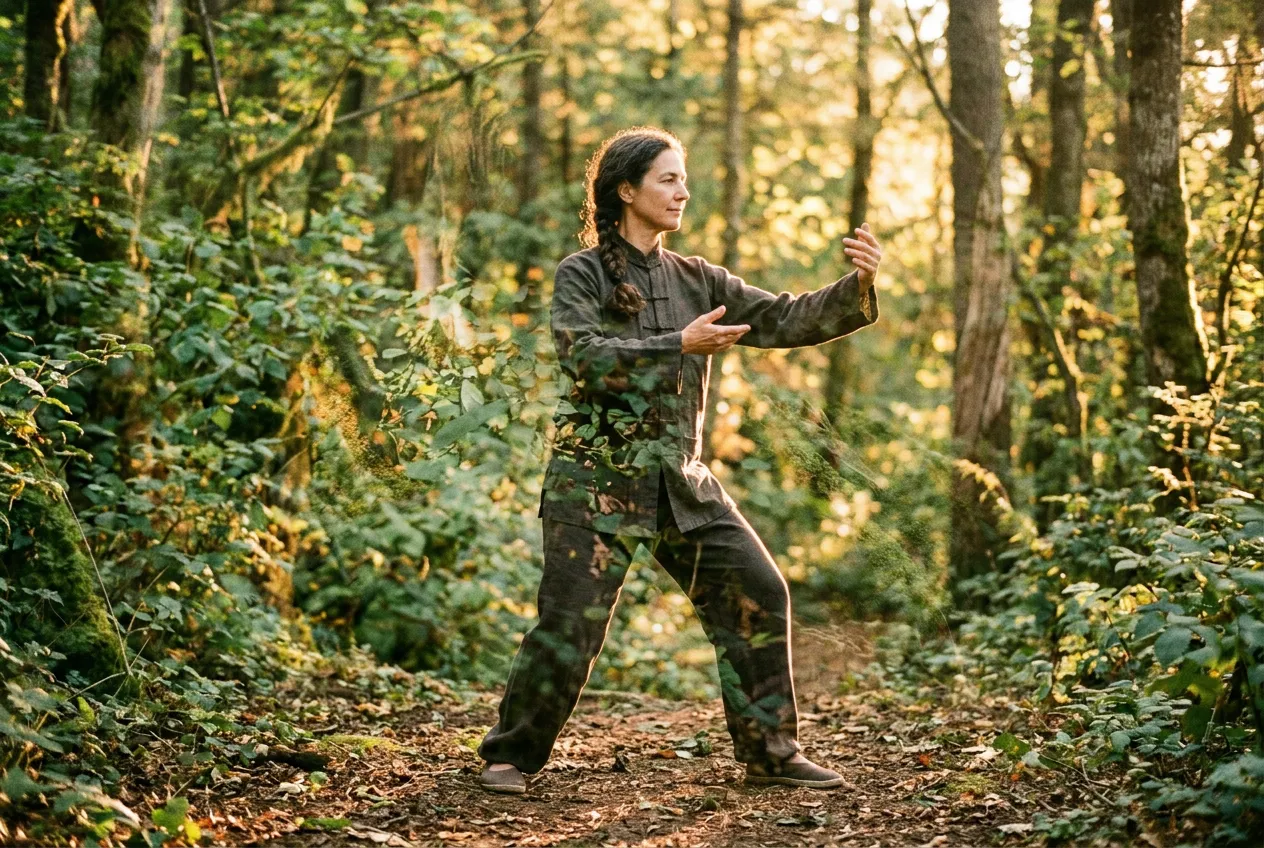
Finish by returning to the basic standing posture, taking 3–5 slow breaths, and noticing the change in how the chest and shoulders feel. The change after a regular practice is cumulative rather than immediate — one session produces noticeable relaxation; a consistent practice over weeks produces a genuine postural shift.
For a complete warm-up routine that includes chest openers alongside lower body and breath preparation, see the tai chi breathing techniques guide and the full tai chi practice section.