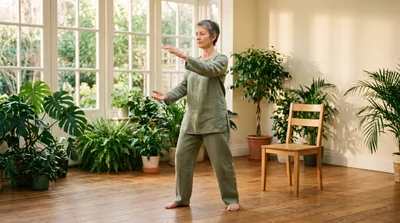
The shoulder and neck are where most people carry the physical residue of their working life. Hours at a desk produce a predictable pattern: shoulders drawn forward and up, the upper trapezius permanently switched on, the chest tight, the upper back rounded, and the neck compensating for all of it.
Tai chi and its associated qigong exercises are unusually well suited to this problem, because they work the shoulder girdle through its full range without load, repeatedly, in a relaxed state. That combination — range plus relaxation plus repetition — is precisely what shortened, over-active tissue responds to, and it is what stretching alone does not provide.
This article covers six movements drawn from tai chi warm-up and qigong practice, why they work, and how to use them.
Why the Shoulders Respond to This Kind of Movement
Shoulder and neck tension is rarely a problem of weakness or of tissue damage. Far more often it is a problem of habitual holding — muscles that have been asked to maintain a static position for so long that the resting tone never fully releases.
Static stretching addresses this poorly. A held stretch produces a temporary increase in tolerance, which is why the relief lasts about twenty minutes. What changes the underlying pattern is repeated, unloaded movement through range in a state where the nervous system is not braced.
Tai chi movements meet that description almost by design. The shoulder work in tai chi is characterised by the principle known as “sinking the shoulders and dropping the elbows” — a deliberate downward release of the shoulder girdle that runs directly counter to the raised, protective posture that desk work creates.
The first year I practised, the correction I heard most often was that my shoulders were creeping up. It took a long time to notice it happening in real time, and longer still for the relaxed position to become the default rather than something I had to remember.
Six Movements
Each of these can be done standing or seated. None should produce pain. Move slowly enough that you could stop at any point in the range.
1. Shoulder Rolls
Stand with arms hanging. Roll both shoulders slowly backward in the largest circle you can make — up toward the ears, back, down, and forward. Ten repetitions backward, then five forward.
The backward direction matters more than the forward, because it opposes the protracted position that desk work produces. Keep the arms completely passive; the movement comes from the shoulder blades, not from the arms.
2. Arm Swings Across the Body
Feet shoulder-width, knees soft. Turn the waist from side to side, letting the arms swing freely and wrap around the body, hands tapping lightly on the ribs and lower back at the end of each swing.
This is the single most valuable movement on the list. It combines thoracic rotation with passive shoulder mobilisation, and because the arms are entirely relaxed, it teaches the shoulders what release feels like. Thirty seconds to a minute, letting the swing find its own rhythm.
3. Chest Opening
Bring both hands up in front of the chest, palms facing each other about a foot apart. Open the arms outward and slightly back, feeling the chest widen, then bring them back together. Coordinate with the breath — inhale opening, exhale closing.
Ten repetitions. Keep the shoulders down as the arms open; the temptation is to shrug at the end of the range, which defeats the purpose. The chest opener sequence covers this family of movements in more depth.
4. Cloud Hands
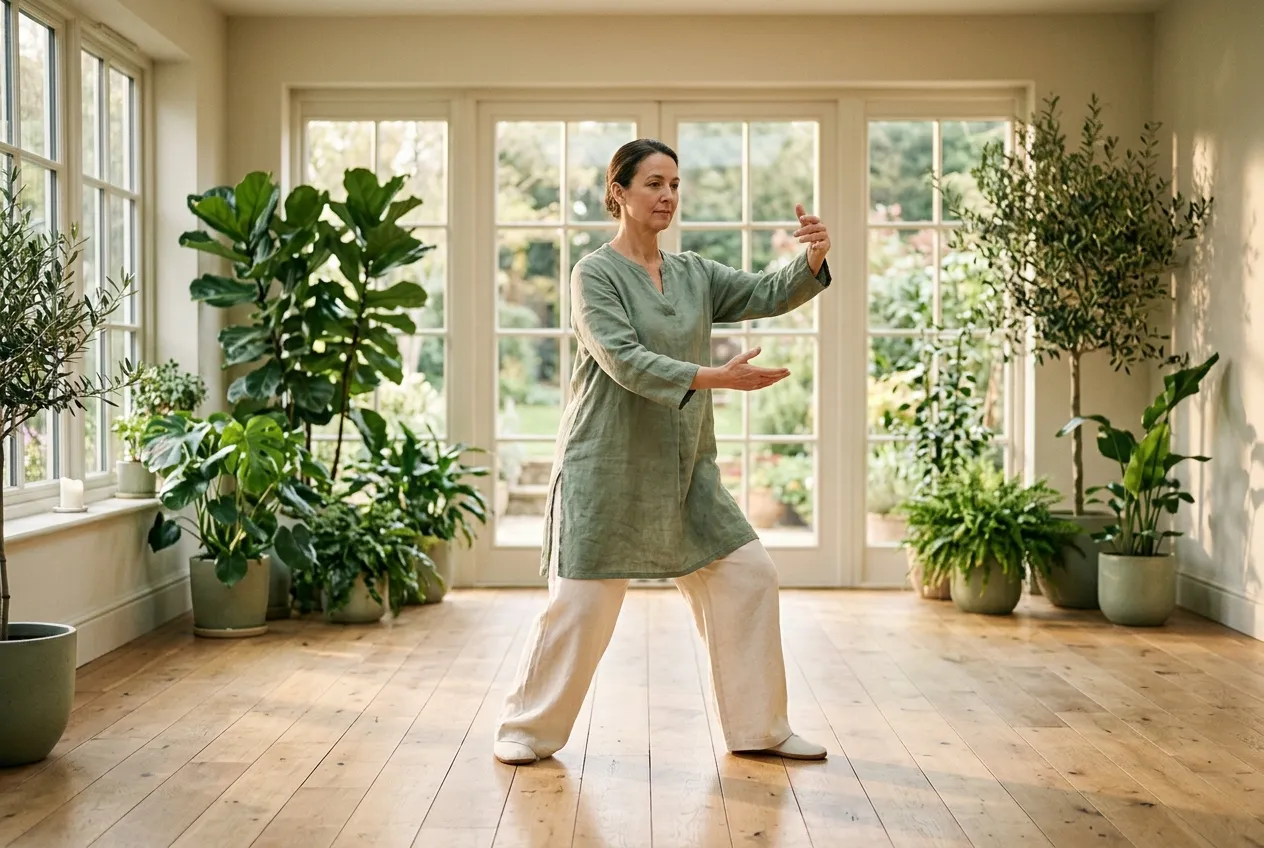
The classic tai chi movement, and excellent shoulder work. Standing with feet shoulder-width, move the hands across the body in a slow, continuous alternating circle, one hand at eye level and one at waist level, turning the waist as the hands pass.
The key point for shoulder health is that the arms should be moved by the waist rather than driven by the shoulders. If your shoulders are doing the work, slow down until the rotation leads. Two minutes.
5. Reaching to the Sky
Interlace the fingers, turn the palms upward, and press slowly overhead while inhaling. Hold for a breath, then lower slowly while exhaling. Six to eight repetitions.
This is drawn from the Eight Brocades qigong sequence, where it is known as “Propping Up the Sky”. It takes the shoulder through full flexion — the range most restricted by desk posture — with the added benefit of lengthening the whole lateral chain. Do not force the arms behind the head; press upward within a comfortable range.
6. Neck Turns and Tilts
Slowly turn the head to look over the right shoulder, return to centre, then to the left. Five each way. Then tilt the ear toward the shoulder, five each side, keeping the shoulders down.
Slow and small. The neck responds badly to end-range forcing, and there is no benefit to going further than comfortable. If any movement produces dizziness, sharp pain, or symptoms travelling into the arm, stop and get it assessed.
How to Use These
Duration. The full sequence takes eight to ten minutes. It works as a standalone routine, as a warm-up before a longer tai chi session, or broken into pieces through the working day.

Frequency. For an established stiffness pattern, once daily is the minimum for change, and twice is better. The tissue adaptations that matter here come from frequency rather than from the intensity of any single session.
Timing. A short version at the desk every couple of hours is more effective than a single long session in the evening. Interrupting the static holding period is the whole point.
Breathing. Slow, into the abdomen, without holding. Breath holding raises shoulder tension, which is the opposite of the goal.
Progress markers. Range of motion improves first — usually within a fortnight. Reduced background aching follows over four to eight weeks. Changes in the habitual resting position of the shoulders take longest, because that is a nervous system pattern rather than a tissue one.
Where this fits into a broader practice: these movements overlap substantially with the standard tai chi warm-up sequence, and anyone doing a regular tai chi session is already getting most of this. The dedicated sequence is for people who either cannot practise a full session or who have a specific shoulder problem to address.
When Shoulder Pain Needs More Than Exercise
Gentle mobility work is appropriate for stiffness, postural aching, and general tension. It is not appropriate as a self-treatment for several things, and knowing the difference matters.
Get an assessment for pain that wakes you at night, pain that radiates down the arm with pins and needles or numbness, a shoulder that cannot be raised above shoulder height, a sudden loss of strength, or pain following a fall or injury. Frozen shoulder, rotator cuff tears, cervical radiculopathy, and referred pain from elsewhere all present as shoulder pain and all need a diagnosis rather than a mobility routine.
Frozen shoulder in particular is worth flagging, because gentle movement is part of its management but the condition follows a long and specific course that benefits from proper guidance. Pushing into the restricted range during the painful phase makes things worse.
For persistent shoulder pain related to arthritis, the arthritis guide covers the joint-protection principles that apply, and the chronic pain article covers pacing for longer-standing problems. The full set of health-related guides is in the tai chi health section.