Chronic pain is the condition where tai chi has accumulated some of its most convincing clinical evidence — and also the one where the practical advice is most easily got wrong. The trials show real reductions in pain and disability for persistent low back pain, fibromyalgia, and knee osteoarthritis. What they cannot tell you is how to get through your first four weeks without aggravating the thing you are trying to treat.
This article covers both. The research first, condition by condition, then the practical adjustments that make the difference between a practice you sustain and one that flares your symptoms and gets abandoned by week three.
Chronic Low Back Pain
Persistent non-specific low back pain — pain lasting more than three months without an identifiable structural cause — is one of the most common reasons people go looking for gentle movement.
The trial most often cited is an Australian randomised controlled trial of 160 adults with persistent low back pain, published in Arthritis Care & Research. Participants did eighteen 40-minute tai chi sessions over ten weeks, compared against a waitlist control. The tai chi group reported reduced pain intensity and reduced pain-related disability at the end of the intervention. The effect sizes were modest but clinically meaningful for a condition where most interventions struggle to beat control conditions at all.
Later systematic reviews pooling tai chi trials for low back pain have generally reached the same conclusion: tai chi outperforms no treatment and performs comparably to other exercise approaches, with the usual caveats about small sample sizes and difficulty blinding participants in exercise research.
The mechanism is not mysterious. Persistent low back pain is strongly associated with deconditioned trunk musculature, guarded movement patterns, fear of movement, and central sensitisation. Tai chi addresses several of these at once — it loads the trunk gently and continuously through rotation, it requires movement in a context that feels safe, and it does so slowly enough that the nervous system does not read the movement as threat. That last point matters more than it sounds. Much of chronic pain rehabilitation is about persuading a protective nervous system that movement is not dangerous.
When I went through a period of low back stiffness in my thirties, the thing that helped was not stretching but the continuous slow rotation through the waist that tai chi demands. Static stretching gave twenty minutes of relief; the rotational work changed how the area felt over weeks.
Fibromyalgia
The fibromyalgia evidence is stronger than most people realise, largely on the strength of a single well-designed trial.
Researchers at Tufts ran a 52-week single-blind comparative effectiveness trial published in the BMJ in 2018, randomising 226 adults with fibromyalgia to either tai chi (in four different dosing arms) or supervised aerobic exercise, the standard recommended treatment. The result: tai chi produced greater improvement in fibromyalgia symptoms than aerobic exercise, with larger benefits in the groups practising for 24 weeks rather than 12.
That is an unusual finding. Aerobic exercise is the most strongly recommended non-pharmacological intervention for fibromyalgia in most clinical guidelines, and tai chi beat it on the primary outcome. The US National Center for Complementary and Integrative Health summarised the result as showing similar or greater benefit.
Why fibromyalgia in particular responds well is worth understanding, because it explains who else might benefit. Fibromyalgia involves central pain amplification, poor sleep, autonomic dysregulation, and a strong exercise-intolerance component — many patients experience post-exertional symptom flares that make conventional exercise prescriptions difficult to follow. Tai chi’s intensity is low enough to sidestep the flare threshold for most people while still providing the movement, breathing, and sleep benefits that reduce central sensitisation.
Knee Pain and Osteoarthritis
Knee osteoarthritis has the deepest evidence base of the three. A 52-week randomised trial published in Annals of Internal Medicine compared twelve weeks of tai chi against standard physical therapy in 204 people with symptomatic knee OA and found that tai chi produced benefits comparable to a standard course of physical therapy, with additional improvements in depression scores and quality of life that physical therapy did not produce.

Knee pain is also where technique matters most, because bad tai chi can genuinely aggravate a knee. The dedicated tai chi for arthritis guide covers the joint-protection details in depth — stance height, knee-over-foot alignment, and turning from the hip rather than twisting through the knee. The same joint-protection logic applies further up the body: the tai chi shoulder exercises guide covers arm and shoulder-specific modifications for anyone whose chronic pain is centred there rather than in the back or knee.
What Kind of Pain Relief to Expect
Being precise about this saves disappointment. Tai chi does not eliminate chronic pain. Across the trials, what changes is a cluster of related things:
- Pain intensity ratings drop by a modest but consistent amount — noticeable, not dramatic, and rarely down to zero.
- Pain-related disability improves more than pain intensity does — people report doing more, with the pain interfering less.
- Mood and sleep improve, and both feed back into pain perception.
- Fear of movement decreases, which matters because avoidance is what turns an acute problem into a chronic one.
The pattern across studies is that function improves faster and further than raw pain scores. That is a genuinely useful outcome — most people with chronic pain want their life back more than they want a specific number to change.
Timeframe: expect the first noticeable changes somewhere between four and eight weeks of consistent practice. Trials showing the strongest effects ran twelve to twenty-four weeks. The fibromyalgia trial specifically found the 24-week groups did better than the 12-week groups, which suggests the benefit continues to accrue rather than plateauing early.
Practising Without Flaring Symptoms
This is the part the research papers do not cover, and it is where most people go wrong in their first month.
Start Shorter Than You Think
The single most common mistake is starting at the duration the trials used. Those participants were being progressively coached into a full session. If you have chronic pain, start with ten to fifteen minutes and add five minutes every week or two, provided the previous level did not produce a flare.
Watch the Delayed Response
Chronic pain conditions, especially fibromyalgia, often produce symptoms 24 to 48 hours after activity rather than during it. Judging a session by how you feel while doing it will mislead you. Keep a simple log — session length, and pain the following two days — for the first six weeks.
Raise Every Stance
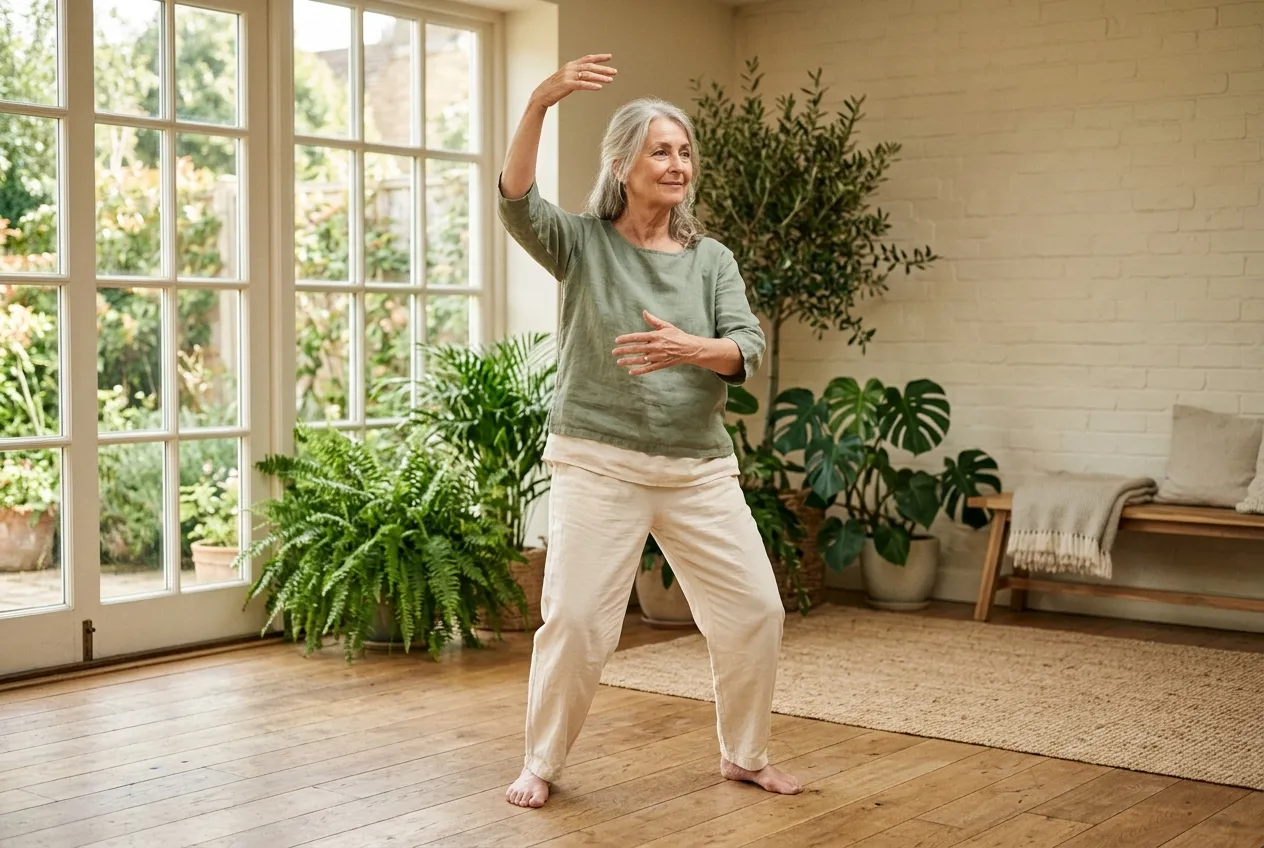
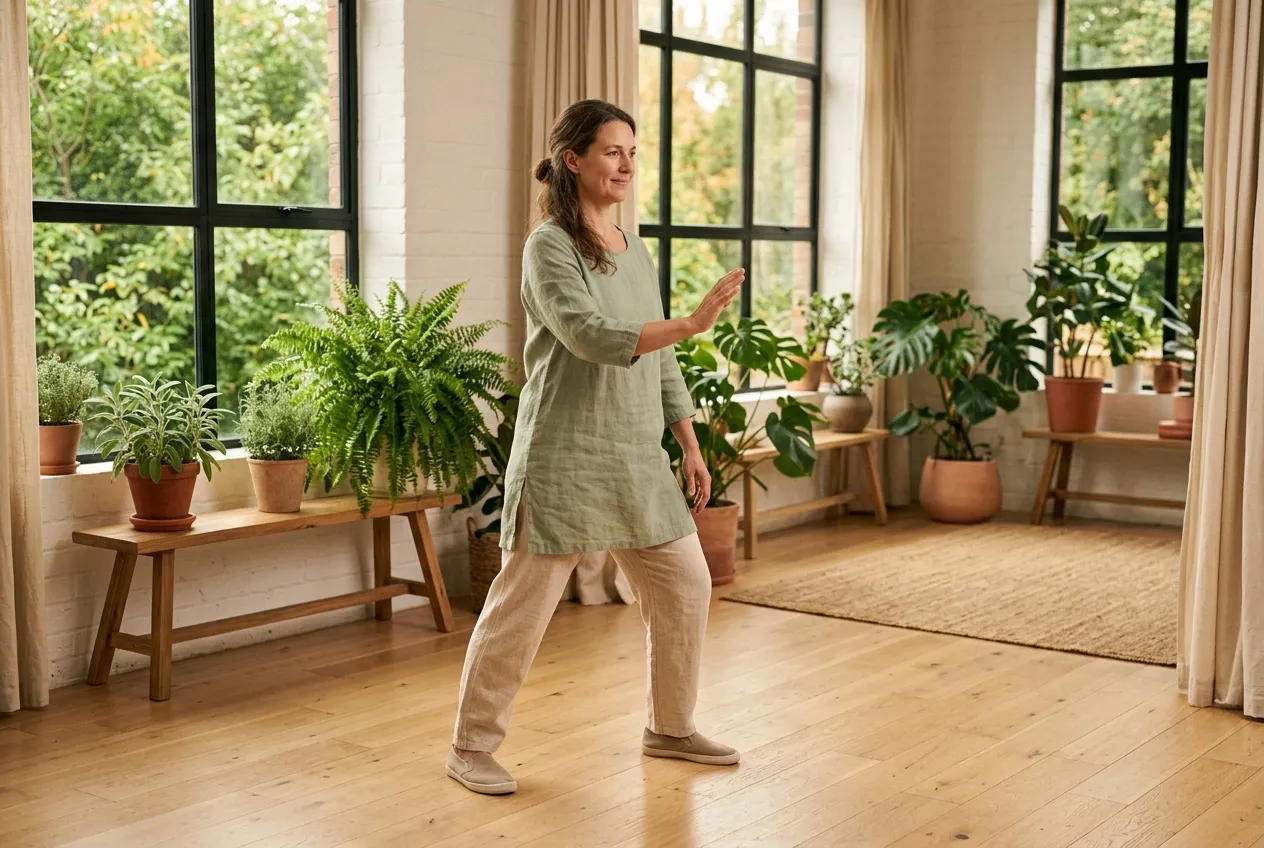
Deep stances are the fastest way to turn a gentle practice into an aggravating one, particularly for knees and lower backs. There is no clinical benefit to depth. Every posture in every style can be done with a nearly upright, high stance, and every trial that produced results allowed exactly that modification.
Sit If You Need To
Seated practice is legitimate practice, not a lesser version. On flare days, a seated version of the same movements maintains the routine and the nervous-system benefits without the load. The seated qigong sequences work well as a flare-day fallback.
Do Not Push Through Sharp Pain
The distinction that matters: a general ache or fatigue that eases within a day is normal training response. Sharp, localised, or nerve-type pain — burning, shooting, numbness — is a signal to stop and modify. Nothing in tai chi requires you to work through pain, and the styles that encourage that attitude are not the ones with the clinical evidence behind them.
In my own practice the temptation is always to hold stances lower than necessary, because it feels like more serious training. For anyone dealing with pain, that instinct is exactly backwards.
A Twelve-Week Starting Structure
Something concrete, because “start gently and build” is easy to say and hard to act on. This progression assumes you are starting from a low baseline and have no acute injury.
Weeks 1-2. Ten minutes, three times a week. Warm-up movements and standing practice only — no form. The aim is to establish that movement at this dose does not produce a flare.
Weeks 3-4. Fifteen minutes, three times a week. Add two or three simple movements repeated slowly rather than a sequence. Cloud hands and a simple weight-shifting drill are enough.
Weeks 5-8. Twenty to twenty-five minutes, three to four times a week. Begin learning a short form. Expect this to be the stage where enthusiasm outruns tolerance — hold the line on session length even when a session feels easy.
Weeks 9-12. Thirty minutes, three to four times a week, running through a short form two or three times. This is roughly the dose most trials used.
If any stage produces increased symptoms over the following two days, drop back to the previous stage for another fortnight rather than pushing on. Progress in chronic pain rehabilitation is rarely linear, and a fortnight lost to a sensible retreat costs far less than a month lost to a flare.
The pattern I have watched people get wrong most often is doing nothing for three weeks and then attempting a full class because they feel unusually well that day. Consistency at a low dose beats occasional ambition every time.
Choosing a Class When You Have Chronic Pain
Class selection matters more for this group than for almost any other. What to look for:
Explicit health orientation. Classes described as “tai chi for health”, “therapeutic tai chi”, or “gentle tai chi” are far more likely to accommodate modification than classes framed around traditional martial training.
Small enough for individual attention. In a class of thirty, nobody notices your knee collapsing inward. In a class of eight, the instructor does.
Willingness to be told. Tell the instructor about your condition before the first class, and see how they respond. An instructor who asks follow-up questions and offers specific modifications is worth travelling for. One who says “just do what you can” without further thought is not paying attention.
A seated option. Instructors who routinely offer seated variants are used to teaching people with pain, which tells you something useful.
If in-person options are limited, guided video practice can work, though it removes the corrective feedback that matters most for joint alignment. The wider health benefits article sets the pain findings alongside the balance and cardiovascular evidence, and the tai chi for seniors guide covers adaptations that overlap heavily with what chronic pain practitioners need. More on the research across conditions is collected in the tai chi health section.
Where Tai Chi Fits in Pain Management
Tai chi is a movement therapy. It sits alongside medical management, physiotherapy, pain psychology, and pacing strategies rather than replacing any of them. For people already working with a pain service, it is usually welcomed — it is low-risk, self-directed, and addresses the deconditioning and movement avoidance that pain services spend most of their time on.

For people not under specialist care, and particularly for anyone whose pain is new, changing in character, or accompanied by red-flag symptoms — unexplained weight loss, fever, bladder or bowel changes, progressive neurological symptoms — the priority is diagnosis, not exercise selection. Get the assessment first.
Frequently Asked Questions
Can tai chi make back pain worse?
It can, if practised with stances that are too deep, sessions that are too long too early, or with twisting that comes from the spine rather than the hips. Practised with high stances and short initial sessions, aggravation is uncommon. The trials that studied tai chi for low back pain reported few adverse events, and those reported were minor.
How often should I practise for chronic pain?
Most positive trials used two to three supervised sessions per week, often with home practice in between. Two or three sessions weekly is a reasonable target. Daily short sessions of ten to twenty minutes work well as an alternative, and for fibromyalgia in particular, frequent short sessions tend to be better tolerated than infrequent long ones.
Is tai chi better than physiotherapy for knee pain?
The Annals of Internal Medicine trial found tai chi produced comparable results to a standard physical therapy course for knee osteoarthritis, with some additional benefit for mood and quality of life. “Comparable” is the accurate word — not better. Physiotherapy targets specific deficits that a group tai chi class cannot address, so the two are complementary rather than interchangeable.
Will tai chi help nerve pain or sciatica?
The evidence base is for non-specific chronic pain, fibromyalgia, and osteoarthritis rather than for radicular or neuropathic pain. Some people with settled sciatica find gentle movement helps, but active nerve root compression needs assessment first, and certain positions may aggravate it. This is a case for getting individual guidance rather than joining a general class.
How long before I notice a difference?
Four to eight weeks for the first noticeable change, with continued improvement over three to six months. The fibromyalgia trial found 24 weeks of practice outperformed 12 weeks, so the sensible expectation is gradual accumulation rather than a quick result.
Can I practise during a flare?
Usually yes, in reduced form. Seated practice, or a few minutes of standing and breathing, maintains the habit and the autonomic benefits without the load that would extend the flare. Complete rest during flares tends to make the return harder. The goal is to reduce, not to stop.