Tai chi is an odd recommendation for an athlete. It has no meaningful cardiovascular stimulus, builds little strength, and requires months of learning before you can do it unsupervised. Almost any other cross-training option delivers something measurable faster.
And yet it has a real constituency among martial artists, climbers, dancers, and endurance athletes, and the reasons they give are consistent. What tai chi offers is not fitness but movement quality — balance, structural organisation, and control of the body in space — plus a form of recovery activity that does not add training load.
This covers what it genuinely provides, for whom, and how to fit it into a week that is already full.
What It Develops That Sport Does Not
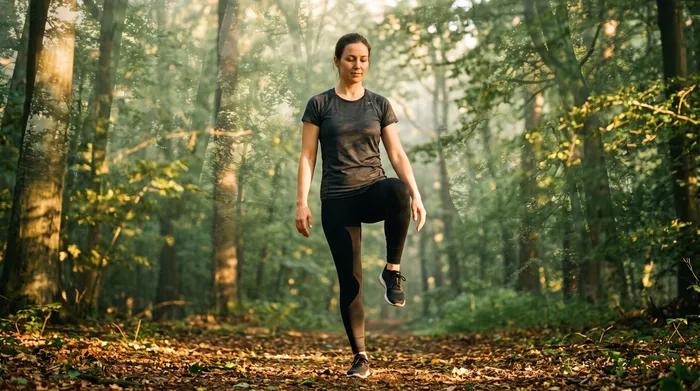
Single-leg control under load. Tai chi spends most of its time transferring weight between legs with control, frequently in positions where one leg carries everything. Most sports demand single-leg stability constantly — sprinting, cutting, kicking, climbing — and few train it deliberately at slow speeds where errors are visible.
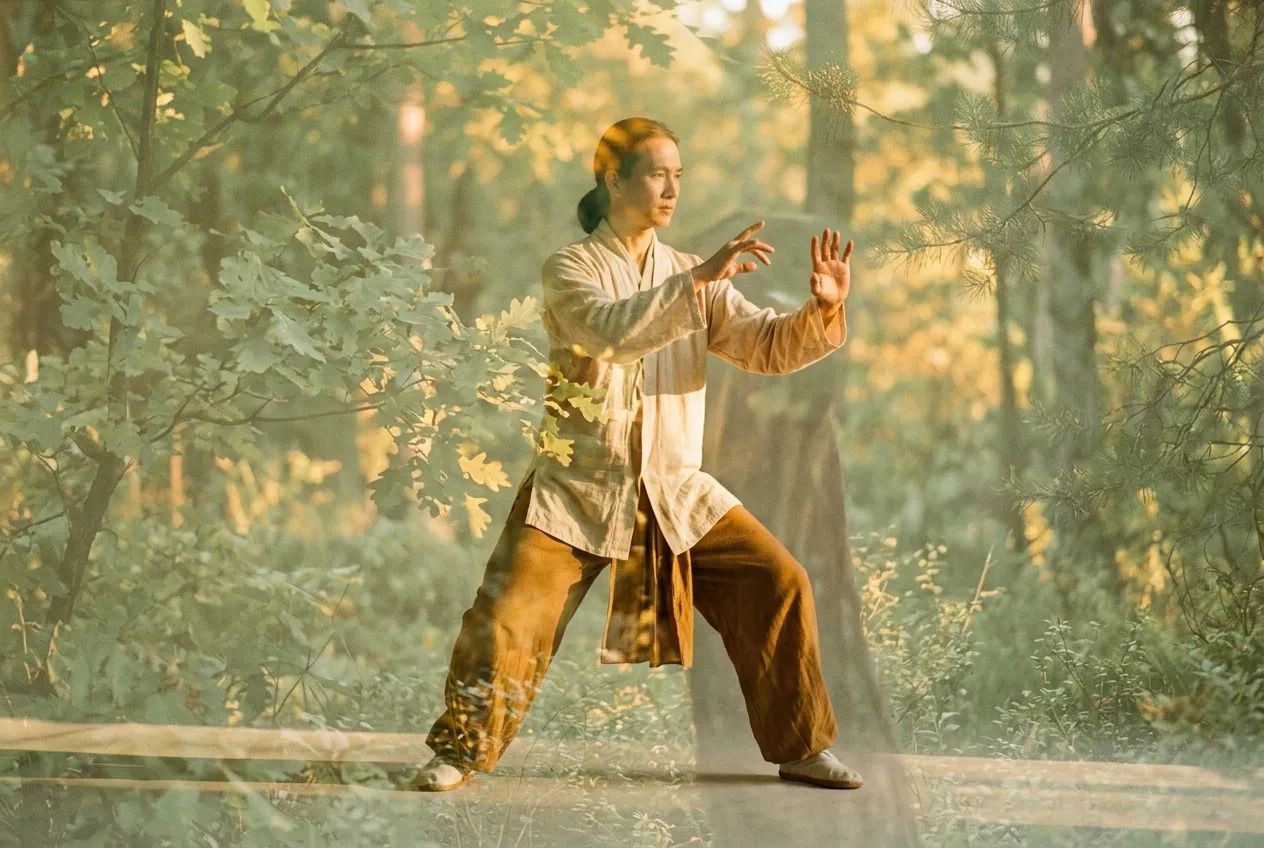
Deceleration and controlled descent. Tai chi is essentially continuous eccentric control: lowering, arriving, and settling under command rather than dropping. Poor deceleration control is implicated in a large share of non-contact injuries, and slow practice trains it directly.
Hip mobility with control. The stances require hip range that many athletes have lost, and they load it rather than merely stretching it. Loaded range is more useful than passive range.
Proprioception at low speed. Slow movement removes the momentum that hides imprecision. Athletes frequently discover that a movement they perform well at speed falls apart when performed slowly, which is a useful diagnosis.
Rotational sequencing. Tai chi organises movement from the ground through the legs and waist to the hands. That is the same kinetic chain that produces a punch, a throw, a golf swing, or a tennis serve. Practising it slowly makes the sequencing conscious.
Breathing under control. Slow diaphragmatic breathing during movement is trainable, and it transfers to breath control under exertion and to faster post-effort recovery.
Relaxation of unnecessary tension. Most athletes carry tension that costs them speed and endurance without their noticing. Tai chi’s whole premise is doing what is required and nothing more.
Who Benefits Most
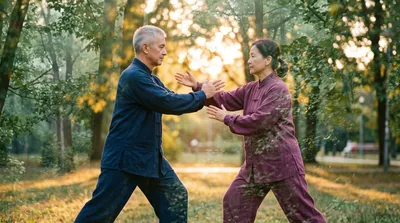
Martial artists get the most, and by a distance. The structural principles transfer directly, push hands develops sensitivity that applies to clinch and grappling, and the rotational power generation is the same mechanism their striking depends on. Practitioners of judo, wrestling, BJJ, and striking arts who take up push hands generally report it improving their sense of a partner’s balance. The push hands guide covers that practice.
Climbers benefit from the balance, the slow controlled weight transfer, and the hip mobility, all of which map onto footwork and body positioning on rock.
Runners and endurance athletes get single-leg stability, hip mobility, and a low-load active recovery session that does not compete with training volume.
Golf, tennis, and rotational sports benefit from the waist-led sequencing and the hip mobility that most of these sports demand and few of them train.
Dancers find the overlap obvious — weight transfer, controlled slow movement, spatial awareness — though many already train these directly.
Older athletes benefit most of all, because balance and joint health become the limiting factors on continued participation, and tai chi addresses both without adding load to a body that recovers slower than it used to.
What It Will Not Do
Being clear about this saves disappointment and wasted training time.
It will not improve your aerobic capacity meaningfully. It will not build strength that matters for performance. It will not replace mobility work targeted at a specific restriction, or rehabilitation for a specific injury. It will not make you faster in any direct way. And it will not produce measurable changes in the first few months, which is the period when athletes accustomed to trackable progress are most likely to abandon it.
There is also no substantial research on tai chi in athletic populations specifically. The claims above are mechanistic reasoning and practitioner report rather than trial evidence. The clinical research base is in older adults and clinical populations, as the health benefits article covers, and generalising from it to trained athletes is not straightforward.
Fitting It Into a Training Week
The realistic constraint for most athletes is time, and tai chi’s learning curve makes it a poor competitor for limited hours.
As active recovery. Twenty to thirty minutes on rest days or the day after hard sessions. Low enough load that it does not interfere with recovery, enough movement that it beats complete rest for stiffness. This is the easiest integration and the one most athletes settle on.
As a warm-up component. Ten minutes of slow movement and standing before training. Not a substitute for a sport-specific warm-up, but a good preparation for the attention and control that follows.
As a cool-down. Fifteen minutes after training, useful for switching the nervous system out of sympathetic dominance, which matters more for athletes in heavy training blocks than most realise.
As off-season work. The most sensible time to learn it. The memorisation phase demands attention that in-season athletes do not have to spare, and off-season is when movement-quality work has room.
As a standalone practice. Three or four sessions a week, treated as its own thing rather than as a supplement. This is where the actual skill develops, and it requires a genuine commitment.
The Martial Arts Case in More Detail
Because martial artists get the most from tai chi, it is worth being specific about what transfers.
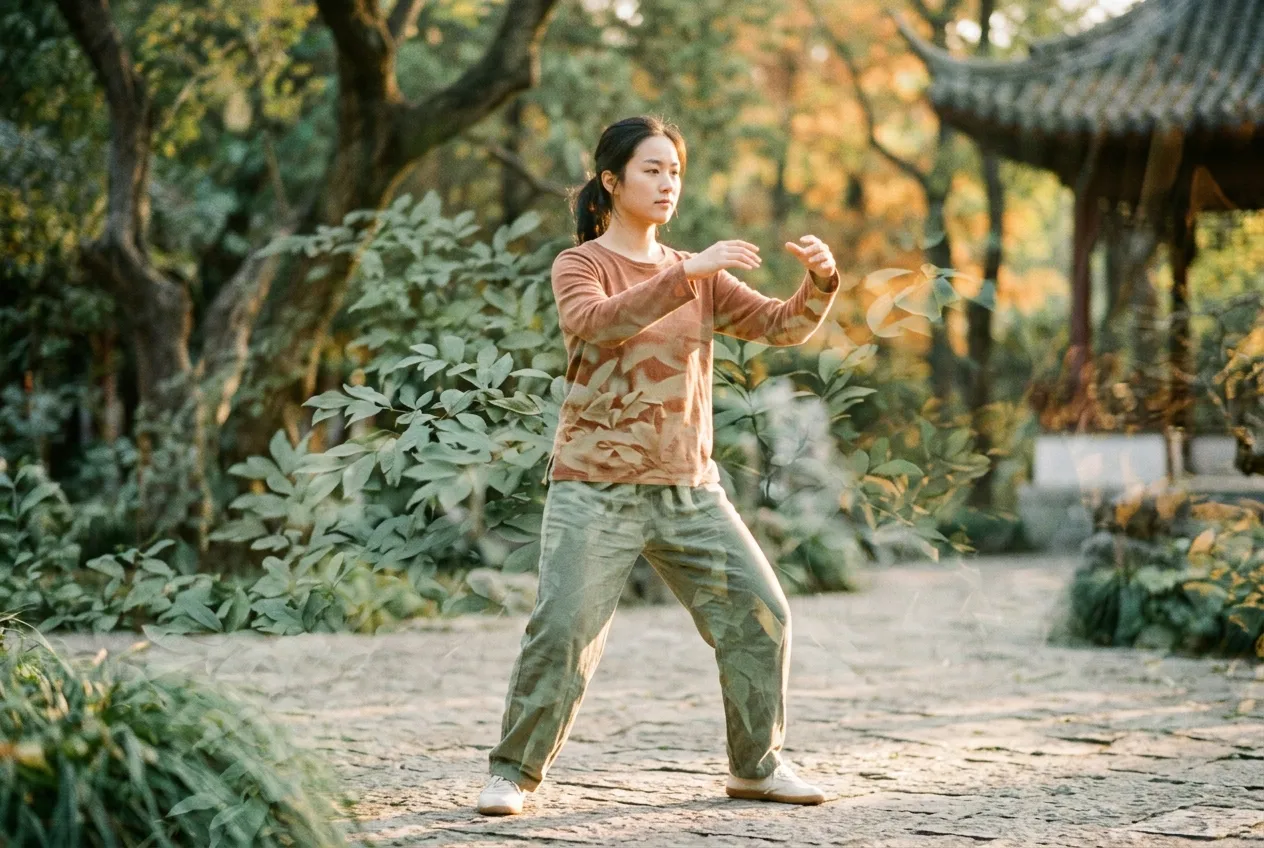
Structure under contact. Grapplers and clinch fighters spend their time being loaded from unpredictable angles. Tai chi’s whole method is organising the body so that force passes through it into the ground rather than being absorbed by muscle. Standing practice and push hands train this directly.
Sensitivity through contact. In grappling, the information that matters arrives through touch — where your opponent’s weight is, which direction they are committed in, where the gap is. Push hands trains exactly this perceptual skill in isolation, without the chaos of live rolling. Practitioners from judo and Brazilian jiu-jitsu who try it often describe it as familiar but slowed down enough to actually study.
Not over-committing. The tai chi instruction against double-weighting and over-extension is, in practical terms, an instruction not to put yourself somewhere you cannot recover from. That principle applies identically in any fighting art. It is also the fault I still catch myself making most often in push hands after several years of practice — the moment I lean into a push further than my rear leg can recover from, a training partner barely has to do anything to unbalance me, which is a more honest teacher than being told about it.
Relaxation. Every striking coach tells students to relax, and most students cannot, because there is no dedicated practice for it. Tai chi is that practice.
Recovery. Combat sports are hard on the body. A low-load session that maintains movement without adding damage has obvious value in a heavy training block.
What does not transfer without specific work is timing, distance, and dealing with speed. Tai chi trained solo will not teach any of those, and a martial artist expecting it to will be disappointed.
What to Practise
Athletes tend to want the useful parts without the full form, which is a reasonable instinct even if traditionalists would object.
The elements with the clearest transfer:
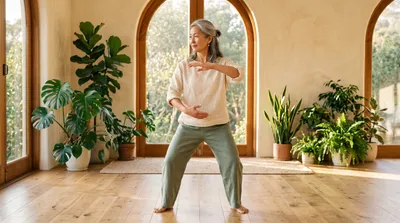
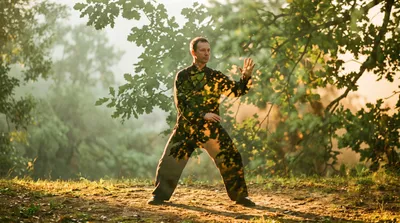
Standing practice. Ten minutes of static holding builds isometric leg endurance, exposes postural asymmetries, and trains the relaxation-under-load quality. Probably the highest-value element per minute spent. The first time I held a standing posture for a full ten minutes, I was surprised by how much low-level tension I had been carrying in my shoulders without noticing — that discovery is, in my experience, the biggest single value of standing practice for anyone coming from training that rarely stops long enough to notice it.
Weight-shifting drills. Slow transfers between legs, forward and back and side to side, with full commitment to each leg. Simple, repetitive, and directly transferable.
Tai chi walking. Slow deliberate stepping with controlled weight transfer. Excellent for deceleration control and single-leg stability.
Cloud hands. Continuous waist-led rotation with the arms following. Trains the rotational sequencing and is easy to learn.
A short form. Once the above are established, the 24-form provides a complete practice and a container for everything else.
Push hands, for martial artists specifically. The highest-transfer element for anyone whose sport involves an opponent.
That set can be practised in twenty minutes and skips the extended memorisation phase entirely. Purists would say you are not really doing tai chi, and they would be right — you are extracting the training elements from it, which is a different and entirely legitimate objective.
A Note on Expectations
The athletes who stick with tai chi are generally the ones who came to it for reasons other than performance — an injury that forced a change, an interest in the tradition, or simply liking it. Those who take it up purely as a performance intervention usually stop within a few months, because the return on time invested is poor compared with almost anything else they could do with those hours.
That is a fair assessment rather than a discouraging one. Tai chi’s value for athletes is real but slow, and it compounds over years rather than weeks. If you have twenty years of training ahead of you, the movement quality and joint health it builds is a good investment. If you are preparing for a season, spend the time elsewhere.
The daily practice routine guide covers structuring practice around an existing schedule, and more practical material is collected in the tai chi practice section.