Push hands is where tai chi stops being theoretical. The solo form lets you believe you are relaxed, rooted, and structurally sound. Two minutes of contact with a partner establishes whether any of that is true.
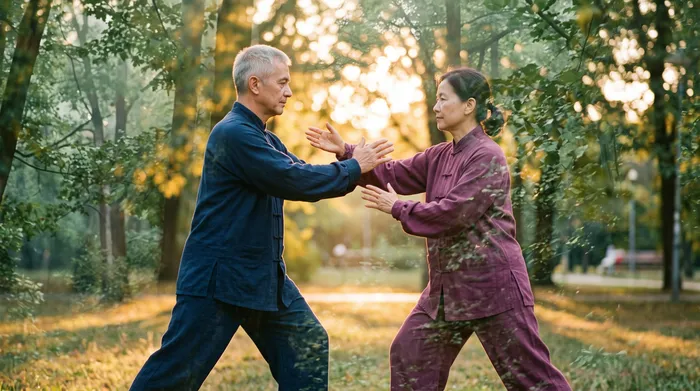
Tui shou — literally “pushing hands” — is the partner practice that bridges the solo form and application. Two practitioners maintain contact through the arms and attempt to unbalance each other while staying relaxed, connected, and sensitive to what the other is doing. It is not sparring, it is not a competition in any conventional sense, and it is the single most useful thing most tai chi practitioners are never taught.
What Push Hands Trains
Listening energy (ting jin). The central skill. Through the point of contact, you learn to detect a partner’s balance, force direction, and intention. This is a genuine perceptual skill that develops with practice and cannot be developed alone — and, along with the balance and structural qualities below, it is part of why the tai chi for athletes guide recommends push hands as cross-training for other sports.
Yielding and neutralising. Meeting force with force is the instinct. Push hands trains the alternative: receiving a push, redirecting it past you, and returning it. Every beginner resists; unlearning that is most of the early work.
Structural testing. The form cannot tell you whether your posture holds under load. A partner can, immediately and repeatedly.
Relaxation under pressure. Staying soft while someone is trying to push you over is difficult, and it is exactly the skill the solo form is supposed to be building.
The four energies in application. Ward off, roll back, press, and push — peng, lu, ji, an — are abstract in the form and concrete in push hands. Feeling them applied to you is a different order of understanding.
Distinguishing full and empty. The classics repeat this instruction constantly. In push hands, being caught with weight in the wrong place has an immediate and unmistakable consequence.
The first time I did push hands with someone substantially better, the experience was of being unable to find anything to push against — every time I committed force it went somewhere I had not intended and I ended up over my own toes. That sensation is the whole practice in miniature.
The Basic Patterns
Push hands is taught through a progression of increasingly free patterns.
Single-Hand Fixed Step
The starting point. Two practitioners stand facing each other in a bow stance, one hand in contact at the wrist or forearm, feet stationary. One partner pushes gently forward; the other yields, redirects the force to the side, and returns with a push of their own. The movement is circular and continuous.
The feet do not move. That constraint is the point — it forces the yielding to happen through the waist and the weight shift rather than by stepping away.
Double-Hand Fixed Step
Both arms in contact, following a set circular pattern that cycles through the four primary energies. The standard sequence — ward off, roll back, press, push — is drilled until it becomes continuous and unthinking.
This is where most practitioners spend the bulk of their push hands time, and there is a great deal in it. The pattern itself is simple; performing it without collapsing, resisting, or losing contact is not.
Moving Step
The same principles with stepping added. Patterns vary between schools — some use a fixed stepping sequence, others allow free movement. Adding footwork multiplies the difficulty because now balance is being challenged in transition rather than from a stable base.
Da Lu
A four-corner pattern training pull down, split, elbow, and shoulder — the secondary energies — usually with stepping. More common in some lineages than others, and generally taught after the basic patterns are established.
Free Push Hands
No fixed pattern. Both practitioners move, apply, and neutralise freely within agreed limits, typically no strikes and no grabbing. This is where the skill is genuinely tested, and it is competitive in the way that a game is competitive.
Competition push hands exists as a formal event with rules and weight categories, and it is somewhat controversial among practitioners — the rule sets tend to reward strength and wrestling instincts over the qualities push hands is supposed to develop.
A First Session
If you have a willing partner and no instruction available, single-hand fixed step is learnable from a description, and doing it badly is more useful than not doing it.
Stand facing each other, close enough that your outstretched wrists meet comfortably. Both step the right foot forward into a bow stance, right wrists touching on the back of the forearm. Left hands rest at the side or lightly on the partner’s elbow.
One of you begins by shifting weight slowly forward, pushing gently toward the other’s centre through the contact point. Not fast, not hard — the aim is that the other person can feel exactly what is happening.
The receiver shifts their weight back and turns the waist, letting the incoming arm travel past the side of their body rather than into it. The contact is maintained throughout; the arm does not push back and does not go limp. As the push spends itself, the receiver turns back and becomes the pusher, and the cycle repeats.
Done properly this looks like two people slowly rotating a shared circle between them. Three things to check as you go: does the contact ever break, does either of you ever brace, and is the yielding coming from the waist and the weight shift or from the arm alone.
Ten minutes of this, then swap the forward foot and do ten minutes on the other side. It is repetitive and it is meant to be. The pattern is a container for the skill rather than the skill itself.
Common Faults
Almost everyone makes the same mistakes, in roughly the same order.
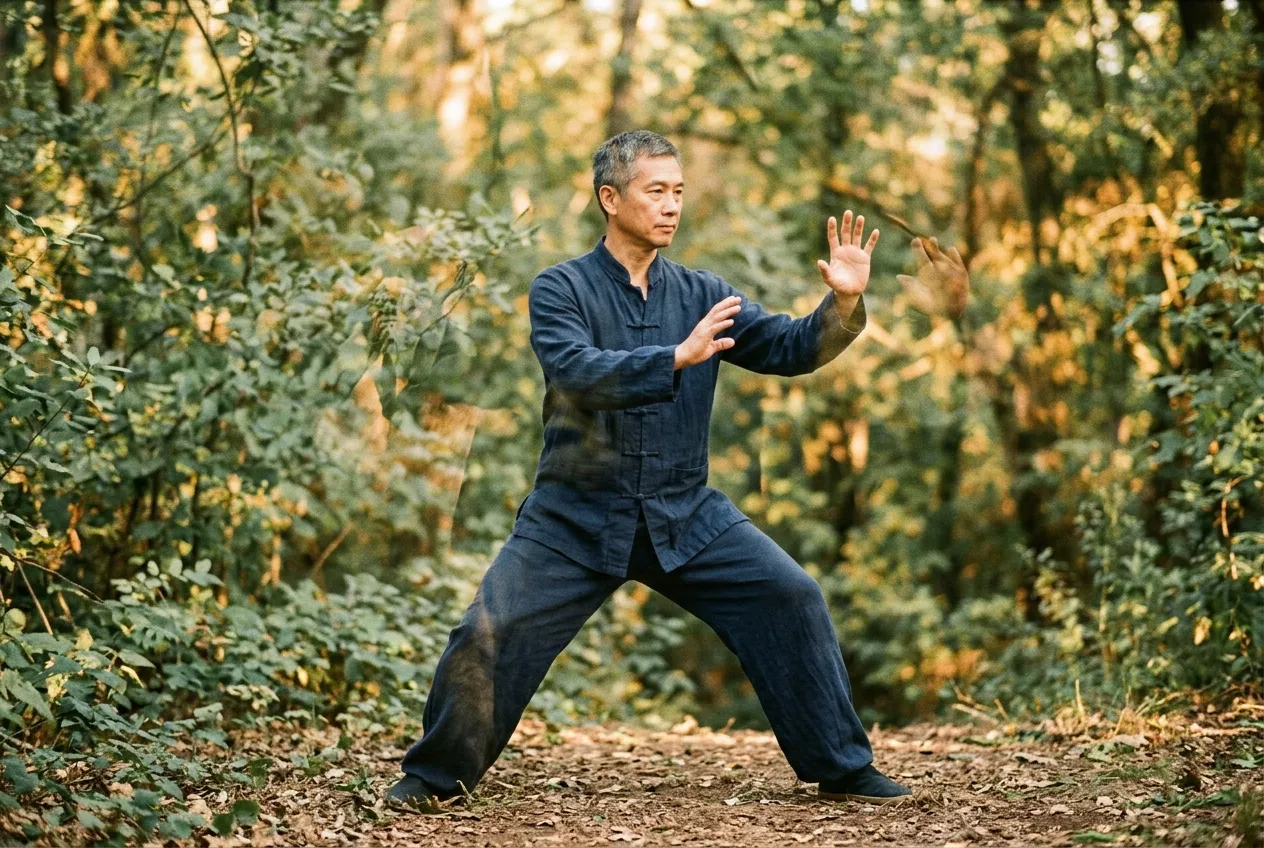
Using strength. The default. If you find yourself straining, you have stopped doing push hands and started wrestling. The corrective is to deliberately use less force than feels adequate and accept being pushed over more often.
Resisting rather than yielding. Meeting an incoming force head-on. The instruction is to receive and redirect, which feels like losing until it starts working.
Collapsing. The opposite fault, and equally common. Yielding is not going soft — the structure must remain, only the direction changes. A collapsed arm is as useless as a rigid one.
Losing contact. Pulling away from the partner’s touch breaks the connection that the entire practice depends on. Contact should be continuous and light.
Leaning. Reaching forward with the torso to push further than your base supports. Instantly exploitable, and the fault a good partner will punish every time.
Double-weighting. Weight evenly distributed on both feet at a moment when it should be clearly on one. The classics name this specifically as an error; in push hands you feel exactly why.
Anticipating. Trying to guess what the partner will do rather than responding to what they are doing. Anticipation produces movement before information arrives, which is a reliable way to be caught out.
Winning. The subtlest problem. Treating push hands as something to win encourages every fault above. The practitioners who improve fastest are the ones willing to be pushed over repeatedly while trying to do it properly — which is what Cheng Man-ch’ing’s instruction to “invest in loss” means.
What Progress Looks Like
Because push hands has no belts, forms, or obvious milestones, it helps to know what improvement actually consists of.
Early on, you stop using so much strength. This sounds minor and is the largest single change. It usually takes a few months and is mostly a matter of accepting that being pushed over is not a failure.
Then you start feeling what your partner is doing before it arrives — a shift in their weight, a moment of over-commitment, a gap where their structure is not supported. This is listening energy beginning to develop, and it is the point where the practice becomes genuinely interesting.
Later, your own responses stop being decisions. You yield without having chosen to, and the redirection happens as part of receiving rather than as a second step after it.
Eventually, according to practitioners much further along than I am, the distinction between neutralising and returning disappears entirely — the same movement does both.
That progression takes years, and it is not linear. Most people report long plateaus punctuated by sudden clarifications, usually after being comprehensively out-classed by someone better.
Starting Push Hands
When. Traditionally after the solo form is reasonably established, typically six months to a year in. Some schools introduce it earlier, and there is a decent argument for that — push hands clarifies the form’s principles in a way that solo practice does not.
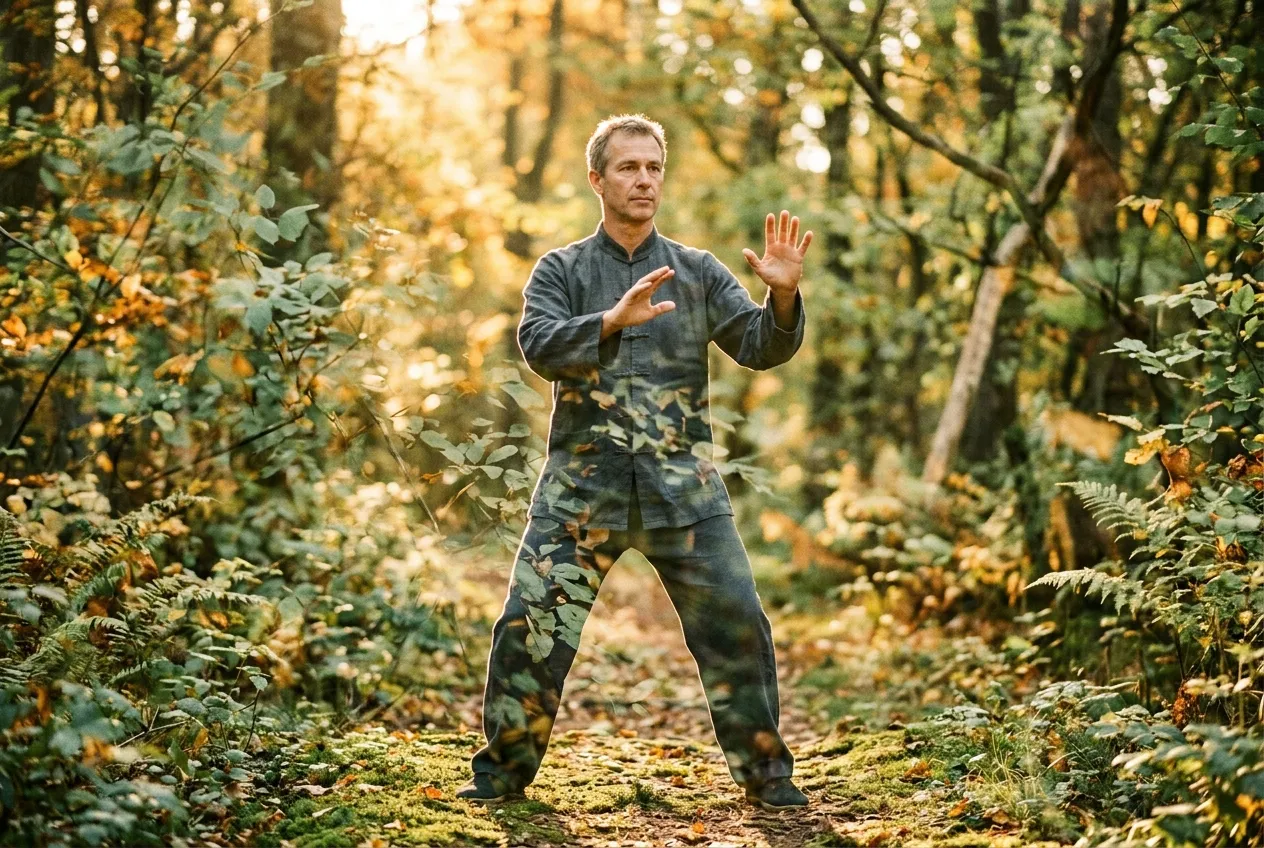
With whom. The partner matters enormously. A cooperative partner of similar or slightly greater skill is ideal. A stronger, more competitive partner who simply muscles you over teaches nothing except frustration, and a partner who lets you win teaches nothing at all.
How much force. Far less than feels natural at first. Both partners should be able to detect what the other is doing, which is impossible if either is using significant strength. Force can increase as skill does.
How long. Ten to twenty minutes at a time is plenty. Push hands is more mentally demanding than the form, and quality drops off noticeably once concentration goes.
What to expect. Frustration, for months. The skills are subtle and the feedback is initially just “you got pushed over again”. The point at which it starts making sense varies enormously between people.
Why Most Practitioners Never Do It
A substantial majority of people practising tai chi have never done push hands, and there are structural reasons.
Health-oriented classes rarely include it. It requires a partner, physical contact, and a class culture that not everyone wants. It carries a small injury risk that a form class does not. It takes class time away from form instruction. And it makes the martial content explicit, which some health-oriented teachers deliberately avoid.
There is also a plain practical issue: it needs even numbers, similar levels, and a teacher confident enough to supervise partner work.
The cost of skipping it is real, though. Push hands is where the form’s principles are tested, and a practitioner who has never been tested has no way of knowing whether their relaxation is genuine or whether their root exists. Plenty of people practise happily for years without it. But it is the fastest route to understanding what the form is actually asking for. The martial art article covers where push hands sits in the wider question of tai chi as a fighting system.
Finding Push Hands Practice
Ask your teacher. Many instructors who do not include it in class will teach it to interested students, or know where it is available.
Look for martial-oriented schools. Classes advertising the martial curriculum almost always include push hands.
Push hands groups. Informal groups meeting to practise exist in many cities, often independent of any particular school and often welcoming across styles.
Workshops. Weekend workshops are a common format and a reasonable way to start without committing to a new school.
Wu style schools in particular tend to emphasise it, as covered in the Wu style overview.
One practical warning. Push hands attracts a certain kind of participant who treats it as a contest to be won by strength, and encountering one early can be discouraging and occasionally painful. A good group manages this; if you find yourself in one that does not, find another.
The tai chi fundamentals guide covers the principles push hands tests, the Yang style overview covers the tradition most push hands practice sits within, and more practice material is in the tai chi practice section.