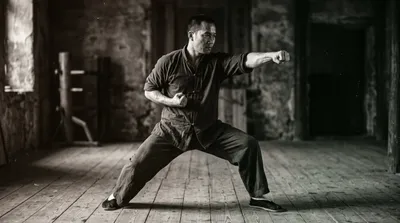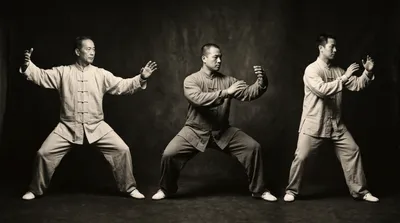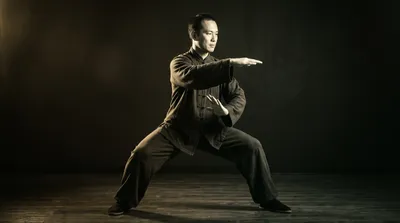
Wu style is the second most widely practised tai chi style in the world and one of the least discussed in the English-language material. It has a distinctive look — compact, slightly leaning, economical — and a reputation among practitioners for producing exceptional push hands sensitivity.
If you have looked at the major styles and found Chen too demanding and Yang too familiar, Wu is worth understanding. This guide covers where it came from, what makes it different, and who it suits.
The Wu Family Lineage
Wu style traces to Wu Quanyou (1834-1902), a Manchu officer in the Imperial Guard in Beijing. He learned tai chi during the period when Yang Luchan was teaching the Guard, and studied particularly with Yang Luchan’s son Yang Banhou, who taught a smaller-frame version of the family art.
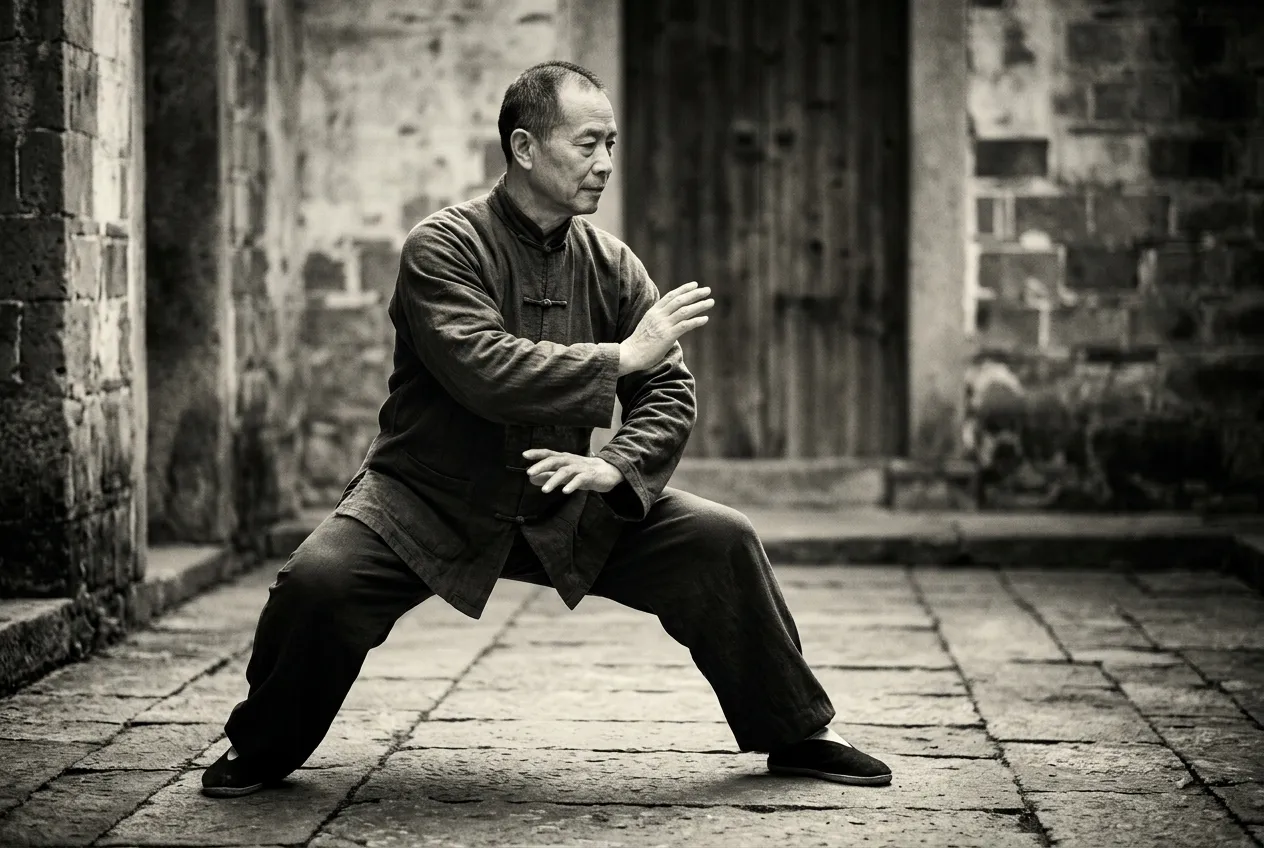
That detail explains a great deal about the style. Wu Quanyou’s tai chi came from the compact, small-frame Yang transmission rather than from the large-frame version that Yang Chengfu later standardised and that most Yang practitioners inherit today. Wu style is, in a sense, a preserved branch of an earlier and more compact Yang.
His son Wu Jianquan (1870-1942) refined the art, taught it publicly during the republican era, and is credited as the founder of Wu style proper. He established schools in Beijing and Shanghai, and the family later spread the style through Hong Kong and from there internationally — which is why Wu style is unusually well represented in Chinese diaspora communities and in Canada, where the family established a major school.
A frequent source of confusion is worth clearing up immediately. Wu style (吳, Wú) refers to this lineage. Wu (Hao) style (武, Wǔ) is an entirely separate style founded by Wu Yuxiang, with an even smaller frame and a strong theoretical orientation. The two are distinguished in English by the Hao in brackets, and they are different arts by different families whose surnames happen to be romanised identically.
What Makes Wu Style Distinctive
The Inclined Posture
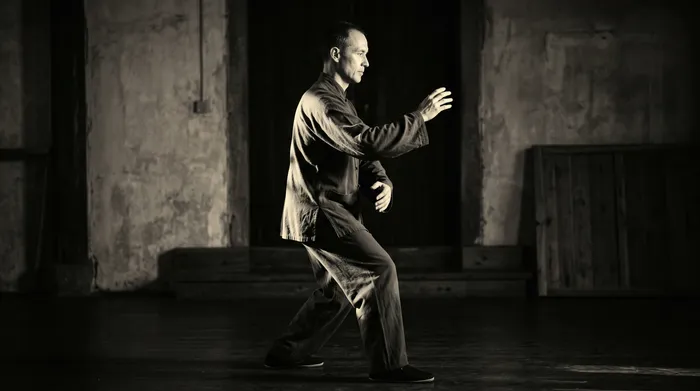
The immediately visible characteristic is the forward lean. Where Yang and Chen styles maintain a vertical spine, Wu style permits — and in some postures requires — the torso to incline forward.
The important qualification is that this is not a bend. The head, spine, and rear leg are held in a single straight line, inclined forward from the ankle, with no rounding of the back or breaking at the waist. Practitioners describe it as a slanted but straight body.
The rationale is martial: the incline extends reach and directs the body’s structure along the line of the technique, particularly in pushing and issuing movements. Done correctly it is stable; done as a slouch it is neither stable nor Wu style.
This is the feature that draws most criticism from practitioners of other styles, who regard the vertical spine as fundamental. Wu practitioners answer that their alignment is equally vertical, just tilted as a unit — which is a fair reply and also a distinction that takes some practice to see.
The Compact Frame
Wu movements are smaller than Yang’s. Stances are narrower and shorter, arm movements more contained, circles tighter. Nothing is extended to its full range.
The effect is a style that requires less space, is less physically demanding in terms of stance depth, and places more emphasis on subtle internal adjustment than on visible external movement. It also makes Wu harder to learn from watching, because there is less to see.
The Push Hands Emphasis
Wu style has a strong reputation for push hands — tui shou, the partner sensitivity practice. Wu Jianquan and his successors emphasised it heavily, and Wu schools generally train it more consistently than Yang schools do.
The connection to the style’s other features is direct. A compact frame with small movements demands finer sensitivity to a partner’s balance and intention, because there is less room for gross adjustment. Push hands is where that sensitivity is built and tested. The push hands guide covers the practice itself in more depth.
The Forms
The traditional Wu form is commonly counted at 108 movements, though as with all traditional forms, counts vary by lineage and convention. It takes twenty to thirty minutes at normal tempo.
A fast form also exists in the Wu curriculum — a quicker, more martially explicit version practised after the slow form is established. This is less well known outside Wu circles and is one of the more interesting features of the style, since it makes the martial content explicit in a way that slow practice does not.
Shorter standardised sets exist, including competition routines and simplified sequences of twenty-four to fifty movements, which are what most beginners encounter first.
Wu style also has weapons forms, notably sword and sabre, with the sabre work particularly well regarded. As in most traditional curricula, weapons come after the empty-hand form is established, and the compact frame carries over — Wu weapons work tends to look economical rather than expansive.
One further element sets the Wu curriculum apart from most Yang schools: the partner routines are more developed. Beyond basic fixed-step push hands, Wu training typically includes moving-step patterns and the two-person set known as da lu, which trains the four corner energies — pull down, split, elbow, and shoulder — in a choreographed exchange. Practitioners who reach that stage generally describe it as the point where the solo form starts making sense.
How Wu Compares With Yang
The comparison most people want, since Yang is the reference point.
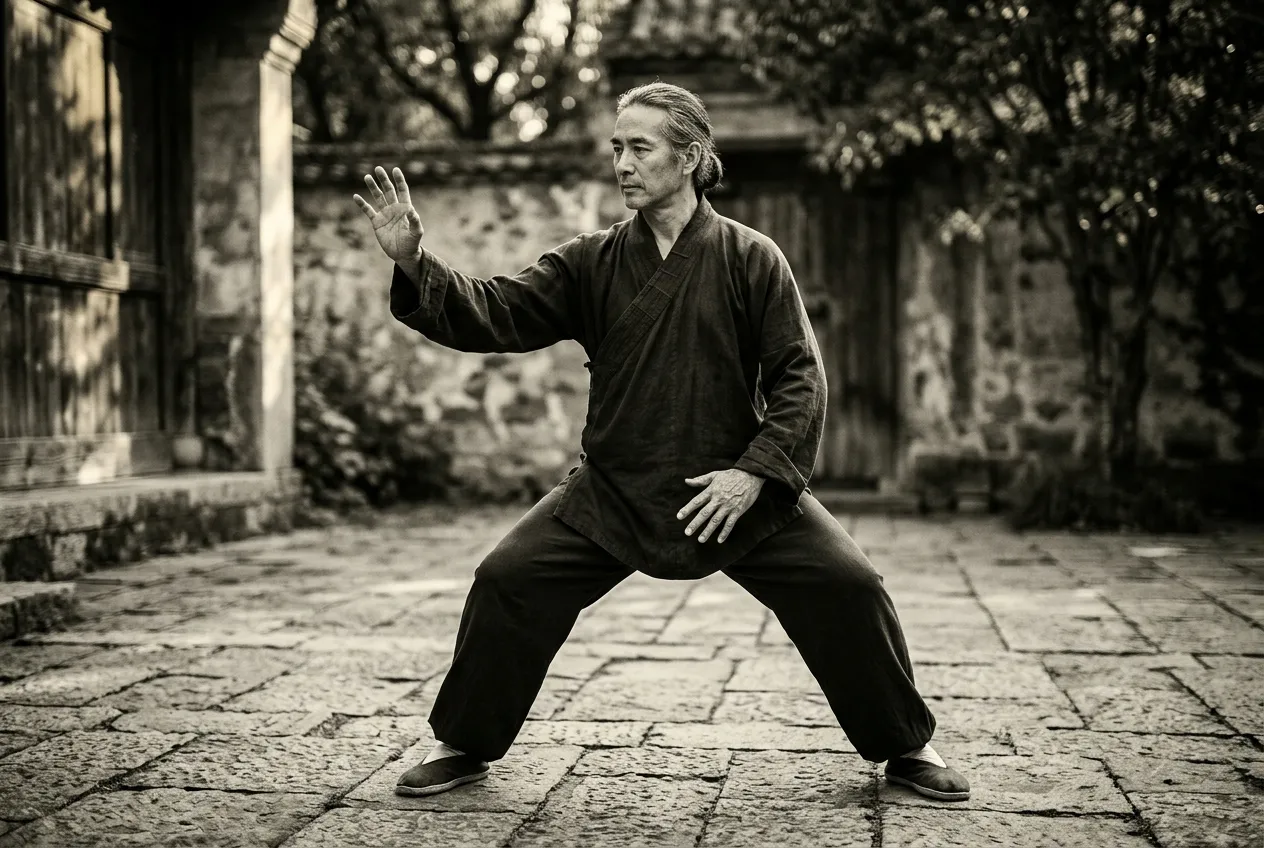
Frame size. Wu is smaller throughout — shorter stances, tighter circles, less extension.
Posture. Yang keeps a vertical spine. Wu uses the inclined straight body in many postures.
Space required. Wu needs noticeably less. This is a genuine practical advantage for anyone practising in a small room.
Physical demand. Broadly comparable, with Wu placing less demand on stance depth and more on precise control.
Learning difficulty. Wu is arguably harder to learn well, because the movements are smaller and the corrections subtler. Yang’s larger movements give clearer feedback to a beginner.
Availability. Yang is far easier to find. Outside major cities and Chinese communities, Wu classes may not exist locally at all.
Push hands. Wu schools generally emphasise it more.
I practise Yang, and my honest impression from watching skilled Wu practitioners is that the style rewards a kind of attention that Yang can let you postpone. With a large frame you can produce a passable form while your internal organisation is still vague. With a small frame there is nothing much to look at except the internal organisation.
Learning Wu Style
A few practical notes for anyone starting, particularly if you are coming from another style.
The lean has to be taught. This is not something to work out from video. The difference between an inclined straight body and a slumped one is the difference between the style working and your lower back complaining, and a teacher watching you from the side is the only reliable way to establish it early.
Expect the movements to feel too small. Practitioners arriving from Yang consistently report that Wu feels cramped for the first few months. The instinct is to extend, which produces Yang movements performed in a Wu sequence. Resisting that instinct is most of the early work.
Push hands starts sooner. Many Wu schools introduce partner work earlier in the curriculum than Yang schools typically do. If partner practice does not appeal, this is worth knowing before you enrol.
The fast form is a long way off. It is taught after the slow form is well established, and in many schools only to students who have been practising for years. Do not choose the style for the fast form.
Lineage matters and is usually stated. Wu schools tend to be explicit about their transmission, often tracing directly to Wu Jianquan through his children and their students. Asking about it is normal and expected rather than presumptuous.
Who Wu Style Suits
Good fit for practitioners interested in the martial and partner-work side of tai chi, those practising in confined spaces, people who have practised another style and want something that emphasises subtlety over range, and anyone with access to a genuine Wu lineage teacher — which is the deciding factor.
Less good fit for absolute beginners with no style preference, since Yang instruction is more available and the larger movements are easier to learn; and for practitioners with lower back problems, since the inclined posture requires good trunk control and is easy to perform as a slouch.
For most people, the practical reality is that style choice is decided by what is taught nearby. Wu is worth seeking out if you have a specific reason to want it, and there is no need to feel you are missing something if you do not.
The styles comparison guide sets all five major lineages side by side, the Yang style overview and Chen style overview cover the two styles Wu is most often compared against, and the rest of the style guides are collected in the tai chi forms section.