Tai chi is not an obvious children’s activity. It is slow, it is repetitive, it requires sustained attention, and it produces nothing that looks like achievement for months. Set against football, gymnastics, or almost any martial art with belts and sparring, it faces an uphill argument.
And yet children do practise it, sometimes with real enthusiasm, and there are things it offers that noisier activities do not. The trick is understanding what actually works with children rather than assuming a scaled-down adult class will do.
What Age Can Children Start?
There is no firm answer, but some rough guidance based on what the practice demands.
Under six. Formal tai chi is unrealistic. What works is animal-themed movement games — moving like a crane, a bear, a monkey — drawn loosely from qigong imagery. This is play with good movement in it rather than tai chi, and that is the right approach at this age.
Six to nine. Short sequences become possible. Children in this range can learn a handful of movements, enjoy the animal and imagery-based framing, and manage perhaps ten to fifteen minutes of structured practice. Precision is not the goal; enjoyment and rough movement quality are.
Ten to twelve. Genuine form learning becomes realistic. Children of this age can learn a short form such as the 24-form over several months, and some develop real interest in the martial background. Attention span supports twenty to thirty minutes.
Teenagers. A different situation altogether, covered in the guide to tai chi for teens.
The variation between individual children at any of these ages is larger than the variation between the ages, so treat this as a starting point rather than a rule.
What Tai Chi Offers Children
Being honest about this matters, because the claims made for children’s mind-body activities are often overstated. Research specifically on tai chi in children is limited, and most of what follows is reasoning from what the practice involves rather than from trial evidence.
Balance and coordination. Tai chi trains single-leg balance, controlled weight transfer, and cross-body coordination — all of which children are actively developing anyway, and all of which transfer to other physical activities.
Body awareness. Knowing where your limbs are without looking is a genuine skill, and slow movement builds it more effectively than fast movement, where speed covers imprecision.
Attention practice without stillness. For children who cannot sit still to meditate — which is most of them — tai chi offers a form of attention training that involves moving. This may be its most distinctive contribution.
Self-regulation. Slow breathing and deliberate movement give children a physical tool for settling themselves. Whether they use it outside class is another matter, but the tool is real.
A non-competitive physical activity. Some children thrive on competition. Others are put off physical activity entirely by it. Tai chi offers movement with no winning, no ranking, and no being picked last.
Cultural exposure. The Chinese context, the animal imagery, the movement names — for many children this is the interesting part.
What it does not offer: much cardiovascular exercise, obvious progression markers, or the immediate excitement of a sport. Children who need those things should have them elsewhere.
Making It Work With Children
The most common failure is teaching children a shortened adult class. Some adjustments that make a substantial difference.
Use the imagery. Tai chi movement names are already vivid — White Crane Spreads Its Wings, Grasp the Sparrow’s Tail, Wave Hands Like Clouds, Golden Rooster Stands on One Leg. Children respond to these far better than to technical description. Ask a child to be a crane and you will get better movement than by asking them to shift weight to the rear leg.
Keep sessions short. Ten to twenty minutes for younger children. A short session they enjoy beats a long one they endure.
Alternate movement and stillness. Long slow sequences lose children quickly. Mixing form work with balance games, animal movements, and short bursts of activity holds attention much better.
Make balance a game. Standing on one leg is naturally competitive-adjacent without being a competition. Children will do it far longer as a challenge than as an exercise.
Do not correct much. Precision comes later. Constant correction of a child’s tai chi is the fastest way to end their interest in it.
Practise alongside them. Children copy far more readily than they follow instruction, and a parent practising is worth a great deal more than a parent supervising.
Accept irregular engagement. Interest waxes and wanes. A child who loves it for three months and ignores it for two has not failed at tai chi.
What to Expect Realistically
Two things are worth setting expectations about before starting.
The first is that most children will not take to it, and that is not a verdict on the child or on tai chi. It is a slow practice competing for attention against activities designed to be immediately engaging. A reasonable success looks like a child who enjoys ten minutes of it a couple of times a week and can stand on one leg for longer than they could before.
The second is that children who do take to it often connect with the martial side rather than the health side. The movements have applications, the imagery comes from fighting arts, and a child who has been told tai chi is relaxing will be considerably more interested on learning that Grasp the Sparrow’s Tail is four techniques strung together. Whether to open that door is a parental judgement, but pretending the martial content does not exist tends to make the practice less interesting rather than more wholesome.
When I have practised in parks, the children who stop to watch are almost never interested in the slowness. They want to know what the movements are for — which is, historically, the right question.
Finding Instruction
Dedicated children’s tai chi classes exist but are not common. The realistic options:
Family or all-ages classes. Some community classes welcome children alongside adults, which works well for children over about eight, particularly if a parent attends too.
School programmes. Tai chi and qigong appear in some school wellbeing and physical education programmes, usually as short sequences rather than full forms. The tai chi in schools guide covers what these programmes typically look like and what to ask about if you want one introduced.
Martial arts schools. Schools teaching several arts sometimes include tai chi in a children’s curriculum, generally in a more martially framed way.
At home. Entirely viable for the informal end of things — animal movements, balance games, a few basic postures — particularly if a parent practises.
Before enrolling a child in an adult class, talk to the instructor. Some classes are entirely happy to include a child; others are quiet, meditative environments where a child would be uncomfortable and disruptive. Both are legitimate, and the instructor will know which theirs is.
A Simple Home Sequence
Something to try that requires no prior knowledge:
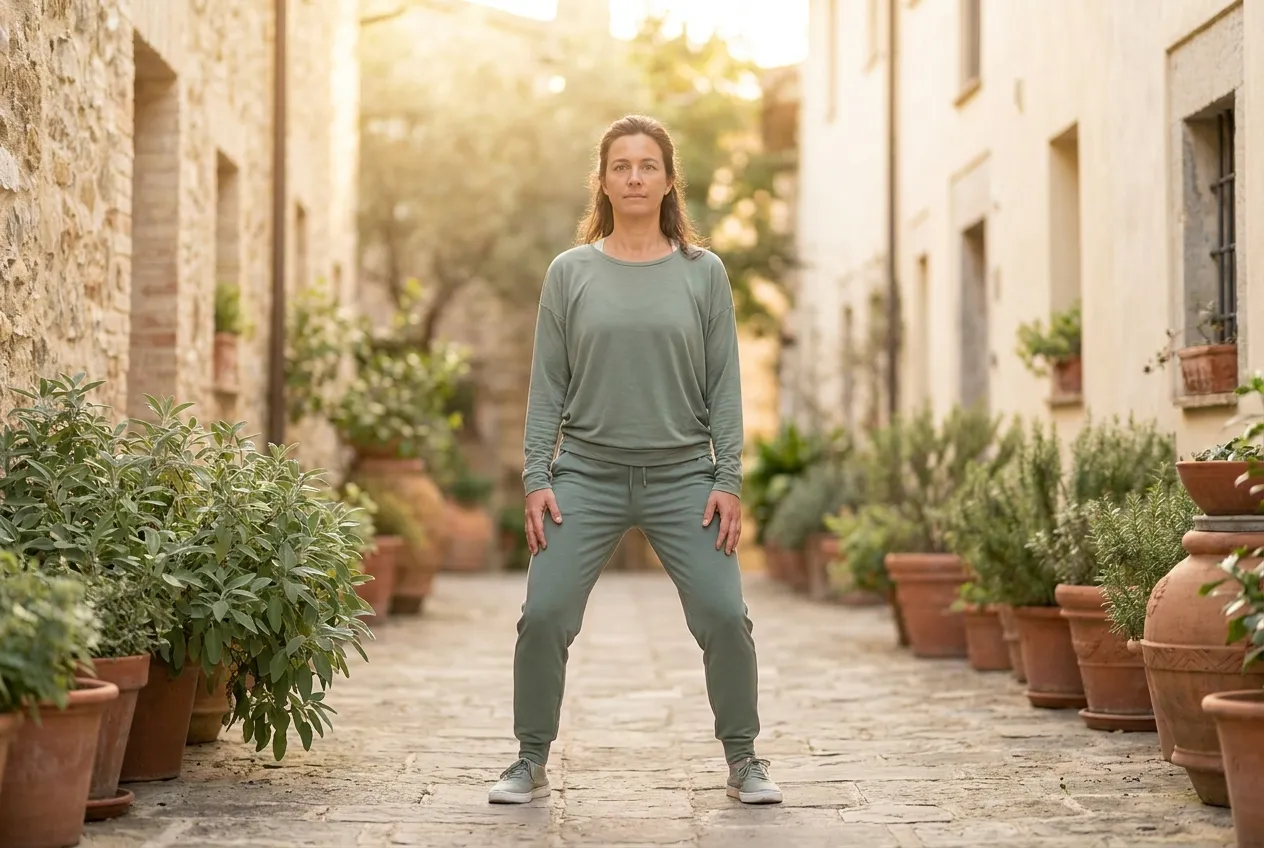
Standing like a tree. Feet apart, knees soft, arms rounded as if holding a large ball. Thirty seconds is plenty for a young child. Frame it as a challenge.
Crane on one leg. Stand on one leg with arms out like wings. Count how long. Swap legs. Repeat.
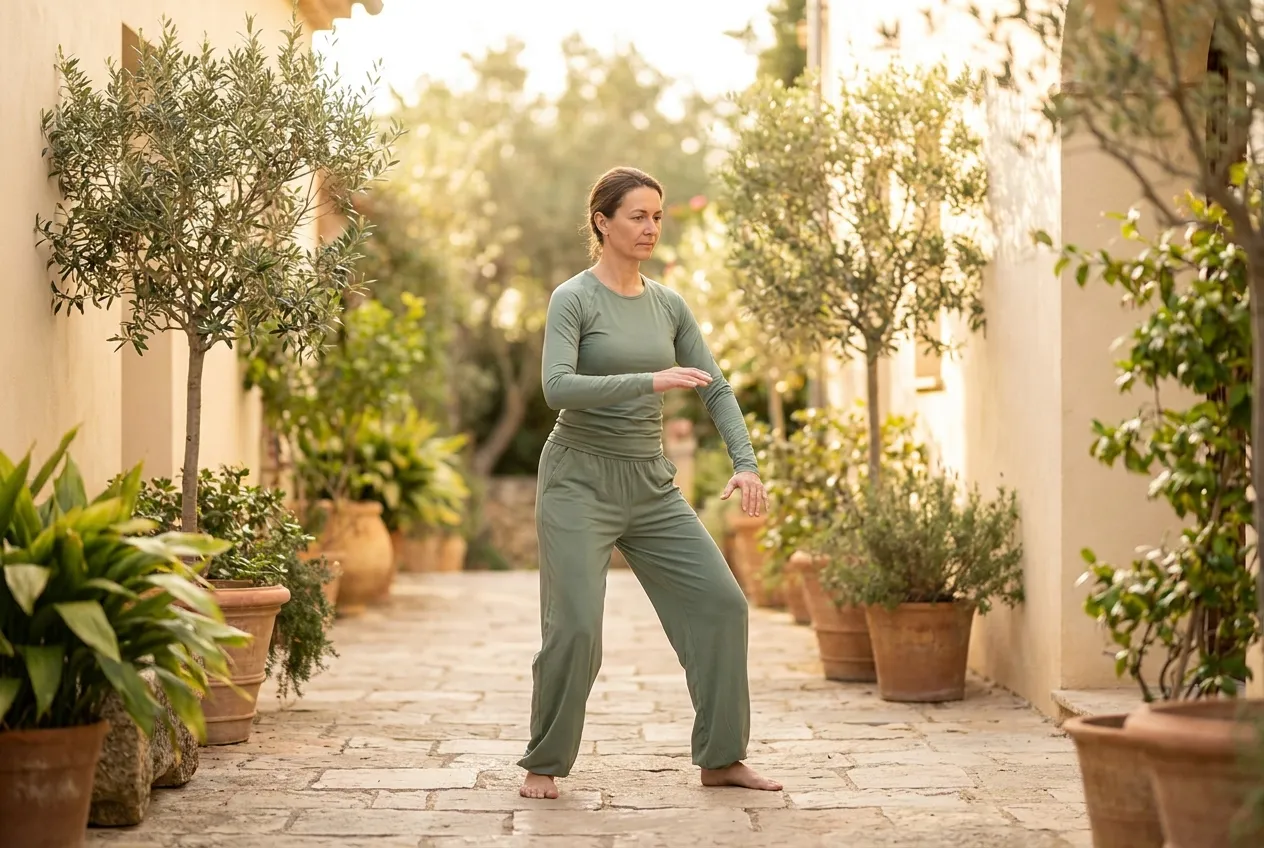
Cloud hands. Step sideways while the hands pass slowly across the body. Describe it as pushing clouds along.
Bear turns. Feet planted, turn the body left and right letting the arms swing and slap the sides. Children enjoy this one.
Settling. Stand still, hands on the belly, feel the breath move it. Five breaths. This is the hardest part for most children and the most valuable.
Ten minutes covers all five with time for repetition and mucking about, and mucking about is not a failure of the session.
The complete beginners guide covers the adult version of getting started if you want to practise alongside your child, and the daily practice routine guide covers building a habit that a child can join. More starting-out material is in the beginners section.