Tai chi has an image problem with teenagers, and it is not hard to identify. It is slow, it looks like something grandparents do in parks, and it offers none of the immediate feedback — winning, levelling up, visible strength gains — that most teenage physical activity provides.
That image is also a fairly poor description of what tai chi actually is. It is a martial art with a serious combat lineage, it is genuinely difficult, and the things it develops happen to be things adolescence is short of: attention, self-regulation, and physical control.
This article covers what tai chi offers teenagers, the obstacles honestly, and how to get past them.
What It Offers at This Age
Stress and anxiety management. Adolescence carries a real load — academic pressure, social pressure, sleep disruption, and a nervous system that is being rewired throughout. Tai chi’s calming effect works through movement rather than through sitting still, which matters for teenagers who find meditation unbearable. The mental health article covers the evidence for anxiety and mood in more detail.
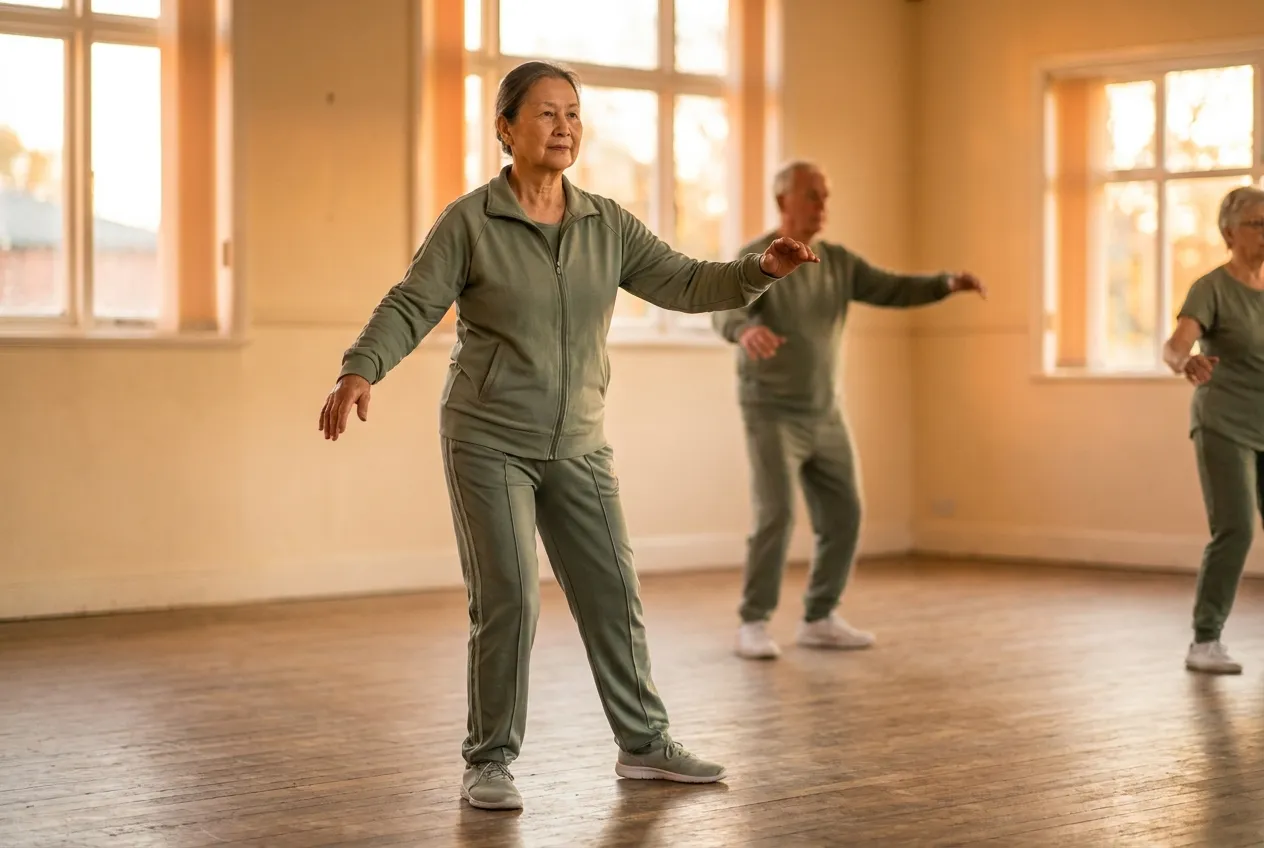
Attention training. Sustained focus is a trainable capacity, and it is under sustained assault. Learning and performing a form requires uninterrupted attention for several minutes at a time, which is more than many teenagers routinely give to anything.
Physical control and proprioception. Adolescent growth spurts disrupt coordination — limbs change length faster than the nervous system updates its model of them. Slow, precise movement is unusually well suited to rebuilding that map, and the balance work transfers to almost every sport.
Athletic cross-training. This is the argument most likely to land with a teenager who already plays sport. Tai chi trains single-leg stability, hip mobility, controlled deceleration, and the ability to move from a stable base — capacities that translate directly to football, basketball, martial arts, climbing, and dance. It also carries essentially no injury risk, which makes it a useful addition to a training week that is already demanding.
Something that is not competitive. For teenagers exhausted by evaluation in every part of their lives, a physical practice with no ranking is a genuine relief. For others it is precisely the problem.
The Obstacles, Honestly
It is slow, and slowness is the point. There is no way around this. Any pitch that promises tai chi is secretly exciting will be found out in the first session.
Progress is invisible for months. A teenager used to seeing a lift go up or a time come down will find the absence of metrics disorienting.
The social element is unusual. Most community classes are predominantly older adults. A fifteen-year-old in a room of retirees is a specific social situation, and some teenagers handle it fine while others will not return.
It is not obviously useful. The martial applications exist but are not taught in most health-oriented classes, so the practice can feel purposeless.
None of these is fatal, but pretending they do not exist wastes everyone’s time.
What Actually Gets Teenagers Interested
Based on what tends to work rather than what ought to:
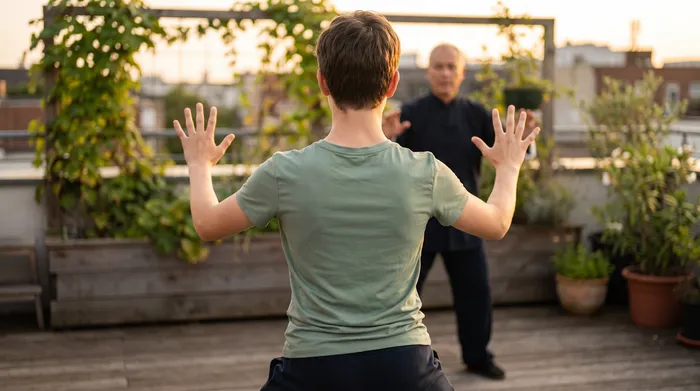
Lead with the martial art. Tai chi is a fighting system. Showing the application behind a movement — that this arm circle is a deflection and a throw — reframes the whole practice. Push hands is particularly effective here: it is partner work, it is competitive in a low-stakes way, and it makes the principles physical rather than abstract.
Frame it as difficult. Tai chi is hard. Holding a low stance is hard. Standing on one leg for ninety seconds is hard. Presenting it as gentle and relaxing is both misleading and the least appealing possible pitch.
Connect it to something they already do. If they play a sport, the balance and stability transfer is a real argument. If they lift, the mobility and recovery angle works. If they are interested in martial arts, the lineage does.
Do not oversell the wellbeing angle. Teenagers are, reasonably, suspicious of adults prescribing calm. The benefits arrive whether or not they were advertised.
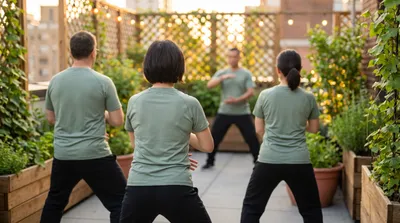
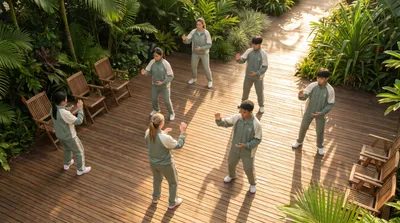
Find the right class. A martial arts school teaching tai chi alongside other arts, or a class with a mixed age range, works far better than a health-oriented group of older adults — not because the latter is worse, but because the social fit matters enormously at this age. Where one exists, a school-based programme solves the social-fit problem entirely, since everyone present is the same age.
Accept a low dose. Fifteen minutes a few times a week is a real practice. Nobody needs to commit to a lifetime.
A Note for Parents
If you are reading this because you want a teenager to take up tai chi, the most useful thing to know is that recommending it rarely works and practising it yourself sometimes does.
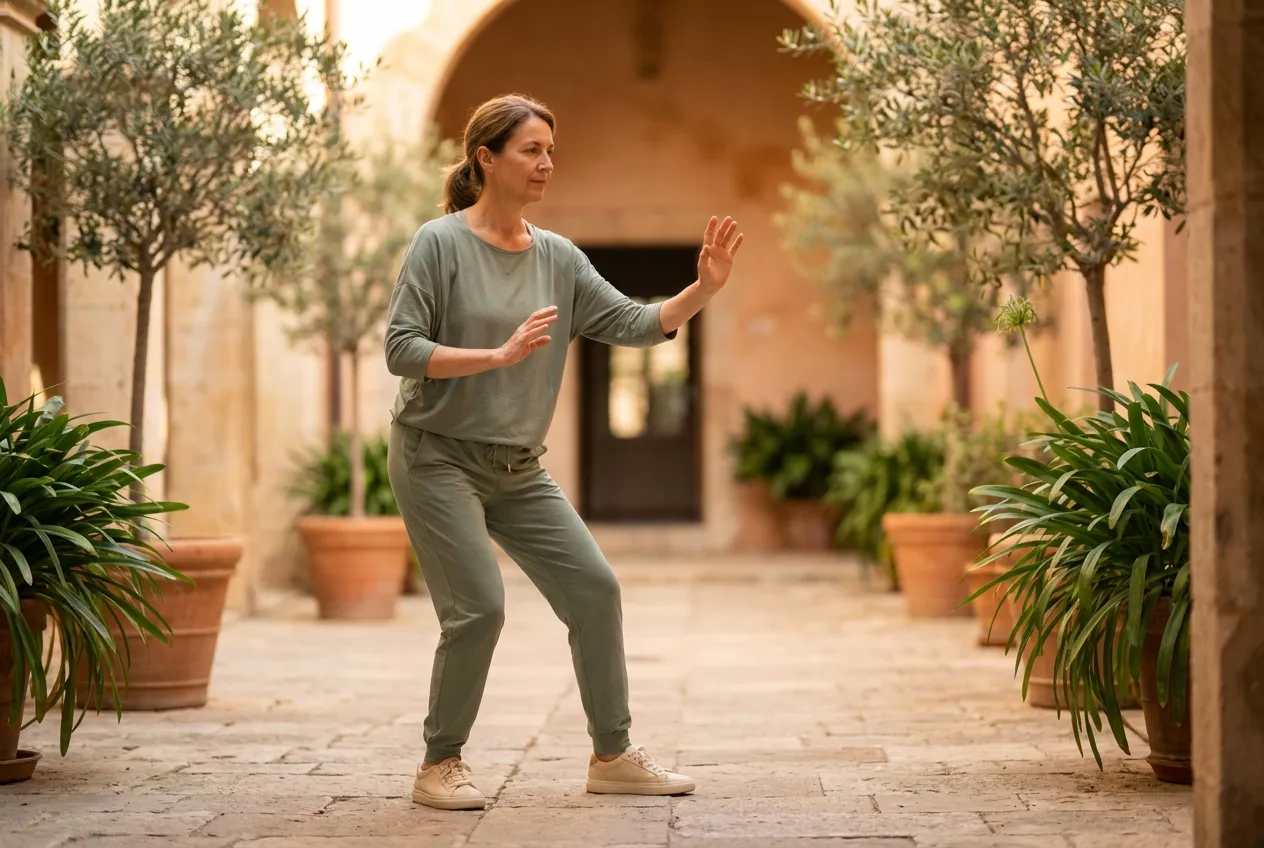
Teenagers are unusually good at detecting when a suggestion is really an intervention. A parent who takes up tai chi for their own reasons, practises visibly and unapologetically, and does not invite anyone to join is in a much better position than one who books a class and drives them to it.
The second most useful thing: let the interest come from where it comes from. If a teenager gets into tai chi through martial arts films, through a video game, through a friend, or through wanting to be better at skateboarding, that is a perfectly good reason. The health benefits do not require the practitioner to be motivated by health.
I came to tai chi through martial arts rather than through wellbeing, and I suspect I would have ignored anyone who pitched it to me at fifteen as a way to manage stress — even though that is one of the things it turned out to do.
Getting Started
For a teenager starting independently, the sensible route is the same as for anyone: learn a short form, ideally with instruction, and practise it. The complete beginners guide covers the process.
Some specifics that matter more at this age:
Video learning is more viable than for most beginners. Teenagers are generally better at learning movement from screens, and the self-directed route avoids the social awkwardness of a class. The limitation is that nobody corrects the errors, and errors learned early persist.
Standing practice is worth including. Holding a static posture for two or three minutes builds both leg strength and attention, and it provides the concrete challenge that form learning lacks early on.
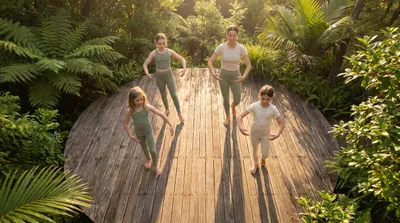
Physical capacity is not a limitation. Deep stances, low postures, and long sessions are all available at this age in a way they may not be later. A teenager can practise in a genuinely demanding low frame, which makes tai chi considerably more interesting as physical training.
Twelve weeks is a fair trial. Long enough to get past the memorisation phase and see what the practice is actually like, short enough to be a reasonable ask.
The guide to tai chi for younger children covers the different approach needed at earlier ages, and more starting-out material is collected in the beginners section.