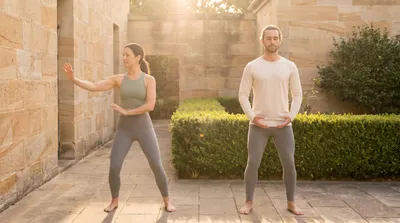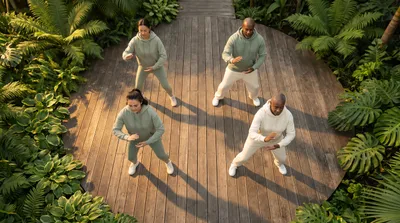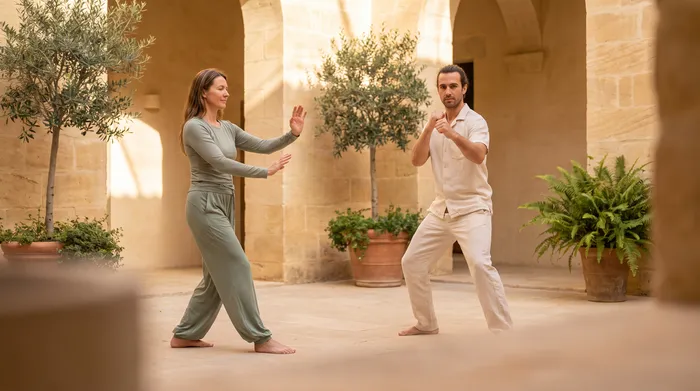
The trick to this comparison is that it is not really a comparison at all. Kung fu is not one martial art — it is the umbrella term Westerners use for the whole vast family of Chinese martial arts, hundreds of systems from Shaolin long fist to wing chun to praying mantis. And tai chi is one member of that family.
So the accurate answer to “tai chi vs kung fu” is that tai chi is kung fu, in the same way a violin is an instrument. What people actually mean by the question, though, is real and worth answering properly: how does slow, soft tai chi differ from the fast, hard styles that the word kung fu conjures — the Shaolin-style arts of films and demonstrations? That is the comparison this article makes.
The Terms, Untangled
Kung fu (gongfu) literally means skill acquired through effort and time — you can have kung fu at cooking or calligraphy. Chinese speakers more often say wushu (“martial technique”) for martial arts generally, though that word now also names the modern competitive sport. In everyday Western usage, kung fu means Chinese martial arts, and especially the external, Shaolin-derived styles.
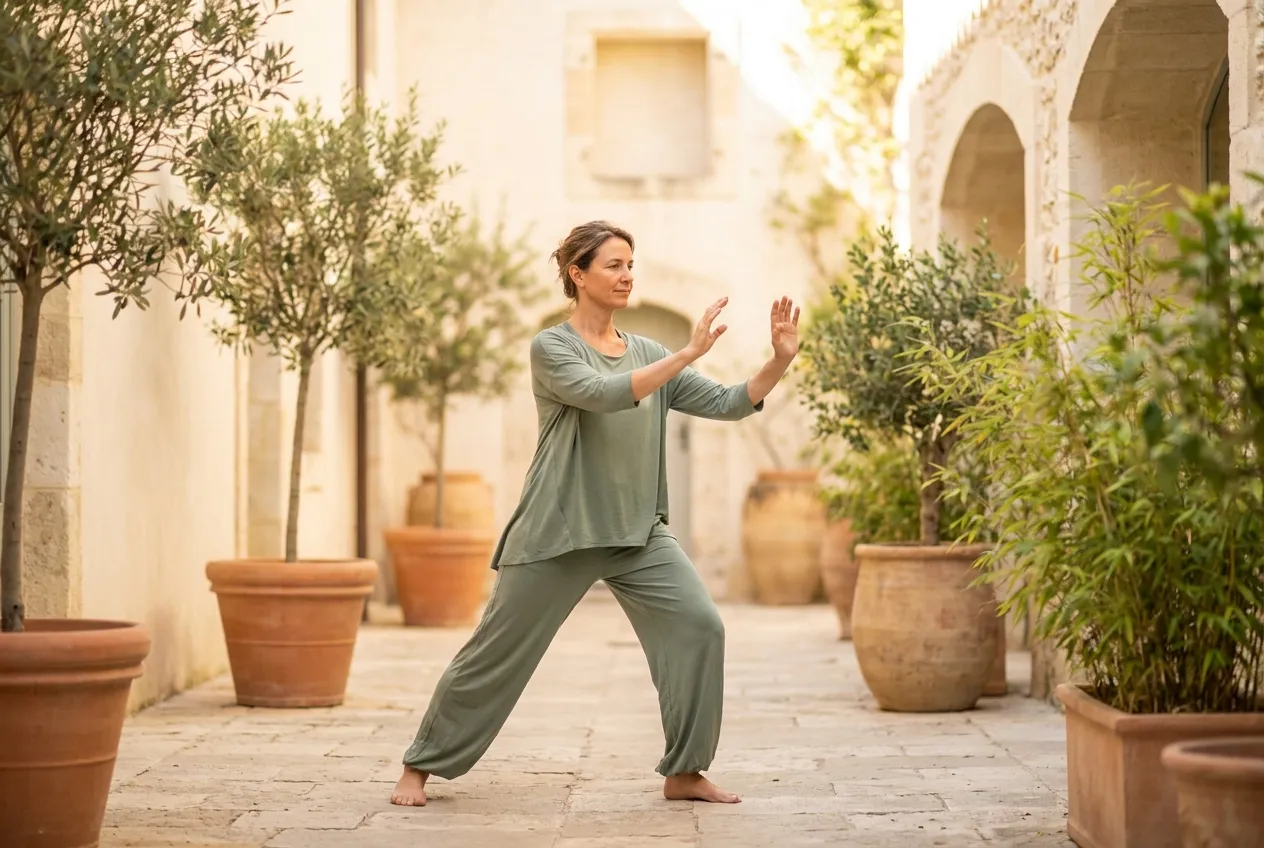
Tai chi (taijiquan) is one specific art within that family, part of the smaller group traditionally called the internal arts (neijia) alongside xingyiquan and baguazhang. The full introduction to what tai chi is covers its nature in depth; the short version is a martial art practised chiefly through slow solo forms.
The internal/external distinction is the traditional dividing line, and it is blurrier than presented — every good external stylist develops internal qualities and vice versa — but it points at something real about training method, which is where the practical differences live.
The Differences That Matter
Speed and appearance. External kung fu trains predominantly at speed, with visible power, jumps, low stances, and athletic explosiveness. Tai chi trains predominantly slowly, with power deliberately concealed inside smooth continuous movement. The same punch exists in both; one practises it fast a thousand times, the other slowly a thousand times, on the theory that slowness builds precision and connection that speed can later inherit.
Physical demands. External styles demand — and build — conditioning: flexibility, explosive strength, cardiovascular capacity, impact tolerance. They are hard exercise from day one. Tai chi demands balance, leg endurance, and patience; its intensity is adjustable from genuinely gentle to surprisingly hard, but it never approaches the athletic ceiling of Shaolin-style training.
Age profile. A direct consequence. External kung fu is overwhelmingly a young person’s training, hard to begin past forty and harder to sustain past fifty. Tai chi is practicable, and beginnable, at any age — which is precisely why it became the world’s default lifelong Chinese art, and why classes skew older.
Injury risk. External training carries the normal injury load of hard athletics plus contact. Tai chi’s injury rate is close to negligible, with sore knees from poor stance work the main complaint.
Learning curve shape. External styles reward you fast — three months in, you are fitter, you can kick, something visible has happened. Tai chi’s first months are slow memorisation with little visible payoff, and its rewards compound later. The pros and cons article is honest about that trade.
Combat training. As typically taught today, external kung fu schools spar more and drill applications more; most tai chi classes never do either. The martial content of tai chi is real but usually dormant — the full discussion of tai chi as a fighting art covers what serious martial tai chi training involves and how rare it is.
Health evidence. Tai chi has a large clinical research literature — falls, blood pressure, arthritis, balance — because its gentleness made it studyable in older and clinical populations. External kung fu has ordinary exercise benefits but nothing like the same evidence base, because nobody runs randomised trials of Shaolin training on seventy-year-olds.
Same Family, Visible Kinship
Spend time around both and the shared ancestry is obvious. Stances overlap — the bow stance of tai chi is the gong bu of every external style. Both organise power from the ground through the waist. Both train forms as the core solo method, use push-hands-like sensitivity drills or their equivalents, share weapons (straight sword, sabre, staff, spear), and carry the same courtesies and teacher-student culture.
Chen-style tai chi sits closest to the external world, with its visible explosiveness and low frames; a gentle hospital-class Yang style sits furthest. The Chen style overview shows how narrow the gap can get — watch Chen cannon fist performed at full speed next to a Shaolin routine and the family resemblance needs no arguing. The distance between the arts is a spectrum with schools scattered all along it, not a wall with soft on one side and hard on the other.
It is also worth knowing that the two combine well and always have. Plenty of external stylists take up tai chi in their thirties and forties as their bodies demand a sustainable practice — that is roughly my own story, arriving at tai chi from a harder martial arts background — and plenty of tai chi people cross-train something faster for the qualities slow practice cannot supply.
A Note on What You See in Films and Demos
Most people’s mental image of both arts comes from performance, and performance distorts both in opposite directions.
Film and demonstration kung fu is modern wushu — the acrobatic competitive sport, optimised for visual spectacle, with aerial kicks and gymnastic difficulty that traditional fighting styles never contained. It is genuinely spectacular and genuinely athletic, and it is to traditional external kung fu roughly what floor gymnastics is to wrestling.
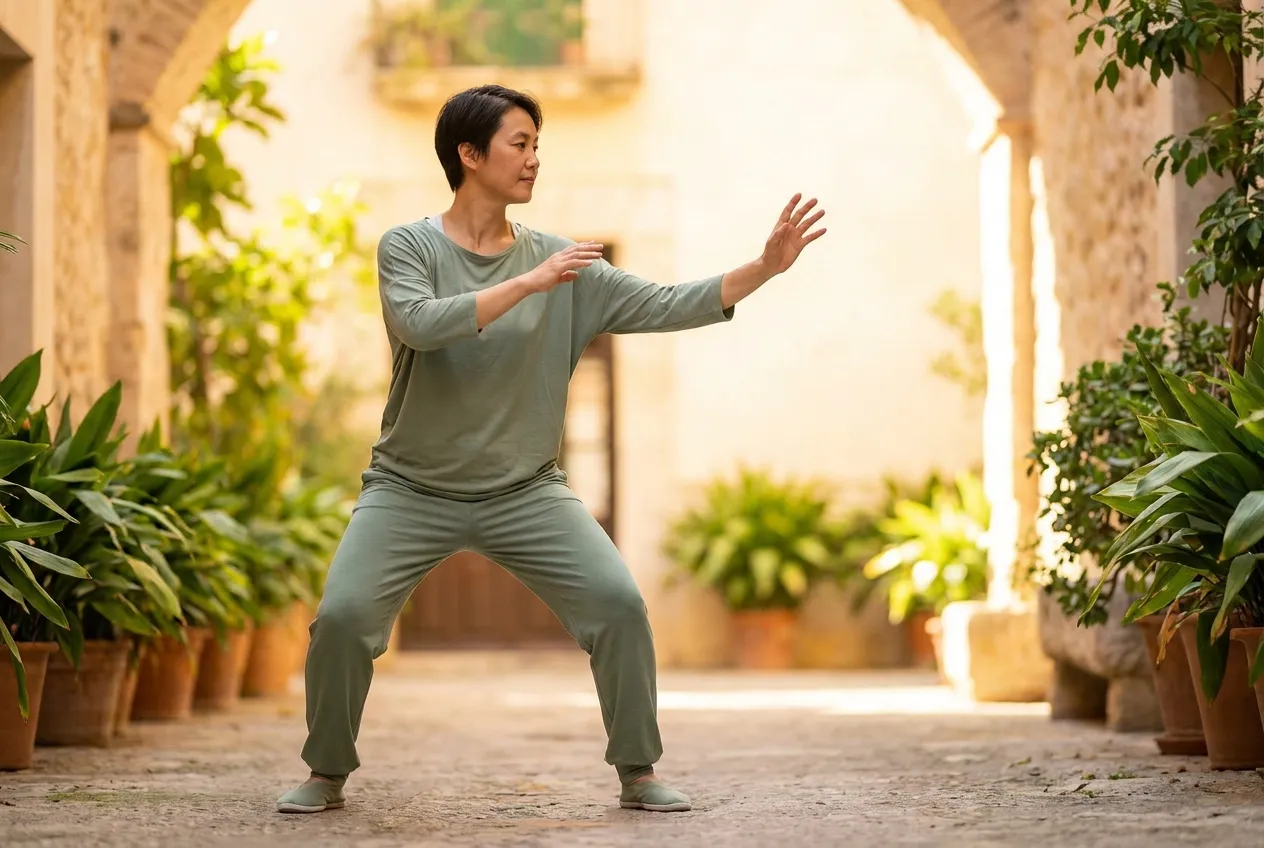
Demonstration tai chi distorts the other way: what reads on camera is the serenity, so the martial structure disappears from view entirely, and the art gets filed as moving relaxation. Meanwhile the internet’s other image of tai chi — elderly masters toppling students without touching them — is theatre of a worse kind, and the martial art article covers what happened when such claims met testing.
The corrective for both distortions is the same: visit real classes. An ordinary external kung fu class is mostly conditioning, drills, and repetition — far less airborne than the films. An ordinary tai chi class is mostly slow careful repetition — far less mystical than the videos. The two look much more like siblings in person than their public images suggest.
How to Choose
Choose external kung fu if you are young or fit, want hard exercise and visible athletic progress, want martial capability sooner, or are drawn to the acrobatic, performative side of Chinese martial arts.
Choose tai chi if you want a practice for the next forty years rather than the next five, joint-friendliness matters, the health evidence matters, you are over about forty-five and starting fresh, or the meditative dimension appeals — the overlap with qigong and breath-led practice is much greater on this side of the family.
Choose by the school, if in doubt. A superb wing chun teacher three streets away beats a mediocre tai chi class across town, and vice versa. Instruction quality dominates style choice for beginners in every martial art, and visiting a class tells you more than any comparison article. More starting-out guidance is in the beginners section.
Frequently Asked Questions
Is tai chi a form of kung fu?
Yes, in the broad sense — kung fu as Westerners use it means Chinese martial arts generally, and tai chi is a Chinese martial art. In the narrower everyday sense, where kung fu means the fast external Shaolin-type styles, tai chi is their slow-training cousin from the internal branch of the same family.
Which is better for self defence, tai chi or kung fu?
As typically taught, an external kung fu school will get you further faster, because it trains speed, contact, and applications routinely, while most tai chi classes train none of them. A tai chi school with serious push hands and sparring is a different matter, but such schools are uncommon. For self defence as the primary goal, arts with constant pressure-testing — boxing, judo, MMA — outperform typical schools of either.
Is tai chi easier than kung fu?
Physically, yes — it demands far less conditioning and carries almost no injury risk. Mentally, it is arguably harder: slower progress, subtler corrections, and a longer wait before the practice feels rewarding. Different difficulty, not less.
Can I do both?
Yes, and the combination is traditional — the arts share stances, weapons, and body mechanics, so each feeds the other. The practical constraint is learning time: starting both simultaneously slows both, so establishing one first (a year or so) before adding the second works better.
Why is tai chi so slow if it’s a martial art?
Slowness is the training method, not the technique. Practising slowly forces correct weight transfer, alignment, and whole-body connection that speed lets you fake; applications, where trained, are performed at full speed. The same logic external stylists apply to slow-motion drilling, tai chi applies to nearly everything.