The Yang long form is the traditional heart of the most widely practised tai chi style — the sequence Yang Chengfu taught, the one his students carried around the world, and the form that a serious Yang-style practitioner expects to spend a lifetime with. It is commonly called the 108, though you will also see it described as the 85, the 88, the 103, and occasionally the 150.
Those numbers all refer to the same form. Understanding why is the natural place to start.
Why the Movement Count Varies
The Yang long form has no single authoritative movement count, because counting depends entirely on conventions that different lineages settled differently.
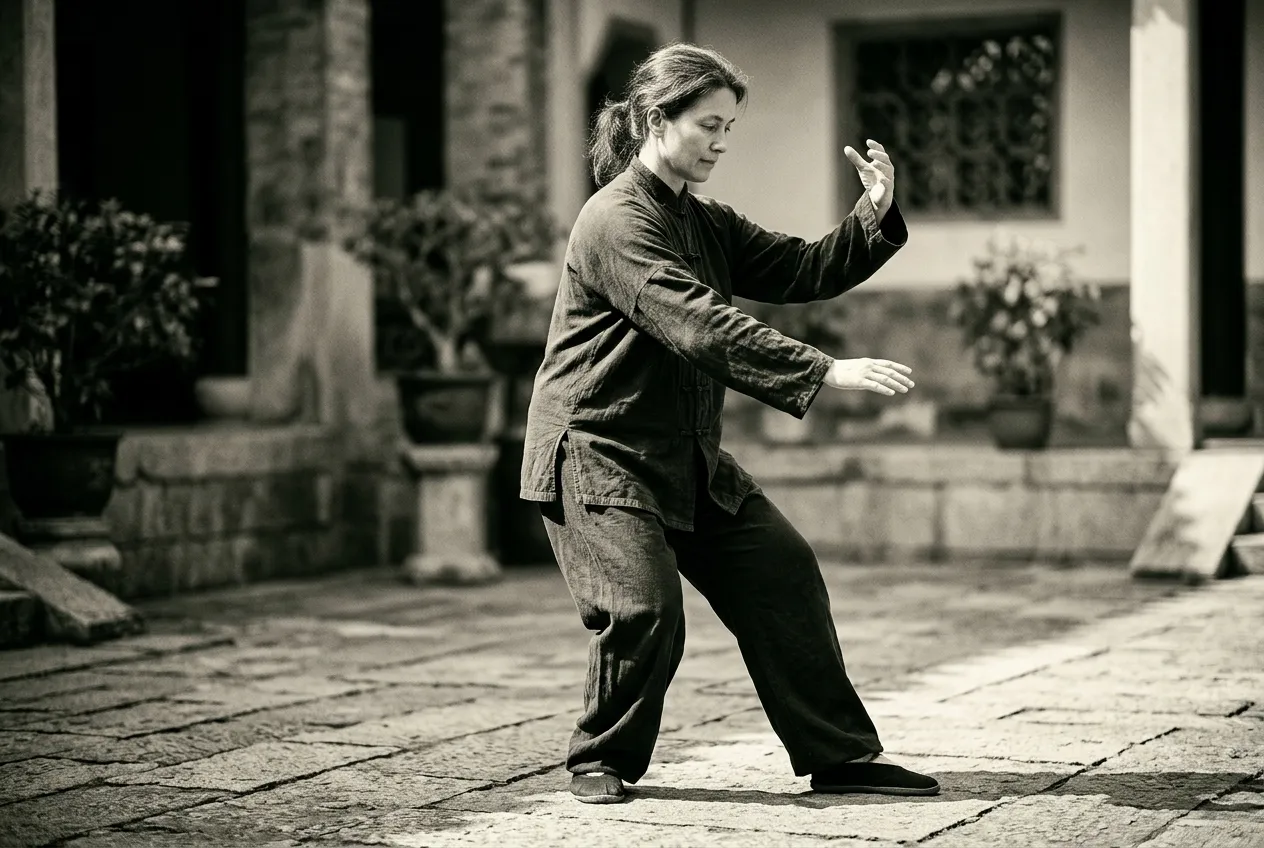
Three things drive the variation. First, whether repeated sequences are counted each time they appear — Grasp Sparrow’s Tail and Single Whip recur several times, and counting each occurrence separately produces a much higher total than counting the sequence once. Second, whether composite movements are counted as one posture or broken into their components; Grasp Sparrow’s Tail alone contains ward off, roll back, press, and push, which can be one posture or four. Third, whether transitional movements are named and counted.
The result is that the traditional Yang form is variously enumerated as 81, 85, 88, 103, 108, or 150 movements, all describing essentially the same sequence. The Fu Zhongwen lineage commonly uses 85; Cheng Man-ch’ing’s short form is a genuinely different and shorter sequence at 37; the 108 count is widespread in Western teaching and in the Wu family tradition.
Practically, none of this matters much. What matters is which teacher and which lineage you are learning from, and that you use their count rather than arguing about someone else’s.
One point of genuine confusion worth clearing up: the Wu family also has a 108 form, developed by Wu Jianquan in the early twentieth century. It is a different form in a different style. If you search for “108 form tai chi” you will find both, and they are not interchangeable.
What the Long Form Contains
The Yang long form is conventionally divided into three sections, of increasing length and difficulty.
The first section is the shortest and is largely foundational — the opening, Grasp Sparrow’s Tail, Single Whip, Brush Knee, and the movements that most beginners already know from the 24 form. Anyone who has learned the 24 will recognise a great deal of it.
The second section is longer and introduces kicks, more complex turning, and the more demanding postures. This is where most learners slow down considerably.
The third section is the longest, contains the most technically difficult material including the low postures and the more intricate transitions, and revisits earlier sequences in new contexts.
A full run takes twenty to thirty minutes at typical tempo, and can extend well past forty at a genuinely slow pace. That duration is part of the point: the long form is a sustained practice in a way that short forms are not, and the physical and mental demands of maintaining quality across half an hour are different in kind from those of a five-minute sequence.
How Long It Takes to Learn
Learning the sequence — being able to get from beginning to end unaided — typically takes one to two years of regular class attendance and home practice. Learning it well takes considerably longer, and most serious practitioners would say the form is never finished.
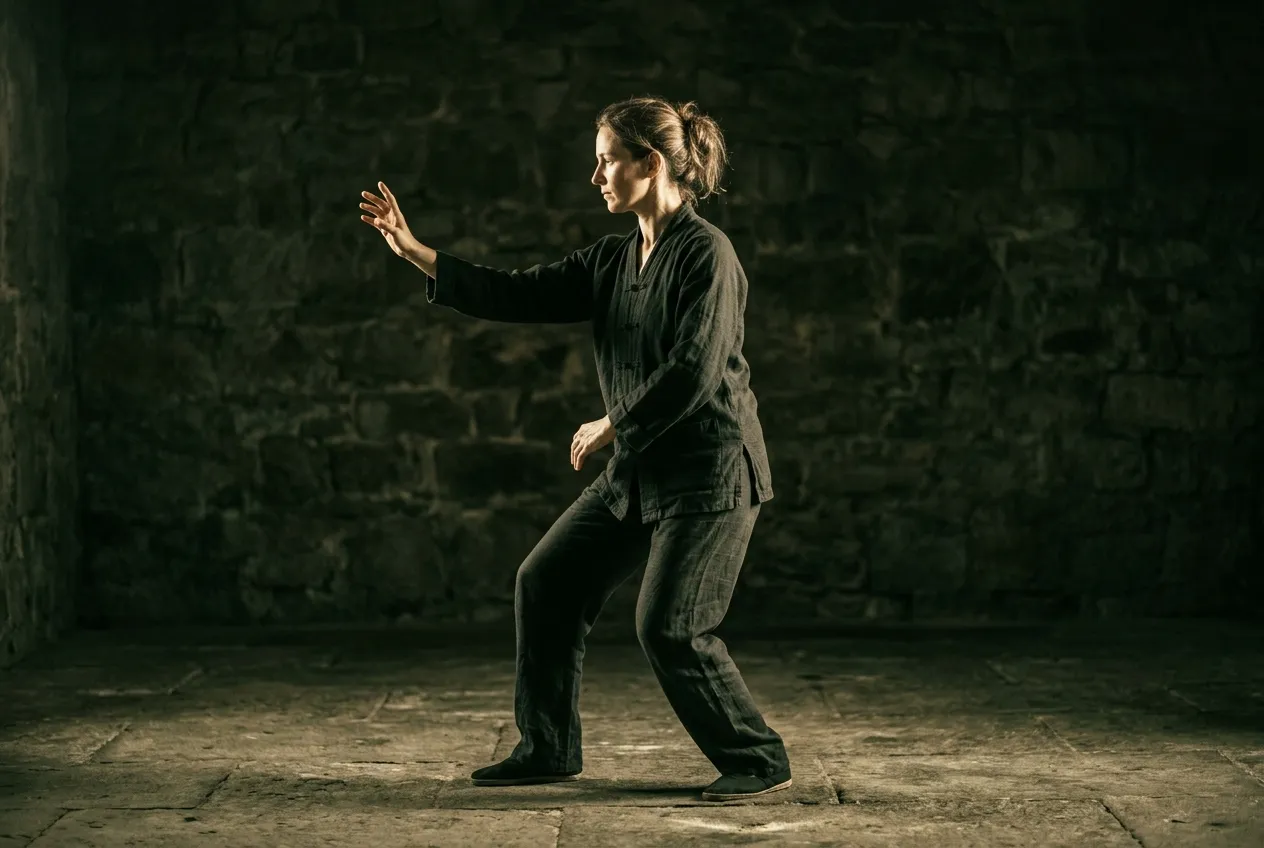
A realistic progression:
Months 1-6. The first section, plus continued work on whatever short form you already know. Expect frequent forgetting.
Months 6-18. The second section. This is where most people stall or drop out, because the novelty has worn off and the material is harder.
Months 18-30. The third section, and consolidation of the whole.
Years 3 onward. Refinement. Weight distribution, waist-led movement, continuity, breathing, and the internal qualities that cannot be addressed while you are still remembering what comes next.
That timeline assumes weekly instruction and practice several times a week. Learning the long form from video alone is possible but considerably harder, and the errors that creep in without correction tend to become permanent.
I learned the 24 first and then spent a long time in the awkward middle ground where I knew a lot of the long form but could not run it without a stumble. Getting through that phase is mostly a matter of continuing to practise something that does not yet feel rewarding, which is the least glamorous part of tai chi and probably the most important.
Is the Long Form Worth It?
An honest assessment, because the answer is not automatically yes.
Arguments for. The long form contains material the short forms omit entirely, including movements that develop capacities the 24 never touches. It is long enough to be a complete practice in itself. It connects you to a lineage transmission rather than to a twentieth-century standardised routine. And the sustained duration produces a quality of absorption that short forms rarely reach — twenty-five minutes in, something changes in how the practice feels.
Arguments against. It requires a teacher, sustained commitment, and a couple of years before you can practise it independently. For health purposes there is no evidence that it outperforms the 24 — the tai chi health benefits guide covers what the clinical research, which overwhelmingly uses short forms, actually supports. And there is a real risk of spending years accumulating sequence at the expense of quality — a long form performed poorly is worth less than a short form performed well.
The people best served by the long form are those with access to good instruction, a genuine interest in the tradition, and the temperament for slow progress. The people least served are those who want measurable health outcomes efficiently, or who practise irregularly.
There is also a middle path that gets less attention than it deserves: learning the first section of the long form and practising that indefinitely. It takes a few months rather than a few years, it contains the foundational material, and it runs to six or seven minutes — a perfectly respectable daily practice. Nothing obliges anyone to complete the form, and a well-practised first section is worth more than a shaky complete one.
For anyone in between, the 48 form is a sensible intermediate step — roughly ten minutes, six months to a year, and no lineage commitment required. It also has the advantage of a standardised reference version, where the long form varies between lineages in ways that can confuse anyone trying to supplement class learning with books or video.
Recognisable Landmarks in the Sequence
The long form is easier to hold in memory if you treat certain movements as landmarks rather than trying to remember an unbroken chain of a hundred postures.
Grasp Sparrow’s Tail recurs several times and functions as a structural marker. It contains the four primary energies — ward off, roll back, press, push — and its reappearance signals a new phase of the form.
Single Whip almost always follows Grasp Sparrow’s Tail and is one of the most recognisable postures in all of tai chi. Counting Single Whips is a common way practitioners locate themselves within the form.
Cloud Hands appears as an extended lateral sequence and gives the practitioner a stretch of familiar, repetitive movement in the middle of more complex material.
The kicking sequences in the second section mark the point where the form’s physical demands step up.
Snake Creeps Down and Golden Rooster Stands on One Leg are the low-then-high pairing that most people find the hardest single passage, and they recur in the later sections.
Cross Hands and the closing return you to roughly where you started, which is one of the quiet pleasures of the form and also a useful check — finishing several feet from your starting point usually means the stepping drifted somewhere.
Learning the form as a sequence of landmarks with material between them, rather than as an undifferentiated list, is the single most useful memorisation strategy I have come across. It is also how most teachers seem to hold it themselves, judging by how they break the form up when teaching.
Practising the Long Form
Once learned, some things become important that were not relevant with shorter sequences.
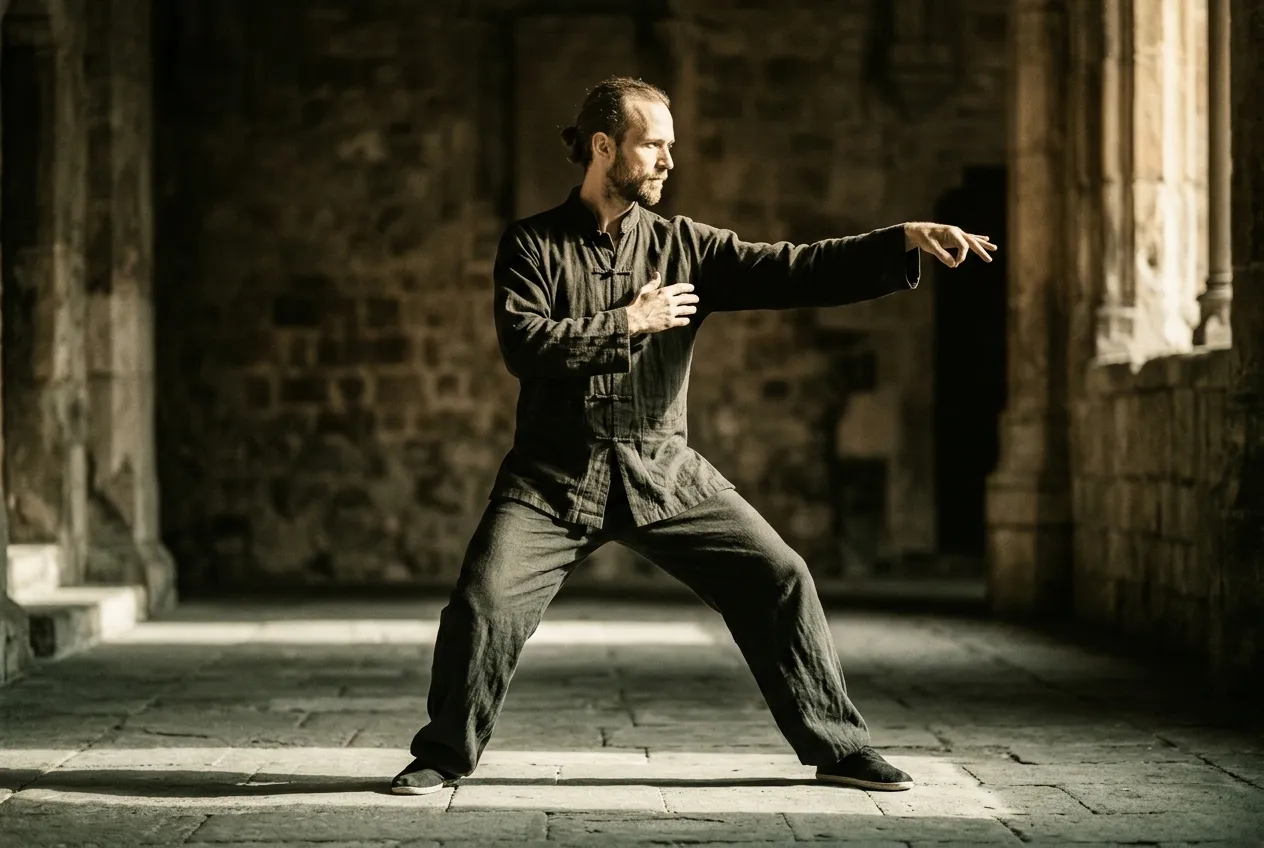
Space. The long form travels. Traditional performance moves across a substantial area and returns approximately to the starting point, and a small room forces compromises. Many practitioners learn a compressed version for indoor practice and the full version for outdoors. The traditional approach is to keep the stepping proportional and simply accept a smaller footprint.
Pacing across the whole form. The common fault is starting slowly and speeding up, usually unconsciously, so that the third section runs noticeably faster than the first. Recording yourself once will reveal this immediately.
Energy management. Half an hour of continuous slow movement is genuinely demanding, particularly in a lower stance. Beginners often perform the first section well and the third section wearily. Practising the third section first, on some days, corrects the imbalance.
Breathing. In short forms, breath can be left largely to look after itself. Across twenty-five minutes it cannot. The traditional guidance — inhale on gathering and rising, exhale on issuing and sinking — becomes practically necessary rather than an optional refinement.
Sectional practice. Even after learning the whole form, practising single sections repeatedly is more productive than always running the complete sequence. Most practitioners alternate.
Video reference is useful for a form this long, particularly for checking orientation and the sections you practise least. TaiChiApp.com includes long-form material filmed from several angles, which is helpful for the third section where the turns come quickly and it is easy to lose your bearings practising alone.
Finding Instruction
The long form is transmitted through lineage teaching, and the practical question is which line your teacher comes from. The major Yang transmissions trace through Yang Chengfu’s students — Fu Zhongwen, Dong Yingjie, Cheng Man-ch’ing, and others — and each has its own emphases, movement counts, and stylistic character.
None is more correct than another. What matters is consistency: learning one lineage’s version thoroughly beats collecting variants from several teachers, which is a reliable route to a confused form.
Practical advice for finding a class: ask directly which lineage the teacher follows and how long they have practised the long form themselves. Teachers who learned it properly are generally pleased to be asked. Be more cautious about classes that teach the long form to beginners with no short-form foundation, since the failure rate is high and the fundamentals get skipped.
The Yang style overview covers the family history and the major forms in more depth, the 24 form guide covers the sensible starting point, and the rest of the sequences are collected in the tai chi forms section.