Most people who learn the Yang 24 form eventually hit the same wall. The 24 has become comfortable, they can run it without thinking, and they want more — but the traditional long form is a year-long commitment and there is nothing obvious in between.
The 48 form is what fills that gap. Created in 1976 by China’s national sports authority as a follow-on to the enormously successful 24, it roughly doubles the length, adds movements the 24 leaves out, and introduces material from three styles other than Yang. It takes about nine or ten minutes to perform and perhaps six months to a year to learn.
This guide covers what it contains, where it came from, and whether it is the right next step for you.
Origins: The Second Standardised Form
To understand the 48, you need the 24 first. In 1956, the Chinese Sports Commission produced the Simplified 24 Form — twenty-four movements distilled from the Yang long form, designed to be teachable to the general population in a few months. It succeeded beyond anything its creators can have anticipated and is now almost certainly the most widely practised tai chi sequence in the world.
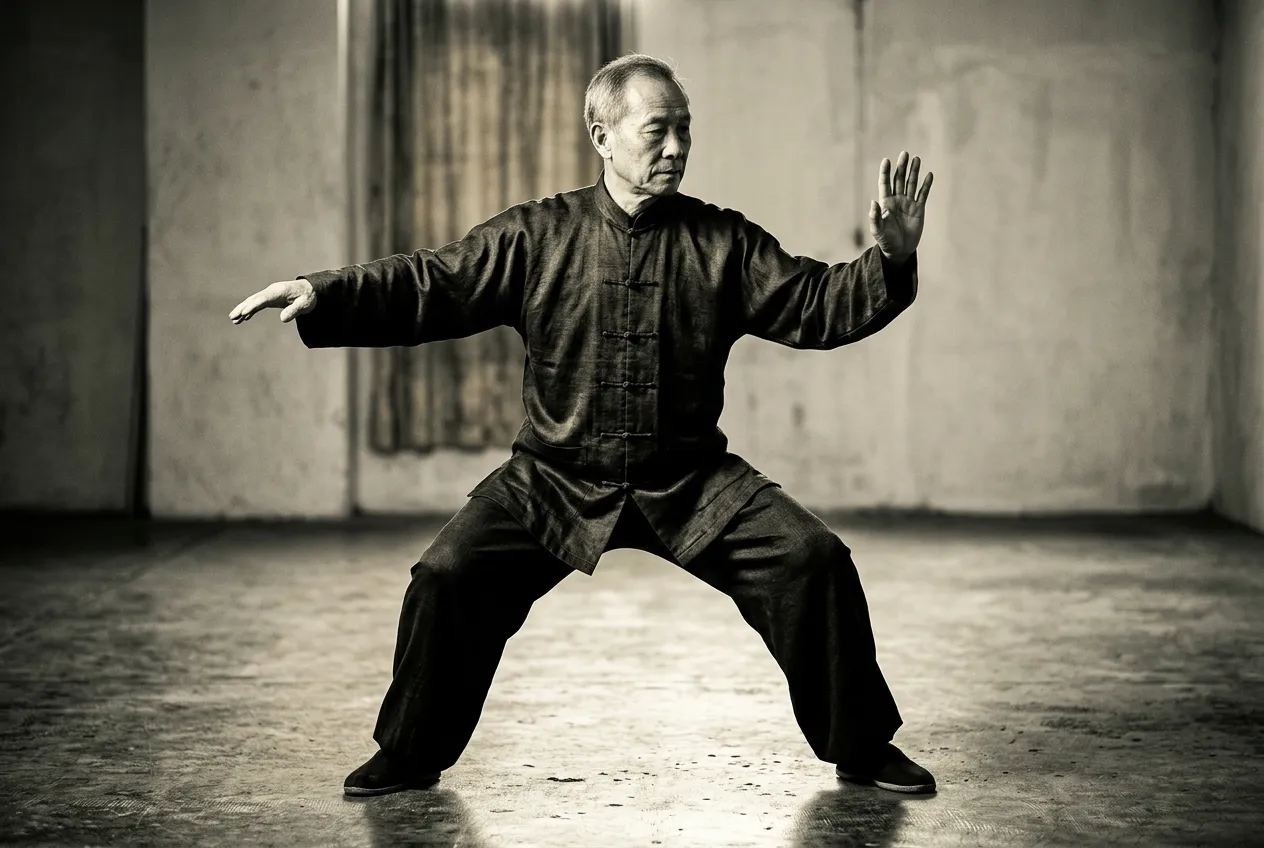
Twenty years later, the same institutional apparatus produced the Combined 48 Form. The brief was different. Where the 24 was designed for absolute beginners, the 48 was aimed at people who had outgrown it: practitioners who wanted more technical range, more physical demand, and exposure to material beyond Yang style.
The word “combined” is the key. Unlike the 24, which is purely Yang-derived, the 48 deliberately incorporates characteristic movements from Chen, Wu, and Sun styles alongside its Yang foundation. It was, in effect, an attempt to give recreational practitioners a taste of the wider tradition inside a single learnable routine.
The same approach later produced the 42-form competition routine in 1989, which is the standardised combined form used in modern wushu competition. The 48 remains the more widely practised of the two among ordinary practitioners. The Wikipedia article on tai chi covers this broader standardisation history — the 1956, 1976, and 1989 committee-produced forms — in more detail.
What the Form Contains
The 48 is organised into six sections of eight movements each — a structure that makes it considerably easier to learn than a continuous forty-eight-movement block. Each section can be practised independently, which is how most people build it.
The overall character remains Yang: even tempo, large open movements, high-to-moderate stances, continuous flow. About two-thirds of the material would be recognisable to any Yang practitioner. What differs is the third that is not.
From Chen style come movements with more visible spiralling and a few with a firmer, more grounded quality — though the 48 does not include fajin or the stamping that characterises Chen forms proper.
From Wu style come more compact postures and some of the subtler weight-shifting patterns.
From Sun style come the open-close hand movements, which appear in the 48 as a distinct and immediately recognisable element.
The form also includes movements that the 24 omits entirely — more kicking, more low postures, more turning, and several techniques that require considerably better balance than anything in the beginner form.
How It Compares With the 24 Form
The differences that matter in practice:
Length. The 24 takes five to eight minutes. The 48 takes nine to ten. As a daily practice, the 48 fills a session more naturally.
Physical demand. Meaningfully higher. There are more single-leg postures, more kicks, and more low work. Anyone who finds the 24 easy will find the 48 a genuine step up.
Balance requirement. The single biggest jump. The 48 contains sustained one-legged positions and transitions that expose balance limitations the 24 never tests.
Memorisation load. Twice the movements, but the six-section structure and the repetition of familiar Yang material make it less than twice as hard. Most people take six months to a year.
Left-right balance. The 48 is more symmetrical than the 24, performing more techniques on both sides. This is a genuine training advantage — the 24 leaves noticeable asymmetries in a practitioner who does nothing else.
The Yang 24 form guide covers the beginner form in detail, and it is worth having that thoroughly established before starting the 48.
Should You Learn It?
The 48 is a good fit if you can run the 24 form from memory without hesitation, you practise regularly rather than occasionally, your balance is reliable, and you want more material without committing to a traditional long form and a traditional school.
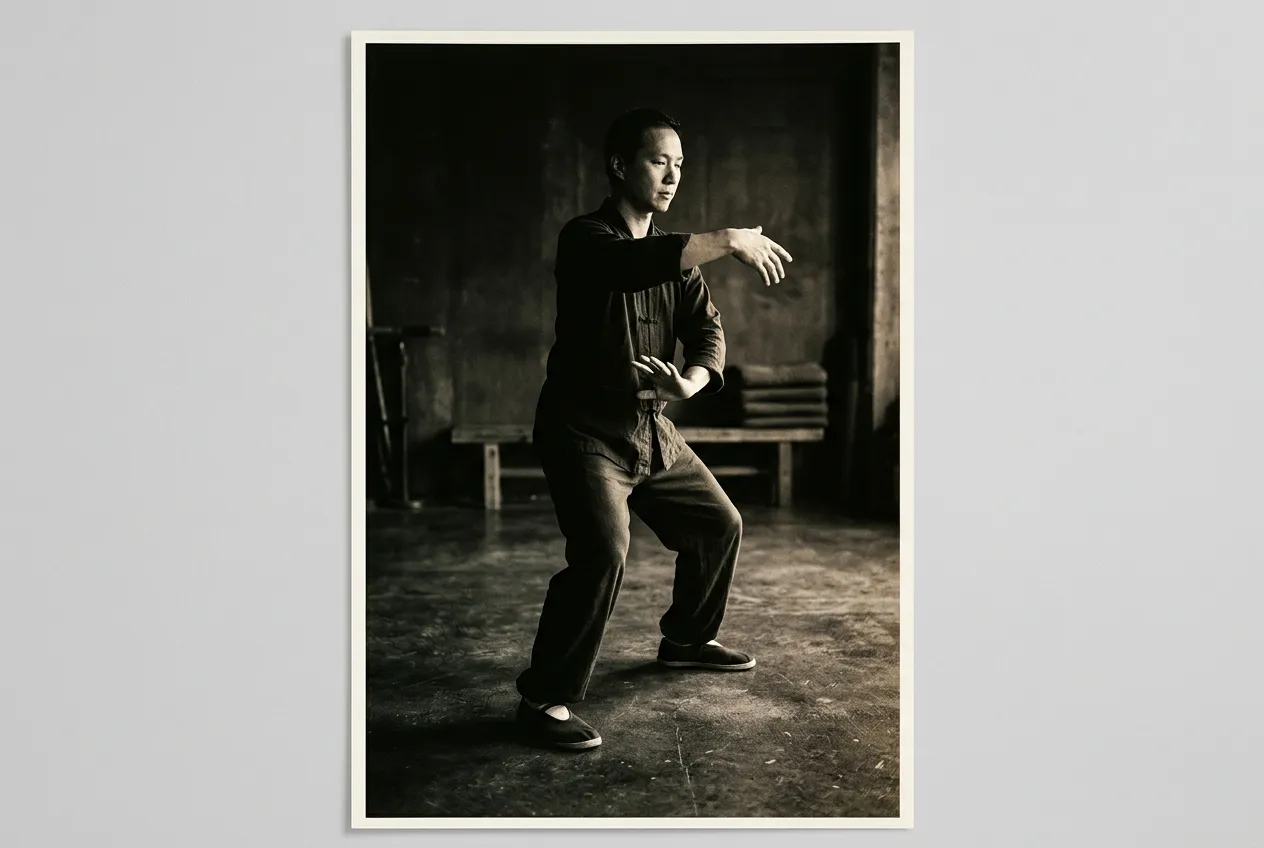
It is a poor fit if you are still thinking about what comes next while performing the 24, if balance or knee problems limit single-leg work, or if your interest is primarily therapeutic. For health purposes specifically, practising the 24 form well beats performing the 48 form approximately, and there is no clinical evidence favouring longer forms — the tai chi health benefits guide covers what the research actually supports.
There is also a legitimate alternative path: instead of learning the 48, deepen the 24. Practise it slower, lower, with more attention to weight distribution and waist-led movement, and add standing practice and push hands. Many experienced practitioners would argue this is the better use of a year. The choice between breadth and depth is genuine, and neither answer is wrong.
When I moved past the 24 the appeal of new material was strong, and in hindsight I learned the next form faster than I refined the first one. That is the common pattern and it is worth being aware of the pull.
Learning It Section by Section
The six-section structure is the practical key. A workable approach:
Learn one section at a time, to memory, before starting the next. Two to four weeks per section is typical for someone practising several times a week.
Practise the accumulated sequence, not just the new section. Run everything you know so far each session, then work on the new material. This is what stops the earlier sections decaying.
Expect the joins to be the hard part. Individual movements are learned quickly; the transitions between sections are where people stall. Practise the last two movements of one section and the first two of the next as a unit.
Do not rush the kicks and single-leg work. These are the technically demanding elements and the ones most likely to be performed badly if hurried. Practise them separately, holding the positions, until the balance is reliable.
Give it a year. Six months is possible with frequent practice and good instruction. A year is more realistic and produces a better result.
Video guidance is genuinely useful for a form of this length, particularly for checking sequence and orientation when practising alone between classes. TaiChiApp.com includes follow-along sequences filmed from multiple angles, which helps with the sections where the form turns and it becomes hard to tell which way you should be facing.
Common Difficulties
Losing orientation. The 48 changes direction more than the 24, and practitioners regularly finish facing the wrong way. The fix is to learn the compass orientation of each section explicitly rather than by imitation.
The Sun-style open-close movements. These feel alien to Yang practitioners and are often performed as a mechanical arm gesture. They should coordinate with the breath and involve the whole torso opening and closing.
Rushing the low postures. The 48 includes lower work than the 24, and the temptation is to drop quickly and rise quickly. Both should be slow and controlled, and the stance can be kept higher without harming the form.
Practising only the sections you like. Almost universal, and it produces a form with three polished sections and three shaky ones. Run the whole thing regularly even when parts of it are unsatisfying.
Building a Practice Around the 48
Once learned, the 48 makes a natural centrepiece for a daily session. A structure that works:
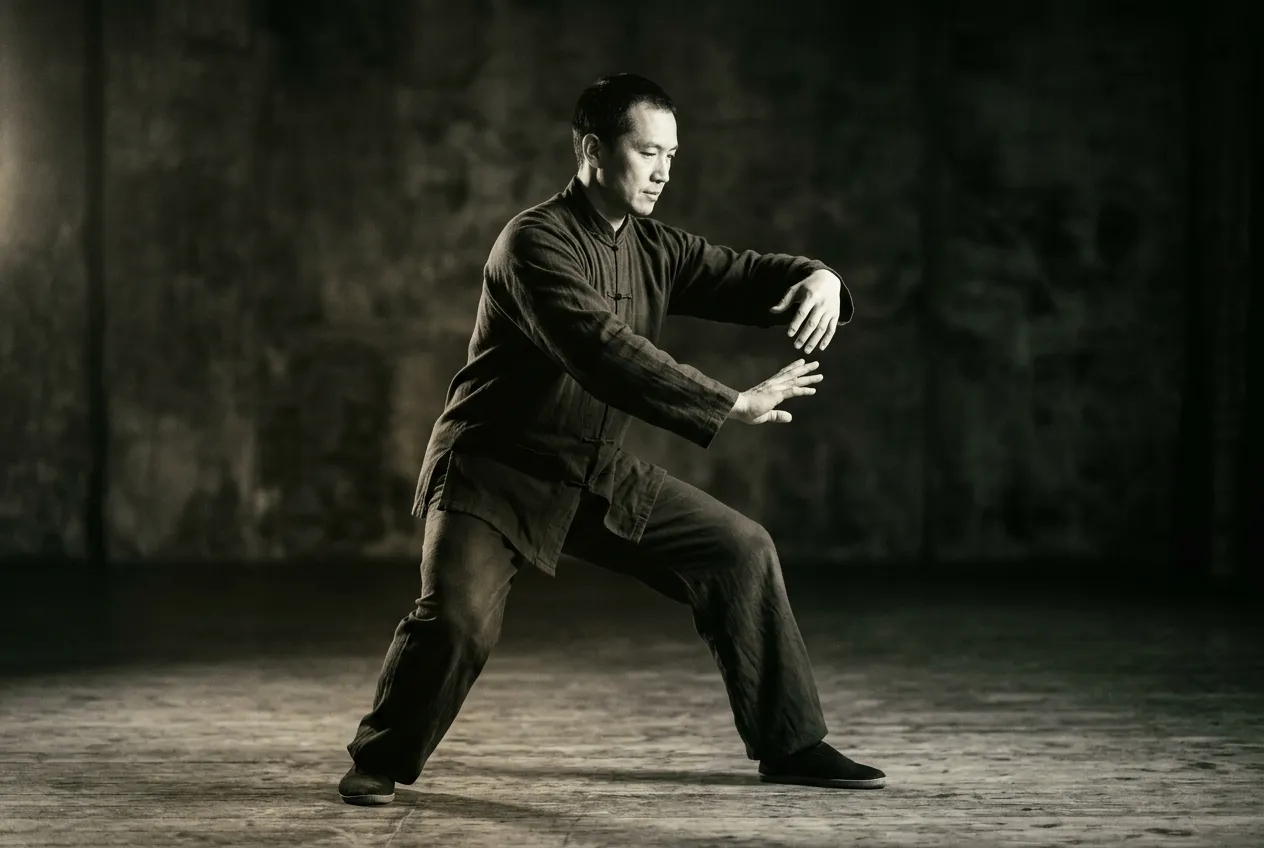
Warm-up, eight to ten minutes. Joint mobilisation and a few minutes of standing. The 48 places more demand on knees, hips, and ankles than the 24, and going in cold is asking for trouble.
One run through at normal tempo. Roughly ten minutes. Treat this as the baseline — a complete pass to see where the form is today.
Section work, ten to fifteen minutes. Pick one or two sections and work them slowly, repeating individual movements. This is where actual improvement happens; running the whole form repeatedly polishes very little.
A second complete run, slower. Deliberately slower than the first, with attention on continuity and weight transfer rather than sequence.
Closing, five minutes. Standing, breathing, settling.
That comes to around forty-five minutes, which is a substantial but manageable daily practice. On short days, the warm-up plus one run takes twenty.
A note on tempo: the standard performance time of nine to ten minutes is a competition convention, not a rule. Practised at a genuinely slow tempo the form can take fifteen minutes or more, and that is generally more useful training than hitting the standard time.
The 48 in Competition and Grading
Worth knowing if you encounter the form in a formal setting.
The 48 has an official standardised version with defined movement names, orientations, and a nominal performance time. Chinese wushu grading systems and many national tai chi associations include it in their syllabuses, and it appears in amateur competition, though the 42-form combined routine has largely displaced it at elite level.
The consequence for ordinary practitioners is that the 48 is more tightly standardised than a traditional family form. Where two teachers of traditional Yang may perform the long form noticeably differently and both be correct within their lineages, the 48 has an official reference version — which makes it easier to learn from books and video, and easier to check yourself against.
Whether that standardisation is a feature or a limitation depends on what you want. It removes ambiguity, and it also removes the individual character that traditional forms accumulate as they pass through teachers. I find the standardised forms easier to learn and slightly less interesting to keep practising, which is a personal reaction rather than a criticism of the form.
Where It Leads
The 48 is a genuine intermediate destination rather than a stepping stone, and plenty of practitioners settle there permanently. It is long enough to fill a practice session, varied enough to stay interesting, and broad enough to give a sense of the tradition beyond a single style.
For those who want to continue, the natural directions are the traditional Yang long form — a substantially larger undertaking covered in the 108 form guide — or a weapons form, or serious study of a single traditional style with a lineage teacher.
The Yang style overview covers the tradition the 48 mostly draws from, and the other sequences are collected in the tai chi forms section.