“Tai chi” is one of the more misleading names in common English usage. It is a partial transliteration of a Chinese term that means something quite specific and philosophical, attached to a practice whose full name includes a third character that changes the meaning entirely.
The art is properly called taijiquan — 太極拳 — usually rendered in older English texts as t’ai chi ch’uan. The three characters translate roughly as “supreme ultimate fist”, and each of them is worth understanding on its own.
The Three Characters
太 (tài) means great, supreme, or utmost. It is an intensifier — the same character appears in words meaning “too much” and in various titles denoting the highest rank of something.
極 (jí) means pole, ridgepole, extremity, or ultimate. Its literal reference is to the ridgepole of a roof, the highest structural beam, and by extension to any furthest point or limit.
Together, 太極 (tàijí) is usually translated as “supreme ultimate” or “great pole”. It is a cosmological term, not a martial one, and it long predates the martial art.
拳 (quán) means fist, and by extension boxing or a fighting method. It is the standard suffix for Chinese martial arts — you find it in xingyiquan, baguazhang’s relatives, changquan, and dozens of others.
So taijiquan is the “supreme ultimate fist”: a martial art named for a philosophical concept. Dropping the quan, as English speakers routinely do, leaves you referring to the philosophical concept alone.
What Taiji Means Philosophically
The term comes from the Yijing, the Book of Changes, one of the oldest texts in the Chinese canon. The relevant line — 易有太極,是生兩儀 — is usually rendered as “in the Changes there is the supreme ultimate, which gives rise to the two forms.”
The two forms are yin and yang. The picture is of an undifferentiated origin state that divides into complementary opposites, from which the two forms give rise to four, then eight, and so on into the full complexity of the world.
Taiji is therefore the point at which unity becomes duality — the moment differentiation begins. The state before it is wuji, the limitless or undifferentiated, which has its own dedicated discussion and its own place in tai chi practice as the still standing posture that begins and ends the form.
That structure is not decorative. It is the organising principle of the movement: the practice begins in wuji stillness, differentiates into full and empty, substantial and insubstantial, opening and closing — and the whole art is an exploration of that division and its resolution.
The Symbol Is Not Called a Yin-Yang
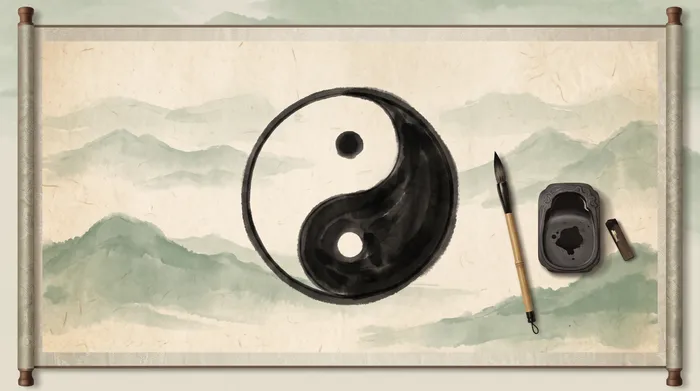
A small but persistent confusion. The black-and-white circular symbol universally known in English as the yin-yang is properly the taijitu — 太極圖 — the “diagram of the supreme ultimate”.
It depicts exactly what the Yijing line describes: a whole containing two complementary halves, each carrying a seed of the other, in continuous rotation. Yin and yang are the two halves; the taijitu is the whole diagram.
This is why the symbol appears on tai chi school logos worldwide. It is not a generic Eastern motif attached to the art for decoration — it is a diagram of the concept the art is named after.
Why the Spelling Varies
You will encounter tai chi, t’ai chi, taiji, tai chi chuan, t’ai chi ch’uan, taijiquan, and taichi. All refer to the same thing. The variation comes from competing romanisation systems.
Wade-Giles, developed in the nineteenth century, produced “t’ai chi ch’uan”. The apostrophes mark aspiration — the difference between the sounds in “top” and “stop” — and are routinely dropped in casual writing, which is where “tai chi chuan” comes from.
Hanyu Pinyin, adopted by China in the 1950s and now the international standard, produces “taijiquan”. The “j” and “q” represent the same sounds Wade-Giles wrote as “ch” and “ch’”.
Pinyin is the more accurate guide to pronunciation for English speakers and is standard in academic writing. Wade-Giles is entrenched in the West through decades of earlier books and school names.
The pronunciation, incidentally, is closer to “tie jee chwen” than to the “tai chi” most English speakers say, and the confusion is entirely the fault of Wade-Giles’s use of “ch” for a sound English speakers read as in “chair”.
There is a further wrinkle worth knowing: “tai chi” in English is also used, quite separately, in the phrase “tai chi symbol” and in discussions of Chinese philosophy, where it refers to the cosmological concept alone. Context usually makes it clear, but not always.
Related Terms You Will Encounter
A few adjacent words that often appear alongside the name and are worth distinguishing.
Neijia (內家), “internal family”, is the category tai chi belongs to, alongside xingyiquan and baguazhang. The distinction between internal and external arts is contested and blurrier than usually presented, but the label is standard.
Wushu (武術), “martial technique”, is the general Chinese word for martial arts, and also the name of the modern standardised competitive sport. A tai chi routine performed in wushu competition is judged on different criteria from a traditional form.
Qigong (氣功), “energy work”, refers to a large family of breathing and movement practices. Tai chi is sometimes described as a form of qigong, which is loose but not unreasonable, and the two are covered separately for good reason.
Tuishou (推手), “push hands”, is the partner practice, and its name is exactly what it describes.
When I started, the profusion of terms felt like a barrier — every book seemed to spell things differently and use words the previous book had not mentioned. It is worth knowing that this reflects the messiness of transliteration and a century of separate transmissions, rather than any real disagreement about what the practice is.
What the Name Tells You About the Art
It is easy to treat the name as historical decoration. It is more useful read as a description of what the practice is trying to do.
An art called “supreme ultimate fist” is claiming that its martial method is organised around the principle of complementary opposites — that its techniques work by managing the relationship between full and empty, hard and soft, advancing and retreating, rather than by opposing force with force.
That is not a philosophical gloss added later. It is the operating principle. The classical texts return constantly to the idea that yielding overcomes hardness, that four ounces deflects a thousand pounds, and that the practitioner should be substantial where the opponent is insubstantial. Every one of those instructions is an application of the yin-yang relationship the name points to.
Whether any given practitioner cares about the philosophy is another matter, and plenty of people practise productively without giving it a thought. But the movement principles they are following came from somewhere, and the name is the clue.
The history of tai chi covers how the art acquired both its name and its lineage, the philosophy and Taoism article goes deeper into the conceptual background, and the introduction to what tai chi is covers the practice for anyone arriving new. More on the tradition’s background is collected in the tai chi history section.