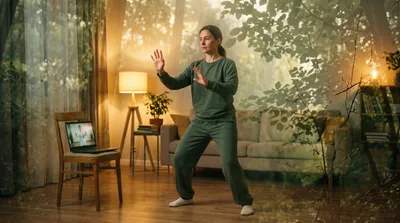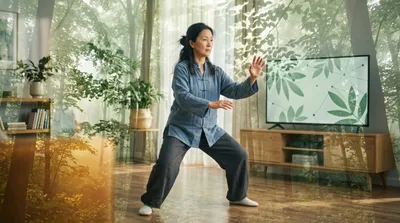
Full disclosure before anything else: I co-founded TaiChiApp.com, which is one of the products this article discusses. You should read everything below knowing that, and I have tried to write the piece I would want to read from someone with my conflict of interest — heavier on how to judge any app, lighter on ranking, and honest about when our own product is the wrong choice.
That said, the question is real and people ask it constantly: there are dozens of tai chi apps, most are poor, and the store listings are indistinguishable. Here is how to tell them apart.
What a Tai Chi App Is Actually For
Getting this straight first, because it determines everything else. An app cannot teach you tai chi by itself — no video can see you, and correction is the irreplaceable core of learning this art, as the online classes guide covers at length. What an app genuinely does well:

- Structures home practice between classes, or where classes don’t exist — the daily-companion role the home practice guide describes.
- Holds the choreography so you are not trying to remember the sequence and perform it simultaneously.
- Paces beginners through material in a sane order, which random video-hopping does not.
- Lowers the entry barrier to near zero: phone, living room, ten minutes.
If you already attend a class, an app is a supplement. If you cannot or will not attend one, an app plus periodic self-filming is the workable second-best. Either way, the app is the practice partner, not the teacher.
It is also worth saying what apps have quietly changed for the better. A decade ago, home learners worked from DVDs filmed once from one angle, or from whatever YouTube’s algorithm surfaced that morning. The current generation of structured apps — across every maker — has raised the floor considerably: sequenced curricula, watchable production, and pacing designed by people who have watched thousands of beginners quit. The gap between a good app and a good class remains real; the gap between a good app and the old ways of learning alone has closed to almost nothing.
The Things That Actually Separate Apps
Having built one — and studied every competitor while doing so — these are the axes on which tai chi apps genuinely differ. Store screenshots reveal almost none of them, which is why free trials matter.
Can you see the feet? The single fastest quality test. Tai chi lives in the legs and weight; apps that film waist-up, or crop to fit portrait screens, cannot teach it. Look for full-body framing and, ideally, multiple angles or dedicated foot close-ups on the movements where stepping is the content.
Real teacher or content-mill footage? A named instructor with a checkable background, teaching progressively, versus licensed stock footage of someone performing while a voiceover reads wellness copy. A depressing share of the store is the latter.
Progression or library? Good apps sequence: fundamentals, then movements, then linked sequences, with review built in. Weak apps are a folder of videos with equal billing, which quietly transfers the curriculum problem back to you.
Follow-along and learn modes both. You need slow, broken-down, repeated instruction while learning, and continuous full-speed follow-alongs once you know the material. Apps built around only one mode serve only half the journey.
Mirroring and pacing controls. Being able to mirror the video (so the instructor’s left is your left), slow it down, and loop a section are small features that matter enormously in practice.
Honest scope. An app teaching one form well beats an app listing forty styles. Breadth in this market is usually a licensing artefact, not a curriculum.
The Landscape, Honestly
Rather than a ranked list that would flatter my conflict of interest, here is the shape of the market and where the notable options sit. App stores change fast, so treat specifics as a snapshot and verify current pricing and content yourself.

Short-session wellness apps. The best known is 7 Minute Chi, built around brief daily tai chi and qigong routines — genuinely well liked for what it is, with calm production and narrated breathing. Apps in this category are mood and movement tools: excellent for establishing a daily habit, not designed to teach you a form properly. If your goal is “move gently and settle, most days”, this category fits; if your goal is “learn tai chi”, it will plateau you early.
General wellness platforms with tai chi content. Larger health apps — ZenFit is a current example pitching tai chi, qigong and Eight Brocades material at older adults — bundle tai chi into a broader offering. Convenient if you want the bundle; the tai chi depth varies and is rarely the platform’s centre of gravity.
Teacher-led course platforms. Established teachers increasingly deliver structured courses through apps or web platforms — Dr Paul Lam’s online lessons are the prominent health-programme example, web-based rather than app-native. This category has the strongest teaching pedigree; the trade-off is usually less app polish and features than the software-first products.
Form-teaching apps. The category TaiChiApp.com is in: apps whose core job is progressively teaching complete forms through structured video, with the multi-angle filming and learn/follow modes described above. This is what we built because it is what we wanted and could not find — and having disclosed the interest, I will simply say the two honest things: it is designed around exactly the criteria this article lists, because we wrote both; and it is the wrong choice for people who want live human feedback, short mood sessions, or a free-forever tool, all of which other options above serve better.
YouTube plus discipline. The zero-cost alternative deserves its place in any honest list: a single good teacher’s playlist, followed in order, does the structural job of a mid-tier app for nothing. What you give up is the pacing, the features, and — realistically — the follow-through; the paid-app completion effect is real. The free resources guide maps that route properly.
What We Learned Building One
A short section that exists because it is the one thing I can offer that a neutral reviewer cannot: what the inside of this problem looks like.
The hardest part of a tai chi app is not the software. It is that filmed instruction must anticipate every question a student cannot ask. In a hall, a teacher sees the confused face and re-explains; on film, the explanation has to be right the first time, for every body type, at every angle of confusion. That is why the production decisions this article keeps testing for — feet in frame, multiple angles, mirrored playback, movements repeated past the point of tedium — are not polish. They are the entire pedagogy, compensating for the absent feedback loop.
The second lesson: completion beats content. Early on we, like everyone, assumed more forms meant a better product. What actually predicts whether someone is still practising a year later is how the first three weeks are paced — small wins, short sessions, review built in before it is needed. Any app you evaluate, evaluate on its first fortnight, because that fortnight is where home practice lives or dies.
And the third, which cost the most to accept: some people should not be our customers. The user who thrives on live correction, group energy, and a teacher’s eye will practise less with any app than without one, because the app becomes permission to skip class. Part of writing honestly about this market is saying that out loud.
Pricing Models, and What They Predict
Tai chi apps monetise four ways, and the model tells you something about the product before you ever open it.

Free with ads almost always means licensed or scraped content — producing original instruction costs too much to give away against ad revenue. Fine for sampling movement; rarely a teaching product.
One-off purchase has become rare but still exists, typically for single-form apps from individual teachers. What you see is what it stays: no ongoing content, and no incentive for the developer to keep it compatible forever. Check the last-updated date before buying.
Subscription is now the dominant model, ours included, for the unglamorous reason that filmed curricula, platform maintenance, and support are ongoing costs. The fair test of a subscription app is whether content and features actually accrue — an unchanged library behind a monthly fee is a one-off purchase wearing a subscription’s price tag.
Freemium tiers are the buyer’s friend regardless of model: enough free material to run the feet test, the progression test, and a real week of practice before paying. Distrust any app whose trial is too short to complete three lessons; the confidence of the trial mirrors the confidence in the product.
One consumer-protection basic that applies everywhere: subscribe through the app stores rather than by handing a card to a website you have known for ten minutes, purely because store subscriptions are trivial to cancel. Reputable products survive easy cancellation fine.
Choosing in Practice
A short decision path that covers most people:
- Want a gentle daily habit more than the art itself? Short-session category. Try the free tiers; pick the one whose voice and pacing you can stand daily, because that is the actual retention factor.
- Want to actually learn a form at home? Form-teaching or teacher-led category. Judge with the feet test, the progression test, and a real trial of the first lessons — every credible option offers one.
- Over sixty, or practising for a specific condition? Look first at programme-descended content (the Tai Chi for Health lineage especially), where the material is designed and safety-checked for exactly that use.
- Already in a weekly class? Ask your teacher what they recommend for home practice first — matching your app to your class’s form and style matters more than app quality, because two versions of the same form will fight each other in your legs.
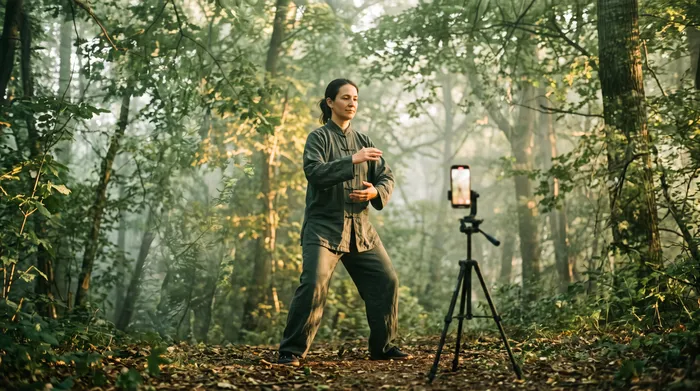
- Whatever you choose, add self-filming. Once a month, phone propped on a shelf, compared against the app’s demonstration. It is the only correction loop an app can’t give you, and it costs nothing.
And the counter-recommendation, stated plainly since the rest of this site says it anyway: if a decent in-person class exists near you and you can afford it, that beats every app in this article for your first six months — ours included. The class-choosing guide covers finding one. Apps earn their place alongside and after that, which is where most of our own long-term users actually keep them.
More on structuring the practice an app supports is collected in the tai chi practice section.