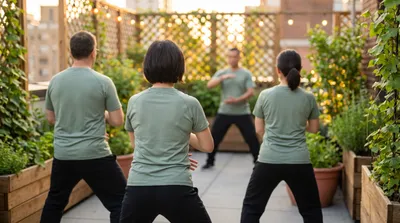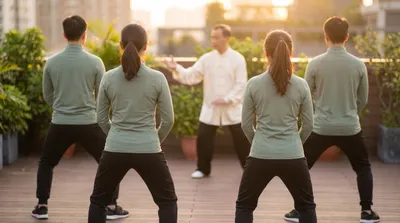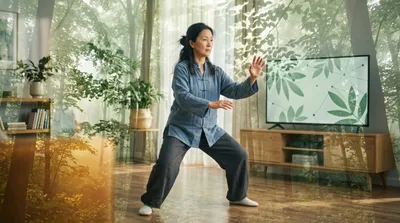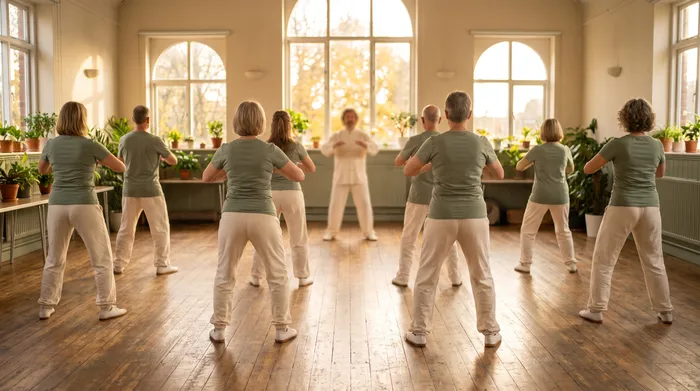
Searching for a tai chi class turns up listings; what it does not turn up is any sense of what you are walking into. Classes calling themselves the same thing range from silent moving meditation to sweaty martial training, and the label on the door barely narrows it down.
This guide covers the class side of starting out: what a typical session actually contains, the types of class you will encounter, and how to judge one from a single visit. It pairs with the guide to evaluating teachers — that article is about the person at the front of the room and their credentials; this one is about the room itself. Between them, and the complete beginners guide for everything around them, you should be able to start well.
What Actually Happens in a Class
The shape varies by school, but a representative hour of a community tai chi class runs something like this:

Warm-up (10-15 minutes). Joint circles, gentle swings, loosening from ankles to neck — often with some standing and breathing. Longer and gentler than most exercise warm-ups, because the class demographic skews older and the practice rewards arriving settled.
Fundamentals or review (10-15 minutes). Stance work, weight-shifting drills, a single movement repeated — or a run-through of previously learned form material for returning students.
New material (15-20 minutes). The next movement or two of whatever form the class is working through, demonstrated, broken down, copied, corrected. Progress is deliberately slow: a movement or two per week is normal, and a short form commonly takes a class six months to a year to cover.
Full run-through and close (5-10 minutes). The group performs everything learned so far, then some closing breathing or standing.
Things that are normal and surprise beginners: long stretches of repetition; being physically adjusted by the teacher (they should ask first — good ones do); periods of near-silence; a range of student ability in one room, with newcomers following approximately from the back; and finishing the hour feeling simultaneously relaxed and like your legs did something.
Things that are not part of any normal beginner class: pain, competitiveness, being pushed past comfort, or fees demanded for rank, uniforms, or “energy attunements”. Any of those is your cue to leave.
The Types of Class Behind the Same Label
Five broad species cover most of what you will find, and identifying which one you are looking at answers half your questions in advance.
Community health classes. Village halls, leisure centres, retirement communities. Gentle, social, health-first, usually teaching a simplified short form or a set programme; the largest category by far and the right one for most people over fifty or anyone practising for balance and general health. Pay-per-session or cheap terms.
Programme-based classes. Structured curricula — Tai Chi for Arthritis and its siblings — delivered by certified instructors, often through health services. Fixed length (commonly 8-16 weeks), fixed syllabus, well matched to specific conditions. What they teach is real but deliberately narrow; graduates wanting more move on to general classes.
Traditional school classes. A named lineage, longer forms, more technical correction, often push hands and weapons at later stages, sometimes gradings. More demanding, more depth, more commitment expected. The right choice if the art itself — not only its health effects — is what draws you.
Martial classes. Usually inside martial arts schools, treating tai chi explicitly as a fighting system: applications, partner drills, sparring at senior levels. The smallest category and the hardest to find; the martial art article covers what distinguishes genuine versions.
Online classes. Live-streamed or recorded, covered properly in the online classes guide — the short version is that they solve access and cannot fully solve correction.
A useful matching heuristic: your goal picks the category, and only then does quality-shopping within the category begin. The commonest mismatch I hear about is a fit forty-year-old bored senseless in a lovely chair-adjacent health class, or a seventy-five-year-old gamely suffering through a martial school — both in perfectly good classes that were never for them.
Evaluating a Class in One Visit
Nearly every class lets you observe or try a first session free. What to look for while you are there — beyond the teacher-evaluation questions covered elsewhere:
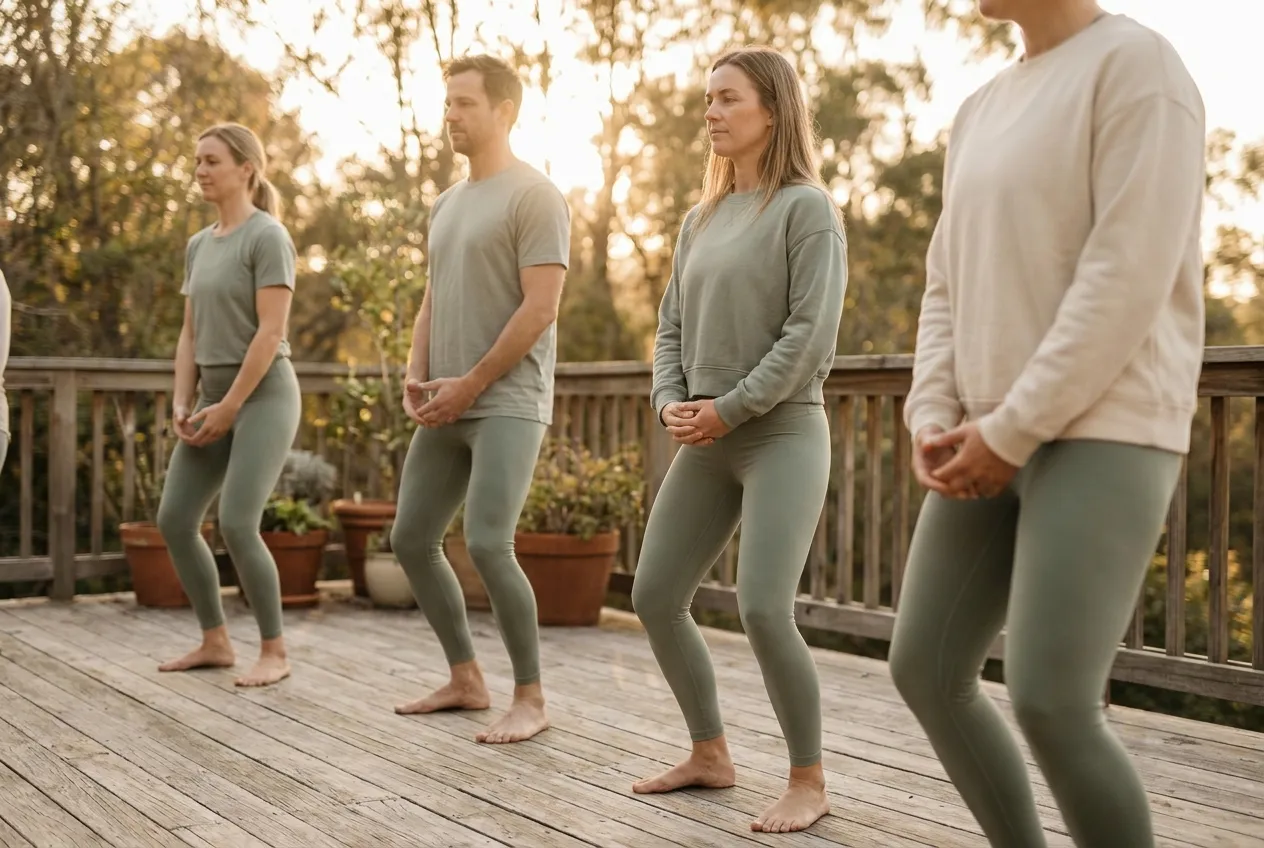
Are beginners handled deliberately? Somebody should acknowledge you, place you where you can see, and either give you a simplified track or pair you with a helper. A class that simply lets you flounder at the back will keep doing so.
Is anyone being corrected? A class where the teacher demonstrates and nobody is ever adjusted is a follow-along session, which has its place but teaches slowly. You want to see individual correction happening — and to notice whether it is offered kindly.
Does the room match you? Age range, pace, formality, atmosphere. You are choosing a weekly habitat, and comfort predicts attendance better than quality does.
Can you see and hear? Mundane and decisive: mirrors or good sightlines, a teacher who talks while demonstrating, a hall where you can hear them.
What do the two-year students look like? The most informative data in the room. If the longer-term students move well, the teaching works; if they all share the same fault, you have met the teacher’s blind spot. And ask one of them how long they have attended — student longevity is the best single quality signal a class has. It is the first thing I look for whenever I sit in on a class as an outsider, because everything else about a room can be performed for a visitor for an hour; a genuinely good long-term student cannot be faked.
How does it end? Small tell: classes that close properly — settled, unhurried, students lingering to chat — tend to be classes people stay in.
Red Flags Worth Naming
Most classes are run by decent people teaching what they know. The exceptions cluster around recognisable patterns, and naming them saves someone a bad year.
Money structured as escalation. Mandatory uniforms in week one, paid gradings at frequent intervals, pressure toward long contracts, expensive “inner school” tiers. Traditional schools legitimately charge for depth; schemes charge for belonging.
Claims that outrun physics. Teachers demonstrating effects on their own compliant students that they decline to demonstrate on anyone else — no-touch throws being the classic. However graceful the rest of the teaching, this is a room where believing things is part of the tuition.
Correction that humiliates. Adjustment should be matter-of-fact and kind. A class whose culture runs on the teacher’s temper produces tense students and tense tai chi, which is a contradiction in terms.
Medical overreach. A teacher who suggests practice can replace medication or treatment has left their competence. Good teachers say “ask your doctor” fluently and often.
No lineage, no history, no peers. Everyone learned from somewhere. Teachers vague about their own training to the point of mysticism are usually concealing brevity rather than depth.
One or two mild oddities are just the territory — this art attracts characters, and some excellent teachers are eccentric. It is the combination of money pressure plus unfalsifiable claims plus isolation from the wider community that marks the rooms to leave.
The Practical Details
Cost. Community classes typically run modestly per session, traditional schools somewhat more per class or by monthly membership; programme courses price as a block. Beware only of large upfront commitments demanded before you have tried a month.
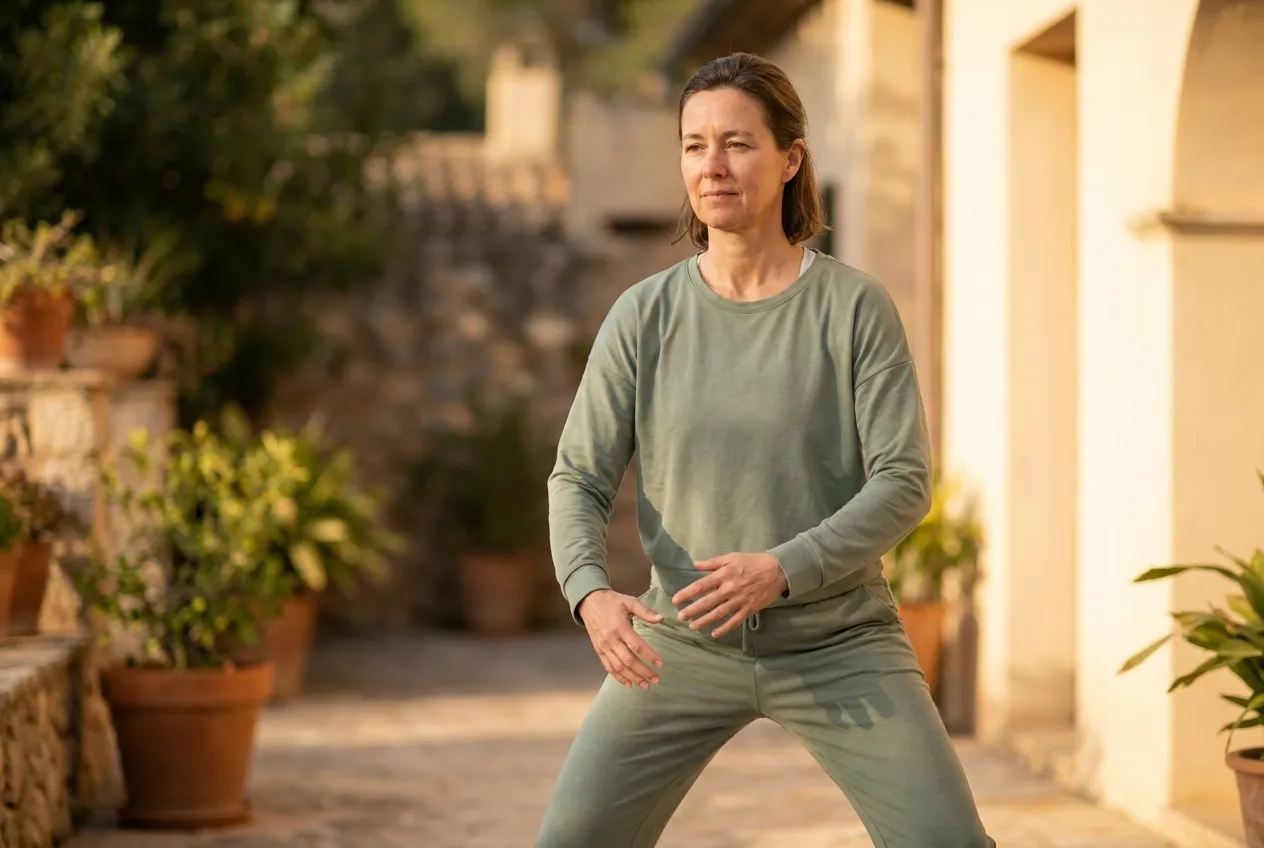
What to wear and bring. Loose clothes, flat shoes, water; the gear guide covers footwear properly. Nothing else. If a class requires buying a uniform in week one, that is a flag worth noticing.
Frequency. Once weekly plus short home practice between sessions is the standard and entirely adequate pattern. The class teaches; the home practice is where learning consolidates.
How long before it feels like something? Give any class you half-like six sessions before judging — the first weeks of tai chi are disproportionately awkward everywhere, and class three is usually the low point. Judge the class on how it teaches, not on how quickly the art yields; the art yields slowly in even the best room, as the beginners guide explains at length.
More starting-out guidance is collected in the beginners section.
Frequently Asked Questions
How do I find tai chi classes near me?
Beyond the obvious map search: check leisure centres and community centres directly (their classes are often invisible to search engines), ask at health-service falls-prevention or healthy-ageing programmes, look for national register listings from bodies like the Tai Chi Union for Great Britain or the Tai Chi for Health Institute’s instructor directory, and check for morning park groups, which advertise nowhere. Searching the style name (“Yang tai chi”, “Chen taijiquan”) also surfaces schools that a generic search misses.
What should I expect at my first tai chi class?
A long gentle warm-up, a lot of watching and copying, some standing, a few movements repeated many times, and probably a pleasant sense of having no idea what your arms are doing. Nobody expects competence from you; the only real first-day jobs are turning up in loose clothes and flat shoes and telling the teacher about any injuries or conditions.
Are tai chi classes suitable for complete beginners?
Most are — rolling enrolment with mixed levels is the norm, and teachers are practised at absorbing newcomers. Classes that run as fixed-length beginner courses are even better if you can find one starting soon. The only classes genuinely unsuitable for a first-timer are advanced sessions within traditional schools, and those are labelled as such.
How much do tai chi classes usually cost?
Community classes are generally comparable to a yoga or fitness class in your area, often cheaper; health-service programme courses may be free or subsidised; traditional schools charge more and usually offer monthly rates. Free options — park groups, health programmes, tasters — are covered in the free resources guide.
Is it better to learn tai chi in a class or online?
For a complete beginner, in-person wins on the single thing that matters most: someone can see and correct you. Online wins on access, schedule, and pace. The strongest budget arrangement is a hybrid — online material as the daily backbone with periodic in-person correction. If both are available and affordable, start in person for the first months, then let online supplement.