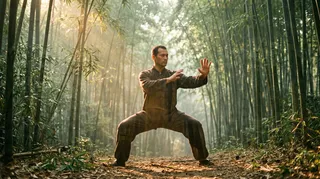
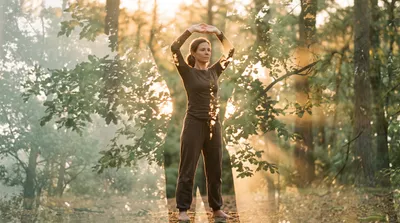
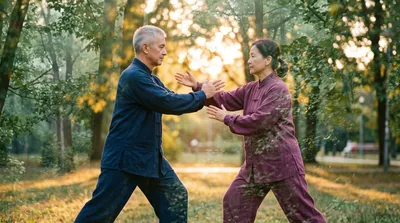
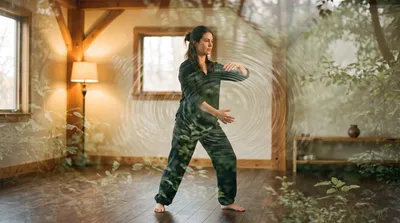
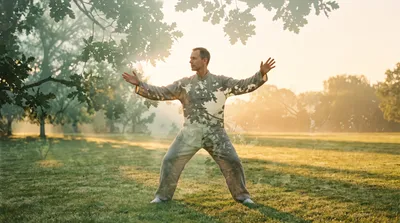
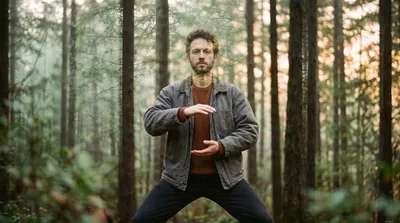
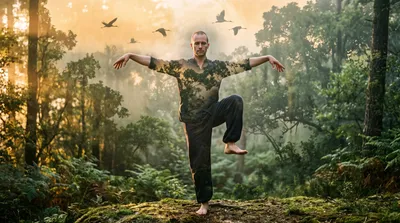
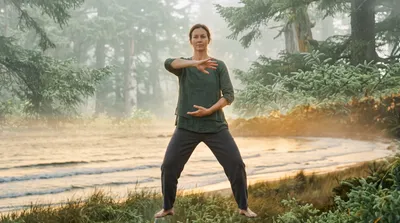
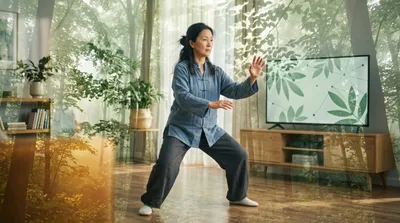
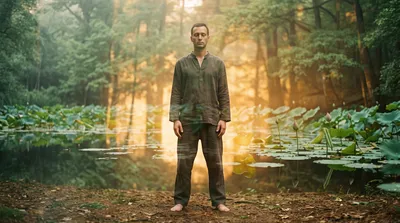
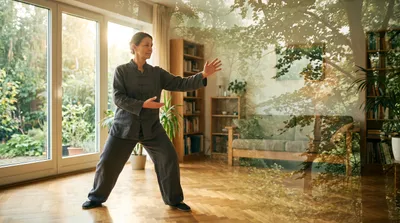
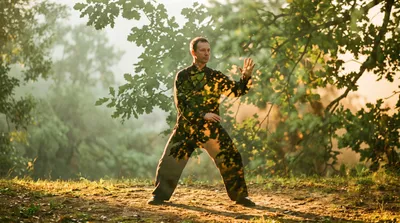
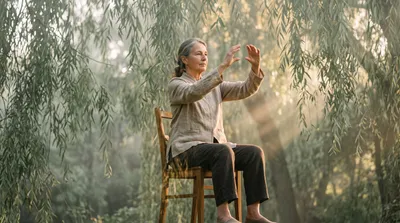
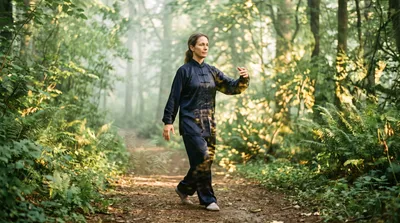
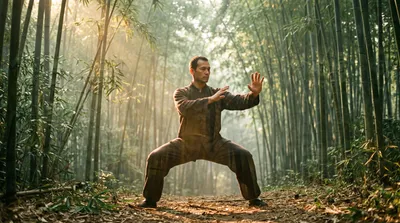
The Eight Brocades — Ba Duan Jin (八段錦) in Chinese — is one of the oldest and most widely practised qigong sets in the world. The name translates literally as “Eight Pieces of Brocade,” suggesting eight movements of beauty and value woven together like silk brocade cloth. The set covers the whole body in a sequence designed for health maintenance, energy cultivation, and structural alignment.
If you have practised tai chi for any length of time, you have likely encountered the Eight Brocades in a warm-up routine or as a complementary practice. It fits naturally alongside tai chi because it shares the same foundational principles — slow, breath-coordinated movement, relaxation of unnecessary tension, and attention to the body’s internal state.
This guide covers all eight movements by name (Chinese and English), the origins of the set, how to approach the practice, and what research suggests about its health effects.
Origins and History
The Eight Brocades has a history spanning at least 1,000 years, though its exact origins are debated. The most commonly cited attribution is to Yue Fei (岳飛), the Song Dynasty (960–1279 CE) military general famous for his loyalty and martial prowess. According to traditional accounts, Yue Fei developed the set to strengthen his soldiers. This attribution is widely repeated in qigong literature, but historians note that it is traditional rather than verified — the evidence connecting Yue Fei directly to the Eight Brocades is circumstantial.

What is more certain is that written descriptions of the Eight Brocades appear in Chinese texts from the Song Dynasty period, and the set has been transmitted continuously since then. The Wikipedia article on the Eight Brocades provides a useful summary of the historical debate and existing textual evidence.
Like all traditional practices that have been transmitted across centuries, the Eight Brocades has evolved. Different lineages practise different versions — some standing, some seated, some with 8 movements and some with variations. The standing version covered in this guide is the most commonly practised in the West and is based on the form standardised by the Chinese Health Qigong Association in 2003.
In my practice, I find the historical depth of the Eight Brocades adds something to the experience of doing it — knowing that practitioners over centuries have worked through these same eight movements creates a sense of connection that newer exercises cannot match.
How to Practise the Eight Brocades
Preparation and Standing Posture

Before beginning, stand in the basic qigong stance: feet shoulder-width apart, knees soft, arms hanging naturally, weight distributed evenly across both feet. This is called Wuji standing — a neutral, receptive posture that allows the body to settle before movement begins.
Take five slow breaths in this position. On each exhalation, let a little more tension leave the shoulders, jaw, and hands. There is no rush to begin the first movement.
The movements should be slow, continuous, and coordinated with the breath. Each piece flows into the next in a continuous practice, though beginners often practise individual pieces until they are comfortable before putting the set together.
For guided video practice of the complete sequence, TaiChiApp.com offers Eight Brocades follow-along sessions that are particularly useful for learning the timing and transitions. Including a [VideoEmbed placeholder] here for the full Ba Duan Jin sequence.
The Eight Movements
Piece 1: Two Hands Hold Up the Heavens — Shuang Shou Tuo Tian (雙手托天)

Clasp the hands together with fingers interlaced, then slowly raise them overhead, turning the palms to face upward as if pressing the sky. Rise onto the toes as the arms reach their highest extension. Hold briefly, then lower the arms in a wide arc back to the sides as the heels return to the floor.
This movement stretches the Sanjiao (Triple Warmer) meridian and creates axial elongation of the spine. In practice it produces a profound stretch through the upper back and side body. The upward stretch on the inhalation and the release on the exhalation are among the most satisfying movements in the set.
Key body mechanics: The arms do not force themselves straight — the extension is through length, not rigidity. Keep a slight softness in the elbows at the top of the movement.
Piece 2: Drawing the Bow to Shoot the Eagle — Zuo You Kai Gong Si She Diao (左右開弓似射雕)
Step out into a wide horse stance (feet wider than shoulder-width, knees bent deeply). Cross the arms in front of the chest, then draw one arm out to the side as if pulling a bowstring, while the opposite arm extends with the index finger pointing like a sight. Gaze follows the pointing finger. Return to centre and repeat on the other side.
The horse stance makes this one of the more physically demanding pieces. It strengthens the legs, opens the chest, and requires integration of upper and lower body movement. When I first learned this piece, I consistently underestimated the depth of horse stance required — the position should feel genuinely challenging, not merely symbolic.
Key body mechanics: The extended arm draws from the shoulder socket, not from hunching forward. The chest opens fully as the bow “draws.” Keep the spine upright — resist the temptation to lean backward.
Piece 3: Separate Heaven and Earth — Tiao Li Pi Wei Xu Dan Ju (調理脾胃須單舉)
From standing, one palm presses upward (as in Piece 1, but single-handed) while the other presses downward, creating an opposing force that stretches through the side body and along the meridians associated with the stomach and spleen. Alternate hands with each repetition.
This piece subtly massages the digestive organs through the opposing stretches. Traditional theory holds that it benefits the spleen and stomach; physiologically, the alternating lateral stretches create compression and release along the torso that may stimulate abdominal circulation.
Key body mechanics: The upward and downward pressures are genuine — not a performance of opposition but an actual sensation of pulling in two directions simultaneously.
Piece 4: Wise Owl Gazes Backward — Wu Lao Qi Shang Wang Hou Qiao (五勞七傷往後瞧)
Stand in the basic stance and slowly rotate the head to look over one shoulder, while keeping the shoulders and hips facing forward. The rotation is in the cervical spine only. Return to centre, then rotate to the other side.
Traditional Chinese medicine theory attributes this piece to addressing the “five labours and seven injuries” — essentially, the accumulated physical and emotional strains of daily life. At a physiological level, it creates rotation in the cervical spine and gentle stimulation of the neck’s proprioceptive system.
Key body mechanics: The chin remains level — do not let the head tilt as it turns. The rotation is at the base of the skull, not forced from the upper neck. Move slowly enough that the movement feels safe and controlled.
Piece 5: Sway the Head and Swing the Tail — Yao Tou Bai Wei Qu Xin Huo (搖頭擺尾去心火)*
Return to the wide horse stance from Piece 2. With hands resting on thighs, lean the torso to one side in a controlled arc while allowing the head to drop gently in the same direction, then sweep across and rise on the other side — creating a wave-like lateral movement through the spine. The “tail” (coccyx) draws the opposite arc.
This piece works the lateral lines of the spine and is said to reduce “heart fire” — the agitation and heat of excess mental activity. In practice, it is genuinely calming, perhaps because the wave-like motion activates the parasympathetic nervous system in a way similar to the rocking movements used to soothe infants.
Key body mechanics: The movement is fluid, not jerky. The transition from one side to the other passes through a moment of central balance before continuing. Reduce the range of motion if you feel any discomfort in the lower back.
Piece 6: Two Hands Hold the Feet — Liang Shou Pan Zu Gu Shen Yao (兩手攀足固腎腰)
From standing, raise the arms overhead on an inhalation, then hinge forward at the hips on the exhalation, sliding the hands down the back of the legs toward the feet. Do not force the reach — go only as far as the hamstrings allow without strain. Then place the hands on the lower back and slowly rise, massaging upward along the spine.
This piece addresses the kidney and lumbar regions in traditional theory, and in practice it provides one of the strongest stretches of the set — the hamstrings, lower back, and posterior chain receive a sustained lengthening.
Key body mechanics: Hinge from the hips, not from the waist. Keep a slight softness in the knees — this is not a strict straight-leg forward fold. The forward movement is slow and controlled; never bounce into the stretch.
Piece 7: Clench the Fists and Glare Fiercely — Zuan Quan Nu Mu Zeng Qi Li (攢拳怒目增氣力)
Return to the horse stance. Bring the hands to fists at the hip creases, with palms facing upward. Punch one fist slowly forward, rotating the wrist so the palm faces down at full extension, while pulling the other elbow back. Glare intensely in the direction of the punch. Retract slowly and repeat with the other arm.
This is the most externally dynamic of the eight pieces — it is the one that most obviously relates to martial applications. The intense gaze (nu mu) is not theatrical: fixing the gaze engages a different quality of focused attention that changes the character of the movement.
Key body mechanics: The punch is slow and controlled — this is not a fast strike but a deliberate extension. The rotation of the wrist happens during the extension, not at the end. Keep the elbow of the punching arm slightly soft at full extension.
Piece 8: Bouncing on the Toes — Bei Hou Qi Dian Bai Bing Xiao (背後七顛百病消)
Rise slowly onto the toes, feeling the body lift and lengthen. Hold briefly at the top, then let the heels drop back to the floor with a controlled but audible “thud.” Repeat 7 times.
This final piece is deceptively simple and often underestimated. The dropping of the heels creates a mild percussive vibration that travels up through the skeletal system — traditional theory says this “shakes loose” stagnation throughout the body. Modern practitioners sometimes describe a genuine sense of release that accumulates over the repetitions.
Key body mechanics: The drop is not a crash — it is controlled but firm. The body remains upright throughout. Avoid locking the knees at any point.
Closing the Practice
After completing all eight pieces, return to the Wuji standing posture and rest for 30–60 seconds. Place both palms over the lower dantian (below the navel) and take three slow breaths, allowing the practice to settle. This closing is as important as the opening — it signals to the body that the active practice phase has ended.
The complete Eight Brocades set, performed once through with appropriate repetitions (typically 6–8 repetitions per piece, or sometimes just 2 for a short version), takes approximately 15–20 minutes.
Health Benefits
Research on the Eight Brocades has grown substantially in recent years. A 2019 systematic review published in Evidence-Based Complementary and Alternative Medicine analysed 35 randomised controlled trials and found evidence supporting the Eight Brocades for improving balance, flexibility, muscle strength, and quality of life in older adults. The evidence base is stronger for physical outcomes (balance, flexibility, pain) than for disease-specific claims.

For a broader overview of qigong’s research-backed health effects, see the qigong health benefits guide. The Eight Brocades is one of the most-studied qigong sets, which makes it a useful reference point for understanding qigong research more generally.
Frequently Asked Questions
Is the Eight Brocades suitable for complete beginners? Yes — the Eight Brocades is considered one of the most beginner-accessible qigong sets. The movements are simple enough to learn individually without prior qigong experience. Most people can complete the basic set within two or three learning sessions. Video instruction significantly accelerates the learning process.

How many times should I practise the Eight Brocades per week? Daily practice produces the best results, though three or four times per week is beneficial if daily practice is not realistic. The daily tai chi practice routine guide covers how to integrate qigong sets like the Eight Brocades into a regular practice schedule.
What is the difference between the standing and seated versions? The standing version (covered in this guide) is the traditional form and provides a fuller-body practice. A seated version exists for practitioners with limited mobility — see the seated qigong guide for chair adaptations of similar movements.
How long does it take to learn the Eight Brocades? The basic movements can be learned in a few sessions. Developing smooth, breath-coordinated movement across all eight pieces typically takes a few weeks of regular practice. The set continues to deepen with years of practice as subtleties become apparent.
Is the Five Animal Frolics related to the Eight Brocades? They are separate traditional qigong sets, though both originate from Chinese classical medicine traditions. The Five Animal Frolics (Wu Qin Xi) has different origins (attributed to Hua Tuo, a physician from the Han Dynasty) and different movement principles. Many practitioners who enjoy the Eight Brocades also explore the Five Animal Frolics as a complementary practice.
The Eight Brocades rewards consistent practice. Each time through the set, something slightly different presents itself — a new sensation in a familiar movement, a subtler engagement of the breath, or a clearer understanding of the principle behind a piece. Browse further resources in the tai chi practice section for guides on related qigong sets and practice approaches.