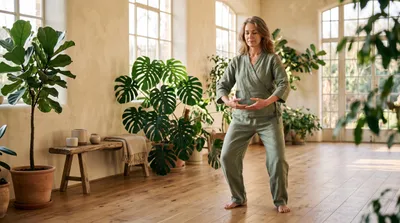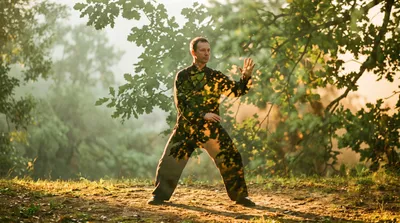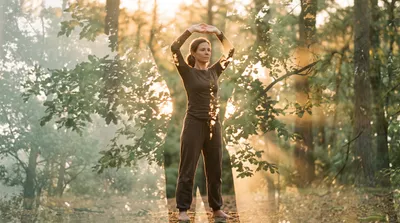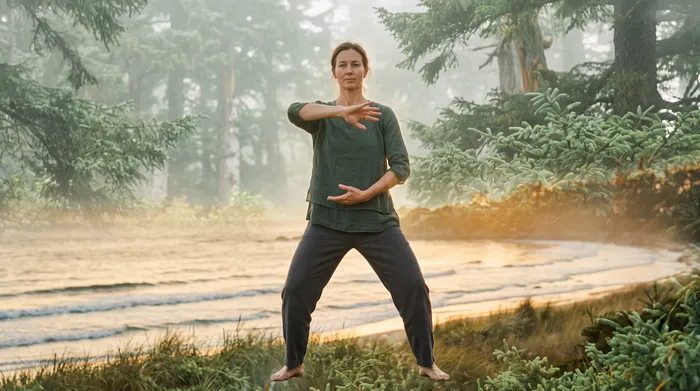
Taiji Qigong Shibashi — usually shortened to Shibashi — is one of the most widely practised qigong sets in the world. The name translates as “18 movements” (shi = ten, ba = eight), and the set lives up to that simplicity: 18 flowing movements drawn from Yang-style tai chi, simplified and sequenced for health practice. It’s accessible enough for complete beginners while offering enough depth to remain interesting for experienced practitioners.
What sets Shibashi apart from older qigong sets like the Eight Brocades (Ba Duan Jin) is its relatively recent origin and deliberate design. This is not a set transmitted across centuries with disputed authorship — it was created in 1979 by Lin Housheng, a Chinese qigong master and healthcare professional, with the explicit purpose of making tai chi-based movement accessible for health promotion. That design intentionality shows in how beginner-friendly the set is without sacrificing the principles that make qigong practice beneficial.
Is Shibashi the Same Thing as Tai Chi?
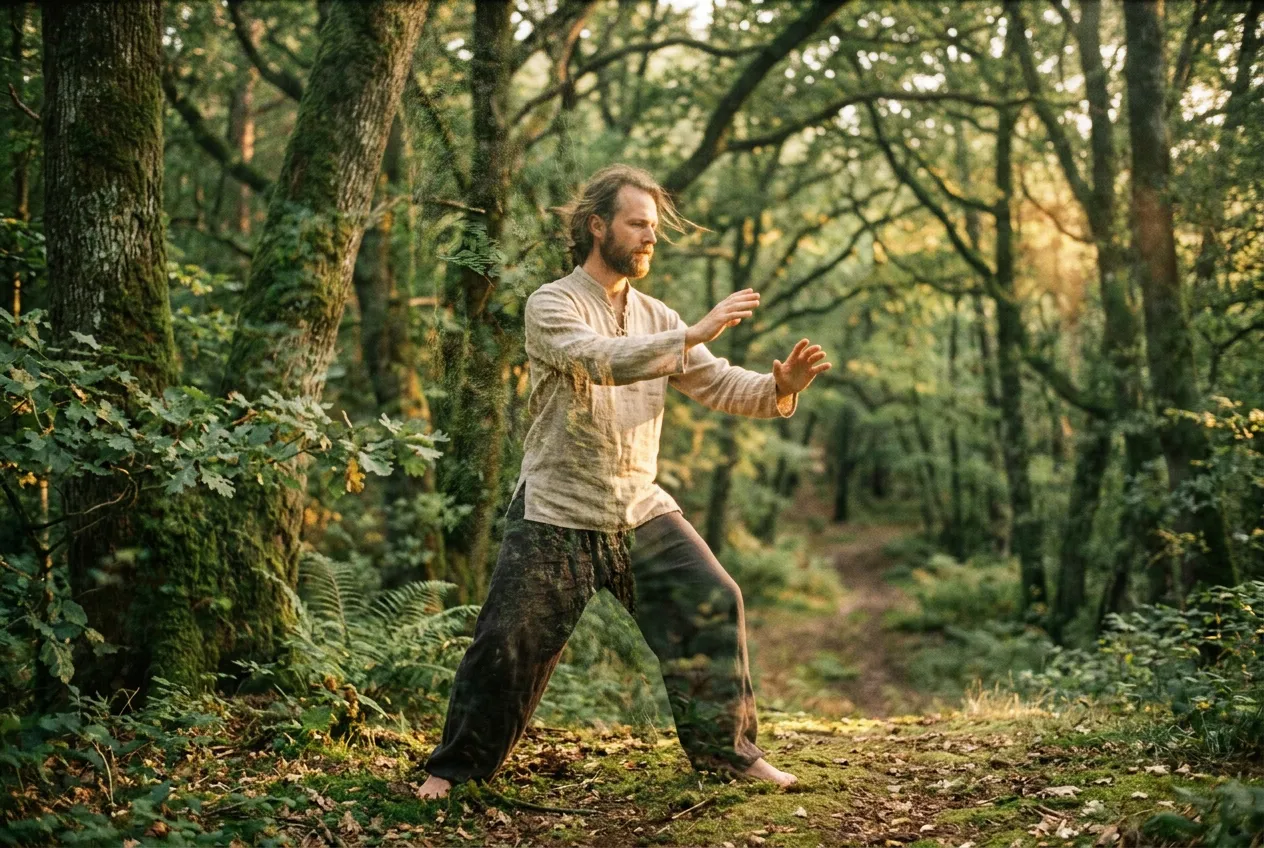
No — Shibashi is a qigong set derived from tai chi movements, not tai chi itself, though the family resemblance is deliberate and obvious once you know what to look for. The movements in Shibashi are drawn from Yang-style tai chi and simplified for accessibility, so if you’ve seen tai chi practised in a park, Shibashi will look immediately familiar — Cloud Hands (Movement 10, below) is a direct borrowing, for instance. But Shibashi was designed as a standalone health practice, not as a training method for tai chi’s martial application or its more demanding forms, and it’s usually classified as qigong rather than as tai chi proper.
Origins: Lin Housheng and the 1979 Design
Lin Housheng (林厚省) created Shibashi in Shanghai in 1979 during a period of significant qigong revival in China. Lin was a physician and qigong researcher who taught at the Shanghai Qigong Research Institute. His goal was to create a set that preserved the core principles of Yang-style tai chi — flowing continuous movement, breath coordination, mental calmness, full-body integration — while being simple enough for elderly and health-compromised practitioners to learn quickly.
The 1979 creation date matters. Shibashi is young enough that its lineage is clear and uncontested, and Lin Housheng’s background in healthcare shaped the set’s structure: each movement targets specific health benefits, the sequence creates a full-body practice without repetitive strain, and the pace is calibrated for therapeutic application.
Lin continued to develop the system after 1979, eventually creating multiple additional sets (Shibashi II, III, IV), but the original 18-movement set remains the most widely practised internationally. It spread through China in the 1980s and internationally through Chinese community and medical networks from the 1990s onwards.
In my experience introducing students to qigong, Shibashi is often the set I recommend starting with. The movements have a tai chi family resemblance that makes them feel purposeful rather than arbitrary, and most people can complete the basic set in two or three learning sessions.
Are There Other Shibashi Sets Beyond the Original 18 Movements?
Yes — Lin Housheng created three further sets after the original, known as Shibashi II, III, and IV, each building on different movement families while keeping the same flowing, breath-coordinated structure. I’ve taught the original 18-movement set far more than the later ones, mostly because it’s the version with the most instructional material available and the version most students specifically ask for by name; Shibashi III in particular shows up often in the search traffic reaching this article, which tells me there’s real interest in it even though English-language instruction for the later sets is noticeably harder to find than for the original.
How to Approach Shibashi Practice
Before covering the 18 movements, a few practice principles worth establishing:
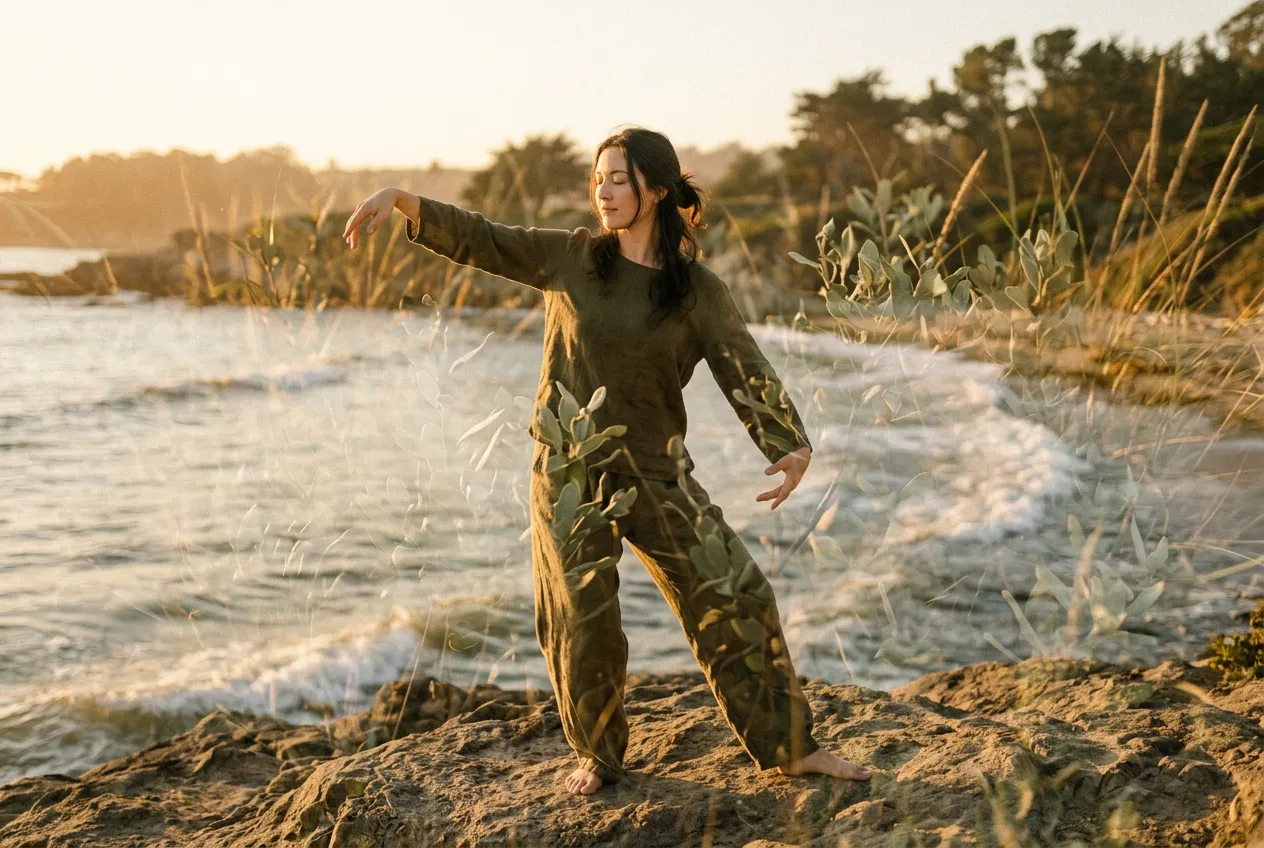
Continuous flow. Unlike the Eight Brocades, where each piece has a somewhat distinct character and can be practised individually, Shibashi is designed to flow as a single continuous sequence. Each movement transitions naturally into the next. Learning it piecemeal is fine at first, but the intention is an uninterrupted flow from Movement 1 to Movement 18.
Breath coordination. The general principle in Shibashi is inhale on expanding movements (arms rising, body opening) and exhale on contracting movements (arms lowering, body gathering). For a complete guide to breath-movement coordination, the tai chi breathing techniques article covers the underlying principles.
Relaxed concentration. The Chinese concept of song — releasing unnecessary tension — is central to Shibashi. The movements should feel buoyant and easy, not effortful. If any movement creates strain, reduce the range until it falls within comfortable limits.
Repetitions. Each movement is typically repeated 6 times before transitioning to the next. Some versions use 8 repetitions. For a health maintenance routine, 6 repetitions per movement produces a complete practice of approximately 20–25 minutes.
For guided video practice, TaiChiApp.com offers a follow-along Shibashi session.
Where Can You Find Shibashi Video Instruction?
The most reliable places to find Shibashi video instruction are structured, purpose-built programs rather than a general video search, because Shibashi’s continuous-flow design (see above) is easy to lose without a consistent pacing reference. When I recommend resources to students, I steer them toward a single instructor’s full sequence they can follow start to finish, rather than assembling movements from different sources — mixing sources for a flowing set like this one tends to produce a disjointed practice, since each teacher paces the transitions slightly differently.
All 18 Movements: English and Chinese Names
Movement 1: Commencing Form — Qi Shi (起勢)
Stand in the basic qigong stance: feet shoulder-width apart, knees soft, arms hanging naturally. On an inhalation, raise both arms forward to shoulder height with palms facing down. On the exhalation, lower the arms back to the sides. This opening movement settles the mind and centres attention. The slowness of this first movement sets the pace for what follows.
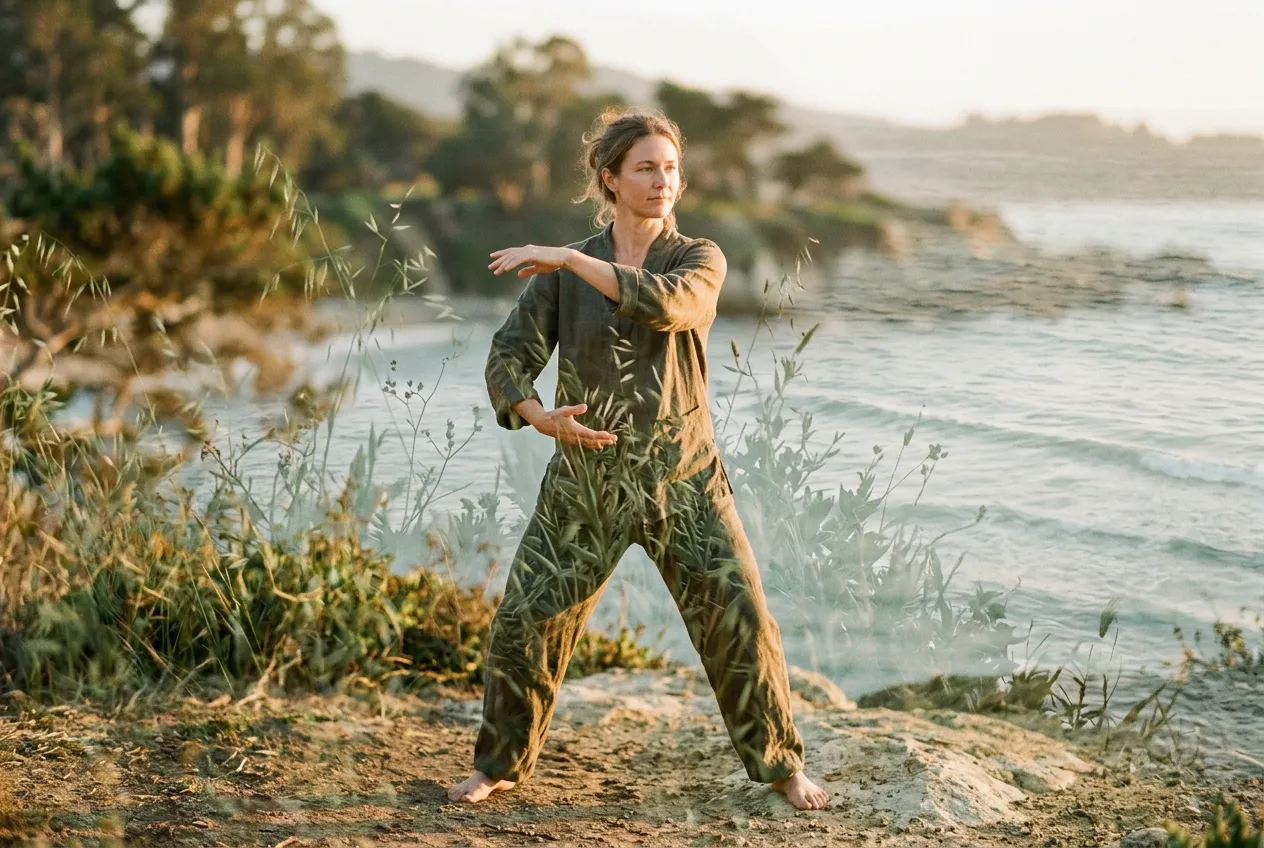
Movement 2: Opening the Chest — Kai Kuo Xiong Huai (開闊胸懷)
With arms at shoulder height (continuing from Movement 1), open the arms wide to the sides on an inhalation, opening the chest. On the exhalation, bring the palms together in front of the chest. The movement creates a feeling of expansion and gathering — one of the most calming movements in the set for nervous system regulation.
Movement 3: Rainbow Dance — Hui Wu Cai Hong (揮舞彩虹)
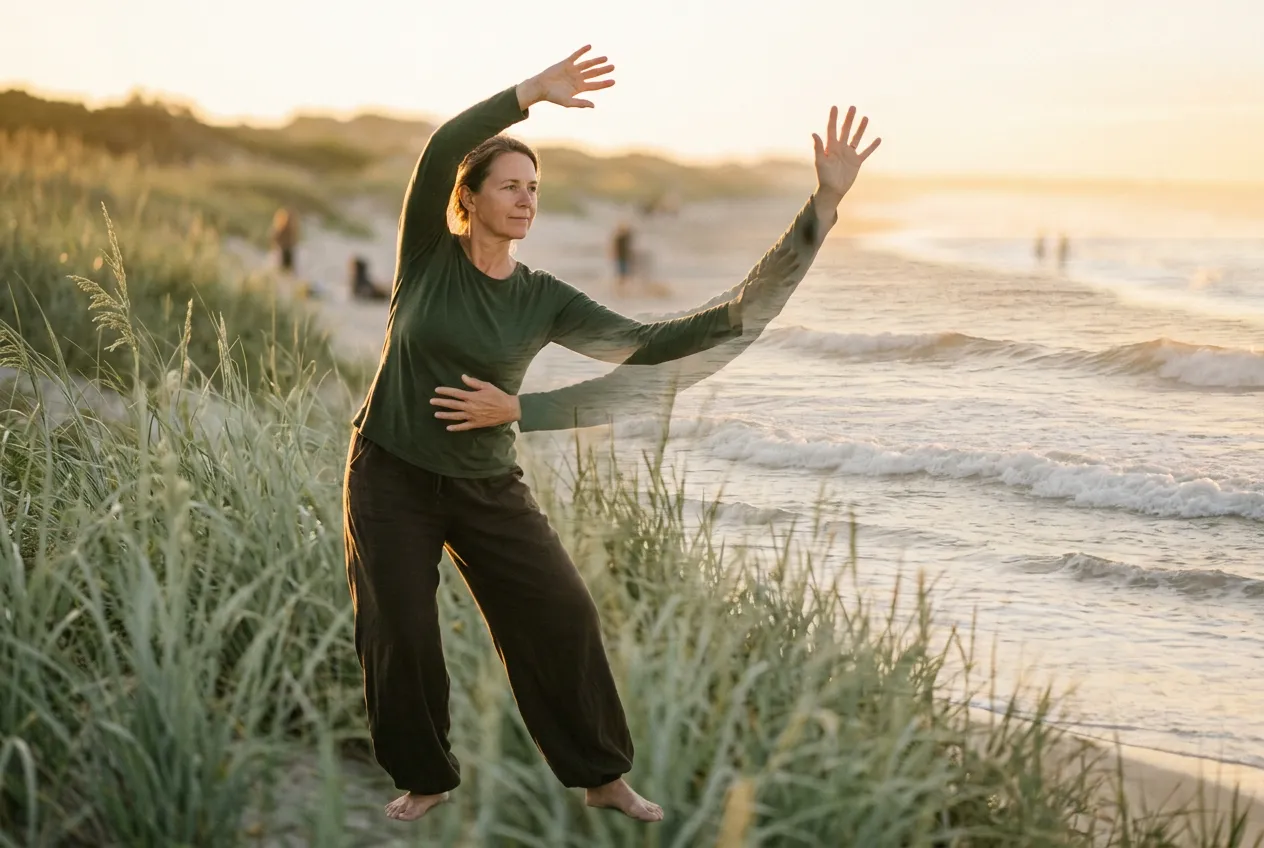
Transfer weight to the right foot while raising the right arm overhead in an arc. The left arm rests at the left hip. On the next repetition, transfer to the left. The arcing overhead movement stretches the side body and challenges balance in a gentle way.
Movement 4: Circling Arms — Lun Bi (輪臂)
Both arms swing forward together on an inhalation, then circle outward and back in a large arc. The movement is continuous and smooth — imagine drawing large circles with both hands simultaneously. This is one of the more vigorous movements in the set and opens the shoulder joints.
Movement 5: Stepping and Swinging Arms — Ding Bu Bai Zhang (定步擺掌)
In a fixed stance, swing both arms to one side (like a turning torso), then to the other. The waist rotates, the hips stay level, and the arms follow the turning loosely. This is a significant spinal rotation that releases accumulated tension in the thoracic and lumbar spine.
Movement 6: Rowing a Boat in the Middle of the Lake — Hu Xin Hua Zhou (湖心劃舟)
Simulate rowing a boat: both arms sweep forward and upward on the inhalation, then circle down and back on the exhalation. The continuous circular motion works the shoulder girdle and creates a rhythmic, almost meditative quality.
Movement 7: Lifting a Ball — Shou Chi Qiu (手持球)
Alternate lifting an imaginary ball — one hand sweeps up from below while the other sweeps down from above, then the hands switch. The movement combines weight transfer and upper-body coordination in a way that feels natural and fluid when the timing is right.
Movement 8: Turning to Look at the Moon — Zhuan Ti Wang Yue (轉體望月)
With arms extended, turn the whole body to look over one shoulder as if gazing at the moon rising behind you. The turn involves the waist, not just the neck. Return to centre and repeat to the other side. This is a full rotational movement that requires balance and coordination.
Movement 9: Pushing Palms While Turning the Waist — Zhuan Yao Tui Zhang (轉腰推掌)
Transfer weight to one foot and extend one palm forward (as if pushing a wall) while the waist turns to the same side. Pull the palm back as weight returns to centre, then push forward to the other side. The pushing action is slow and rooted — a softer version of the pushing energy found in tai chi forms.
Movement 10: Wave Hands Like Clouds — Yun Shou (雲手)
The hands move in overlapping horizontal circles in front of the body, one hand passing over the other in a continuous flowing pattern. Yun Shou — Cloud Hands — is one of the most recognisable tai chi movements and appears in nearly all Yang-style forms. In Shibashi it provides a gentle, continuous flowing action that calms the nervous system.
Movement 11: Scooping the Sea and Looking at the Sky — Lao Hai Guan Tian (撈海觀天)
Step forward into a bow stance, then sweep both arms down (scooping) and arc them upward overhead while tilting the head back to look at the sky. Return to standing and repeat. This is the most dramatic movement in the set — the full arc from floor to sky creates a genuine sense of expansion.
Movement 12: Pushing Down and Pushing Out — Tui Bo Zhu Lang (推波助浪)
Sink the weight and push both palms downward on the exhalation, as if pressing down on a surface. Then rise and push both palms forward. The alternating down-push and forward-push works the leg muscles and creates rhythmic breath coordination.
Movement 13: Flying Like a Dove — Fei Ge Zhan Chi (飛鴿展翅)
Arms extend to the sides at shoulder height, then draw together in front of the chest like a bird folding its wings, then open again. The movement is slow and expansive, with the chest opening on the extension and softening on the closing.
Movement 14: Reaching Up with Punching Arms — Shen Bi Chong Quan (伸臂衝拳)
Alternate pushing one fist forward and slightly upward while the other arm draws back at the hip. Unlike the Eight Brocades’ punch (which is horizontal), this version is directed slightly upward — the direction of growth and uplift in traditional Chinese movement symbolism.
Movement 15: Wild Goose Flying — Da Yan Fei Xiang (大雁飛翔)
With arms spread wide, rise onto the toes as the arms lift on an inhalation (the goose takes flight), then lower the heels and arms on the exhalation (the goose glides down). This rhythmic rising and falling is grounding and energising simultaneously.
Movement 16: Rotating the Wheel — Zhuan Zhang Xuan Zhou (轉掌旋周)
Both arms sweep together in large vertical circles, as if rotating a large wheel in front of the body. The circles alternate directions. This movement works the shoulder joints through full range of motion and requires coordination between the two arms.
Movement 17: Bouncing a Ball — Pao Qiu (拍球)
Shift weight from foot to foot while “bouncing” an imaginary ball with one hand, then the other. The arm drops and rebounds in a relaxed, springy movement. The weight transfer creates a rocking rhythm that is one of the most playful movements in the set.
Movement 18: Closing Form — Shou Shi (收勢)
Raise both arms forward to shoulder height on an inhalation, then lower them slowly to the sides on the exhalation. Repeat three times. Return to the quiet standing posture. The closing form mirrors the opening, creating a sense of completion and return.
Shibashi Within a Broader Practice
Shibashi is complete as a standalone practice, but it also fits naturally alongside other qigong and tai chi work. Many practitioners use it as a warm-up before tai chi form practice, or alternate it with the Eight Brocades depending on how much time is available.
Within a structured daily practice routine, Shibashi’s 20–25 minutes sits comfortably in a morning session. The daily tai chi practice routine guide covers how to structure a session that includes both qigong sets and form work. For those interested in how Shibashi compares to similar traditional sets, the qigong health benefits article covers the evidence for qigong practice generally.
Browse the full tai chi practice section for additional guides on qigong sets, breathing techniques, and practice principles.