Walk into a tai chi class and there is a fair chance something gentle is playing — bamboo flute, guqin, water sounds, the general category of music that streaming services file under “meditation”. Walk into a different class and there will be silence, sometimes deliberately.
Both are defensible, and the question of whether to practise with music turns out to be more interesting than it first appears.
The Case For Music
It sets a tempo. Beginners consistently practise too fast, and speed up further as they go. A slow, steady musical background provides an external reference that keeps the pace honest, which is genuinely useful in the first year.
It covers distraction. Practising at home with traffic outside or a household elsewhere in the building is easier with something to mask it. Consistent sound is less disruptive than intermittent sound.
It marks the session. Starting the music signals the start of practice and helps switch attention over. Habit cues matter more than they sound, and this is a good one.
It makes group practice cohere. In a class, shared music helps a group move together without anyone counting.
Some people simply enjoy it. This is not a trivial consideration. A practice you look forward to is a practice you continue.
The Case Against
It gives you a crutch for timing. If the music is keeping your tempo, you are not. Practitioners who always practise with music often find their pacing collapses without it, which suggests the internal sense of rhythm never developed.
It occupies attention that should be elsewhere. Tai chi is partly an attention practice, and the mental health benefits linked to that quality depend on the mind actually doing the work rather than resting on something pleasant. Music gives the mind something pleasant to attend to, which is precisely what you might want to avoid — the discomfort of an unoccupied mind is where some of the work happens.
It masks feedback. The sound of your own breathing, the shifting of your feet on the floor, and the small sounds of your own movement are information. Music covers them.
It is not traditional. Classical tai chi practice was silent. Park practice with cassette players is a twentieth-century development, and while nothing is wrong with it, nobody should imagine it is the authentic method.
My own habit is silence for solo practice and no strong objection to music in a class. The change I noticed on dropping it was that I could hear my feet — and that my stepping was considerably less quiet than I had assumed.
What Music Works
If you do practise with it, some things matter.
Slow and steady tempo. Anything with a driving rhythm or noticeable tempo changes works against the practice. The traditional Chinese instrumental music sold for the purpose — guqin, dizi, erhu, guzheng — is slow for exactly this reason.
No lyrics. Words pull attention into language processing, which is the opposite of what you want.
Minimal dynamic variation. Music that swells and recedes drags the practice with it.
Long enough. A track that ends mid-form is disruptive. Practice-length recordings of twenty to forty minutes exist for this reason.
Quiet. Background level, not foreground. If you cannot hear your own breathing over it, it is too loud.
Nature recordings — water, wind, birdsong — occupy a middle position, providing masking without much melodic content to follow. Some practitioners find them ideal; others find them faintly ridiculous. Practising outdoors provides the same thing authentically, which the outdoor practice guide covers.
A Middle Approach
If you are undecided, a compromise that works well: use music while you are learning a form, and drop it once you know the sequence.
During the learning phase the tempo reference is genuinely helpful and the attentional demands are already high — you are trying to remember what comes next, which leaves little capacity for subtler work anyway. Once the form is memorised and the practice shifts toward quality rather than recall, silence starts to earn its place.
Alternatively, alternate. Music one session, silence the next. The contrast makes it obvious what each is doing, which is more informative than committing to either on principle.
The Wider Practice Environment
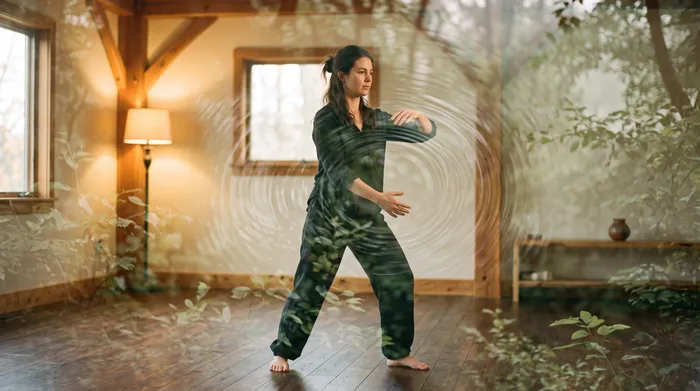
Music is one element of a larger question, which is what your practice space should be like.
Light. Bright natural light for morning practice, dimmer for evening. Practising under harsh overhead lighting is oddly unsettling and worth avoiding.
Temperature. Slightly cool rather than warm. Tai chi warms you gradually, and a room that is comfortable when you start will be too warm by the end.
Floor. Smooth enough to pivot on, not so slippery that you slide. Bare boards, vinyl, or short carpet all work. Thick carpet resists turning and is harder on the knees than it appears.
Clutter. A clear space matters more than a large one. Having to work around furniture distorts the form and makes it harder to settle.
Interruption. Phone away, door closed, household informed. Twenty uninterrupted minutes beats forty interrupted ones, and the single most common cause of a poor session is a phone within reach.
Consistency. Practising in the same place at the same time builds an association that does a surprising amount of the motivational work for you.
None of this needs to be perfect. Tai chi is practised in cramped flats, hospital corridors, and airport departure lounges by people who wanted to practise more than they wanted ideal conditions. But when you can arrange the environment, it is worth arranging.
The daily practice routine guide covers structuring sessions, the meditation article covers the attentional side that music most directly affects, and more practical guidance is in the tai chi practice section.