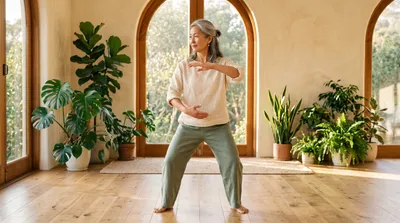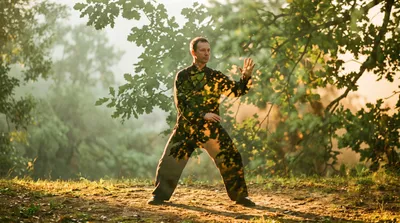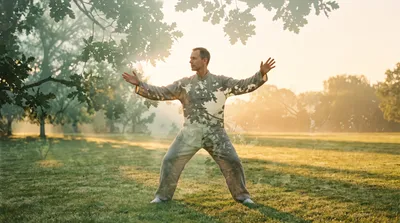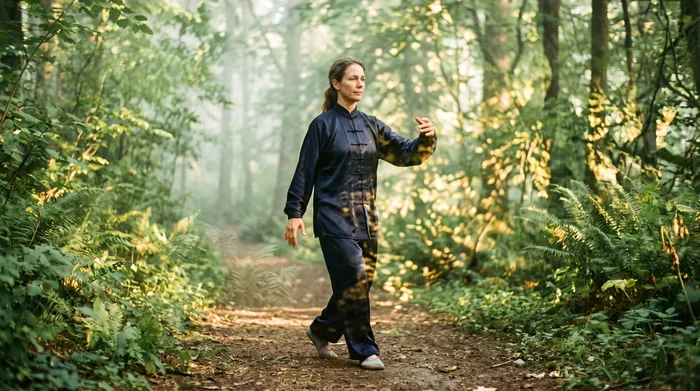
There is a quality to tai chi walking that makes it immediately distinguishable from ordinary walking. It is slower, more deliberate, and almost impossibly precise about weight transfer. Watch someone practise tai chi walking and you will notice the full commitment to each step — nothing is casual, nothing is wasted.
Tai chi walking is both a training exercise and a meditation. It teaches the body mechanics that underlie all tai chi movement — rooting, weight shifting, foot placement — in their purest, most isolated form. And because it requires only yourself and a few metres of floor, it can be practised anywhere: a hallway, a garden path, a stretch of grass in a park.
This guide explains the mechanics of tai chi walking and how to begin a walking practice.
What Are the Benefits of Tai Chi Walking?
Tai chi walking builds single-leg balance, strengthens the ankle and knee stabilisers involved in weight transfer, and sharpens body awareness — the same core benefits as the standing form, isolated into a movement simple enough to practise anywhere. Because the pace is so much slower than ordinary walking, these benefits come from precision rather than repetition volume — a few minutes of genuinely careful stepping does more than a longer session rushed through at normal speed. The balance carryover is what I notice most in daily life: stepping onto uneven ground stopped feeling like a small hazard once months of tai chi walking had trained my ankles to find stability mid-step, not just after landing.
What Makes Tai Chi Walking Different
Ordinary walking is highly automated. Most adults barely think about how they walk — the brain delegates the task to learned motor programs that run without conscious involvement. This automation is efficient but it also means most people walk with accumulated habits and compensations that they are entirely unaware of.
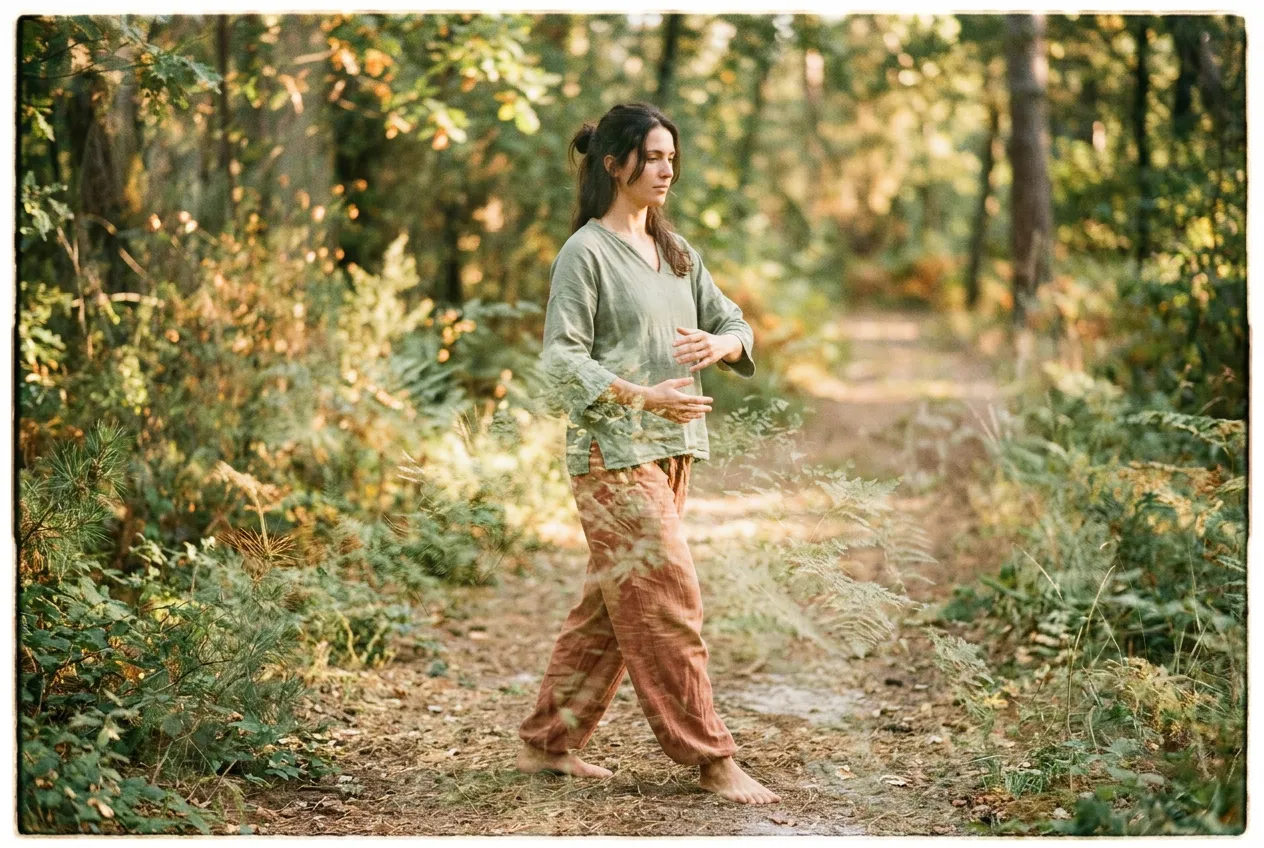
Tai chi walking interrupts that automation deliberately. By slowing walking down to a fraction of its normal pace and demanding precise attention to each component of the step, it forces the practitioner to confront exactly what their body does when it moves through space.
The differences from ordinary walking are immediately obvious once you begin:
Weight must be fully committed before the foot moves. In hurried everyday walking, the weight often floats between both feet as the body propels itself forward. In tai chi walking, each step begins from a position of complete single-leg balance — the moving foot lifts only when the standing leg has fully accepted the body’s weight.
The foot reaches and places, it does not plop. In ordinary walking, the foot tends to land somewhere vaguely in front of the body. In tai chi walking, the reaching foot extends with precision, contacts the ground with the heel first (in most styles), and rolls through to the flat foot before any weight transfers.
The movement is continuous but not hurried. There is a flow between steps, but no momentum. Each step is complete in itself.
In my first years practising tai chi, I thought I understood weight shifting until I tried tai chi walking. It exposed gaps in my practice that standing forms had hidden — particularly a tendency to commit weight prematurely before my body had fully arrived over the supporting foot. Slowing down and isolating the walking movement made those habits visible.
The Basic Mechanics
Starting Position
Stand in the basic tai chi stance: feet shoulder-width apart, knees soft, weight evenly distributed. Take a few slow breaths and let the body settle. Feel the pressure of the floor through the soles of the feet.
Shift all of your weight onto the right foot until you could comfortably lift the left foot without any compensatory lean or lurch. This full weight transfer to one side is the foundation of everything that follows.
The Step
With your weight fully on the right foot, slowly lift the left foot from the floor. Do not peel the toes up first — lift the whole foot gently from the ground as one unit, keeping it close to the floor.
Reach the left foot forward. In Yang-style tai chi walking, the reaching foot comes down heel first — the heel touches the floor while the toes remain raised and the foot remains empty of weight. This heel placement is the “landing” but it carries no weight yet.
From this heel contact, slowly transfer the weight forward: the foot flattens, the knee bends to absorb the weight, and the body’s centre of gravity moves over the new foot. This weight transfer should take several seconds, not a fraction of a second. As weight fully arrives on the left foot, the right foot becomes free.
Then — and only then — the right foot lifts to begin its reach forward.
Knee Alignment
Knee alignment is critical throughout. As the weight transfers onto the forward foot, the knee must track directly over the second and third toes — it should neither collapse inward (valgus) nor bow outward (varus). Valgus collapse is extremely common in tai chi practitioners who are rushing their weight transfer or who have tight hip abductors.
Watch your own knees carefully in a mirror if possible, or have someone observe you. The knee alignment at weight transfer is the most common technical error in tai chi walking.
Foot Placement
The feet should step in a narrow-track path — not on a single line (which creates instability), but close to one. In Yang-style walking, the feet are usually placed roughly shoulder-width apart in the forward-back direction and very close in the lateral direction, almost as if walking on two rails of a very narrow railway track.
Wider lateral placement produces a waddling movement that lacks the integrated quality of proper tai chi walking. Keep the feet close together laterally while the steps themselves are generous in length.
Is Tai Chi Walking Good for Balance?
Yes — tai chi walking is one of the most direct ways to train balance within tai chi practice, because every step requires a full, unhurried transfer of weight onto a single leg before the other foot is allowed to move. This differs from balance exercises that simply ask you to hold a static position; tai chi walking trains balance dynamically, in the exact transitional moments — mid-weight-shift — where most real-world stumbles actually happen. When I first practised it seriously, the single-leg holds exposed a wobble in my standing leg that static balance drills had never revealed, because those drills let me brace rather than genuinely balance.
Coordinating the Arms
Arms in tai chi walking are either naturally relaxed at the sides, or swing gently in opposition to the feet (left arm forward as the right foot steps, and vice versa) — the same natural arm swing as ordinary walking, but exaggerated slightly and made conscious.
Some teachers have students hold their hands in specific positions (such as raising the rear hand slightly while the other descends) to add upper body coordination. As a beginner, it is usually better to let the arms hang naturally while learning the leg mechanics, and add arm coordination only once the leg work feels stable.
Breath and Walking
Breath coordination with tai chi walking can be approached in two ways. The first is to let the breath find its own rhythm without forcing coordination with the steps — allow the inhale and exhale to be natural and quiet, and simply notice when each naturally occurs relative to the step cycle.
The second approach, once the walking pattern itself is established, is to coordinate deliberately: inhale during the reaching phase of each step, and exhale during the weight transfer. This coordination produces a profound sense of integration between breath and movement that is one of tai chi’s defining qualities.
For deeper exploration of breath coordination in tai chi, the tai chi breathing techniques guide covers this subject in detail.
Tai Chi Walking as Meditation
Tai chi walking is often described as meditation in motion — and this is not metaphorical. The quality of attention required to walk correctly at tai chi pace cannot be maintained while also running a mental commentary about the day’s tasks. The practice demands the same quality of present-moment awareness as seated meditation.
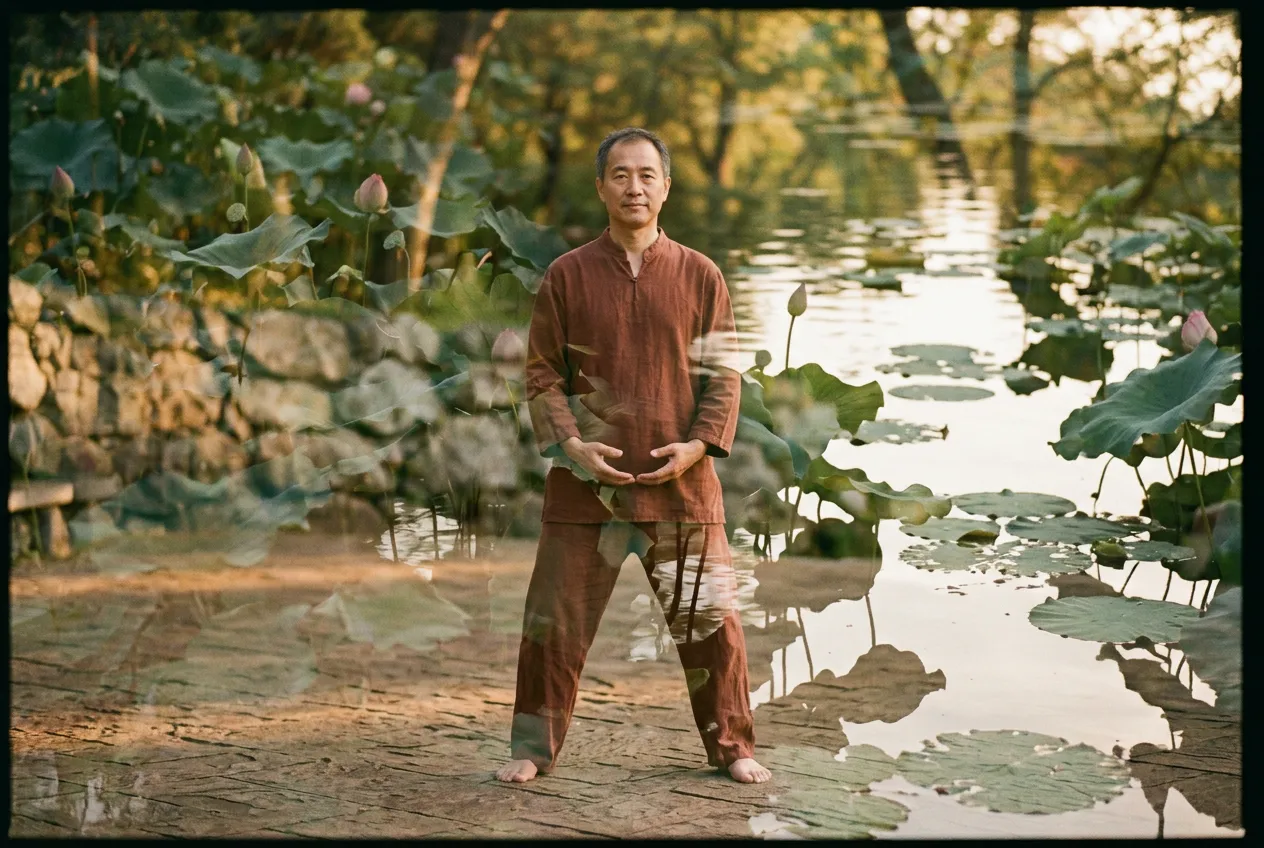
This makes tai chi walking particularly valuable for people who struggle with conventional meditation. Rather than sitting still while the mind races, tai chi walking provides a physical anchor for attention — the sensations of weight transfer, foot placement, and breath give the mind something concrete to return to when it wanders.
I have found outdoor tai chi walking particularly useful in this regard. Practising in a park or garden adds the sensory richness of natural surroundings, which supports the meditative quality without adding distraction. The guide to practising tai chi outdoors covers how to find and use outdoor practice spaces effectively.
Building a Walking Practice
Begin with just ten minutes of tai chi walking in a quiet space where you will not feel self-conscious about moving at an unusually slow pace. Indoors, a hallway provides enough space to take six to eight steps, turn carefully, and walk back.
The turning is itself a practice. Rather than casually spinning around at the end of each length, treat the turn as its own movement: shift to full single-leg balance, turn the body precisely, and step in the new direction with the same care as the walking itself.
As the basic mechanics become more natural — which takes weeks rather than sessions — extend the duration to 20–30 minutes and begin exploring outdoor practice.
For integrating tai chi walking into a broader daily routine alongside form practice and qigong, see the daily tai chi practice routine guide. For general information on what tai chi does for the body over time, the tai chi health benefits guide covers the research.
Is Tai Chi Walking Good for You?
Yes — tai chi walking is a low-impact, joint-friendly practice suitable for nearly every fitness level, and its main value comes from the balance, coordination, and body-awareness training described above rather than from cardiovascular intensity. It won’t replace a brisk walk or other aerobic exercise as a fitness driver, but as a movement practice that improves how the body moves through everything else, including ordinary walking, it earns its place alongside — not instead of — more vigorous activity. I treat it as a complement to my regular exercise rather than a substitute for it: a short tai chi walking session doesn’t leave me out of breath the way a run does, but it changes how stable and grounded I feel for the rest of the day.
What Tai Chi Walking Builds
Regular tai chi walking practice develops several physical capacities directly: single-leg balance, proprioceptive awareness in the feet and ankles, hip stability during weight transfer, and controlled knee tracking. These are foundational skills that carry directly into all standing tai chi forms.
Beyond the physical, it builds something harder to quantify — the habit of moving with attention. After consistent tai chi walking practice, most practitioners report noticing their ordinary walking has changed: they are more aware of how they place their feet, how they carry their weight, and how hurried or mechanical their normal movement has become.
That awareness is the deeper gift of the practice. Explore more resources in the tai chi practice section for related guides on developing your practice.