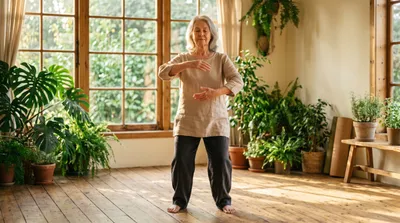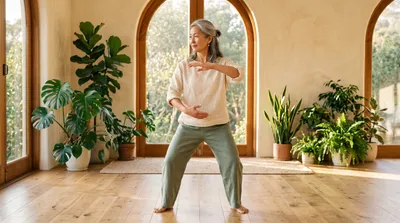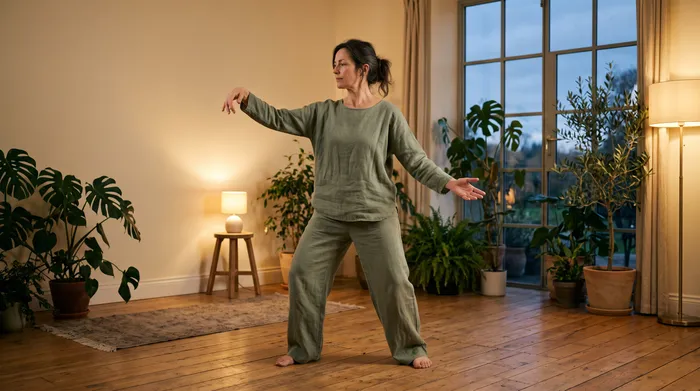
Sleep is one of the outcomes tai chi research has measured most consistently, and one of the few where the effect shows up reliably across different study populations — older adults with insomnia, cancer survivors, people with chronic conditions. The improvements are modest rather than transformative, but they are durable, and they come without the side effects of sleep medication.
If you are practising tai chi specifically to sleep better, the useful questions are what size of effect to expect, when to practise, and what to do in a session. This article answers all three.
What the Sleep Research Shows
Two studies do most of the heavy lifting in this literature.
The first is a randomised controlled trial of Tai Chi Chih in 112 healthy older adults with moderate sleep complaints, published in the journal Sleep. Participants practised for 25 weeks and were compared with a health education control. The tai chi group showed improved sleep quality on the Pittsburgh Sleep Quality Index, including improvements in sleep duration and sleep efficiency, and the authors concluded that tai chi was a useful non-pharmacological approach for older adults with moderate sleep complaints.
The second, and larger, is a three-group randomised clinical trial published in JAMA Network Open in 2021. It assigned 320 older adults with clinically diagnosed insomnia to twelve weeks of tai chi, twelve weeks of conventional exercise, or no intervention. Both tai chi and conventional exercise produced sleep improvements relative to control — and, notably, those improvements were still present at 24-month follow-up.
That durability is the interesting part. Sleep interventions frequently show an effect at the end of the intervention that has evaporated a year later. A benefit still measurable two years on suggests either a lasting change in sleep physiology or, more likely, that participants kept practising.
There is also a body of work on tai chi for sleep in cancer survivors, where insomnia is common and persistent, generally showing improvements in self-reported sleep quality, in a population where insomnia is both common and persistent.
I would not describe tai chi as a treatment for severe chronic insomnia on this evidence. What the studies support is a meaningful improvement in sleep quality for people with moderate difficulties, sustained over time, at essentially no risk.
Why It Works
Sleep onset requires the nervous system to shift out of sympathetic dominance. For a great many people with sleep difficulties, the problem is not that they are insufficiently tired but that they arrive at bedtime with an autonomic system still running in daytime mode — heart rate slightly elevated, breathing shallow and fast, mind still processing.
Tai chi produces that autonomic shift directly. Slow movement paired with slow abdominal breathing raises parasympathetic activity and reduces sympathetic tone. It is essentially the same physiological pathway that makes tai chi useful for anxiety and stress, which is not coincidental — poor sleep and anxiety share a great deal of underlying mechanism.
Three secondary routes also contribute:
Reduced pre-sleep cognitive arousal. The form requires enough attention to displace rumination. Twenty minutes where your attention is occupied by weight transfer and hand position is twenty minutes not spent rehearsing tomorrow’s problems.
Improved daytime function. Better mood and reduced fatigue during the day feed back into more regular sleep timing.
Gentle physical loading. Enough activity to build sleep pressure, not so much that it delays sleep onset the way vigorous late exercise can.
The last point is a genuine advantage over conventional exercise. Standard sleep-hygiene advice tells people not to exercise vigorously within a few hours of bed. Tai chi carries no such restriction — its intensity is low enough that practising immediately before bed is not just permitted but arguably ideal.
When to Practise for Sleep
The best evidence-based answer is that timing matters less than consistency, but the practical answer for sleep specifically is evening.
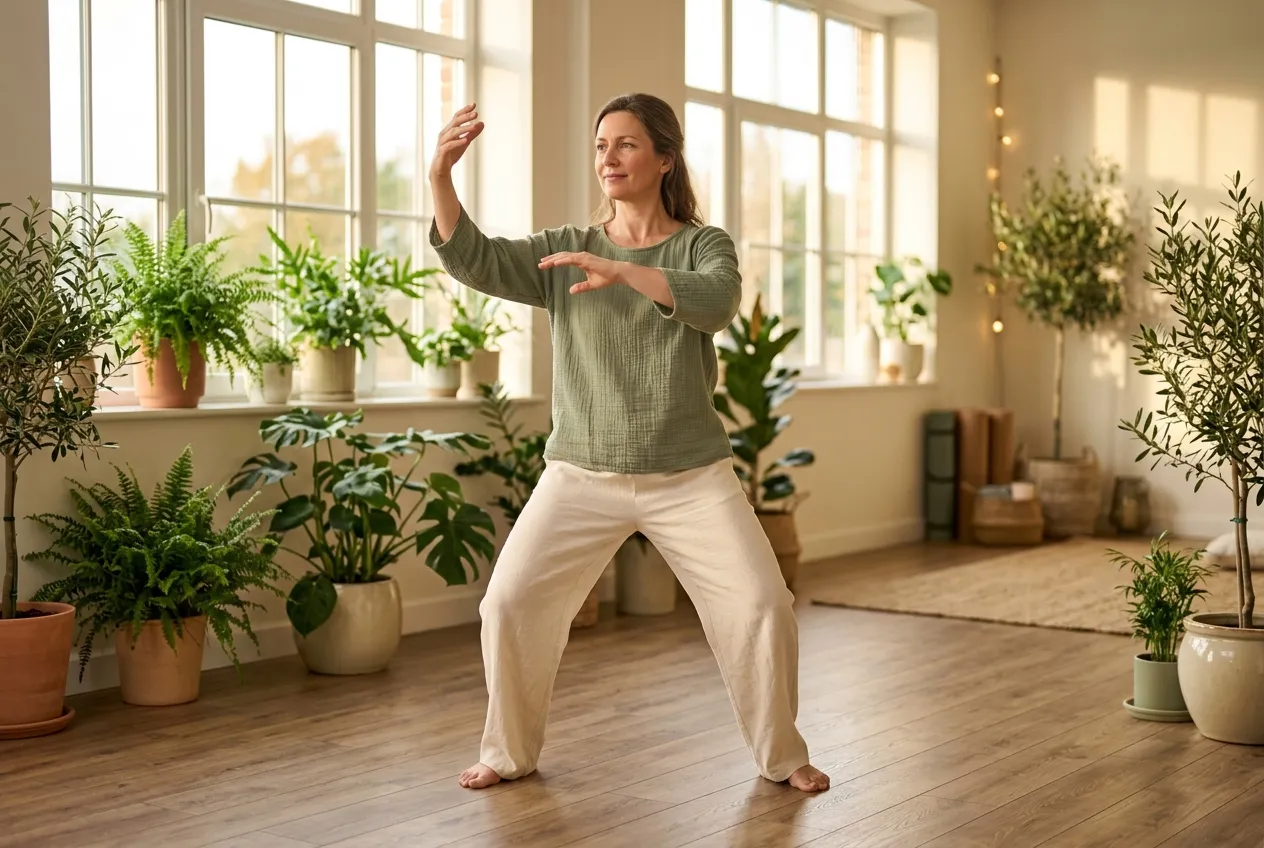
Evening practice, 30 to 90 minutes before bed. This uses tai chi as a wind-down ritual. The autonomic shift it produces carries directly into sleep onset. This is what I would recommend to anyone whose main problem is difficulty falling asleep.
Morning practice. Better if your problem is daytime fatigue, low mood, or an irregular sleep schedule. Morning light exposure combined with movement helps anchor circadian rhythm, which addresses sleep timing rather than sleep onset.
Both, if you can. The trials generally used daytime or unspecified timing and still found sleep effects, so evening practice is not a requirement — just an optimisation.
Personally I practise in the morning most days, but on nights when I know my mind is too busy to settle, ten minutes of slow standing and breathing before bed is more reliable than anything else I have tried.
A Sleep-Oriented Evening Session
Twenty minutes is enough. The design principle is that everything should get slower and quieter as the session progresses, ending in near-stillness rather than in movement.
Minutes 1-4: Loosening. Gentle shoulder rolls, waist rotations, arm swings. Nothing demanding. The purpose is to release the physical holding patterns accumulated during the day, particularly around the neck, shoulders, and jaw.
Minutes 5-8: Standing and breathing. Feet shoulder-width, knees soft, arms hanging. Let the breath drop into the abdomen. Count breaths if it helps. This is where the autonomic shift begins, and it is the part people skip when they are in a hurry — which is exactly when it matters most.
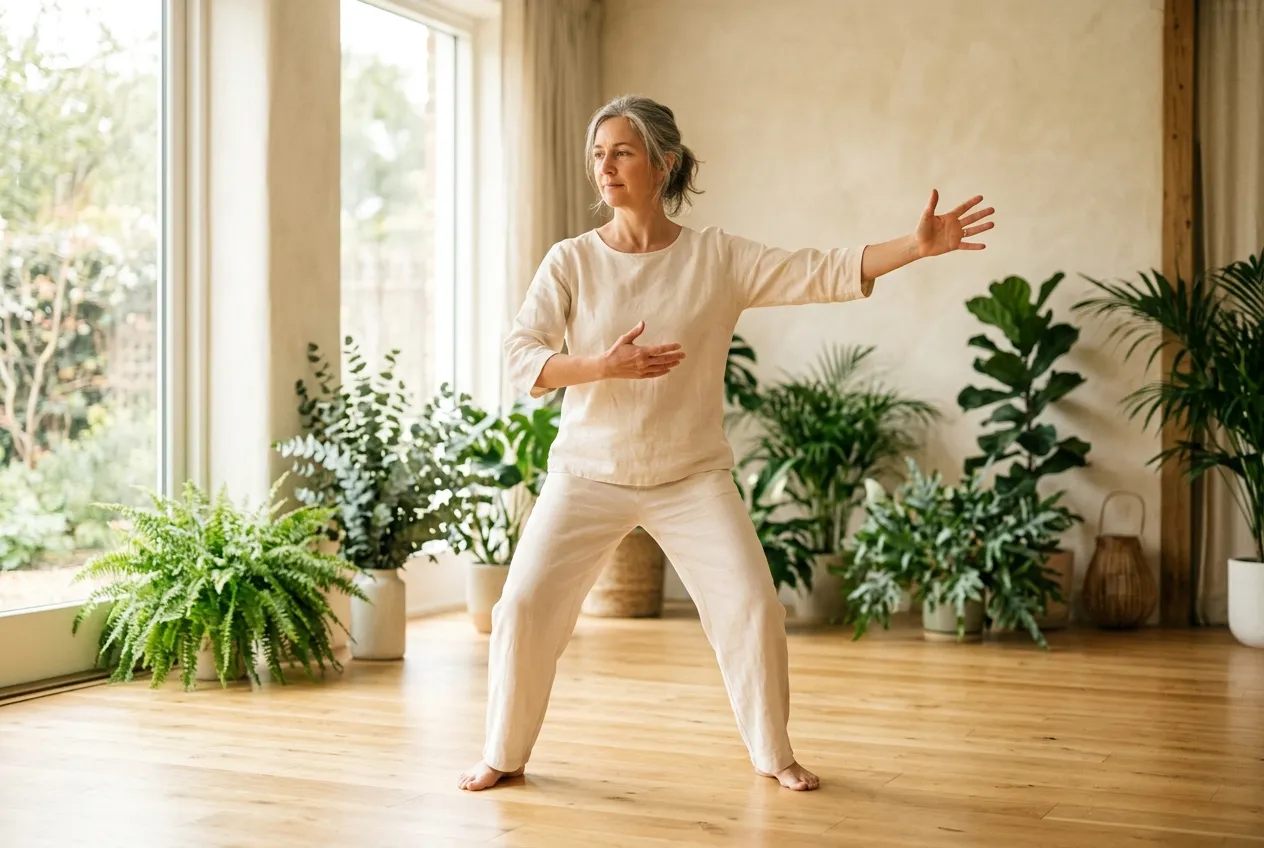
Minutes 9-16: Slow form or repeated movement. Either a short form run once at half speed, or a single movement — cloud hands works particularly well — repeated continuously. Repetition is better than sequence learning here, because learning demands cognitive effort and cognitive effort is what you are trying to wind down.
Minutes 17-20: Closing stillness. Stand quietly with hands resting over the lower abdomen. Do not go straight to your phone. Move from here to your bedroom.
Two rules that make a large difference: keep the lights low throughout, and do not practise in front of a screen following an instructor video. The screen light and the attentional demand of following along both work against the goal. Learn the sequence in daylight; practise it in dim light from memory.
The breathing techniques guide covers the abdominal breathing pattern in more depth, and it is worth getting right — the breathing does more of the work here than the movement does.
What to Expect, Realistically
Some honest calibration:
Expect the first changes within two to four weeks of consistent evening practice, usually in how quickly you fall asleep rather than in how long you sleep. Total sleep duration changes are smaller and slower.
Expect variability. A single good session does not guarantee a good night, and one bad night after a good session does not mean the practice is failing. Sleep is affected by too many variables — caffeine, alcohol, stress, room temperature, light exposure — for any one intervention to override all of them.
Expect a ceiling. If you have severe chronic insomnia, obstructive sleep apnoea, restless legs, or a circadian rhythm disorder, tai chi will not fix the underlying problem. Sleep apnoea in particular is a medical condition requiring diagnosis and treatment, and no amount of gentle movement addresses it. Loud snoring, witnessed breathing pauses, or waking unrefreshed despite adequate time in bed all warrant a conversation with a doctor rather than a new exercise routine.
For everyone in the large middle ground — sleeping adequately most nights, badly some nights, taking too long to settle — a short evening practice is one of the more reliable levers available, and it costs twenty minutes.
How It Compares With the Alternatives
Three non-drug approaches dominate the sleep landscape, and it helps to know where tai chi sits among them.
Cognitive behavioural therapy for insomnia (CBT-I) is the first-line treatment recommended in most clinical guidelines, and it has larger effects than any exercise intervention. It works on the behavioural and cognitive drivers of insomnia — time in bed, conditioned arousal, unhelpful beliefs about sleep — which movement practices do not touch. If you have diagnosed chronic insomnia, CBT-I is the intervention with the strongest case, and tai chi complements rather than replaces it.
Sleep hygiene advice alone — consistent bedtimes, dark rooms, no late caffeine — has surprisingly weak evidence as a standalone treatment, though the individual components are sensible. A tai chi practice functions partly as sleep hygiene with a structure people actually follow, which may be why it performs better than generic advice.
Sleep medication works quickly and reliably in the short term. Its problems are tolerance, dependence, next-day impairment, and, in older adults, an increased falls risk that is far from trivial. That last point makes the comparison interesting: tai chi is the one sleep intervention that reduces falls risk while improving sleep, rather than trading one against the other.
The practical position: tai chi is a low-cost, low-risk addition that suits people with moderate sleep difficulties, and a reasonable adjunct for those already in treatment. It is not a substitute for diagnosing what is actually keeping you awake.
Fitting It Into the Wider Picture
Sleep improvement is one strand of what regular practice does, and it interacts with the others. Better sleep improves pain tolerance, mood, and immune function; the broader health benefits article sets out how these outcomes overlap. Reduced anxiety improves sleep, and improved sleep reduces anxiety, so the mental health guide is worth reading alongside this one if stress is part of what keeps you awake.
If you want to build the evening session into something more regular, the daily practice routine guide covers how to structure practice across a week, and the rest of the research is collected in the tai chi health section.