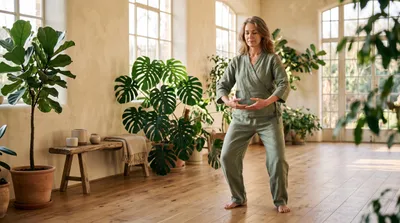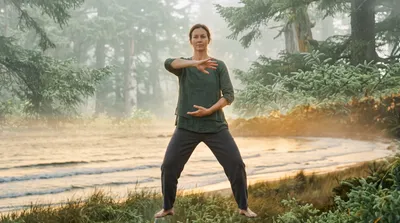
Qigong is the easiest entry point into the whole Chinese movement tradition. Where tai chi asks you to memorise a sequence before you can practise alone, most qigong exercises are single movements, repeated — learnable in minutes, deep enough to occupy years.
This is a working set of eight exercises for someone starting from nothing. They are drawn from the most widely taught traditional material, they need no equipment and little space, and together they cover the three things qigong trains: posture, breath, and slow coordinated movement. If you want the research background on what regular practice does, the qigong health benefits article covers it; this one is purely practical.
A note on scope before starting. Qigong is a vast category — hundreds of systems, from medical to martial to meditative. What follows is the common, gentle, health-oriented core that most modern classes teach. Nothing here is esoteric, and nothing requires believing anything: treat qi as a teaching image for attention and coordinated relaxation and every exercise works exactly the same.
Before You Start
Three ground rules that apply to every exercise below.
Height over depth. Knees soft, never deeply bent. Nothing in beginner qigong benefits from a low stance.
Nose breathing, into the abdomen. Let the belly swell on the inhale and settle on the exhale. If a movement ever makes you hold your breath, slow the movement down.
Comfort is the range. Move to perhaps eighty percent of what feels available and no further. Qigong works through repetition, not intensity.
Ten to twenty minutes daily beats an hour on Sundays, and morning practice suits most people — though any consistent time works.
On clothing and space: anything loose, flat shoes or bare feet, and enough room to extend both arms in every direction. A quiet corner of a bedroom is genuinely sufficient, which is one of qigong’s underrated advantages — the exercise you can do without rearranging your life is the one that survives winter, travel, and busy weeks.
One more orientation point. In everything below, the instruction “slowly” means slower than that. The universal beginner error is a pace that looks slow and is still twice the speed the exercise wants. When a movement takes a full breath cycle to complete, you are close.
1. Wuji Standing
The foundation everything else rests on. Stand with feet parallel, shoulder-width apart, knees unlocked, arms hanging, spine long, head balanced as though gently suspended from above. Breathe into the abdomen and do nothing else for two to three minutes.
This feels like nothing and is the hardest exercise on the list to do attentively. It teaches the aligned, released posture that every other movement starts from. If you learn only one thing from this article, learn to stand.
2. Lifting the Sky
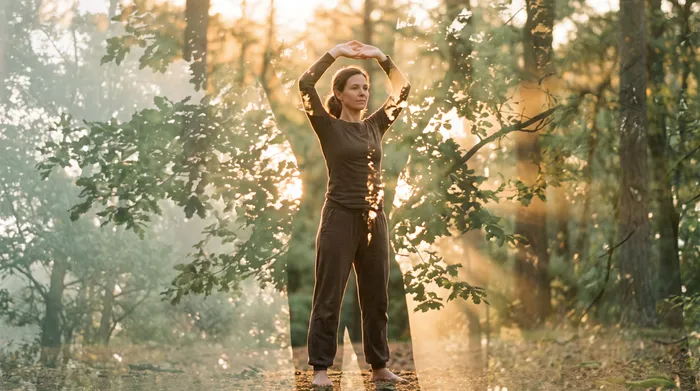
The classic opening exercise. From standing, interlace the fingers in front of the body, palms up. Inhale as the hands rise up the centreline, turning palms toward the sky as they pass the face, and press gently upward as though supporting the sky, lengthening the whole body. Exhale as the arms release and float down in a wide arc to the sides.
Eight to ten repetitions. The movement stretches the whole trunk, opens the shoulders, and — more usefully — teaches the coordination of breath with movement that defines everything in qigong: inhale as the body opens and rises, exhale as it closes and settles.
3. Shoulder and Arm Swinging
Feet shoulder-width, knees soft. Turn the waist rhythmically left and right and let the arms swing entirely passively, wrapping around the body, hands tapping the hips and lower back as they land.
One to two minutes, letting the rhythm find itself. This is the single best release for accumulated shoulder and neck tension I know, and it doubles as a lesson in the central principle of the internal arts: the waist moves, the arms follow. It appears in the warm-up sequence for exactly that reason.
4. Holding the Ball
From wuji standing, raise the arms as though embracing a large, light ball against the chest — elbows slightly below wrists, shoulders down, fingers softly spread, a small space under each armpit. Hold for one to three minutes, breathing slowly.
This is zhan zhuang, the standing practice, in its basic form. It builds leg endurance, exposes every unnecessary tension in the shoulders, and trains sustained attention. Expect your shoulders to creep upward; lowering them again, over and over, is the exercise. When the arms tire, lower them, stand for a few breaths, and finish.
5. Silk-Reeling Circles
Feet slightly wider than shoulder-width. Place the right hand at the lower abdomen and trace a large, slow circle: up the centreline, out to the right at eye level, down and back to the start — letting the waist turn to carry the hand, the palm rotating naturally through the circle. Eight circles, then reverse direction, then swap hands.
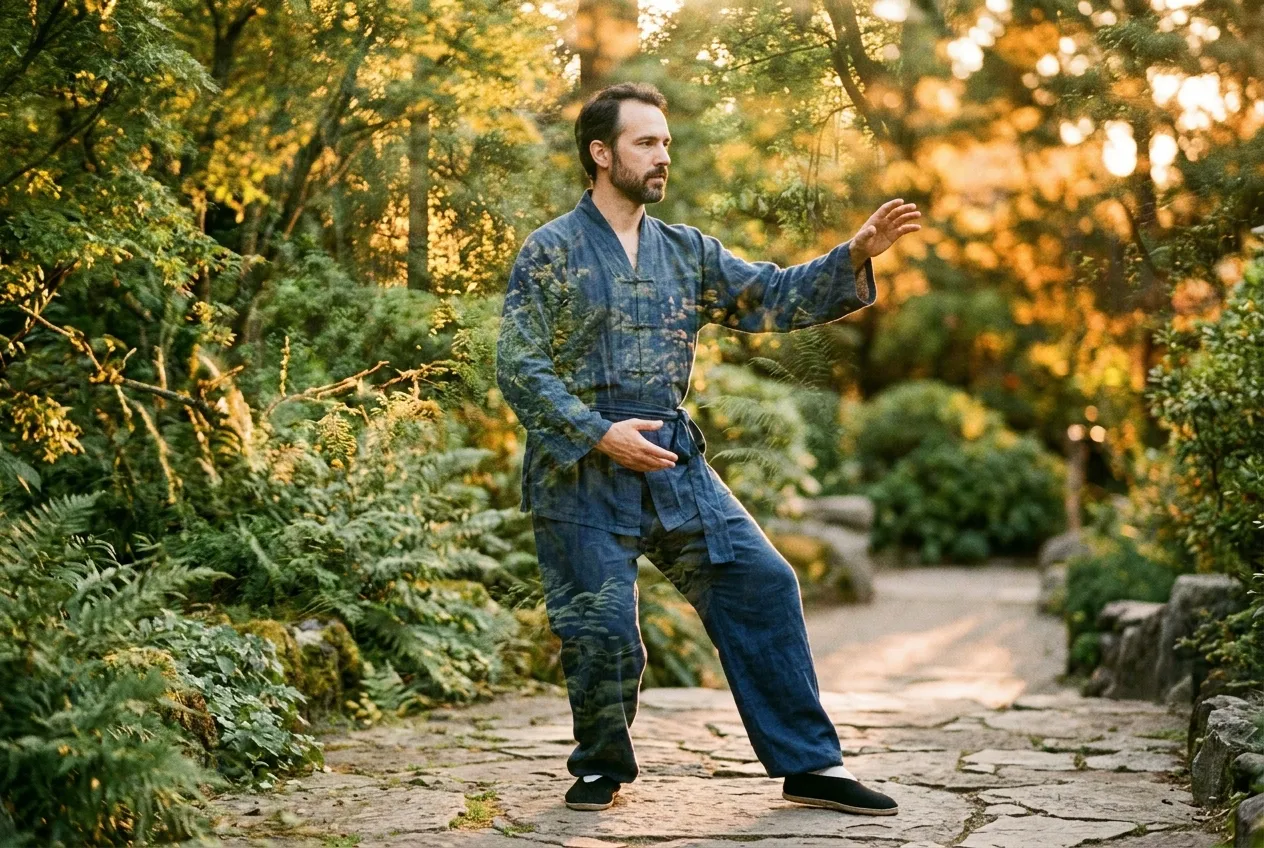
Borrowed from the Chen tradition’s chan si gong, this teaches spiral coordination — hand, arm, waist, and weight all moving as one connected system. Do not worry about doing it correctly; worry about doing it smoothly.
6. Separating Heaven and Earth
From standing, one palm presses upward above the head, fingers turned inward, while the other presses down beside the hip — the body lengthening between them on the inhale. Release and swap sides on the exhale, the hands passing each other in front of the chest. Eight repetitions each side.
This is one of the Eight Brocades, the most widely practised qigong set in the world, and it gives a genuine stretch through the sides and shoulders while continuing the breath-movement coordination work.
7. Wave Hands Like Clouds
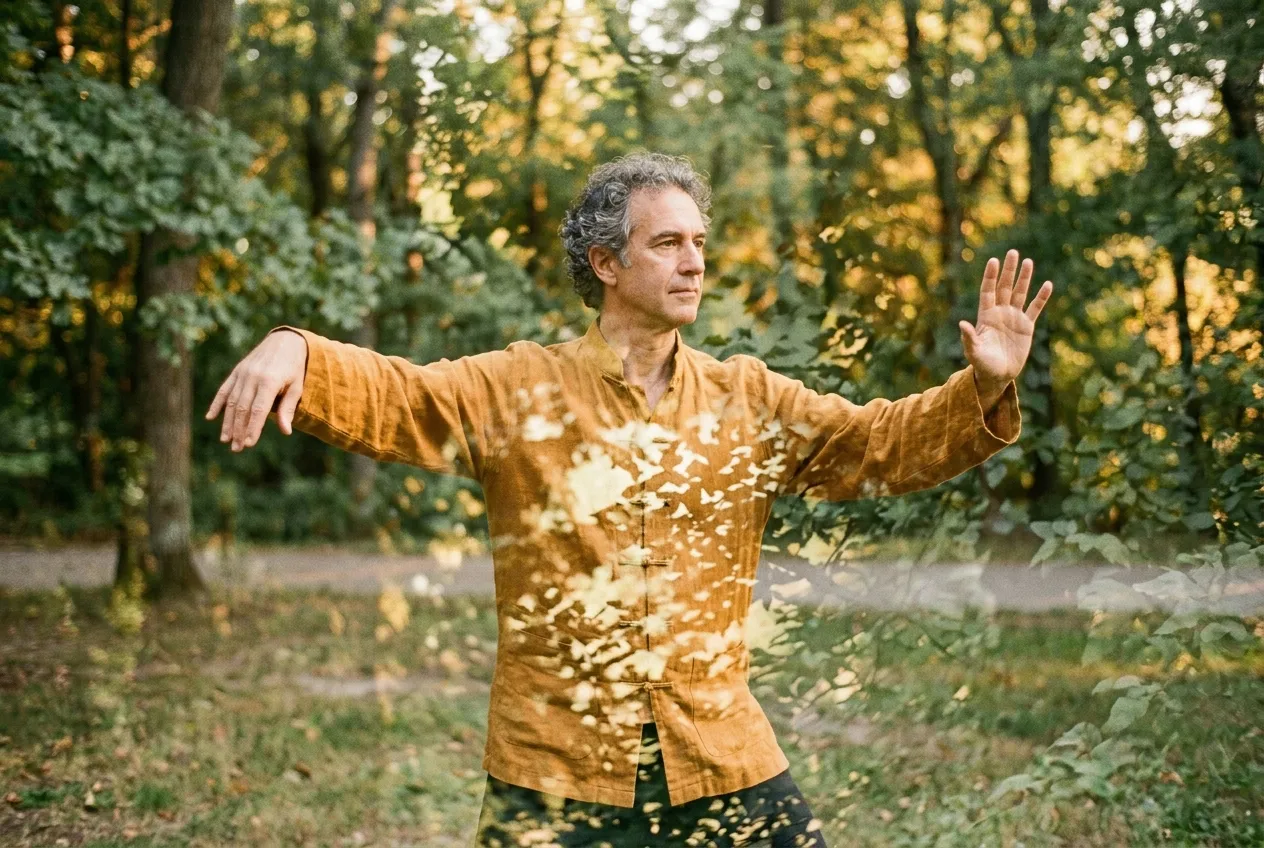
The tai chi movement, practised as a standalone qigong drill. Shift the weight fully to the right foot as both hands drift right, one at eye height and one at waist height. Turn the waist left, transferring weight to the left foot, as the hands exchange heights and drift left. Continue, flowing, for one to two minutes; add sideways stepping once the stationary version is smooth.
Cloud hands trains weight transfer, waist rotation, and continuous unbroken movement — the three skills that make tai chi look the way it does. If you later learn a tai chi form, this exercise will already have taught you a third of it.
8. Closing: Gathering and Settling
Every session should end deliberately. Stand in wuji, and on the inhale let the arms float out and up in a wide arc to shoulder height; on the exhale, let the palms drift down the centreline, as though pressing something gently toward the floor, and rest them over the lower abdomen. Three to five repetitions, then stand quietly for a few breaths with hands resting on the belly.
The closing matters more than it appears to. The settled state the practice produces is the point; walking straight off into your phone discards it. Give yourself thirty seconds of standing quietly at the end — noticing the breath, the weight in the feet, the warmth in the hands if it is there — before the day resumes. Sessions that end properly are the ones you find yourself wanting to repeat tomorrow, and wanting to repeat it tomorrow is the entire game.
Common Beginner Mistakes
Watching people learn these exercises, the same handful of faults account for nearly everything.
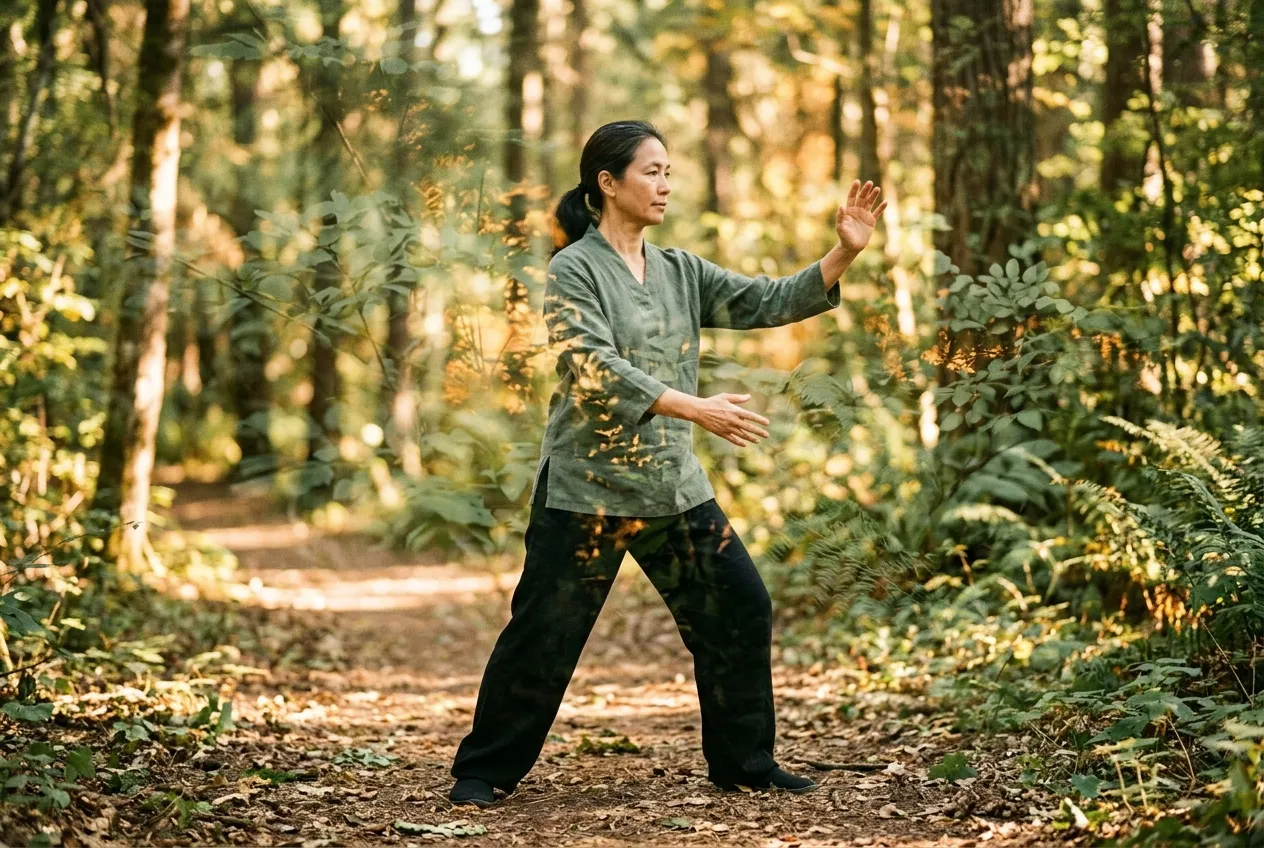
Moving too fast. Every exercise above should be slower than feels natural — roughly the pace of your own slow breathing. Speed is how the attention escapes.
Breathing backwards. The belly swells on the inhale. A surprising number of adults have learned the reverse (chest up, belly in), and unlearning it is genuinely worth a week of attention on its own. The breathing techniques guide covers this in detail.
Chasing sensation. Warm hands, tingling palms, a feeling of heaviness — these are common, benign, and beside the point. Practitioners who hunt for sensations tense up trying to produce them, which is precisely the wrong training.
Shrugging. The shoulders rise the moment attention goes elsewhere, in every exercise involving raised arms. Checking and releasing them, repeatedly, is not a failure of the practice — it is the practice.
Locking the knees. Especially during the standing exercises, where fatigue invites the legs to brace straight. Soft knees, always — locked joints block exactly the settled, springy quality the standing is meant to build.
Skipping the standing and the closing. Beginners want the moving exercises because they feel like doing something. The still ones do the deeper work.
Seated Adaptations
Every exercise in this set except cloud hands adapts directly to a chair, which matters for anyone with limited standing tolerance, balance concerns, or fatigue conditions. Sit toward the front of a firm chair, feet flat, spine self-supporting rather than leaning back. Lifting the sky, holding the ball, silk-reeling, separating heaven and earth, and the closing all work essentially unchanged; the arm swinging becomes a gentle seated waist turn. A fuller seated programme is covered in the seated qigong guide.
Seated practice is complete practice, not a concession. The breath, posture, and attention work — which is most of what qigong is — survives the chair entirely.
When to Be Careful
Qigong is among the safest forms of exercise that exist, and the cautions are few and mostly obvious. Recent surgery, acute injury, and late pregnancy call for medical guidance first, as with any activity. Anyone with significant balance impairment should do the standing exercises near a wall or chair. Dizziness during breathing work means you are forcing the breath — return to normal breathing and let the depth develop on its own over weeks rather than pushing it. And any practice that produces pain, as opposed to mild muscular effort, is being done too low, too far, or too long.
How Qigong Relates to Tai Chi
Worth a short orientation, since the two are constantly confused and this site covers both.
Qigong is the broader, older category: individual exercises and short sets coordinating posture, breath, and attention, practised for health, meditation, or as martial arts conditioning. Tai chi is a specific martial art whose slow solo forms work on the same principles — which is why tai chi is sometimes loosely described as a form of qigong, and why the two share so much vocabulary.
The practical differences for a beginner: qigong exercises are learnable in minutes and repeatable immediately, while a tai chi form takes months to memorise; qigong is mostly stationary or nearly so, while tai chi travels and demands more of balance and legs; and qigong isolates one quality at a time where tai chi integrates everything at once.
That is also the argument for starting here. Several of the exercises above — the standing, cloud hands, the silk-reeling — are lifted directly from or shared with tai chi training, and a month of daily qigong makes a subsequent tai chi class dramatically easier. The full comparison covers the distinction properly if you are deciding between them.
Putting It Together
The full set takes fifteen to twenty minutes: standing (2-3 min), lifting the sky, arm swinging, holding the ball, silk-reeling, separating heaven and earth, cloud hands, closing. On short days, do exercises 1, 3, and 8 in five minutes and count it as practice — because it is.
After a few weeks, the natural next steps are the structured traditional sets, which sequence movements like these into coherent routines: the Eight Brocades is the standard first set, and Shibashi — eighteen tai chi-flavoured qigong movements — is the gentlest bridge toward tai chi proper.
When I first met these exercises I filed them as warm-ups for the real training. That assessment reversed over the years: the form gives the practice its shape, but the qualities the form depends on — the released shoulders, the abdominal breath, the waist-led connection — are built here, in movements simple enough to actually attend to. More practice material is collected in the tai chi practice section.